Combat Profile
Immovable Wrath
Unleashes purifying flames that incinerate delusion and bind enemies in place, rendering them unable to flee or act against their true nature.
Unshakeable Resolve
Cannot be moved, confused, or swayed from purpose; all purifying actions deal increased damage to beings of illusion or spiritual corruption.
His compassion is so fierce it appears as wrath -- those who see only the anger miss the mercy beneath. His immobility is both strength and limitation: he does not pursue
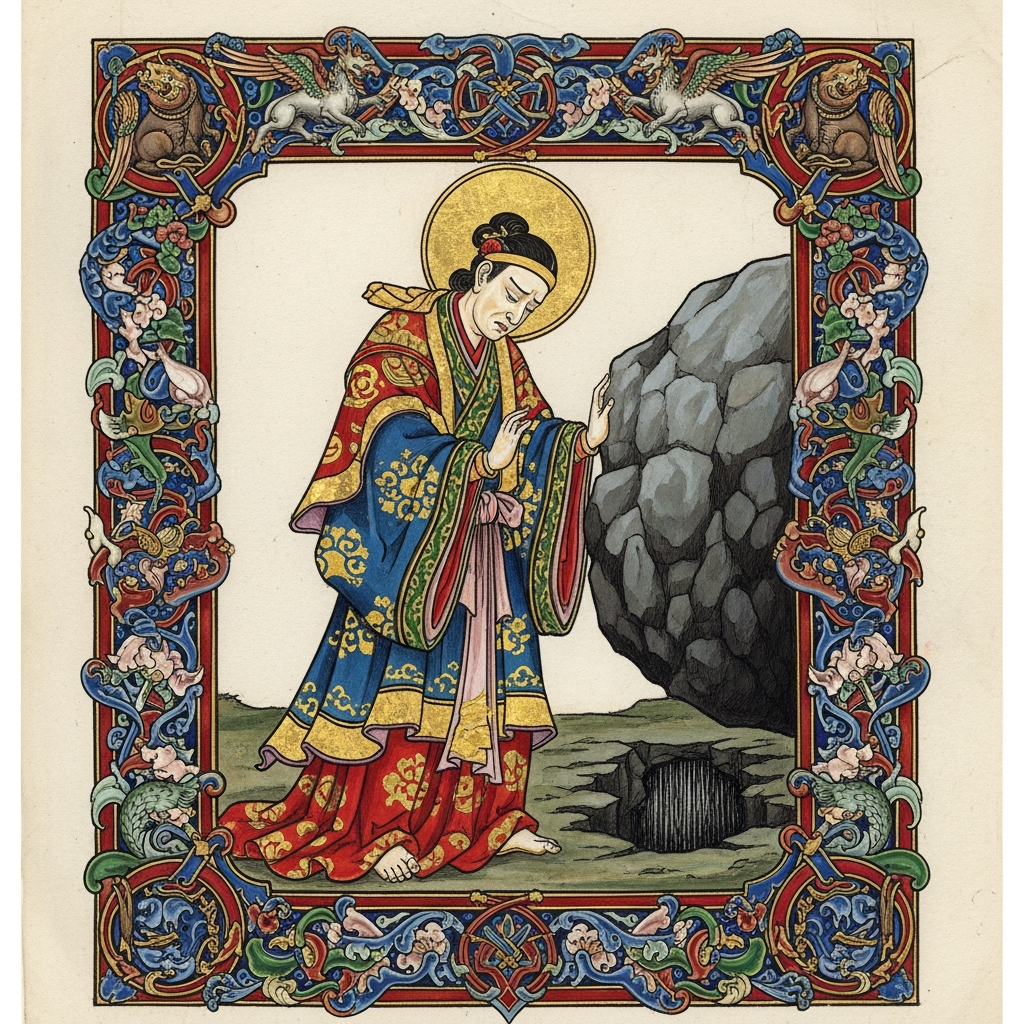
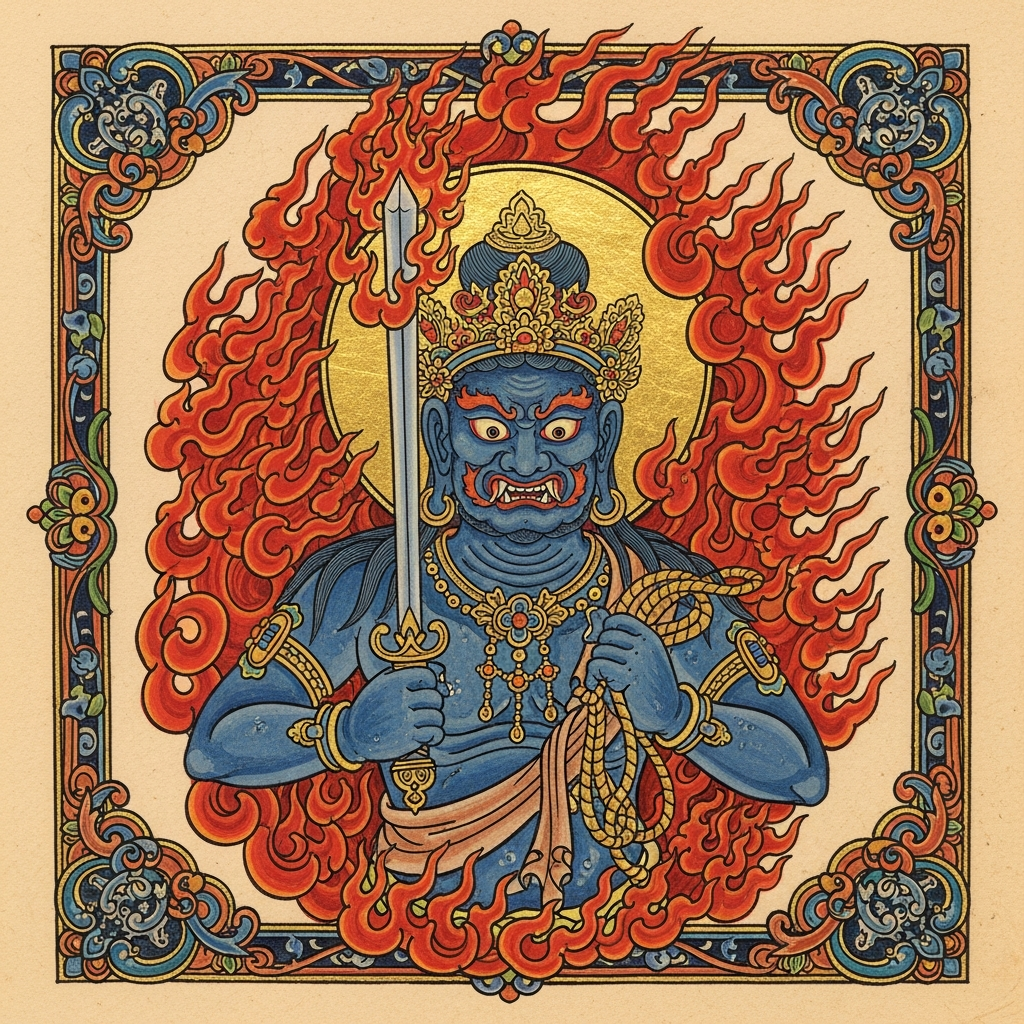
“He sits upon a great rock, immovable. His face is twisted with fury. In his right hand he holds the sword of wisdom. In his left, the rope that binds evil. Behind him roars the fire that consumes illusion. He is angry because you are suffering, and you do not need to be.” — Shingon liturgical description
Lore: Fudo Myoo (Sanskrit: Acala, “The Immovable One”) is the chief of the Five Wisdom Kings (Godai Myoo) in Japanese esoteric Buddhism, and he represents the wrathful compassion of Dainichi Nyorai (Vairocana, the Cosmic Buddha — the same being with whom Amaterasu was identified). His iconography is among the most striking in all of Asian religious art: a blue-black figure seated or standing on a rock, surrounded by flames, face contorted in a snarl, fangs protruding (one pointing up, one pointing down), left eye squinting, right eye wide open, holding the devil-subduing sword Kurikara in his right hand and the binding rope (kensaku) in his left.
The flames behind him are not hellfire — they are the purifying fire (goma) that burns away the Three Poisons of Buddhism: greed, anger, and ignorance. He is immovable because truth does not retreat. He is wrathful because compassion, when confronted with suffering caused by delusion, manifests as fierce determination to destroy the cause of that suffering. The rope is for binding demons, yes, but also for lassoing those who resist enlightenment and dragging them toward salvation whether they want it or not.
Fudo Myoo is the patron deity of the yamabushi — mountain ascetics who practice shugendo, the fusion of Shinto mountain-worship and Buddhist esoteric practice. He is invoked in fire rituals (goma), waterfall austerities, and the protection of practitioners during intense meditation retreats. His cult is among the most active in Japanese Buddhism today.
Parallel: Fudo Myoo’s wrathful compassion directly parallels the concept of God’s “righteous anger” in the Hebrew prophets — a fury born not from malice but from love confronted with injustice. The flaming sword echoes the cherubim’s flaming sword guarding Eden (Genesis 3:24). His role as wrathful protector parallels the Archangel Michael (flaming sword, dragon-slayer, captain of the heavenly host) and the Vajrayana Buddhist figure Vajrapani (the thunderbolt-wielding protector). The key theological distinction: in the Abrahamic tradition, God’s wrath is judicial (punishment for transgression); Fudo Myoo’s wrath is medicinal (burning away the disease of ignorance).
2 min read
The Three Poisons (greed, hatred, delusion) -- he exists to burn them away. Few beings can counter him directly
*Dainichi-kyo* (Mahavairocana Sutra); Shingon and Tendai esoteric Buddhism; mountain *shugendo* traditions