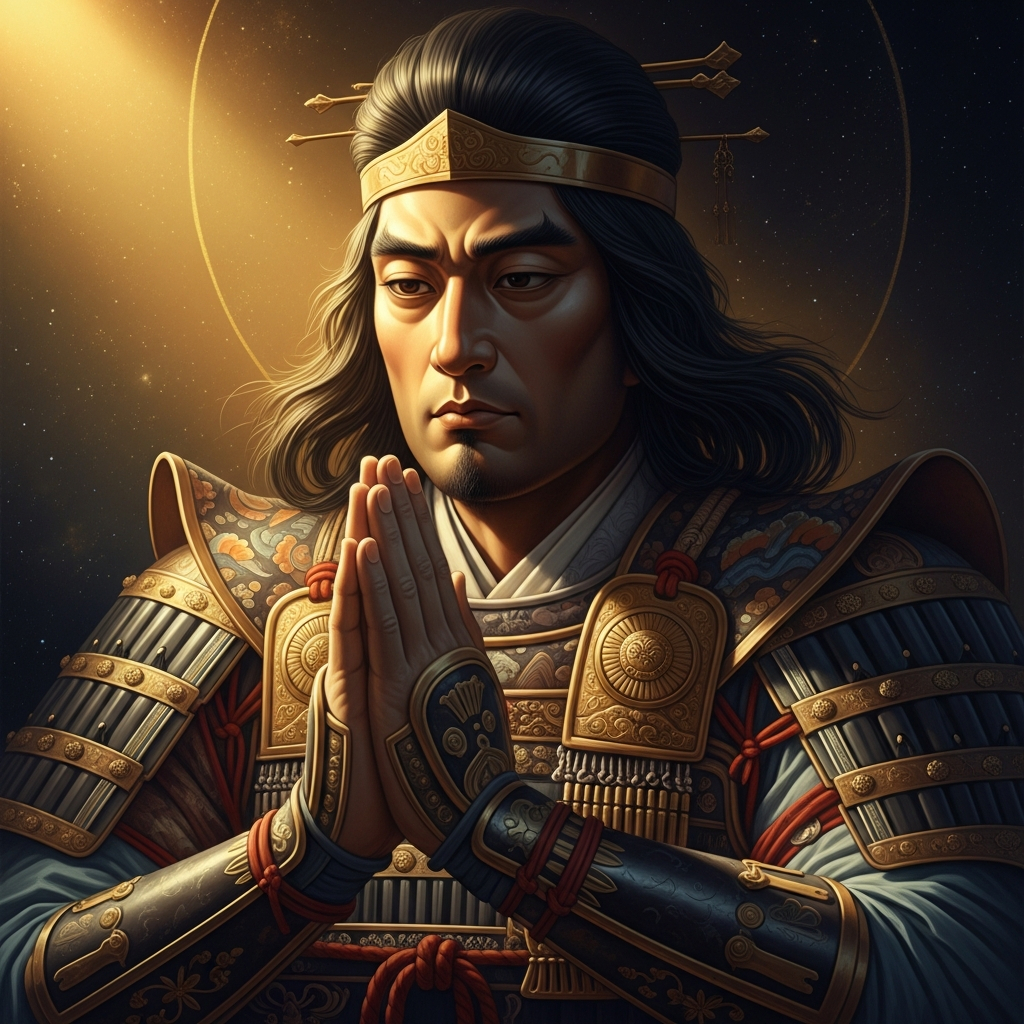
Combat Profile
Kusanagi Descent
Susanoo manifests his legendary sword to cleave through divine and mortal defenses alike, dealing massive damage and piercing all resistances.
Tempestuous Nature
Susanoo's presence destabilizes reality itself; random chaotic effects trigger each turn, potentially benefiting or harming any combatant unpredictably.
Impulsive, destructive, emotionally volatile -- his rampages caused suffering even in heaven. Banished twice (from heaven and from his father's presence)
“This serpent had an eight-forked head and an eight-forked tail. Its eyes were red as winter cherries. Pine trees and moss grew on its back. Its length extended over eight valleys and eight hills.” — Kojiki
Lore: Susanoo is the wild card of the Shinto pantheon — simultaneously the greatest troublemaker and the greatest hero. Born from Izanagi’s nose during the post-Yomi purification, he was assigned to rule the sea, but instead he wept and raged, yearning for his dead mother Izanami. His tantrums devastated the world: mountains withered, seas dried up. Izanagi banished him. Before leaving, Susanoo went to heaven to bid farewell to Amaterasu, but his visit turned destructive — the rampage that drove her into the cave. For this, he was expelled from heaven, his beard cut, his fingernails torn out — a divine humiliation.
But on earth, Susanoo was transformed. Wandering in Izumo province (modern Shimane Prefecture), he encountered an elderly couple, Ashinazuchi and Tenazuchi, weeping because they had to sacrifice their last daughter, Kushinadahime, to the eight-headed serpent Yamata no Orochi, which had already devoured their other seven daughters, one each year. Susanoo agreed to slay the monster in exchange for Kushinadahime’s hand. He devised a plan: build a fence with eight gates, place a vat of sake (brewed eight times for potency) at each gate. The dragon came, thrust a head through each gate to drink, became stupefied, and Susanoo hacked it to pieces. In the fourth tail, he found the miraculous sword Kusanagi no Tsurugi, which he sent to Amaterasu — an act of atonement that partially restored their relationship. He married Kushinadahime and settled in Izumo, composing what is traditionally considered the first Japanese love poem:
“Yakumo tatsu / Izumo yaegaki / tsuma-gomi ni / yaegaki tsukuru / sono yaegaki wo” (“Many clouds rise — / the clouds form a fence, / a many-layered fence of clouds / in which the newlyweds may hide. / Oh, that many-layered fence!”)
Parallel: Susanoo is the archetypal trickster-hero who must be exiled before he can become a savior, a pattern seen in Moses (exiled to Midian before returning to liberate Israel), Heracles (driven mad, commits atrocities, then redeems himself through labors), and Thor (uncouth and destructive but ultimately the protector). The dragon-slaying specifically parallels Perseus and Andromeda (hero arrives at a town where a maiden is about to be sacrificed to a sea monster, slays it, marries her), St. George and the Dragon, and Marduk’s slaying of Tiamat. The detail of the sacred sword found inside the dragon’s body resonates with Beowulf recovering treasure from the dragon’s hoard and Sigurd/Siegfried gaining power from Fafnir. The use of intoxication to defeat the monster is a distinctly Japanese touch — cunning over brute force.
2 min read
Amaterasu (his sister, who he both tormented and ultimately served); Yamata no Orochi (the dragon he slew)
*Kojiki* I.14-19; *Nihon Shoki* I; Ashkenazi, *Handbook of Japanese Mythology*