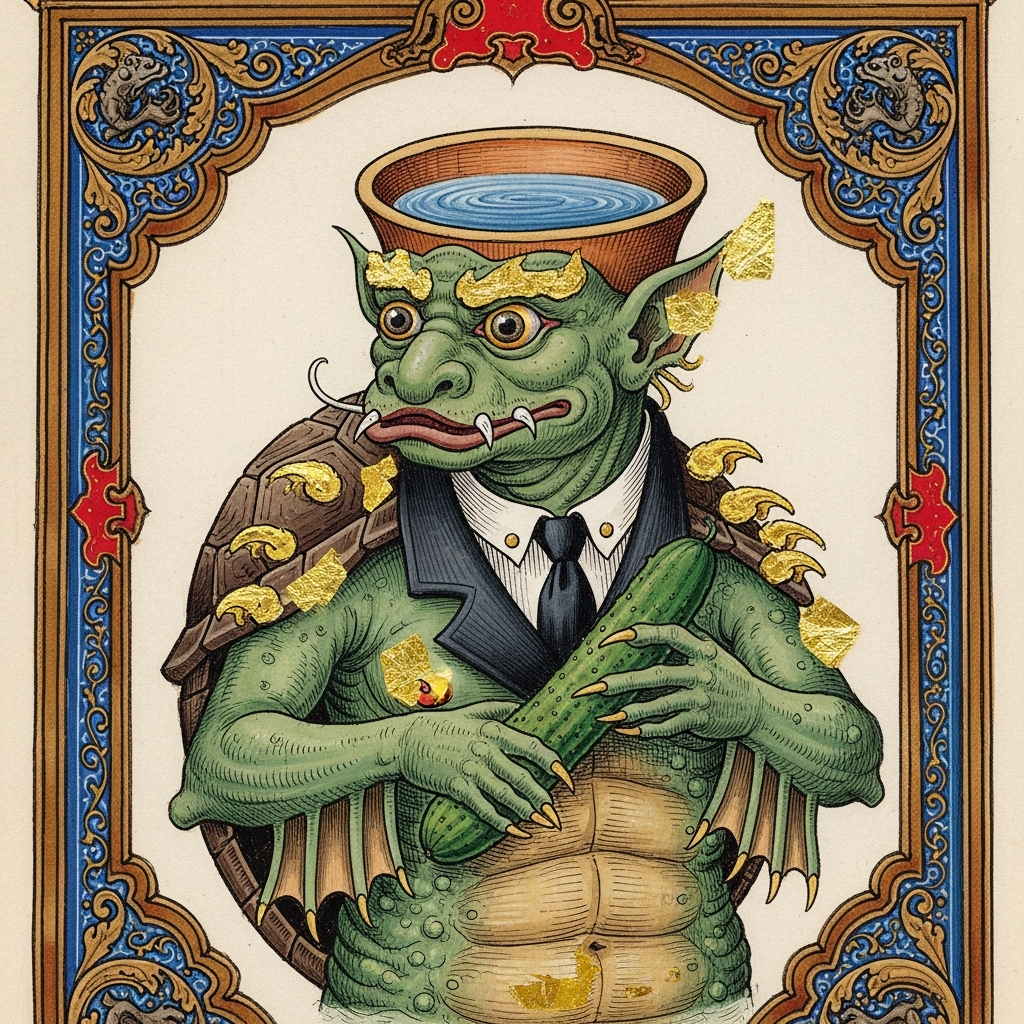
Combat Profile
Shirikodama
Kappa briefly paralyzes a target by extracting their vital essence through water contact, draining their strength.
Mischievous Appetite
Kappa gains power near bodies of water and is drawn to cucumber offerings, which temporarily pacify its hunger for mischief.
The dish (*sara*) on top of their head must remain filled with water -- if the water spills, the kappa is paralyzed or dies. Because kappa are fanatically polite, a deep bow will force them to bow in return, spilling their head-water
“If you must cross the river, write your name on a cucumber and throw it in. The kappa will be satisfied and leave you in peace.” — Folk wisdom
Lore: Kappa are among the most distinctively Japanese of all yokai — small, turtle-like humanoids with green or blue skin, a beak, a shell on the back, and most importantly, a water-filled dish (sara) on top of the head that is the source of their supernatural power. They are formidable wrestlers (many sumo traditions link to kappa myths) and skilled swimmers, lurking in rivers and ponds where they drown unwary travelers and livestock, supposedly to extract the shirikodama. They are obsessed with politeness and cucumbers.
The kappa’s weakness — their compulsive politeness forcing them to bow when bowed to, spilling their head-water and rendering them helpless — is a brilliant piece of folklore that simultaneously warns of water danger and teaches children the power of good manners. Kappa who are shown mercy often become loyal allies, teaching bone-setting, irrigation techniques, and herbal medicine. They are also considered expert bone-doctors in folk tradition. Kappabashi, a famous street in Tokyo, is named after a kappa said to have helped build a drainage canal. The mix of danger and absurdity, menace and ridiculousness, is characteristic of Japanese yokai tradition as a whole — a tradition that takes its monsters seriously but never loses its sense of humor.
Parallel: Water spirits that drown travelers are nearly universal — the Scottish kelpie, the Slavic vodyanoy, the Germanic nixie, and the Australian Aboriginal bunyip all fill similar ecological niches. But the kappa is genuinely unique in its specifics. The “weakness hidden in a physical feature” motif has a distant echo in Samson’s hair (Judges 16) and Achilles’ heel, but the kappa’s polite compulsion has no direct parallel. The idea that defeated supernatural beings must teach secrets to their captors appears in the binding of Solomon’s demons (who were forced to build the Temple) and the Irish tradition of capturing leprechauns.
2 min read
Politeness (a bow forces a reciprocal bow); cucumbers (offering a cucumber with the family's names written on it purchases safe passage); iron, deer antlers, and monkey
Toriyama Sekien; regional folklore from every part of Japan; *kappa maki* (cucumber sushi roll) is named for them