Combat Profile
Divine Doctrine
grants all allies unwavering certainty and spiritual alignment, rendering them immune to doubt and corruption for one cycle
Hierarchical Wisdom
all teachings and guidance emanate with absolute authority, and those who follow the prescribed path gain divine protection
Rigidity of doctrine; the Hierophant can become the Pharisee, valuing the letter over the spirit
“And I tell you that you are Peter, and on this rock I will build my church.” — Matthew 16:18
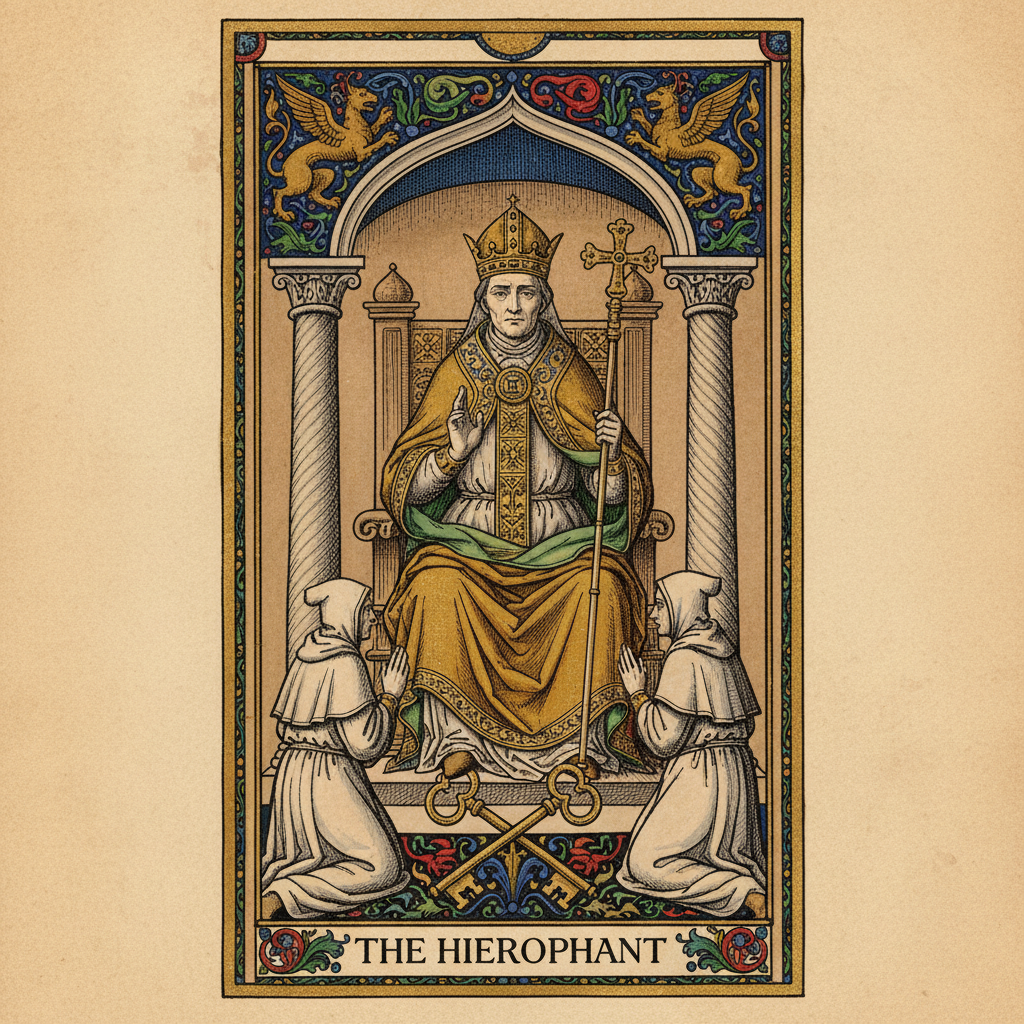
Lore: He wears the triple crown of the papacy and holds a triple cross (the three worlds: physical, astral, spiritual). Two acolytes kneel before him, receiving the keys to doctrine. At his feet rest two crossed keys — the Keys of Heaven given to Peter (Matthew 16:19). He sits between two gray pillars (echoing the High Priestess, but here the pillars are institutional, not mystical). He is the bridge (Vav, the nail that connects) between heaven and the congregation. He is every tradition that has endured: the Torah read in synagogue, the Mass celebrated in cathedral, the Dharma transmitted from teacher to student. His danger is real — every spiritual institution risks calcifying into mere authority. But without the Hierophant, each generation starts from scratch and loses what the ancestors learned.
Biblical Parallel: Aaron as High Priest, wearing the Urim and Thummim, mediating between God and Israel (Exodus 28). Peter receiving the Keys of Heaven (Matthew 16:18-19). The Levitical priesthood. Also Ezra, who reassembled the Torah after exile and taught it to a people who had forgotten (Nehemiah 8:1-8).
1 min read
The Hermit (IX) -- inner wisdom vs. institutional teaching; The Devil (XV), the anti-priest
Rider-Waite-Smith deck (originally called "The Pope"); Golden Dawn; papal iconography