Contents
The god of youth and love falls ill with longing for a woman he has only seen in a dream. She is Caer Ibormeith — she turns into a swan every other year. To have her, he must find her among one hundred and fifty swans and call her name. If he is wrong, he drowns.
- When
- Mythic time · Earliest manuscripts c. 9th century CE
- Where
- Brú na Bóinne (Newgrange) · Loch Bél Dracon · Ireland
The god of love had never been in love before.
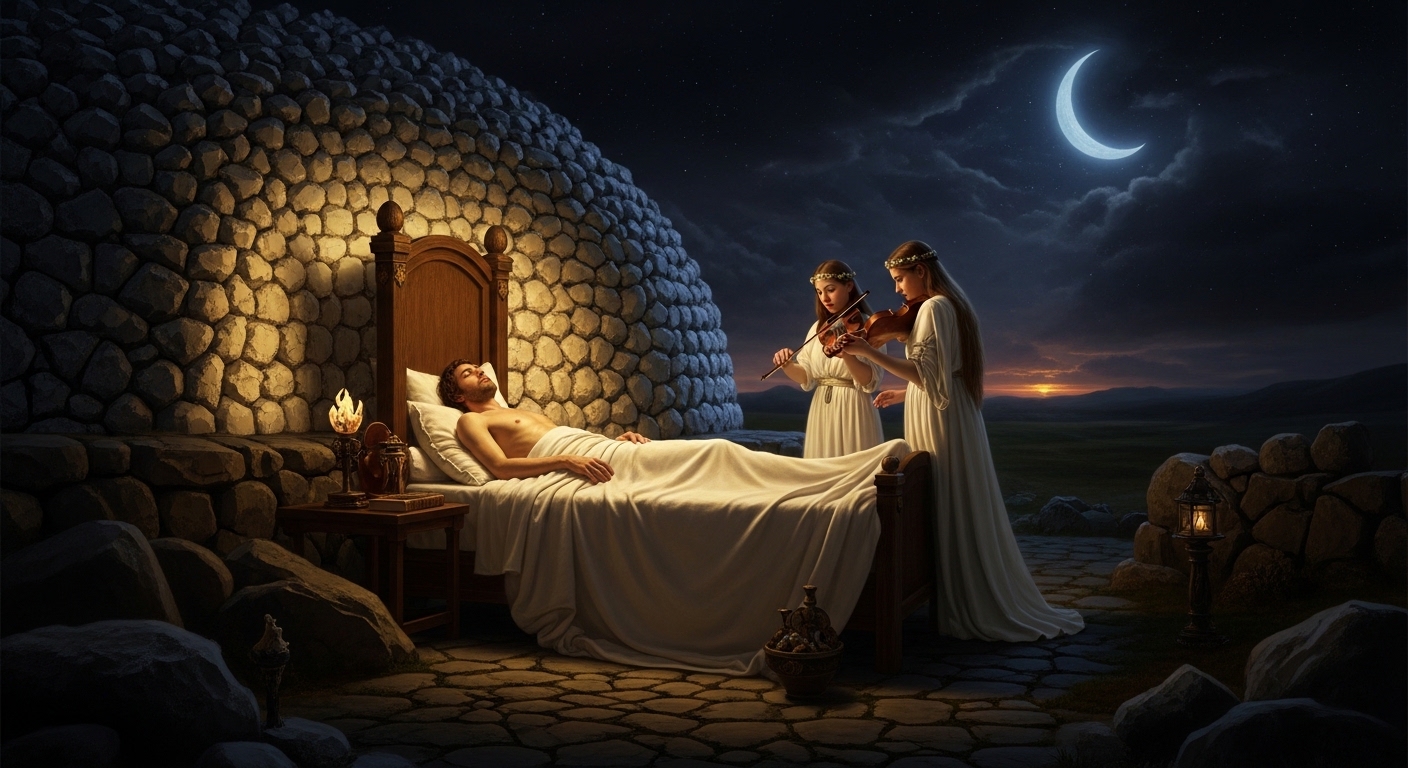
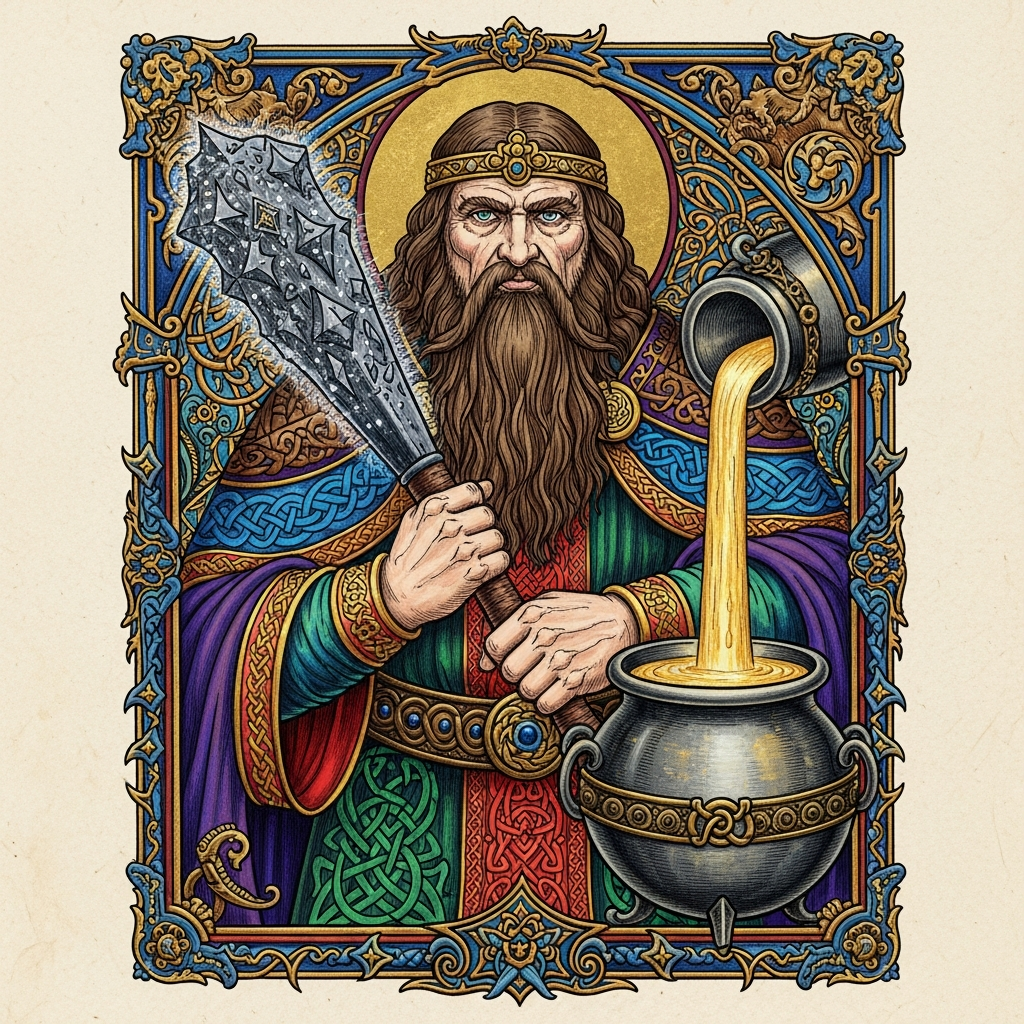
He is Aengus Og — Young Aengus, Mac Óg, the young son — born through a deception his father worked on a river goddess to have one night with her. He grew up in the tumulus at Newgrange, the great passage tomb that predates memory, its entrance aligned with the winter solstice sunrise so that once a year, for seventeen minutes, the chamber fills with light. He tricked the Dagda out of it by asking to stay “for a day and a night,” then pointing out that all days and nights are days and nights, and since there was no day without him, the mound was his. He lives at the edge of the world and the edge of the living, in the most ancient man-made structure in Ireland.
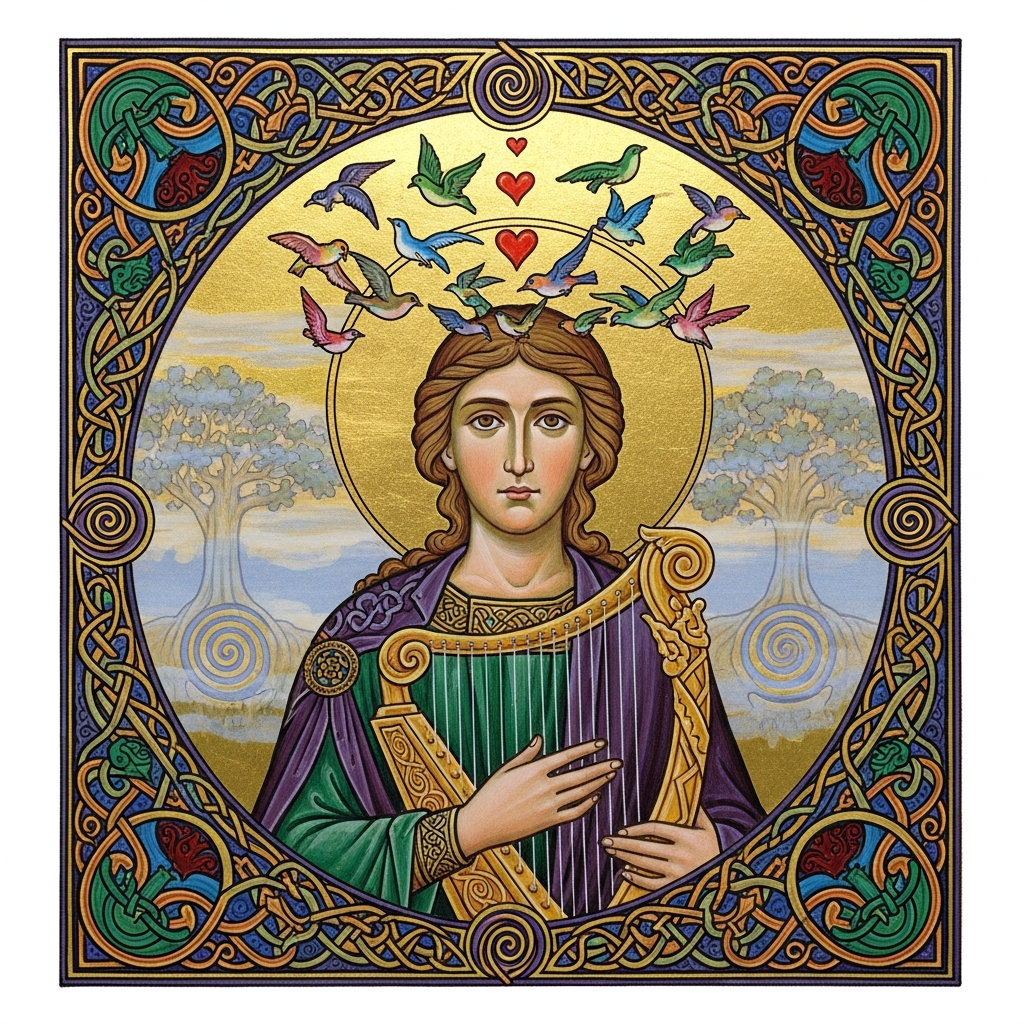
He had power over love the way a river has power over the surrounding landscape — not by intending anything, but by being the shape of the thing. Birds made of his kisses flew from him constantly, four birds, invisible to all but the poets who looked for them. He moved through the stories of other gods as a helper, a complicator, a weaver of desire. He brought Étaín back from the dead. He helped Diarmuid escape.
But he had never, until the dream, wanted anything himself.
The woman appeared at his bedside on the first night.
She was more beautiful than anything he had woken from before. She played a stringed instrument — a tiompán — and the music was the kind that does not allow sleep and does not allow waking, that leaves you suspended in a place you cannot identify as either. She played for a full night. At the first light of dawn, she was gone.
He waited for the second night.
She came. She played. She was gone at dawn.
By the end of a year, he had stopped eating. His face had thinned to the expression of someone who has been waiting for so long that waiting has become a face. The physicians of the Tuatha Dé Danann came and looked at him and could find no illness. There was no wound, no fever, no wasting disease. There was only the woman who came every night and the question of what would happen when she stopped coming.
Fergne, the physician who diagnosed love, was the first to say it plainly: He is dying of longing. The cure for longing is its object. Find the girl.
The search took three years and required the cooperation of every king in Ireland.
The Dagda knew nothing. The king of Connacht was consulted. A name emerged: Caer Ibormeith, daughter of Ethal Anbuail of Sidh Uamuin in Connacht. Her father refused to surrender her. The king of Connacht and the Dagda together defeated Ethal Anbuail in battle and took him prisoner. He explained, then, why he could not simply hand her over.
Caer Ibormeith was not entirely in his custody.
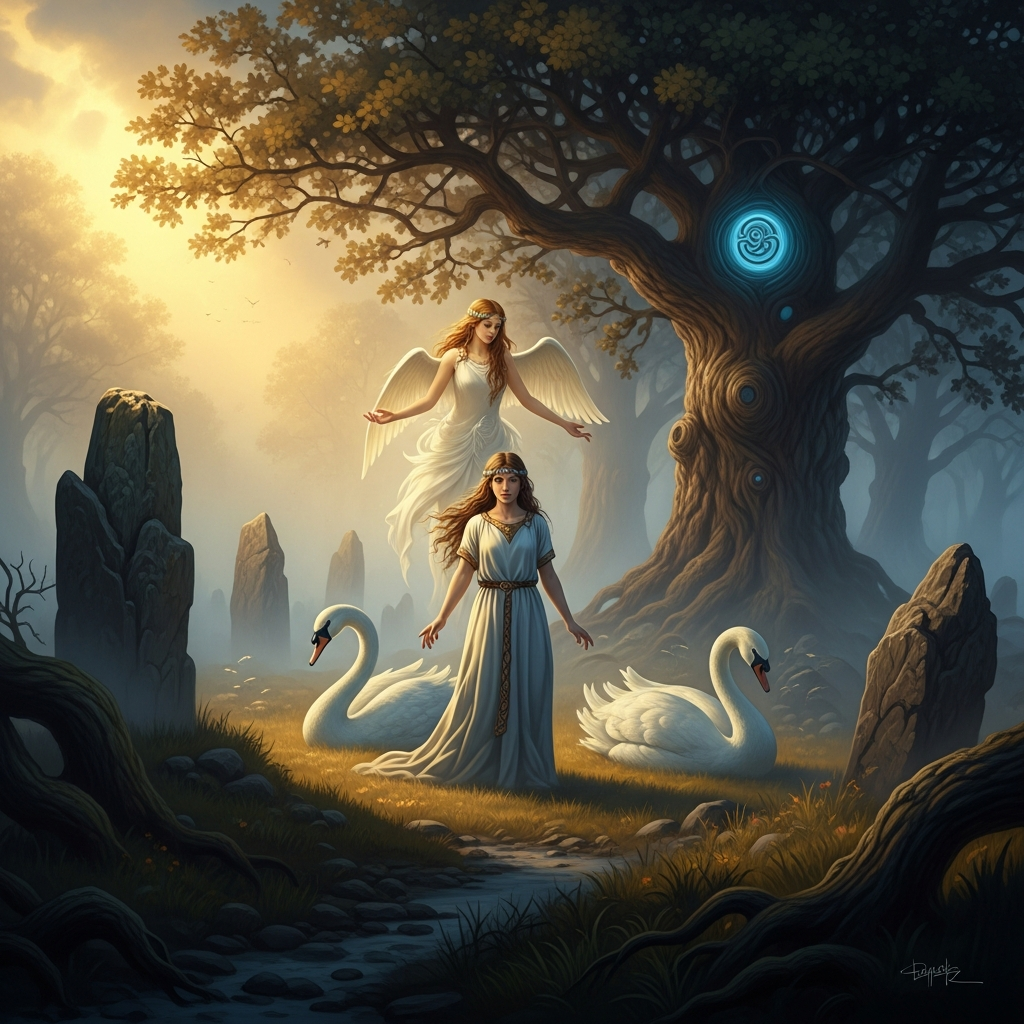
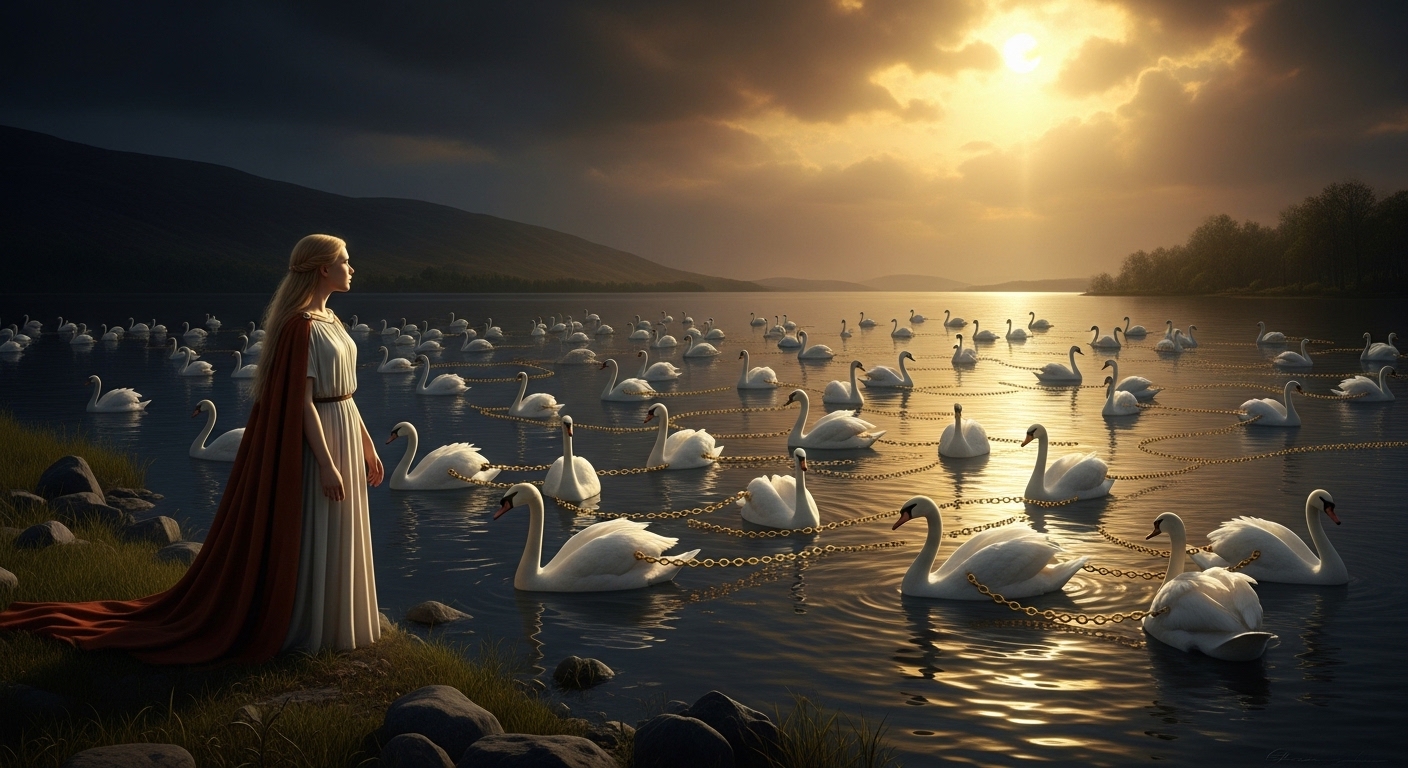
On the feast of Samhain — every other year — she transformed. She became a swan. For one year in swan form, one year in human form, endlessly alternating, never fixed in either, never simply herself in any unambiguous sense. She lived at Loch Bél Dracon, the Lake of the Dragon’s Mouth, with one hundred and fifty other swan-women, each linked in pairs by chains of gold or silver.
Ethal Anbuail could not guarantee which form she would be in on any given Samhain. But he could promise that the next one was a swan-year. He could describe where she would be. He could not promise that she would agree to anything.
Aengus was given this information and told that he could approach the lake on Samhain and call her name among the swans. If he chose correctly, she might come. If he chose wrong, and put his hands on the wrong swan, the consequences were left unspecified in a way that made them clear.
He agreed.
He went to the lake.
One hundred and fifty swans moved on the silver water in the grey light before dawn. They were beautiful and identical in the way that makes identification impossible — the same white, the same movement, the same gold chains linking each to another. The feast of Samhain had stripped the boundary between the living world and the other one, and the light at Loch Bél Dracon had the quality of light in neither.
He called her name.
Caer Ibormeith.
One of the swans separated from the rest. The distance between them closed.
He did not step back. Every account of what happened next is careful here: he went into the water. He transformed. He became a swan, because to stand on the bank and look down at her from human height was already the wrong kind of distance. They touched. They circled together on the water, linked now by the same principle that linked each pair of swans, though nothing visible connected them.
They flew.
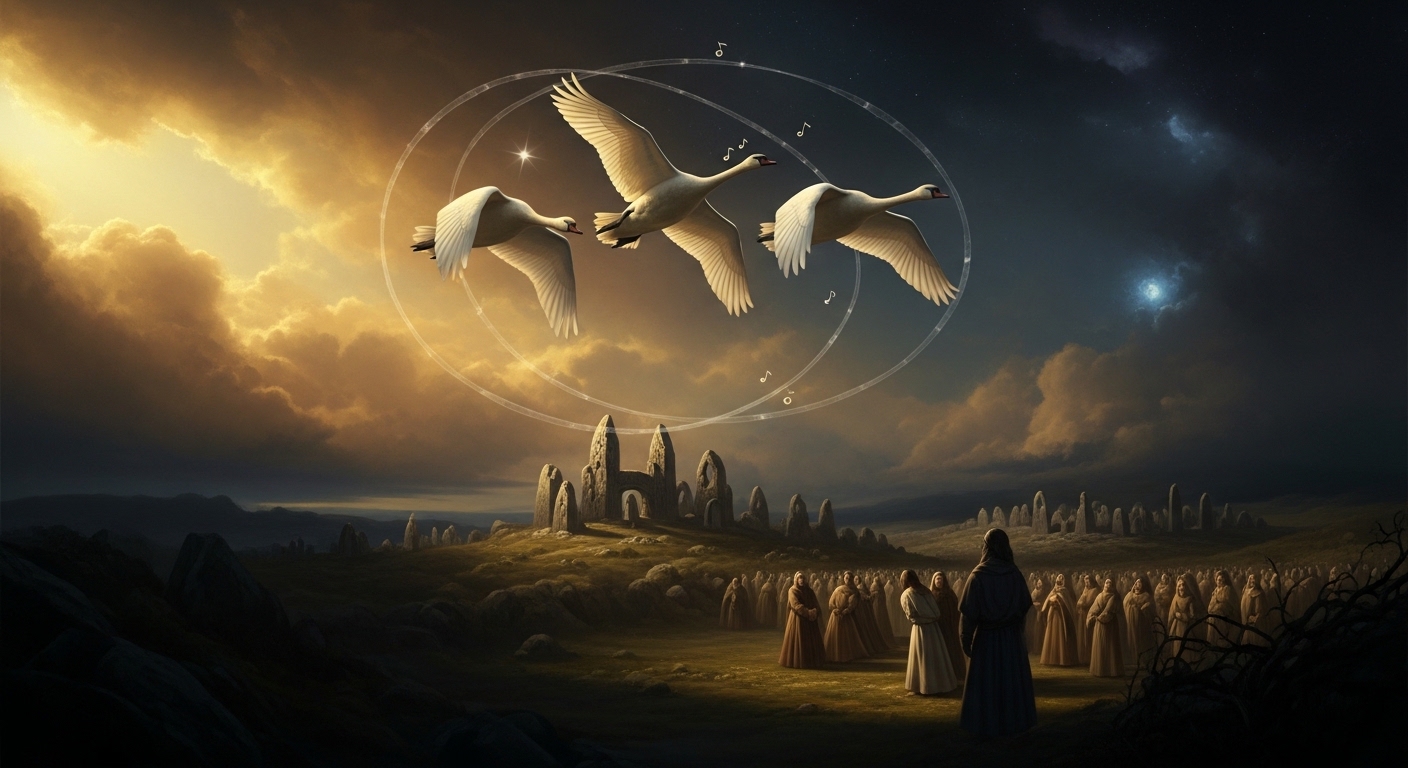
Three times they circled Brú na Bóinne.
The people in the surrounding territory heard singing — swan-singing, which is one of the three sounds that can make a sleeping person sleep deeper and a waking person fall asleep. They slept for three days and three nights. In the accounts that preserve this detail carefully, it is not presented as magic imposed on them from outside. It is presented as the natural consequence of being near that much longing finally met, that much grief converted all at once into its opposite.
Aengus Og and Caer Ibormeith are not described afterward as king and queen, husband and wife, lord and subject. The accounts simply note that she stayed with him. What stayed, by implication, was the swan-nature: the alternation, the transformation, the refusal to be fixed. The god of love did not cure his beloved of her changing nature. He changed with her.
The story is usually read as a romance, and it is. But it is also something more precise: a description of what love actually requires of the lover.
Aengus had power over love as an external force. He could move desire in others, weave it, direct it. What he could not do, until Caer Ibormeith, was be inside it. The illness that nearly killed him was not weakness — it was the cost of love encountered as a subject rather than an object. Every physician he consulted tried to treat his body. His body was fine. What was ill was the part of him that had spent its whole existence doing something to other people and had now had it done to him.
The cure was the lake and the swans and the name spoken in the cold air at the moment between one year’s form and the next.
He got it right.
Scenes
Echoes Across Traditions
Entities
Sources
- Aislinge Oenguso (The Dream of Aengus), Old Irish, c. 9th century CE
- Tochmarc Étaíne (The Wooing of Étaín) — parallel swan transformation motif
- Dindshenchas, Metrical (references to Brú na Bóinne)