Ah Puch: The Smell That Warns of Death
Classic Maya period, c. 300-900 CE; mythic time predating historical record · Mitnal, the ninth and lowest level of Xibalbá; the presence of death anywhere on the earth's surface
Contents
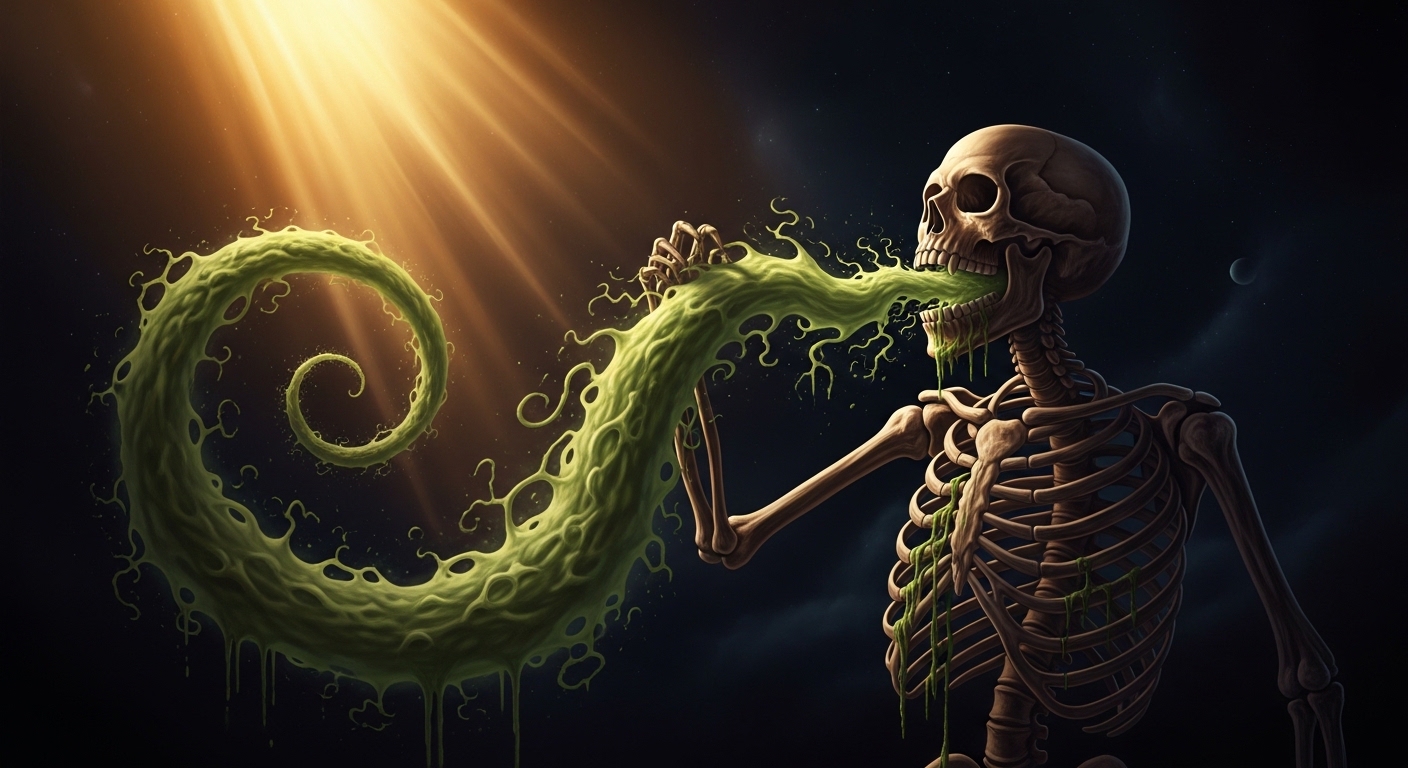
Ah Puch, the skeletal lord of the lowest level of Xibalbá, announces himself not with thunder or darkness but with the smell of decomposition — and when the Maya smell that smell unexpectedly, they know he is nearby, choosing.
- When
- Classic Maya period, c. 300-900 CE; mythic time predating historical record
- Where
- Mitnal, the ninth and lowest level of Xibalbá; the presence of death anywhere on the earth's surface
He does not announce himself with thunder.
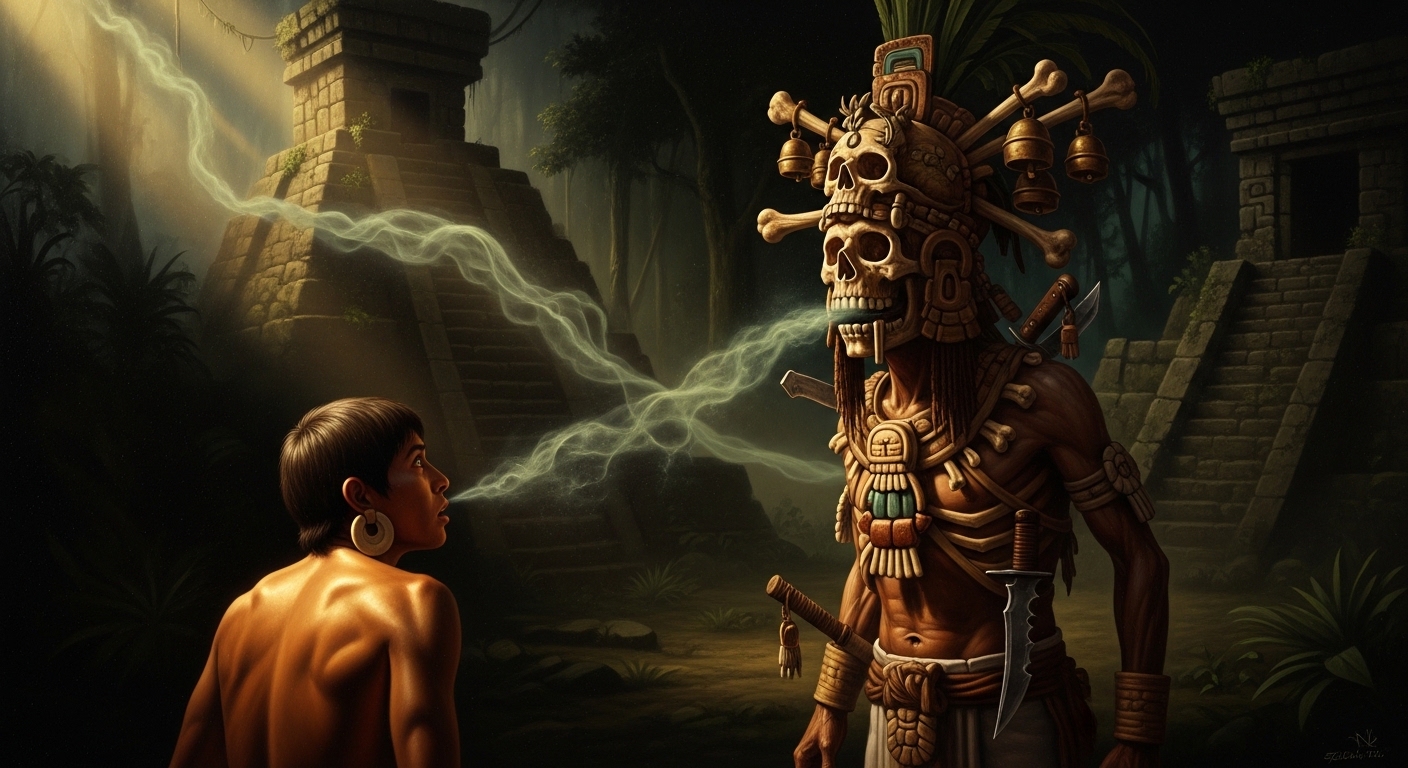
Most of the death gods of the world arrive with drama — the chariot horses, the pale rider, the darkening of the sky, the owl at the window. Ah Puch arrives with a smell. The Maya of the Yucatán say that when you catch an unexpected smell of decomposition — the sweet-rot smell of something dying in the heat, the particular note that every animal brain is wired to recognize as danger — Ah Puch is nearby. He is in the room, or just outside the door, or standing at the threshold deciding.
Whether he decides to take you or decides to pass depends on things you cannot know in advance.
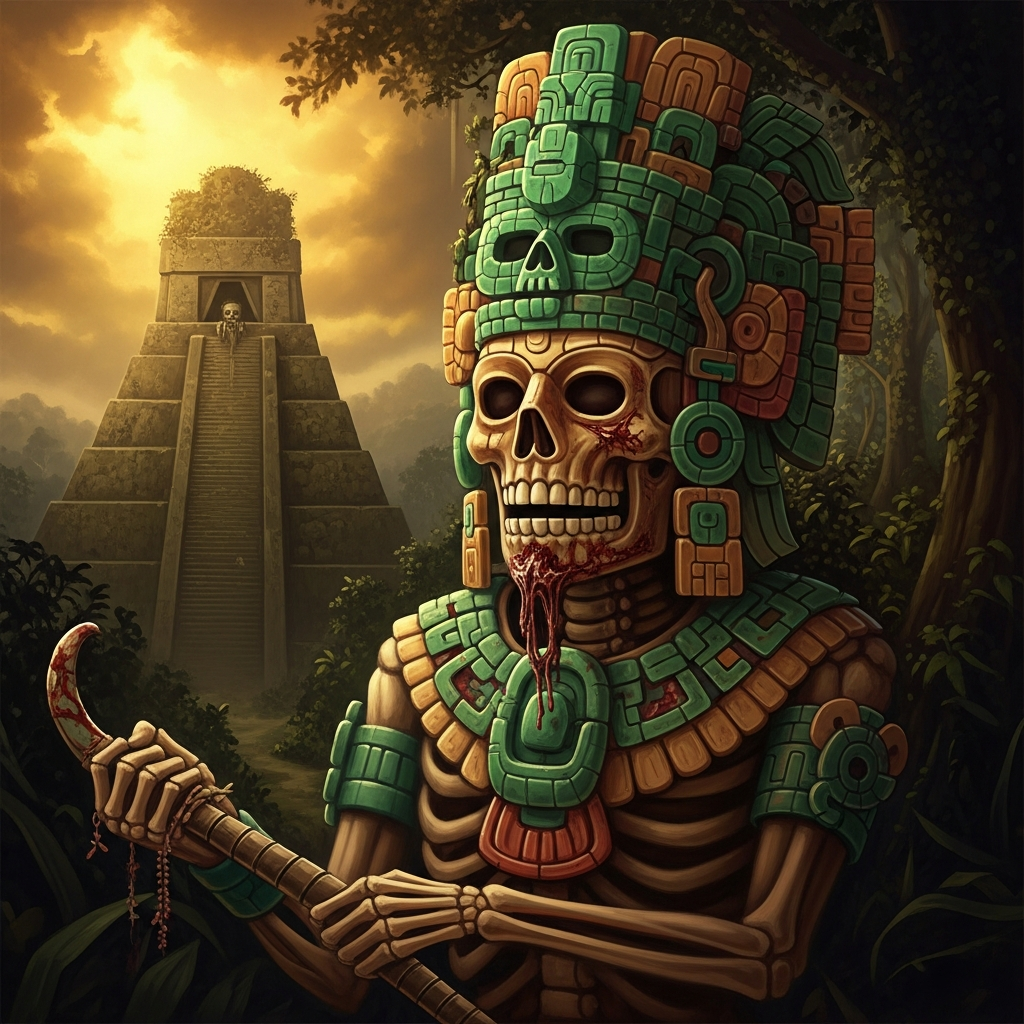
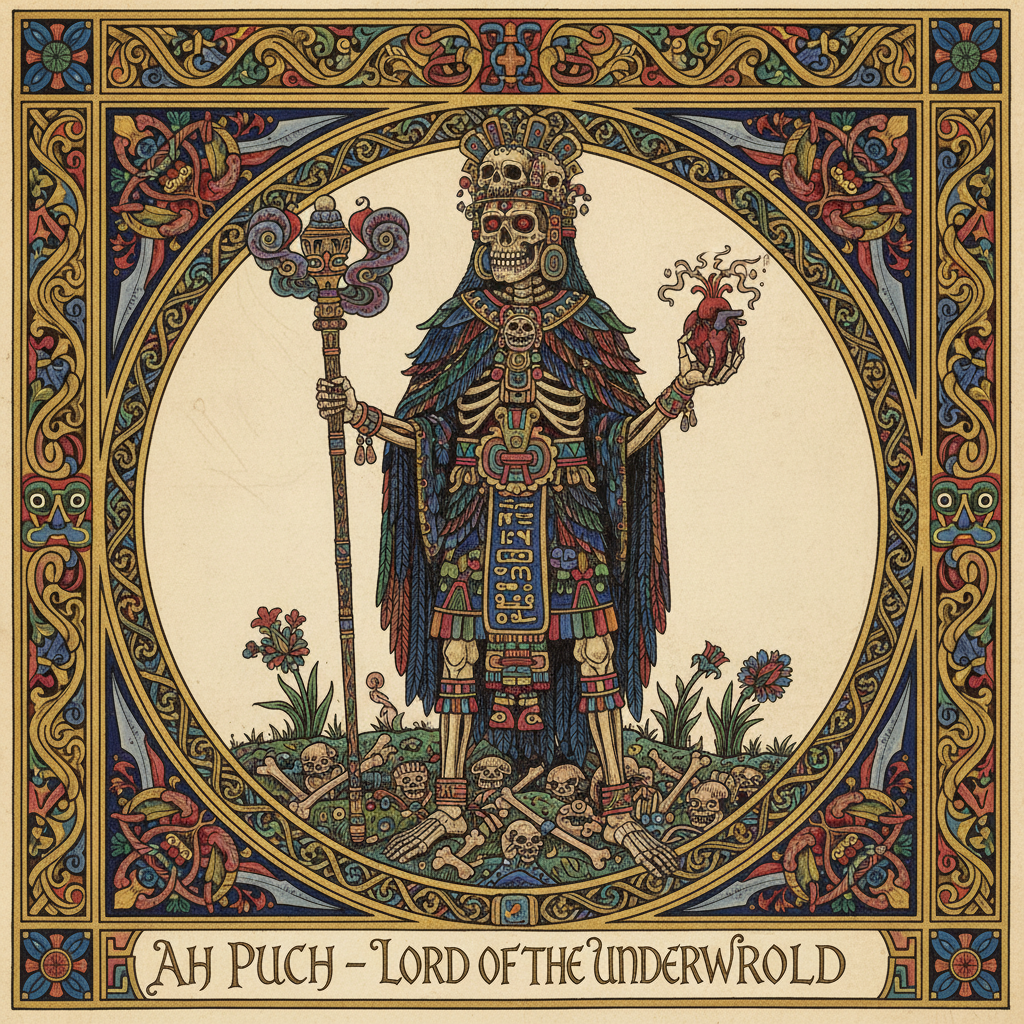
He is shown in the surviving Maya codices as a skeleton wearing a collar of cut bells, his bones exposed, his spine visible, his skull grinning with the particular grin that bones have because they have no choice. Sometimes he wears a muan owl on his head — the owl that calls at night and means death is watching. Sometimes he wears decomposing flesh on his skeleton, the transitional state between person and bone that is the most honest visual representation of what death actually is.
He is not abstract. He is not metaphorical. He is what happens to a body when it stops.
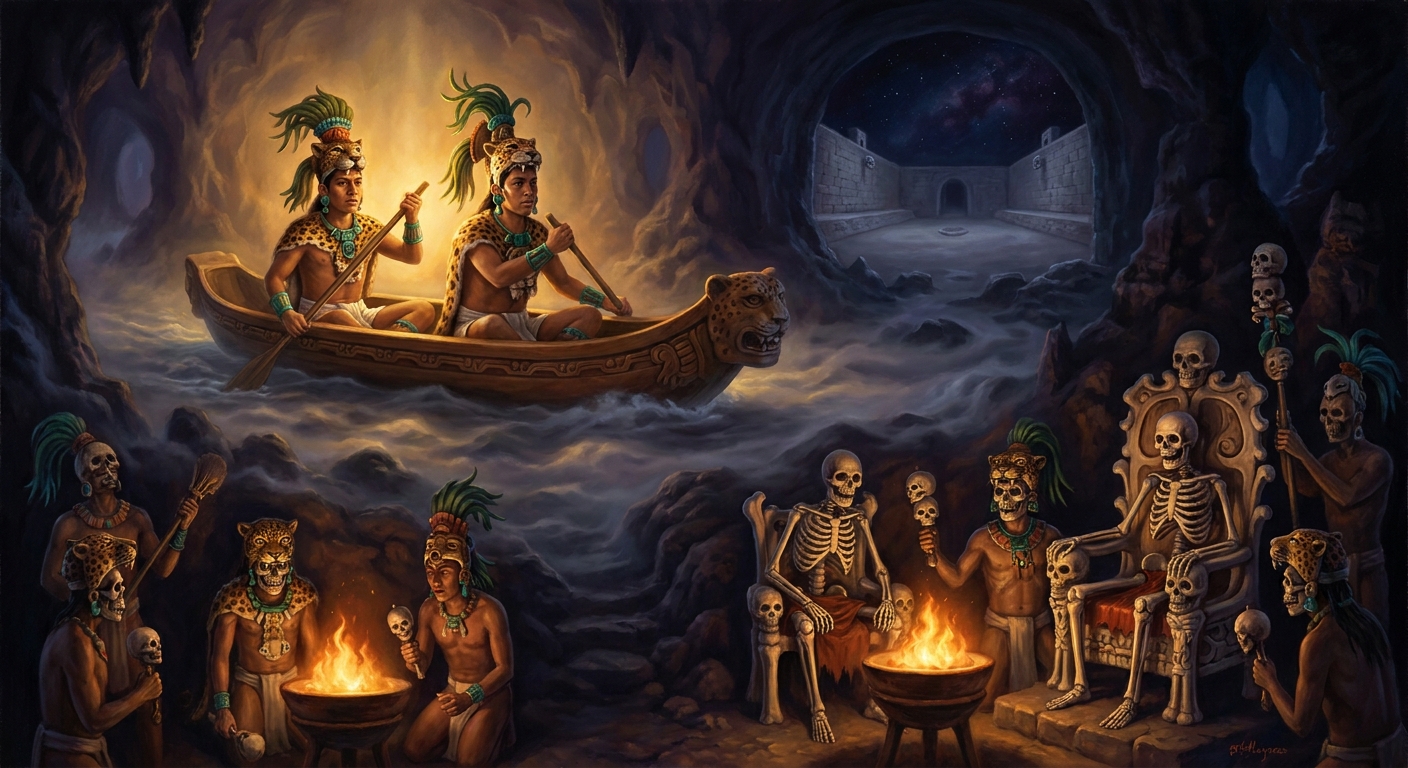
Ah Puch rules the ninth and lowest level of Xibalbá — Mitnal, the coldest and darkest place in the underworld, the level farthest from the surface. The Xibalbá of the Popol Vuh has various lords, arranged in something like a political hierarchy: One Death and Seven Death at the top, the disease and suffering lords below them, and at the bottom something like Ah Puch, the residue of death when everything else has been stripped away.
He is also called Kisin — the Flatulent One — a name that sounds disrespectful but is accurate to what decomposition is. The gas that a decomposing body produces is part of his essence. He is not elevated death, dignified death, the death of heroes remembered forever. He is the death that happens to everyone, the chemical process of return.
The Maya worldview did not flinch from this.
Where some religious traditions surround death with purifications and idealizations — the spirit ascends, the body is irrelevant — the Maya kept the body in the picture. The codices show death gods with intestines hanging from their ribcages. They show death lords holding severed heads, sitting on piles of bones, presiding over scenes of exactly what Xibalbá is: the place where the physical substances of former people accumulate.
The owl is his bird.
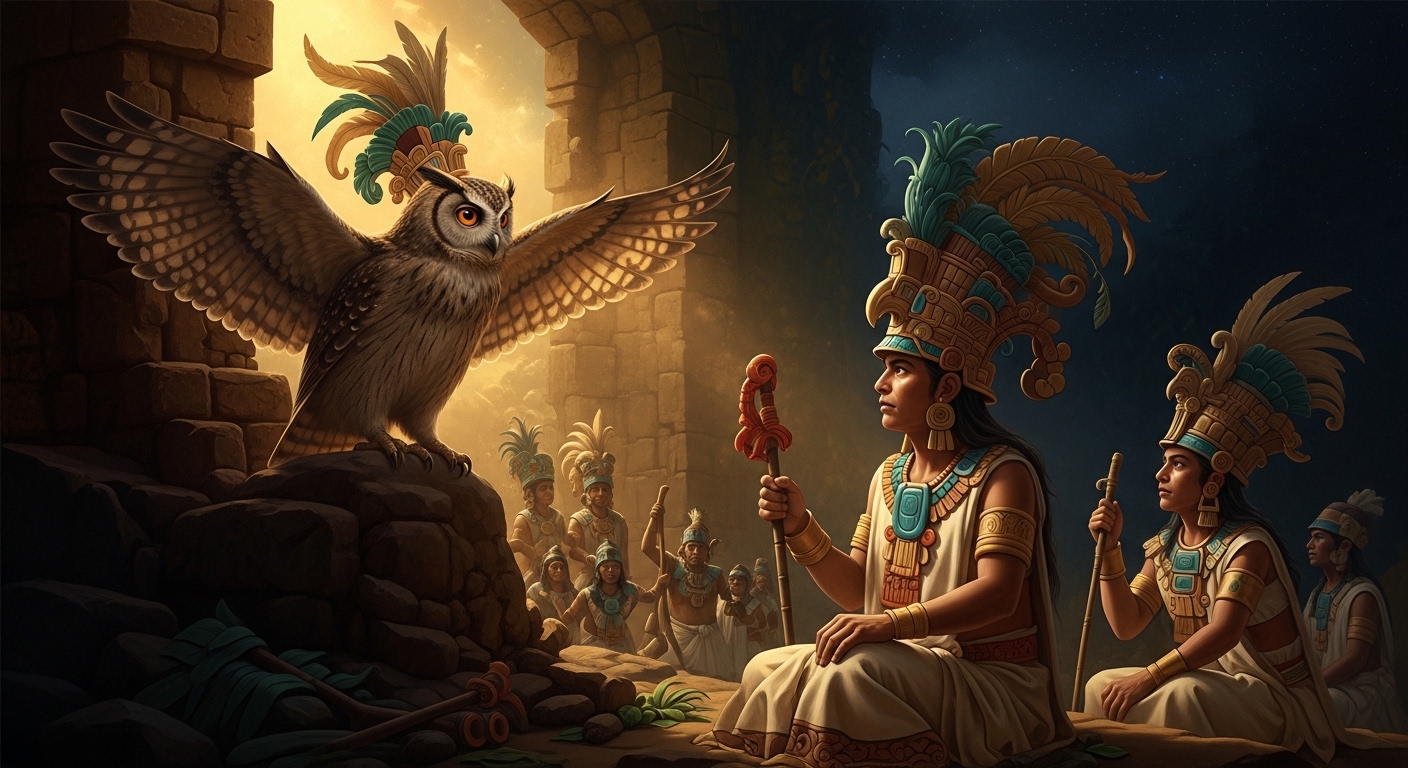
The muan owl calls at night and the Maya understood the call as the sound of the death realm making itself heard in the living world. When you hear an owl near your house, Ah Puch is listening. When you smell something dead in a room that has nothing dead in it, Ah Puch is standing somewhere you cannot see him.
This proximity theology — the death god as a constant presence that comes near rather than waiting for you to come to it — makes Ah Puch more intimate than many death deities. He does not stand at the end of a long road you travel only when dying. He is in the village. He walks through the milpa at night. He is the guest at every feast who has not been invited and cannot be turned away.
The people of the Yucatán who still honor Ah Puch — under his name Kisin or under the Christian overlay of death images that the Spanish introduced — describe him as someone to be cautious around rather than hostile to. You do not anger him. You do not mock death. You acknowledge, when the smell comes, that he is nearby, and you go about your business quietly, not drawing attention, hoping the visit is not for you.
He smells like what he is.
He is what everything comes to, if you wait long enough.
The smell passes. He has gone to someone else’s house, or he has found what he was looking for, or he has simply moved on through the village the way a patrol moves through, checking everything, taking note. The air clears. You go back to your corn.
He will be back.
Scenes
Echoes Across Traditions
Entities
- Ah Puch
- Kisin
- One Death
- Seven Death
Sources
- Mary Miller and Karl Taube, *An Illustrated Dictionary of the Gods and Symbols of Ancient Mexico and the Maya* (Thames & Hudson, 1993)
- Diego de Landa, *Relación de las Cosas de Yucatán* (c. 1566, translated by Alfred Tozzer, 1941)
- Michael D. Coe, *The Maya* (Thames & Hudson, 8th ed., 2011)