Mucius Puts His Hand Into the Fire
Traditional date c. 508 BCE — the Etruscan siege of Rome under Lars Porsenna · The Etruscan camp outside Rome, on the right bank of the Tiber
Contents
During the Etruscan siege of Rome, a young Roman named Gaius Mucius infiltrates the enemy camp to assassinate Lars Porsenna — and when he is captured, he holds his own hand in a burning brazier to show that Roman courage cannot be broken by pain.
- When
- Traditional date c. 508 BCE — the Etruscan siege of Rome under Lars Porsenna
- Where
- The Etruscan camp outside Rome, on the right bank of the Tiber
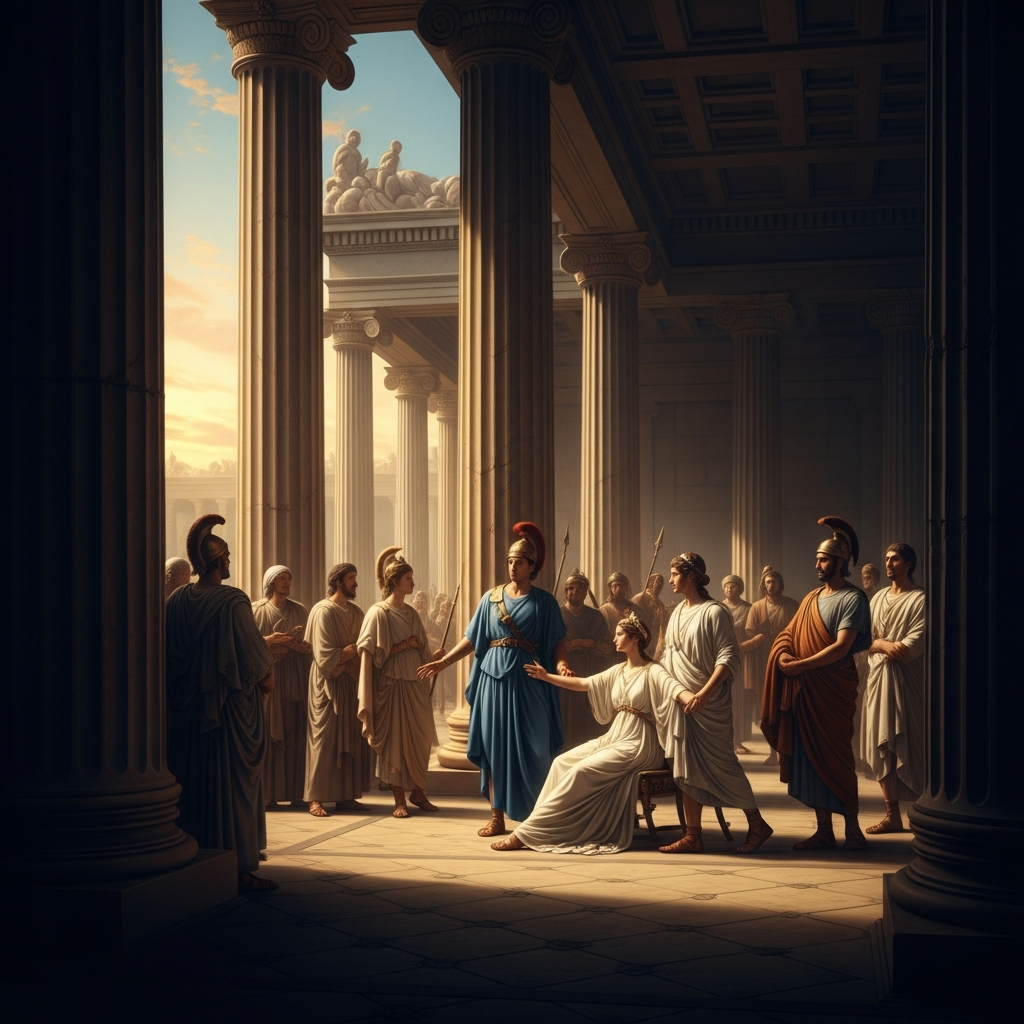
He enters the Senate without being called and asks permission to do what no Roman has done before: enter the enemy camp as a spy and kill the king.
The Senate gives permission.
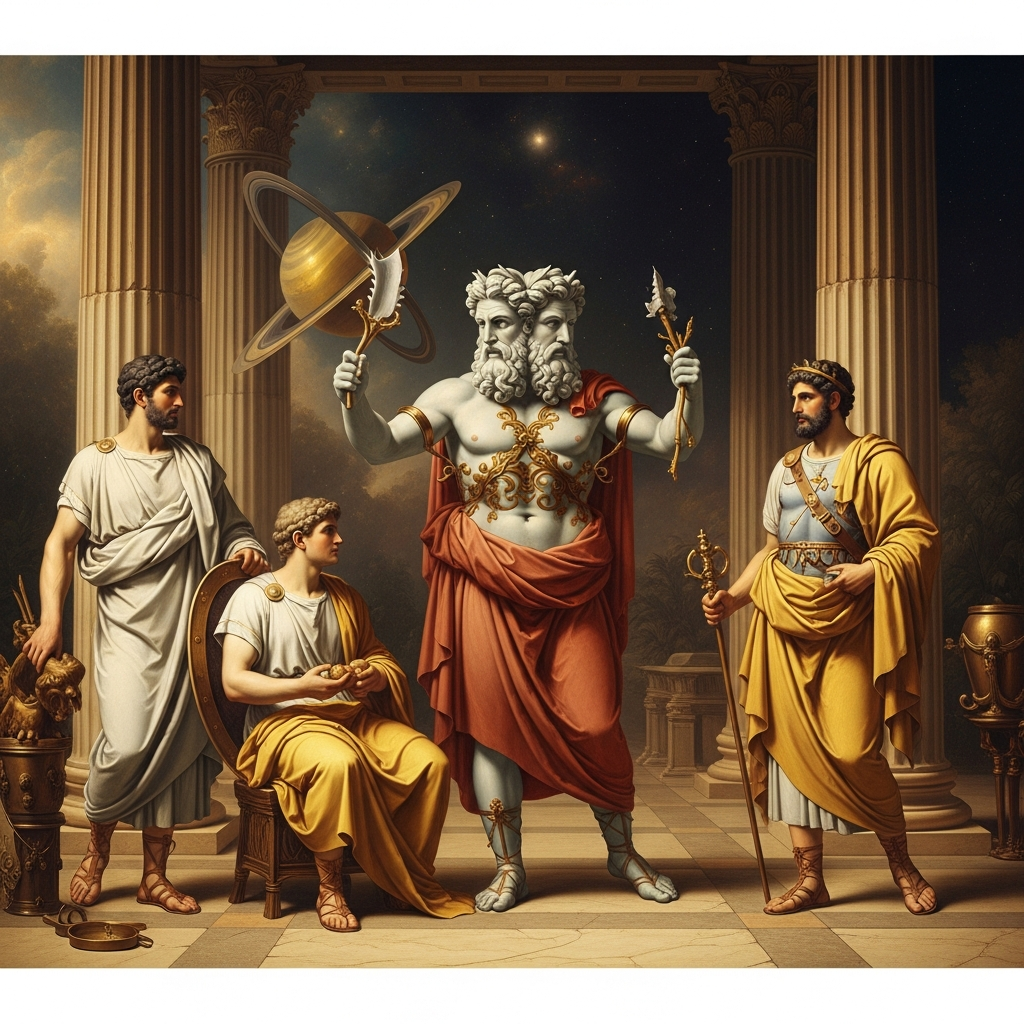
Gaius Mucius crosses the Tiber and enters Lars Porsenna’s camp alone, carrying a concealed sword. He does not know what Porsenna looks like. The camp is full of soldiers and administrative activity; it is payday, and a well-dressed man is seated on a dais doing the paying. Mucius assumes the well-dressed man doing official business is the king.
He kills the wrong man.
The well-dressed man is Porsenna’s secretary — his quaestor, the administrative official — who happens to be seated in the king’s chair because the king was absent or to one side. Mucius stabs him, realizes immediately from the reaction that this is not the king, and is seized before he can do anything further.
He is brought before Porsenna.
Porsenna demands to know who sent him and what he was doing.
Mucius’s answer is famous and precise: I am a Roman citizen. My name is Gaius Mucius. I came to kill you as an enemy. I have as much courage to die as to kill. Romans act with courage, and they suffer with courage. Nor am I alone in my intention against you. After me there is a long line of men seeking the same honor.
The last part is probably a bluff. The bluff is designed to make Porsenna afraid of a continuous assassination program — to make the threat eternal rather than singular. Whether it is true or not, the effect is the same: Porsenna cannot kill every Roman who might come for him.
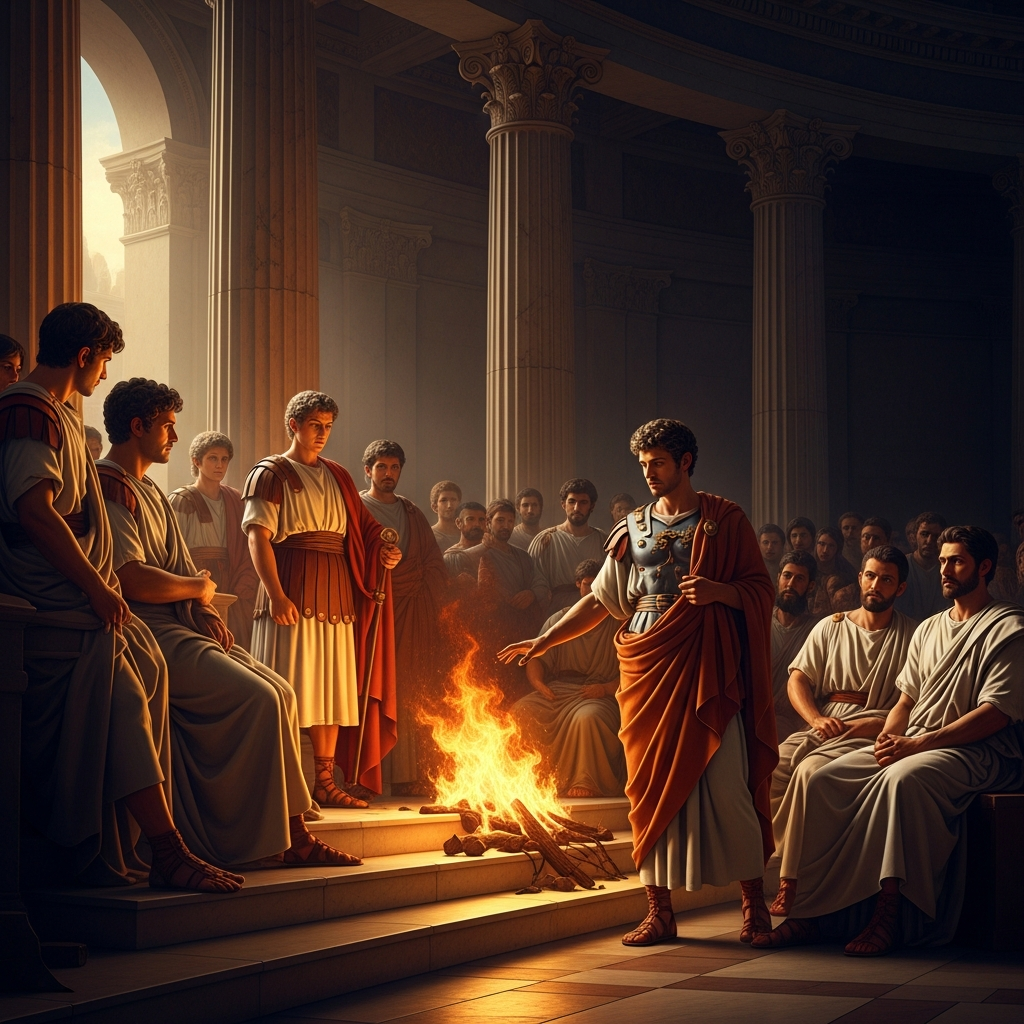
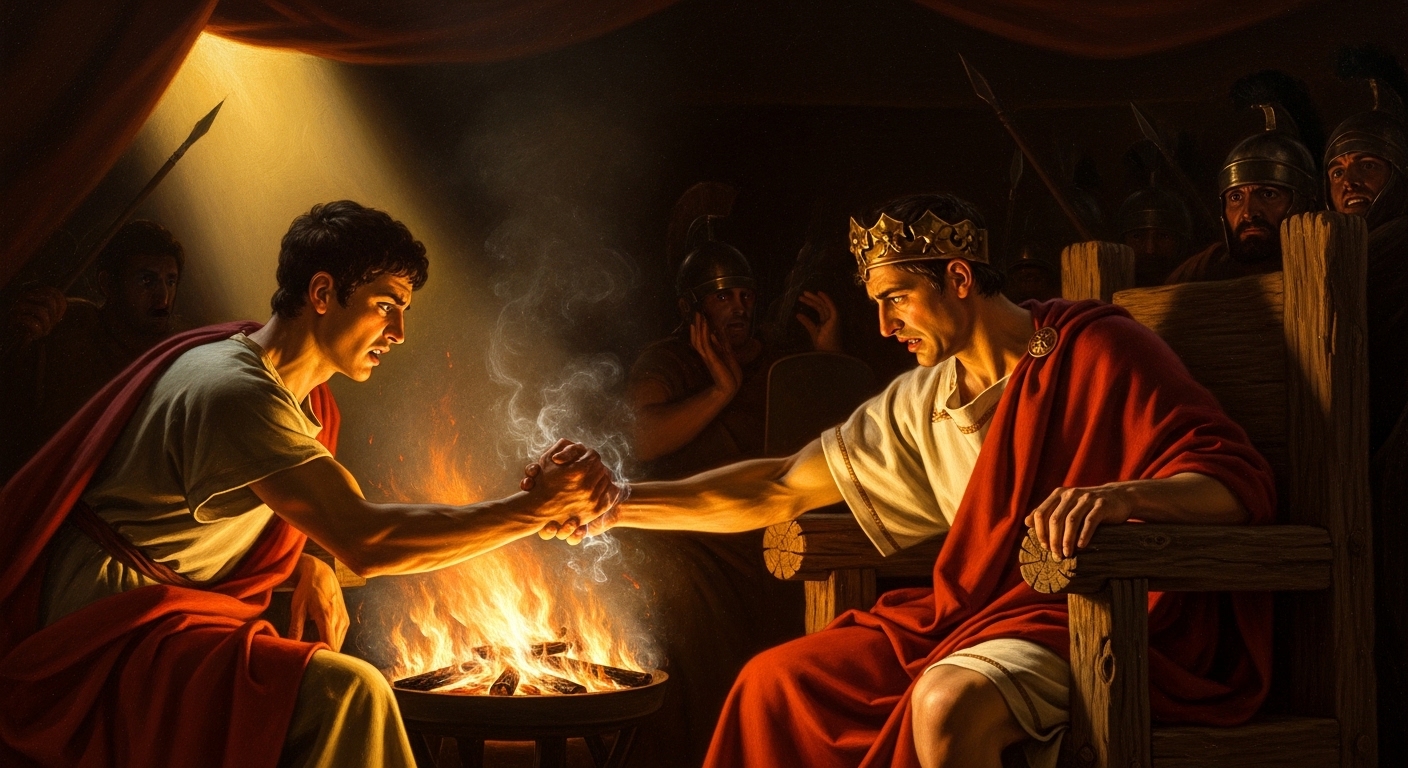
Porsenna orders him taken to the fire. He will torture the information out.
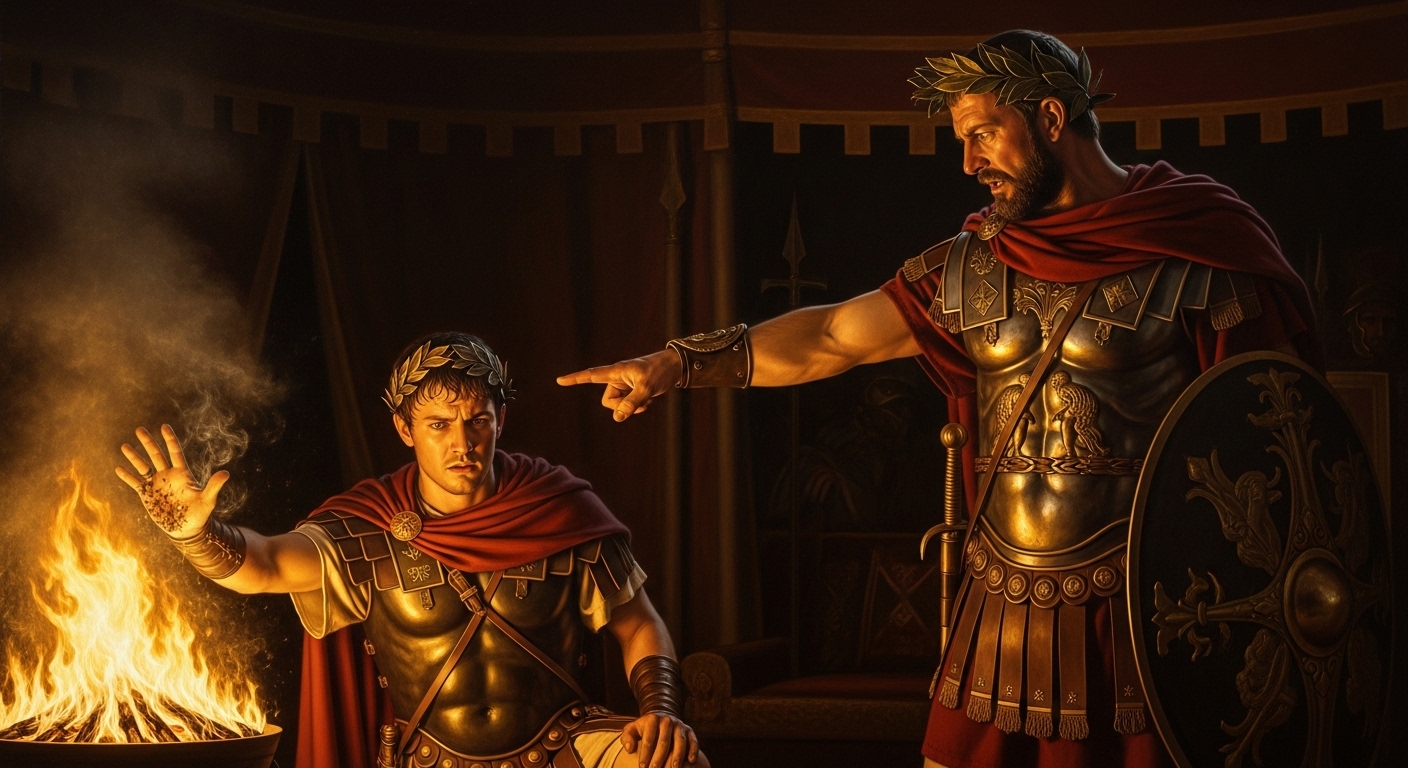
Mucius turns to the fire himself.
He puts his right hand into the burning brazier. He holds it there. He watches it burn with the expression — Livy says — of a man entirely indifferent to what is happening to his body. He says: see how cheap the body is to those who seek great glory.
He keeps his hand in the fire until Porsenna orders his men to pull it out, shaken.
Porsenna’s response is the measure of what Mucius achieved.
He calls the man brave and dangerous. He orders him released. He sends him back to Rome not as a prisoner or as a negotiating gesture but because a man who burns his own hand rather than tell you what you want to know cannot be broken by anything further, and breaking him would cost more than releasing him would.
Mucius returns to Rome. The hand is gone — burned to the bone, or amputated in the aftermath. He is given the name Scaevola: left-handed, the man who uses his left hand because his right is gone. The left-handed man in a culture that associated the left with ill omens is paradoxically made into a hero — the man whose left hand is a permanent monument to what his right hand endured.
Porsenna eventually makes peace with Rome.
The peace treaty that ends the siege is a complex matter in the sources — some say it was favorable to Rome, some say it involved humiliating terms. What the tradition insists is that Mucius’s act contributed to Porsenna’s decision to negotiate: that the prospect of a continuous series of Roman assassins, each willing to demonstrate their resolve in the same way, made siege and occupation untenable.
The Senate erects no statue to Mucius. The name is enough — the name and the story and the permanent reminder that the man called Left-Handed was right-handed until he made the choice that proved something about Rome. Every generation of Roman boys heard this story in school. Every generation understood what it meant: that Rome’s body politic was a body capable of putting its own hand into the fire.
The hand burns. Rome stands. This is the formula.
Scenes
Echoes Across Traditions
Entities
- Gaius Mucius Scaevola
- Lars Porsenna
- the Roman Senate
Sources
- Livy, *Ab Urbe Condita* II.12 (c. 27-25 BCE)
- Plutarch, *On the Fortune of the Romans* (c. 75 CE)
- Valerius Maximus, *Memorable Deeds and Sayings* III.3 (c. 30 CE)
- Dionysius of Halicarnassus, *Roman Antiquities* V.27-30 (c. 7 BCE)