Anansi Buys All the Stories in the World
The Anansi tradition is deeply rooted in Akan (Asante/Ashanti) oral culture, West Africa, with continuous attestation from at least the 17th century and likely much older; diaspora versions spread through the Caribbean from the 17th century CE onward · The sky court of Nyame; the forest floor where Anansi sets his traps; the crossing-places between the human world and the world of divine beings; eventually the entire world, since Anansi wins
Contents
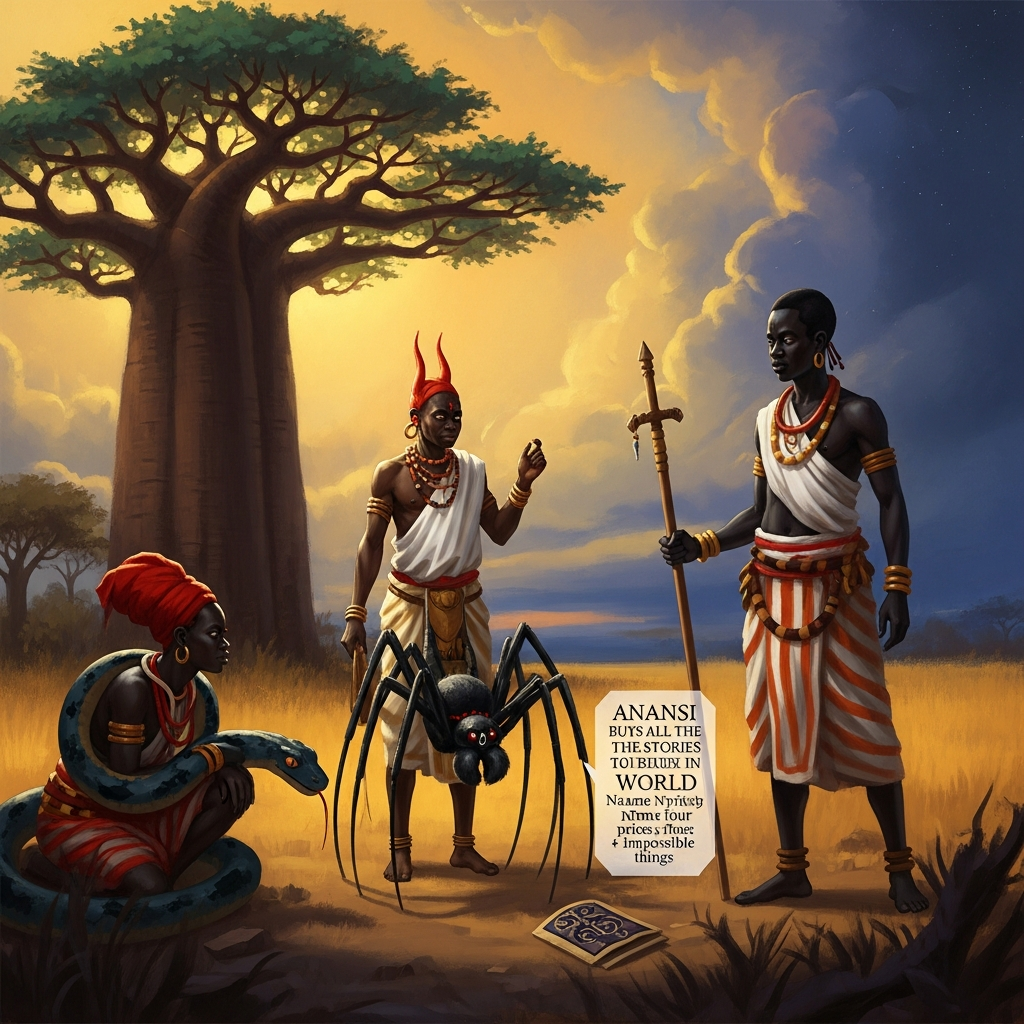
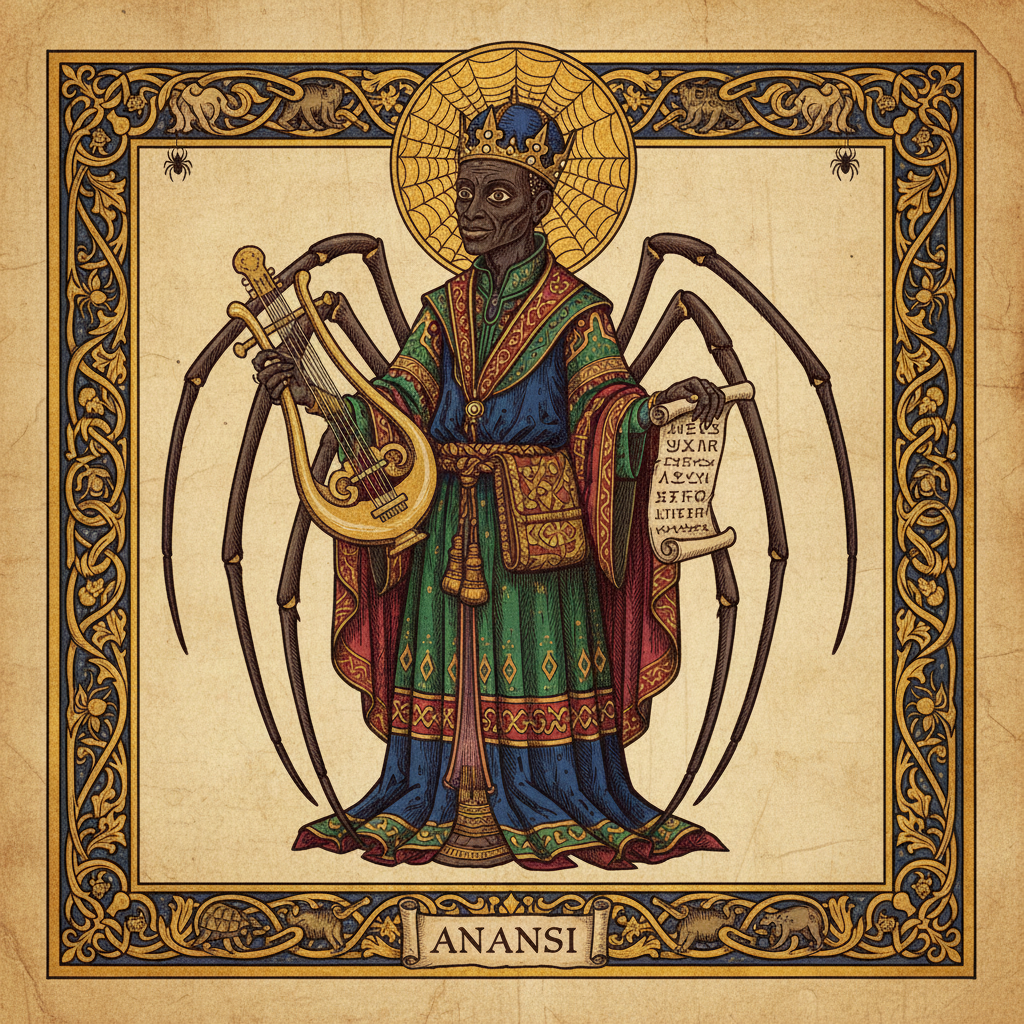
Anansi the spider wants to own all the stories in the world — which belong to Nyame, the sky god. Nyame names his price: four impossible things. Anansi delivers all four.
- When
- The Anansi tradition is deeply rooted in Akan (Asante/Ashanti) oral culture, West Africa, with continuous attestation from at least the 17th century and likely much older; diaspora versions spread through the Caribbean from the 17th century CE onward
- Where
- The sky court of Nyame; the forest floor where Anansi sets his traps; the crossing-places between the human world and the world of divine beings; eventually the entire world, since Anansi wins
Before Anansi, the stories had a different owner.
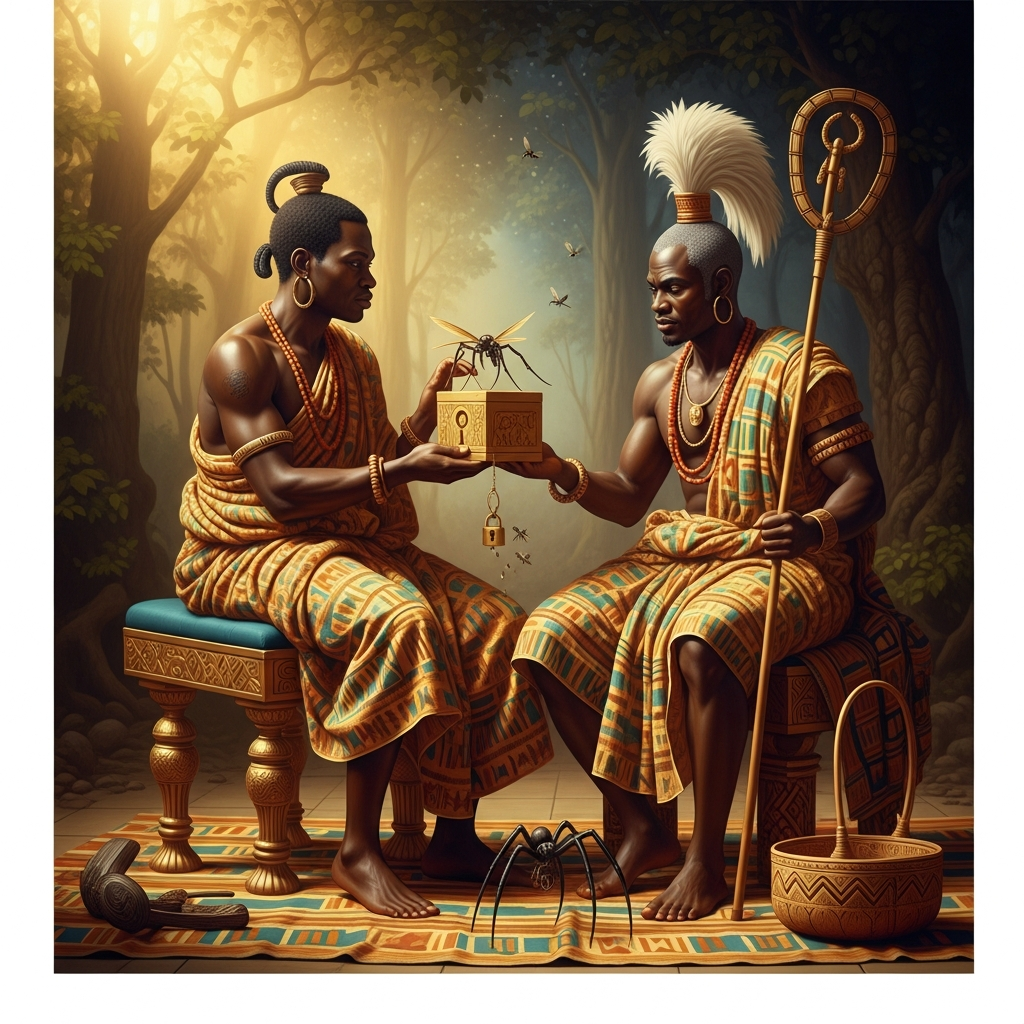
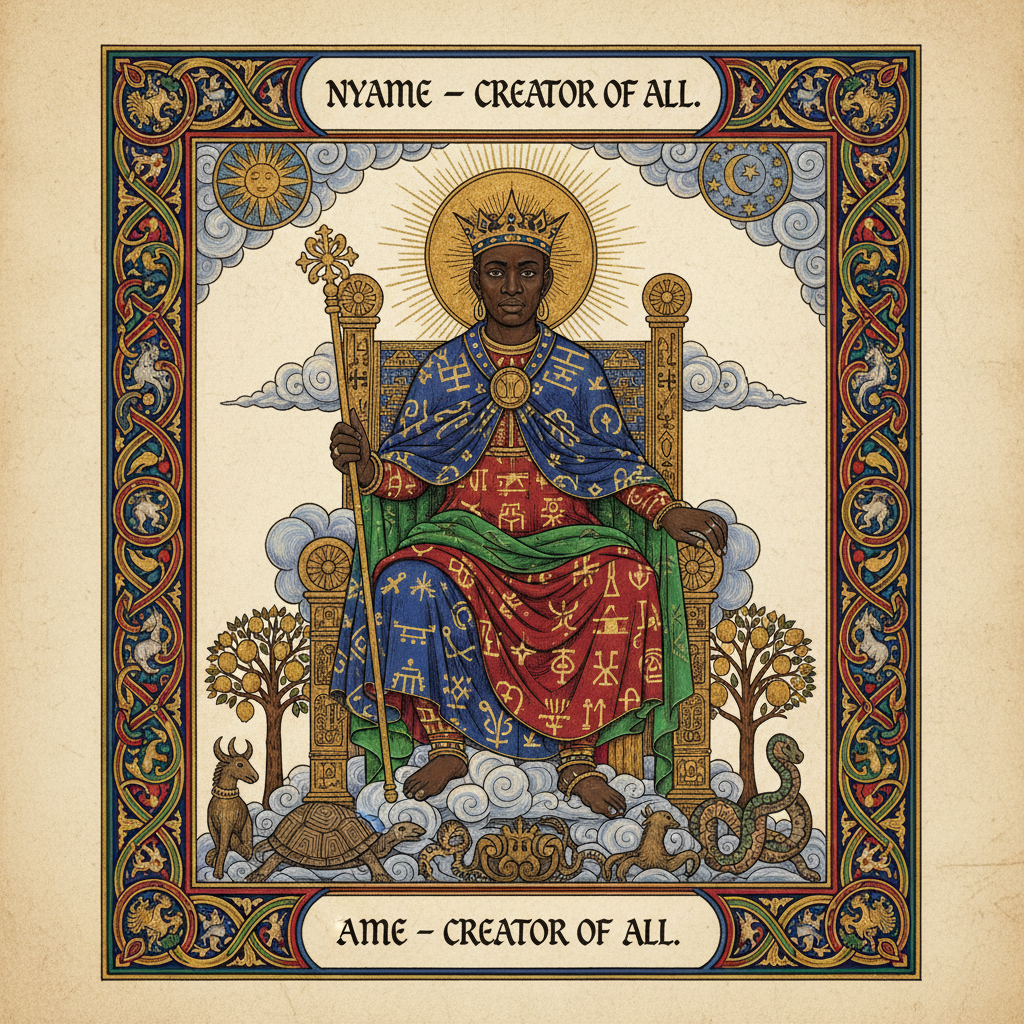
All the stories in the world — every tale, every riddle, every wisdom-saying, every account of what happened and what it meant — belonged to Nyame, the sky god. They were kept in a wooden box in the sky. They were called Nyame’s stories. When you wanted a story, it came from Nyame.
Anansi went to Nyame and said he wanted to buy them.
Nyame is amused.
He has heard many requests, but this one is unusual. The sky god looks down at the small brown spider on the web at the edge of the sky and says: powerful kings and wealthy chiefs have tried to buy the stories. None of them could pay my price. What can a spider pay?
Anansi asks: what is the price?
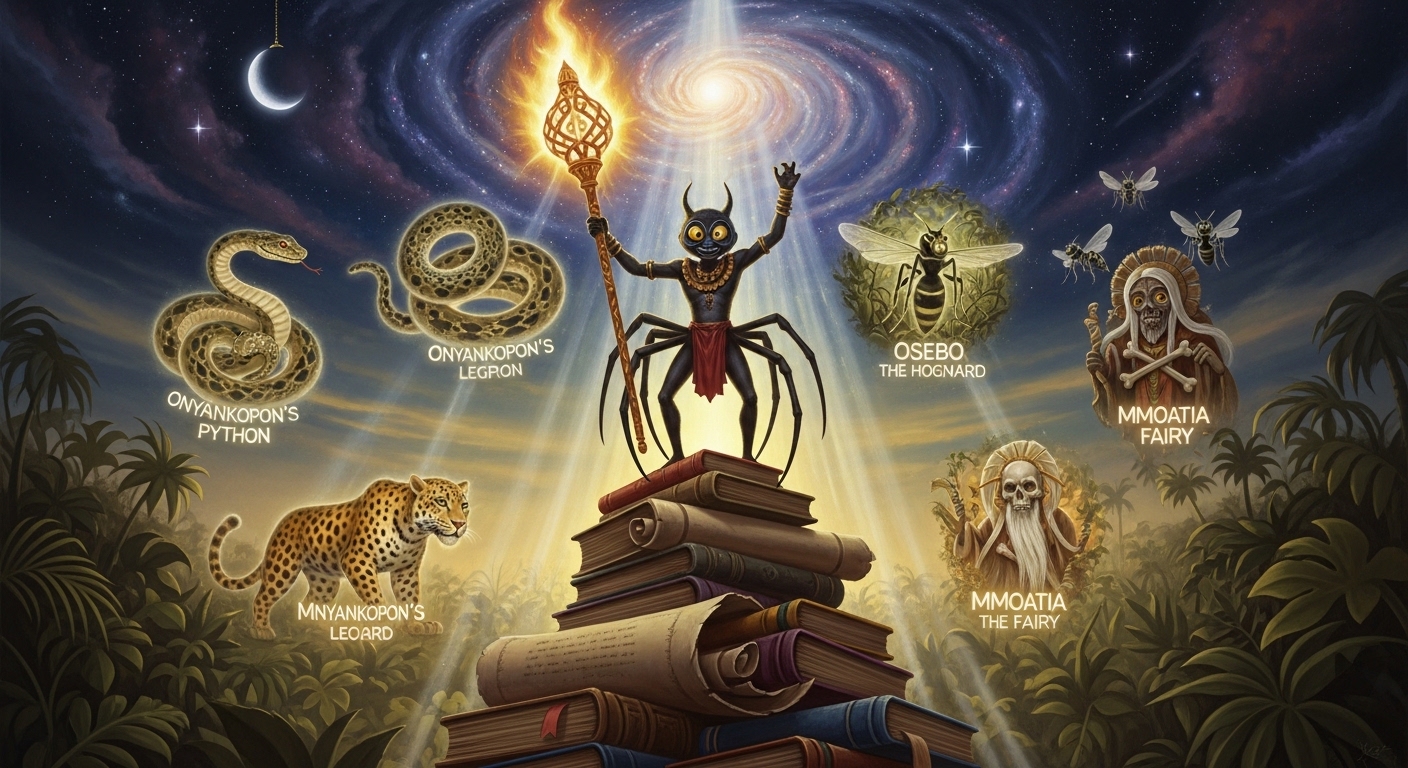
Nyame says: four things. Onini, the python who swallows antelopes. Osebo, the leopard with the terrible claws. Mmoboro, the hornets who sting everything that moves. And Mmoatia, the fairy who cannot be seen.
Bring me these four, says Nyame.
Anansi says he will pay.
He goes home and talks to his wife Aso.
This is important: Anansi is clever, but Aso is often the strategist. She tells him how to catch the python. He listens. He goes into the forest and finds a long palm branch and a length of vine.
He finds Onini and begins talking to himself, loudly, as if continuing an argument he has been having: My wife says you are shorter than this palm branch. I say you are longer. How can we settle this?
Onini, who has a python’s investment in being the longest, is drawn into the conversation. He lies alongside the palm branch to settle the question. He is not longer, he says. He is at least as long. Anansi says: you keep moving. Let me tie you to the branch to hold you still while we measure.
The python allows this. The python is tied. The python is caught.
Anansi carries him to Nyame.
The hornets are next.
He takes a gourd of water and a large leaf. He approaches the hornets’ nest. He begins to pour water over himself, and over the hornets’ nest, while shouting that it is raining and the hornets should take shelter in his gourd. The hornets fly into the gourd. He plugs the hole with the leaf.
He carries them to Nyame.
Osebo, the leopard.
He digs a pit in the place where Osebo walks. He covers it with branches and leaves. He waits. The leopard falls in. In the morning, Anansi looks into the pit and speaks with the leopard sympathetically: a proud creature like you, stuck in a hole in the ground. I will help you out.
He bends two young trees down into the pit and tells the leopard to hold them. The leopard grabs them. Anansi releases the trees and the leopard is flung upward, and as he passes through the air Anansi binds him with vine.
He carries him to Nyame.
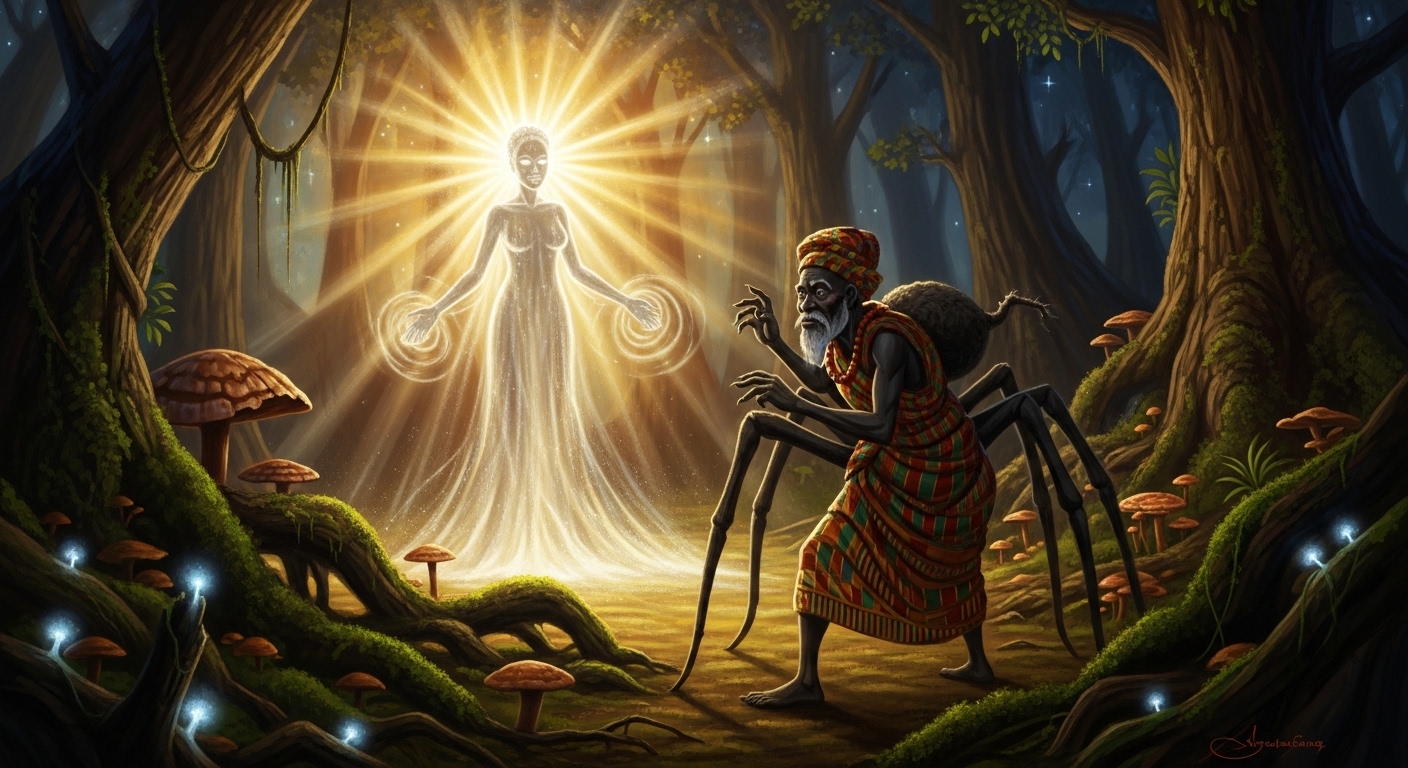
Mmoatia, the fairy who cannot be seen, is the hardest.
He carves a small wooden figure — a doll — and covers it with sticky sap from the gum tree. He places it in the path where the fairies walk, with a bowl of yam in front of it.
Mmoatia comes and eats the yam. She thanks the doll. The doll does not respond. She thanks it again. Silence. She strikes it. Her hand sticks. She strikes it with her other hand. It sticks. She kicks it. Her feet stick. She is caught.
Anansi carries her to Nyame.
Nyame calls the people together.
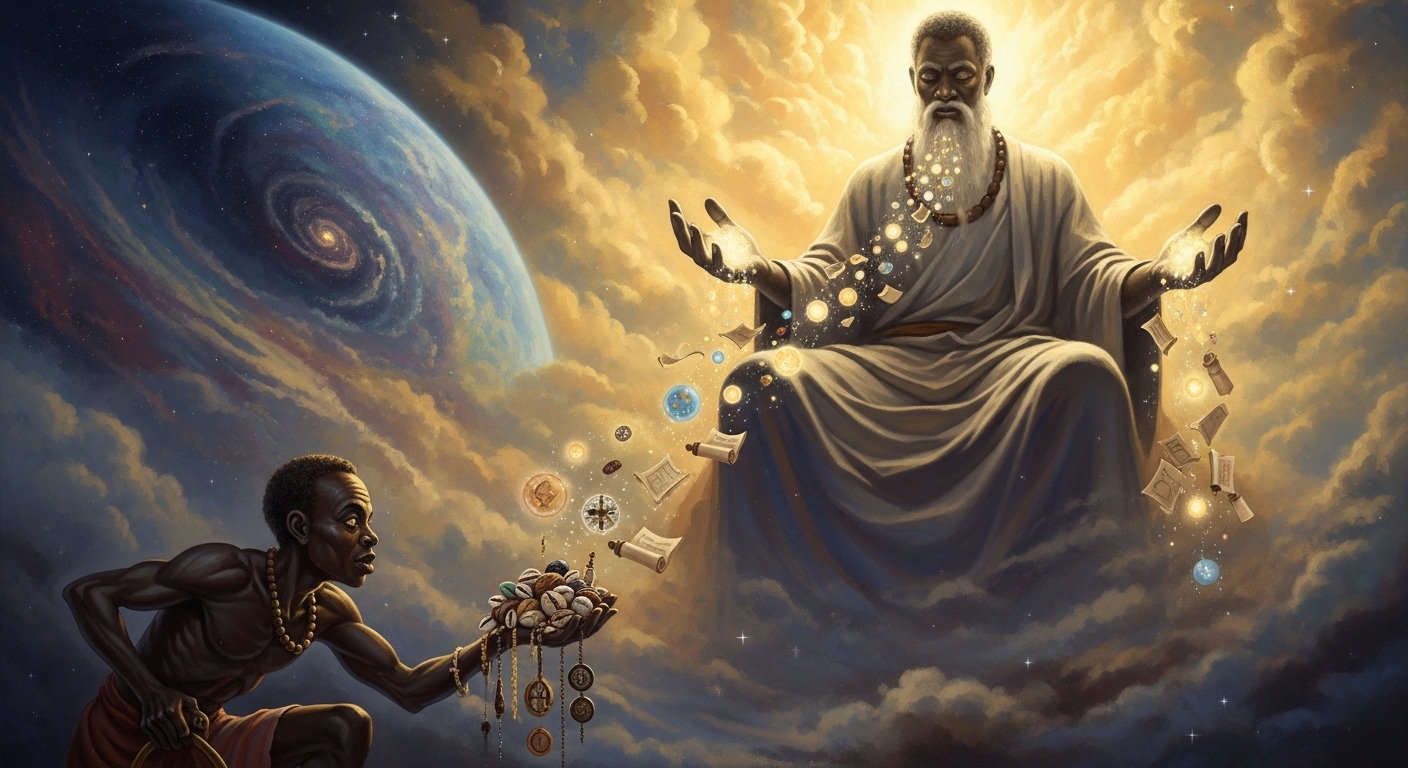
They come from everywhere — the chiefs, the elders, the warriors, the common people. Nyame holds up the four things Anansi has brought and says: This is what no one has done before. The great chiefs of earth could not pay this price. A small spider has paid it. I will do what I promised. Anansi, I give you all my stories. From this day, they will be known as spider stories.
Anansi takes the box of stories.
He opens it.
The stories scatter everywhere — into every village, every household, every family. They go into children and old women, into the fingers of griots and the mouths of grandmothers. They go to places Nyame’s box never reached. They go across the water to the Caribbean, and from there into every place the Akan diaspora settles, and then further, because stories travel on their own once released.
There is a question embedded in the story’s structure.
The four things Anansi captured are not random. They form a system.
Onini the python: the creature of irresistible length, of coiling danger, of slow patient constriction. You catch the python by appealing to its pride.
Mmoboro the hornets: the creature of collective force, of the many that move as one, of pain distributed across every surface. You catch the hornets by creating false urgency.
Osebo the leopard: the creature of predatory confidence, of the apex position, of the one who is not accustomed to being prey. You catch the leopard with patience and apparent sympathy.
Mmoatia the fairy: the invisible being, the one from the spirit world who cannot be perceived directly. You catch the fairy with an offering and the consequences of its own response.
Each capture requires a different form of intelligence: flattery, misdirection, sympathy, and the capacity to make a trap that works without your presence. These are not tricks. They are arts. The art of speaking to vanity. The art of creating a convincing false context. The art of pretending to help while actually trapping. The art of patient preparation.
To own all the world’s stories, you must be a master of all four.
The diaspora carried Anansi across the Atlantic.
The enslaved Akan people brought their spider-stories to Jamaica, Suriname, the American South, the Caribbean islands. In Jamaica he is Anancy. In Suriname, Anansi. In the American South, he shades into Br’er Rabbit — the small, clever animal who consistently outwits the larger and more powerful — and through that figure into every American trickster story.
He survived the Middle Passage not as a memory of a homeland that was lost but as a capability — the cognitive equipment for a world where direct confrontation with power was suicidal and survival required the exact arts that caught the four impossible things: flattery, misdirection, sympathy, patience.
Anansi is not beloved in the Akan tradition because he is good. He is beloved because he is capable. He is the tradition’s instruction in how to survive when you are small and the world is large.
He owns the stories.
Therefore, he told you this.
Scenes
Echoes Across Traditions
Entities
Sources
- Harold Courlander, *A Treasury of African Folklore* (1975)
- Roger D. Abrahams, *African Folktales* (1983)
- Peggy Appiah, *Ananse the Spider: Tales from an Ashanti Village* (1966)
- R.S. Rattray, *Akan-Ashanti Folk-Tales* (1930) — earliest systematic collection from the tradition
- Henry Louis Gates Jr., *The Signifying Monkey* (1988) — diaspora transmission
- Kwame Anthony Appiah, *In My Father's House* (1992)