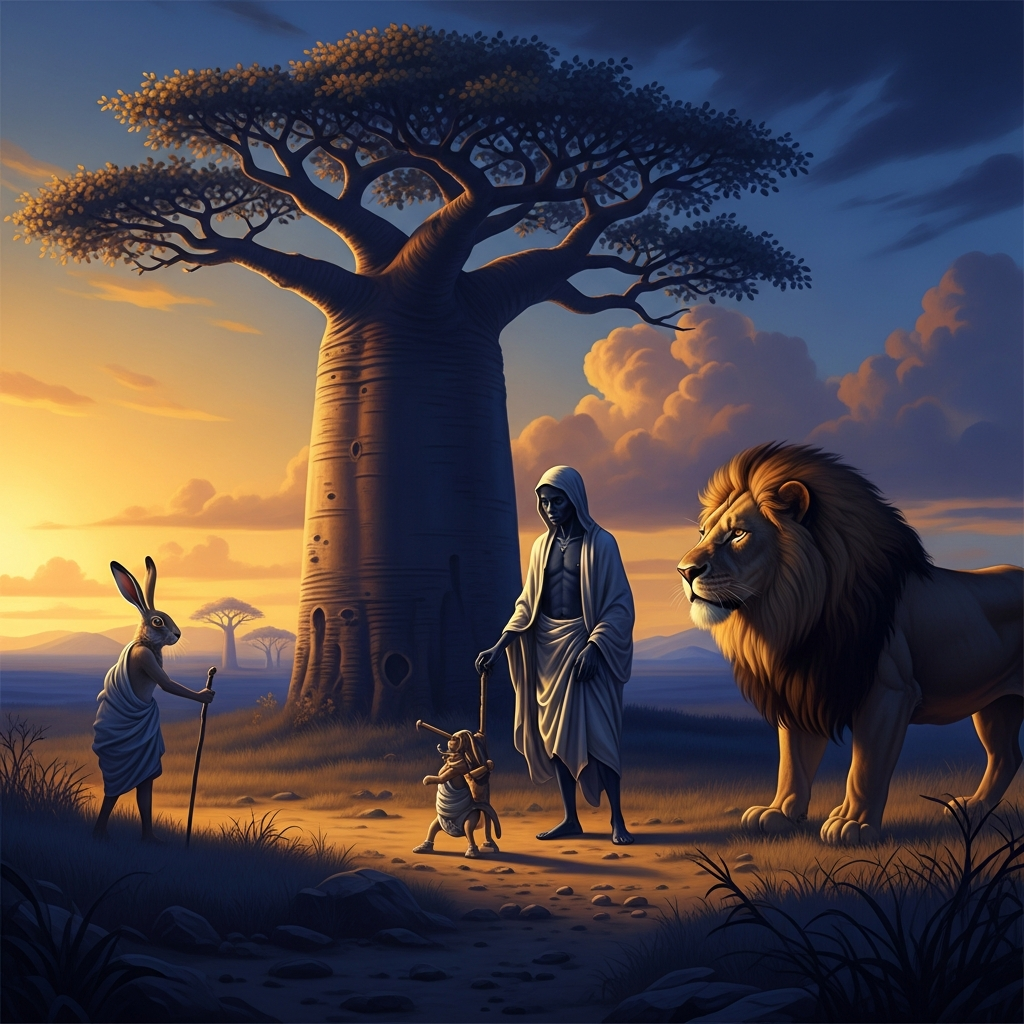
Al-Khidr: The Green One
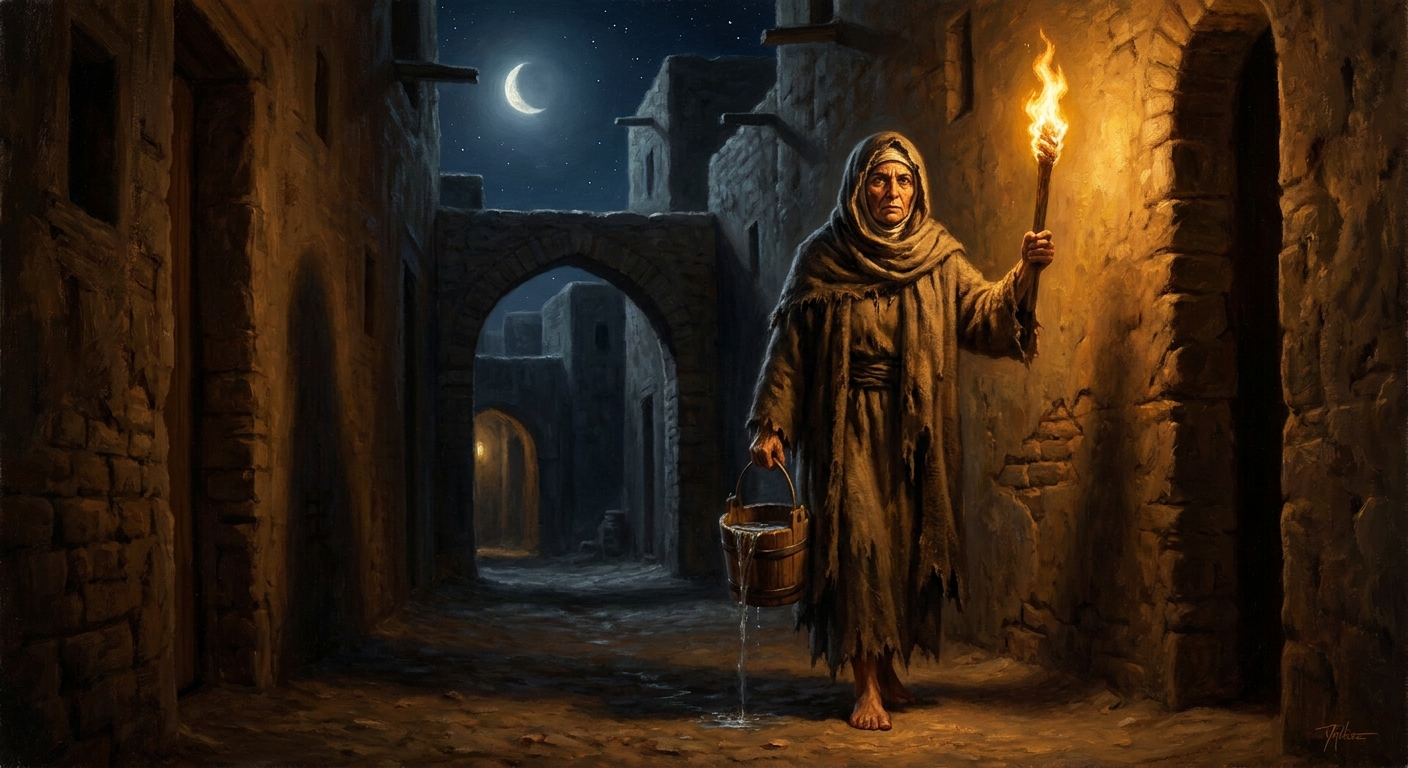
Outside ordinary time — the narrative is deliberately unanchored, set 'at the confluence of two seas' · Majma' al-Bahrayn — the confluence of two seas — a liminal geography that commentators have never agreed to locate on any map
Contents
Moses — receiver of the Torah, liberator of a people, the man God spoke to directly — goes looking for the most knowledgeable person on earth and finds a stranger who scuttles boats, kills children, and repairs walls for free. Three acts of apparent injustice. Three lessons he is not patient enough to wait for. The stranger dismisses him, and that dismissal is the teaching.
- When
- Outside ordinary time — the narrative is deliberately unanchored, set 'at the confluence of two seas'
- Where
- Majma' al-Bahrayn — the confluence of two seas — a liminal geography that commentators have never agreed to locate on any map
He is looking for the most knowledgeable person on earth.
This is Moses — the man to whom God spoke through a burning bush, the man who held up his staff and the sea parted, the man who came down from Sinai with stone and commandment. He is not, by any measure, a man who lacks knowledge. But he has said, somewhere, to someone, that he himself is the most learned. And God, the Qur’an suggests, does not allow that claim to stand uncorrected.
At the confluence of two seas, he is told, there is a servant of Ours whom We have given, from Our own presence, a knowledge that We have not given you.
Moses takes a servant and a fish. The fish is a sign — when it escapes into the water and swims freely, that is the place. They walk until Moses is tired and stops to eat. It is only then that the servant remembers: at the rock where they rested, the fish slipped out of the basket and found the sea. He had meant to mention it.
That is the place, says Moses. Turn back.
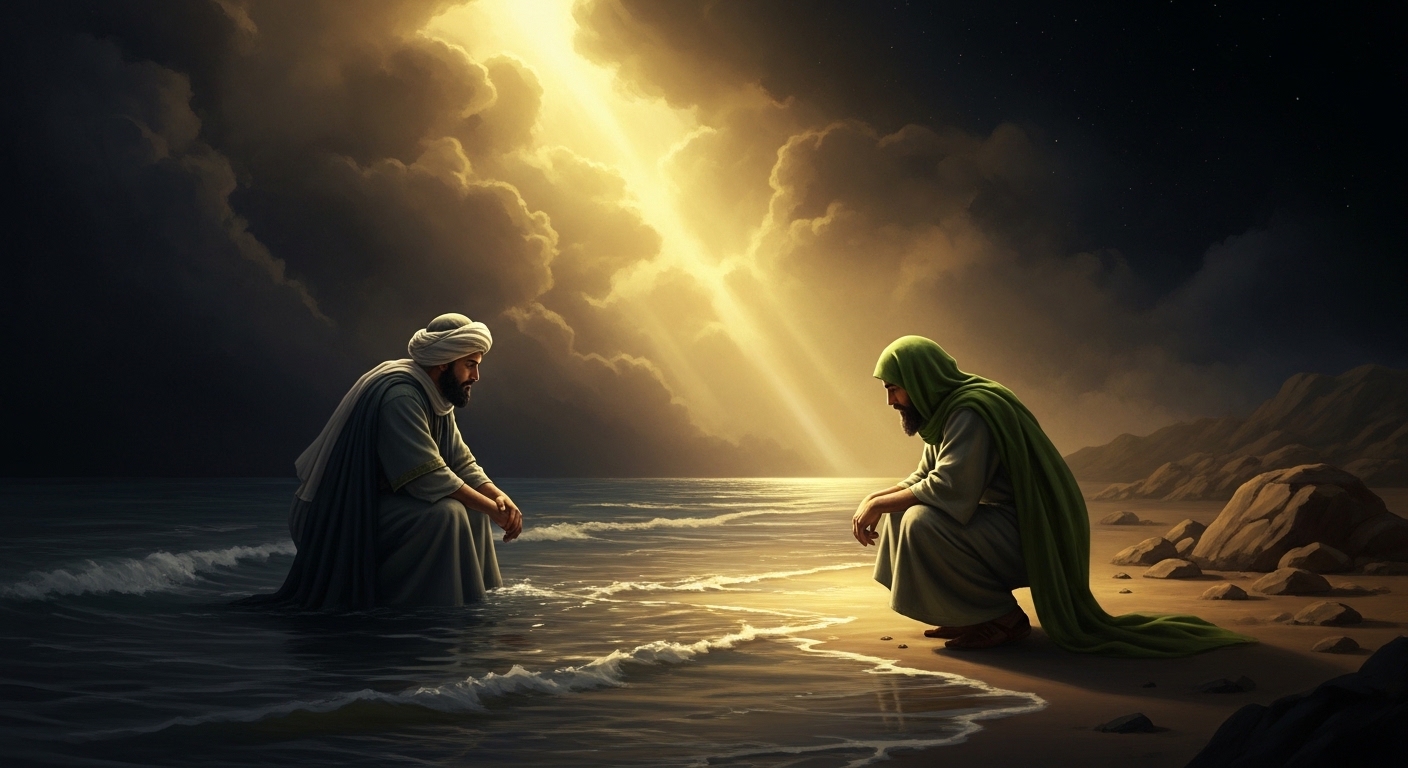
They find him at the water’s edge.
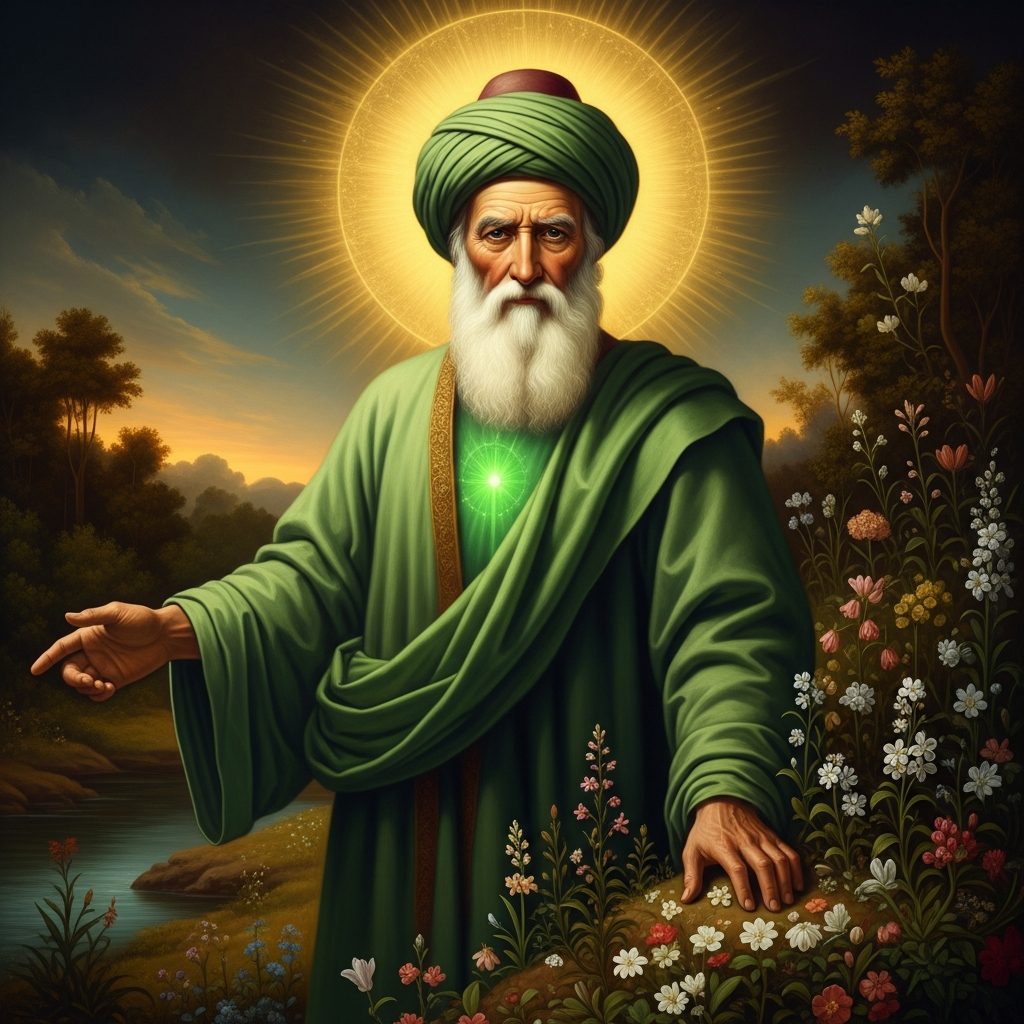
The Qur’an does not name him here. The name Al-Khidr — the Green One — comes from the hadith tradition, from the trace of living green that springs up wherever he sits on bare earth. He is identified in some traditions with the servant of God who was given rahma min ‘indina — mercy from Our presence — and ‘ilm ladunna — knowledge from Ourselves. Not learned knowledge. Not transmitted knowledge. Not the knowledge Moses received through an angel and a burning bush and forty days on a mountain.
Something else.
Moses addresses him with the deference of a student. May I follow you, so that you can teach me something of the right guidance that God has taught you?
The man looks at him.
You will not be able to bear with me, he says. How could you be patient in the face of something you do not understand?
Moses promises. He swears by God. He is Moses — he will be patient.
Then if you follow me, says Al-Khidr, you must not question anything I do until I myself mention it to you.
The first act happens on a boat.
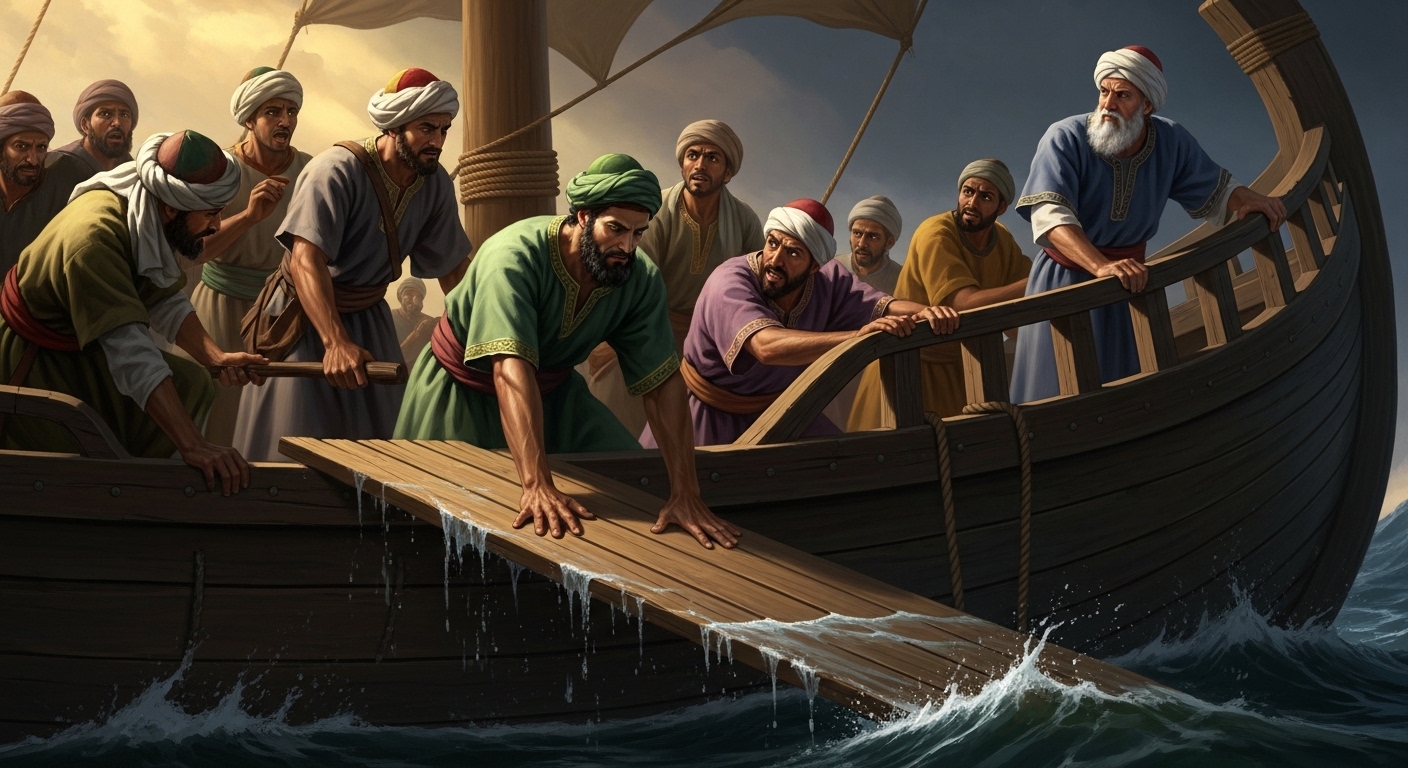
They board as passengers. The boat belongs to poor fishermen. It is their livelihood, their single asset, the thing between their children and the hunger of the sea. While they are still on the water, Al-Khidr moves to the hull and begins to work. He is not repairing it. He is making it worse. He pulls up a plank, deliberately, and the boat takes in water, and Moses is standing there watching the poor men’s boat be scuttled by the man he is following.
Have you done this to drown the people on it? Moses says. He has forgotten the agreement in forty seconds. This is a monstrous thing.
Al-Khidr’s answer is quiet. Did I not tell you that you would not be able to bear with me?
Moses apologizes. He remembers. He promises again. They go on.
The second act is worse.
They encounter a boy on the road — a young boy, unnamed, in the bloom of health. Al-Khidr kills him. There is no preamble in the Qur’an. The act is as abrupt in the text as it would be in life: the man kills the child, and Moses is watching, and Moses, who has just promised again, cannot keep the promise for a second time.
Have you killed an innocent soul who has not killed anyone? Moses demands. This is a terrible thing.
Al-Khidr looks at him. Did I not tell you that you would not be able to bear with me?
This time Moses’s apology has the texture of a last chance. If I question you again, he says, then you are entitled to leave me. I will have broken the terms.
The third act is strange in a different way. It does not feel like an injustice — only like a waste.
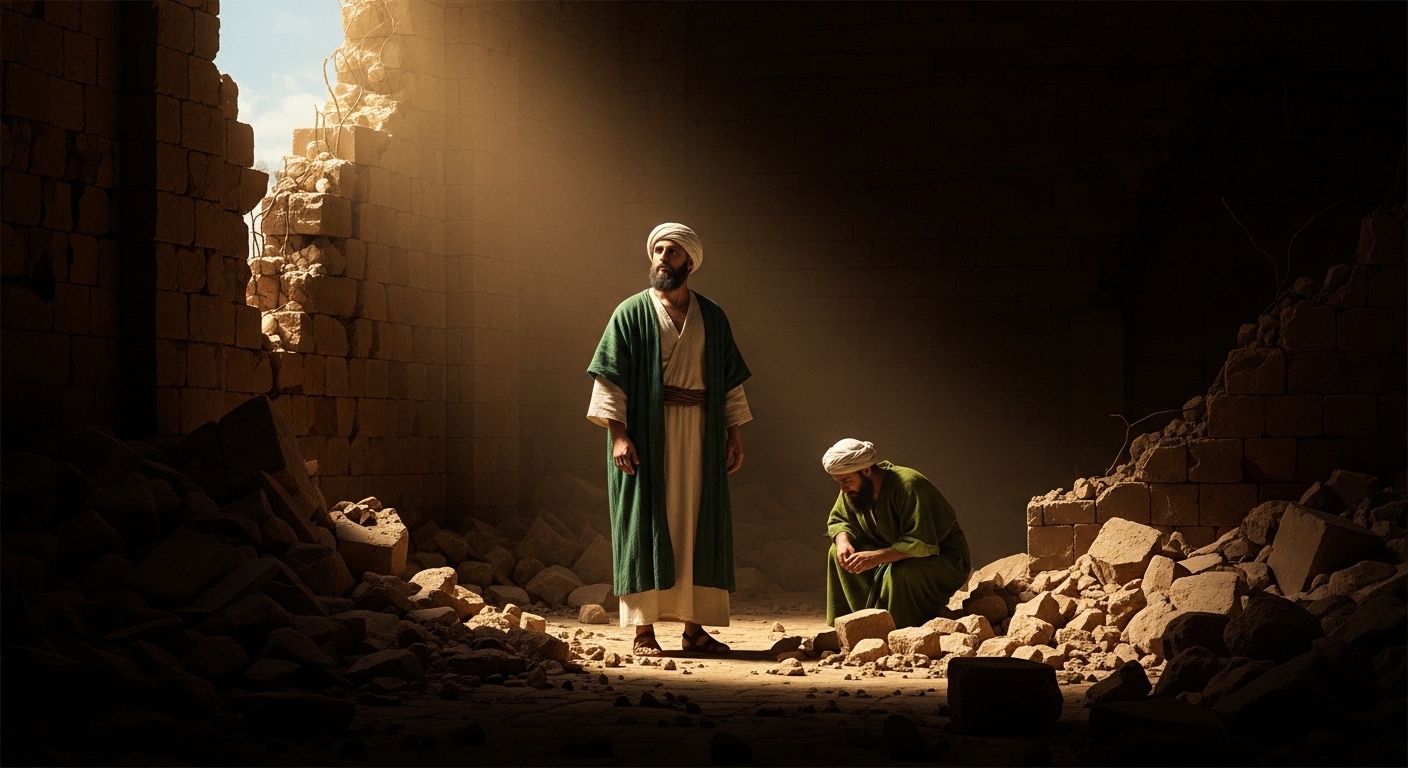
They come to a town and ask the people for food. The people refuse. There is a wall here that is crumbling, about to fall. Al-Khidr stops. He rights it. He rebuilds it. He does this for the townspeople who did not feed them, who did not offer them welcome. He does it for nothing, for no payment, for no return.
Moses does not accuse him of anything wrong this time. He only says what seems obvious: If you had wanted, you could have taken payment for it.
It is a milder objection. But it is still an objection. And it is the last one.
This is where we part ways, says Al-Khidr.
Then he explains.
The boat: there was a king ahead, seizing every sound vessel by force. The damaged boat would be passed over. The poor fishermen’s livelihood was preserved by the wound that looked like destruction.
The boy: his parents were believers. The Qur’an’s word is mu’minin — people of faith. The boy himself was destined, had he lived, to become a source of transgression and ingratitude that would have broken them. God intended to give them a better child in his place, one closer to purity. The mercy was hidden inside the act that looked like murder.
The wall: beneath it, buried under the rubble, was a treasure left by a righteous man for his two orphaned sons. They are not yet of age to claim it. The wall’s collapse would have exposed the treasure before they were ready to protect it. Their father’s last bequest required, for its delivery, a stranger to repair a stranger’s wall for no payment in a town that did not offer bread.
I did none of it on my own authority, Al-Khidr says at the end. That is the meaning of what you could not bear.
The Sufi tradition has lived inside this story for a millennium and has not finished with it.
Ibn ‘Arabi — the Andalusian mystic who will become the most systematic theologian of Islamic esotericism — returns to Al-Khidr repeatedly. In the Fusus al-Hikam, the chapter on Moses is also, essentially, a chapter on Al-Khidr: the difference between prophetic knowledge (‘ilm nabawi), which is revealed through God’s messengers and concerns the outer governance of human life, and the direct knowledge (‘ilm ladunni) that bypasses the normal channels entirely. Moses’s knowledge is vast and correct and divinely authorized. Al-Khidr’s knowledge is not more divinely authorized — it is differently authorized. It operates in a register that prophetic law cannot adjudicate.
This is the knife-edge the story walks. It is not saying that law is wrong. Al-Khidr himself says he acted on divine authority, not on his own caprice. But it is saying that divine authority sometimes operates on frames too large for human patience to hold open.
The Sufis do not allegorize Al-Khidr into abstraction. They insist on his literalness.
He is alive. He drinks from the Water of Life in the barzakh, the intermediate realm between this world and the next. He appears — has appeared, will appear — to sincere seekers at moments of genuine need. There are Sufi masters who claim they received their training from him directly, bypassing the normal chains of transmission. The Persian tradition calls him Khizr, and he walks the roads green, and the desert blooms under his feet, and he cannot die because he once found what no one else has found.
In the popular tradition — from Anatolia to Bengal — Al-Khidr is the figure who appears when you are lost. Not lost on a road. Lost in the way that a soul is lost. He appears at the moment of genuine desperation, addresses the seeker by name, and is gone before the seeker understands what happened. He is the guardian of hidden springs in deserts. He is the green light on the surface of dark water.
He is the principle that the most important guide does not announce himself as a guide.
What Moses could not tolerate was the interval between the act and the explanation.
This is the teaching that the story transmits, and that every Sufi master will reformulate for every student: patience is not waiting for suffering to end. Patience is remaining in relationship with a teacher whose frame is larger than yours, in the space between the apparently wrong act and the revelation that has not arrived yet.
The Arabic word the Qur’an uses is sabr — patience, endurance, the active staying-present with difficulty rather than the passive bearing of it. Moses had taqwa — the fear of God, the scrupulous attention to what is permitted and forbidden. He did not have sabr with Al-Khidr, because sabr requires agreeing to not-understand for longer than the understanding-mind can stand.
The boat is filling with water. The boy is on the ground. The wall is being repaired for people who did not offer bread. And the knowing, the whole-frame knowing that makes the act not only intelligible but merciful, is coming — but it has not come yet.
Moses could not stay in that space.
Al-Khidr dismisses him kindly. He has explained everything. He has honored the bargain by revealing the reasons at the end. He parts with Moses on good terms, with no accusation. But the lesson is in the dismissal: this knowledge cannot be transmitted to someone who cannot survive the wait.
Al-Khidr does not appear in the Qur’an by name. The identification is hadith, not Qur’an — Sahih al-Bukhari records the full story with the name. This means scholars dispute whether the green stranger is a prophet, a saint, an angel, or something that belongs to no category the theology has defined. The dispute is, from the Sufi point of view, exactly the right response. A figure who escapes the categories is demonstrating what the story is about.
He is still appearing, in the literature. Every major Sufi order has at least one founding story in which Al-Khidr provides the initiatory transmission when no human master was available. He is the teacher who arrives when the chain of transmission has broken, the living link who cannot die because the knowledge he carries must never die with him.
Moses is the most frequently mentioned prophet in the Qur’an. He appears in more verses than anyone, including Muhammad. And yet it is Moses who cannot wait for the explanation. This, too, is the story: that greatness in one register of knowledge is not greatness in another, and the stranger by the water knows something the lawgiver does not, and the lawgiver is large enough to go looking for him.
Scenes
Echoes Across Traditions
Entities
- Al-Khidr
- Moses
Sources
- Qur'an 18:60-82 (Surah Al-Kahf, 'The Cave')
- Tafsir Al-Jalalayn, commentary on Surah Al-Kahf (~15th c.)
- Ibn 'Arabi, *Fusus al-Hikam* ('Bezels of Wisdom'), ch. on Moses (~1230)
- Annemarie Schimmel, *Mystical Dimensions of Islam* (UNC Press, 1975), ch. 4
- Patrick Franke, *Begegnung mit Khidr* (Franz Steiner, 2000) — the most complete scholarly treatment