Iblis: The One Who Refused
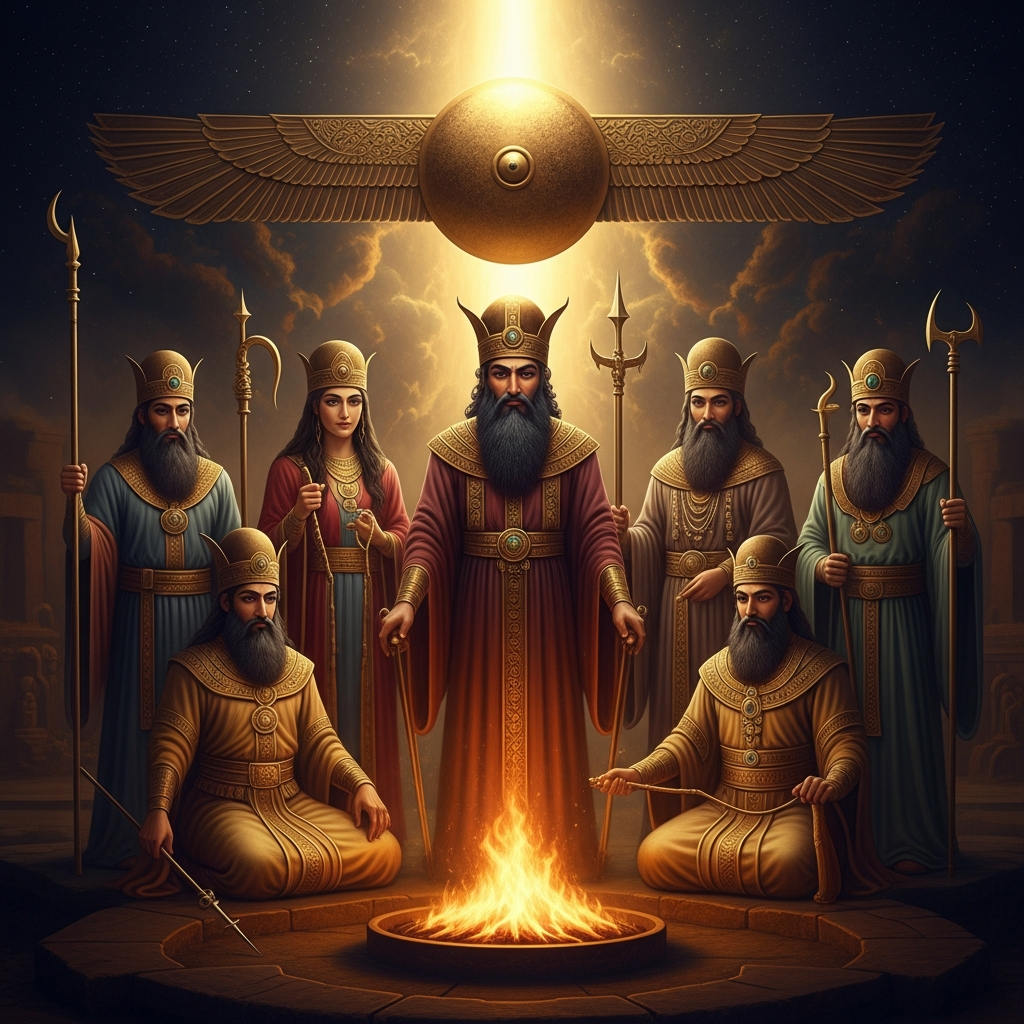
Primordial time — before the first human set foot on earth, at the moment of Adam's creation · The celestial court — the moment before history, when the angels were still receiving their orders and the clay of Adam had not yet been breathed into
Contents
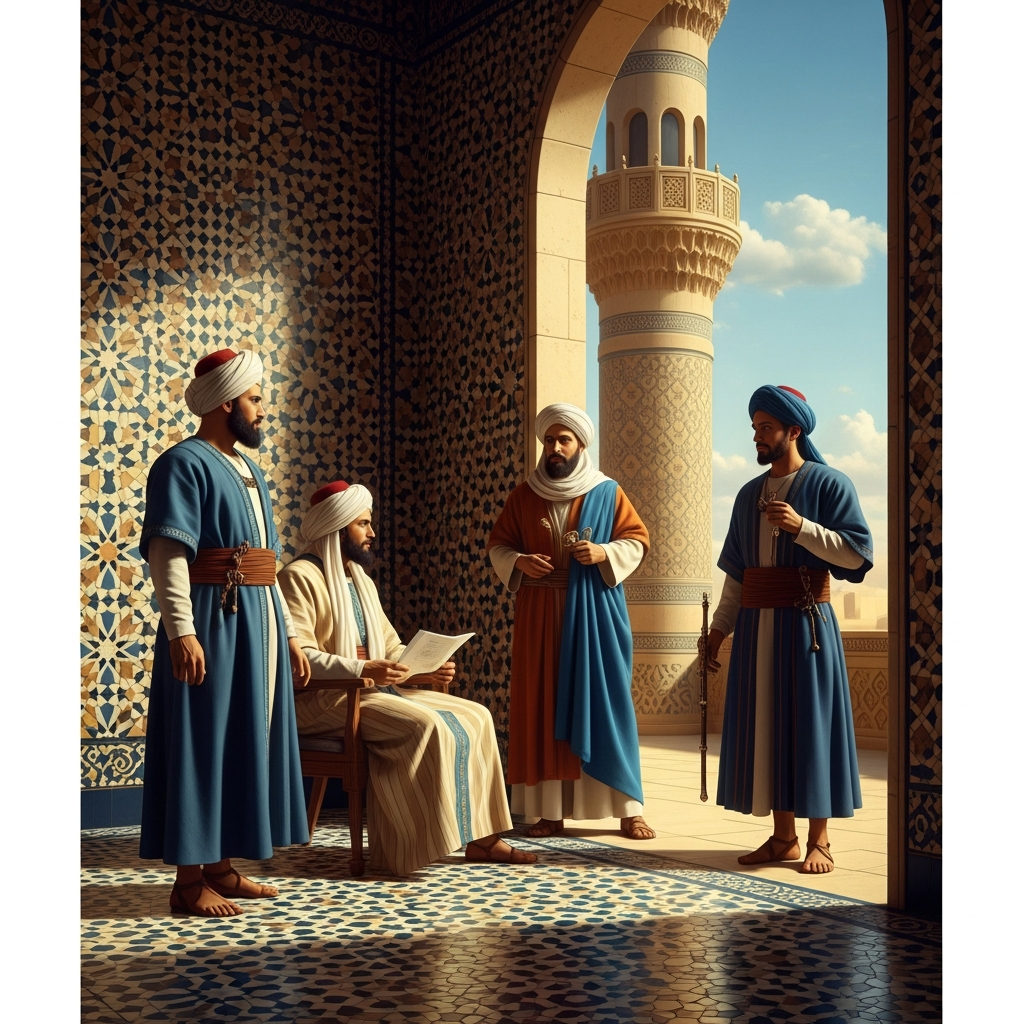
God creates Adam from clay and commands every being in the heavens to bow before him. All bow — except one. Iblis, made from fire, refuses: *I am better than he is.* He is expelled, given a reprieve until the Day of Judgment, and turns his exile into a vow to mislead the creature he would not honor. The orthodox tradition calls this pride. The Sufi mystics of Baghdad and Khorasan call it something else entirely: the most radical monotheism ever practiced, and its most catastrophic cost.
- When
- Primordial time — before the first human set foot on earth, at the moment of Adam's creation
- Where
- The celestial court — the moment before history, when the angels were still receiving their orders and the clay of Adam had not yet been breathed into
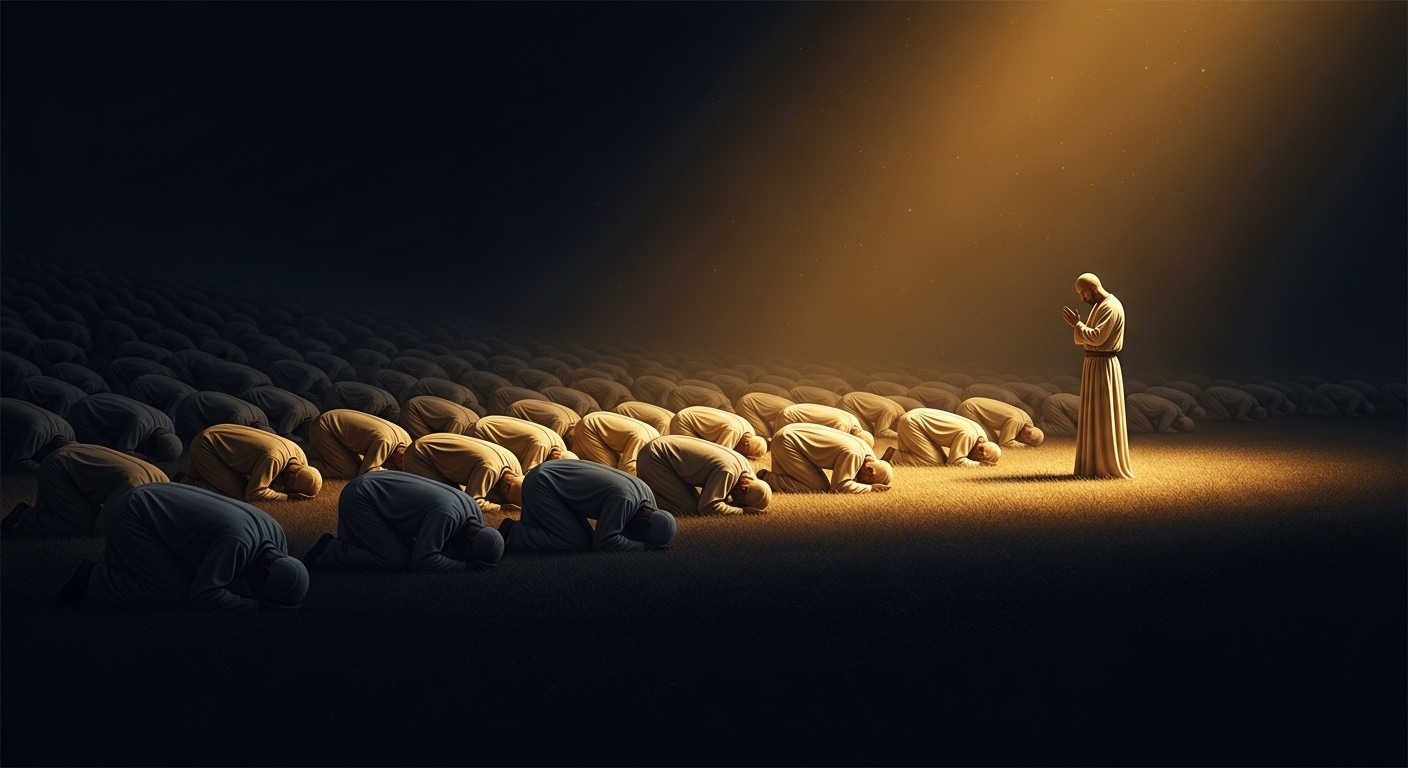
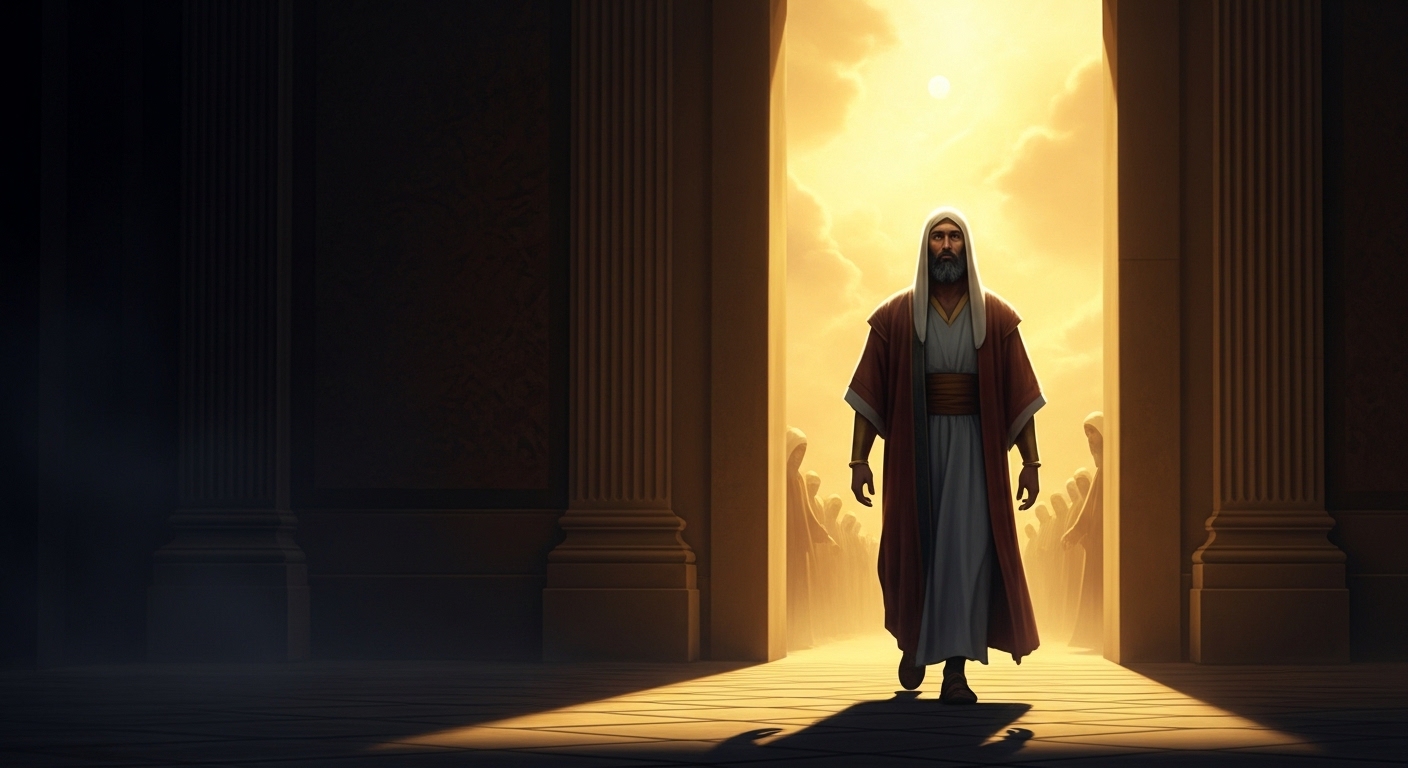
God commands the angels to bow.
The Qur’an tells this story in six different places — in Surah Al-Baqarah, in Al-A’raf, in Al-Hijr, in Al-Isra’, in Al-Kahf, in Sad — each time with slight variations, as though the text is circling something it cannot say in a single pass. The core is the same in all of them: God fashions Adam, God instructs the heavenly beings to prostrate, and they do. Fa-sajadu kulluhum ajma’un — they all prostrated, every one of them. Every one but Iblis.
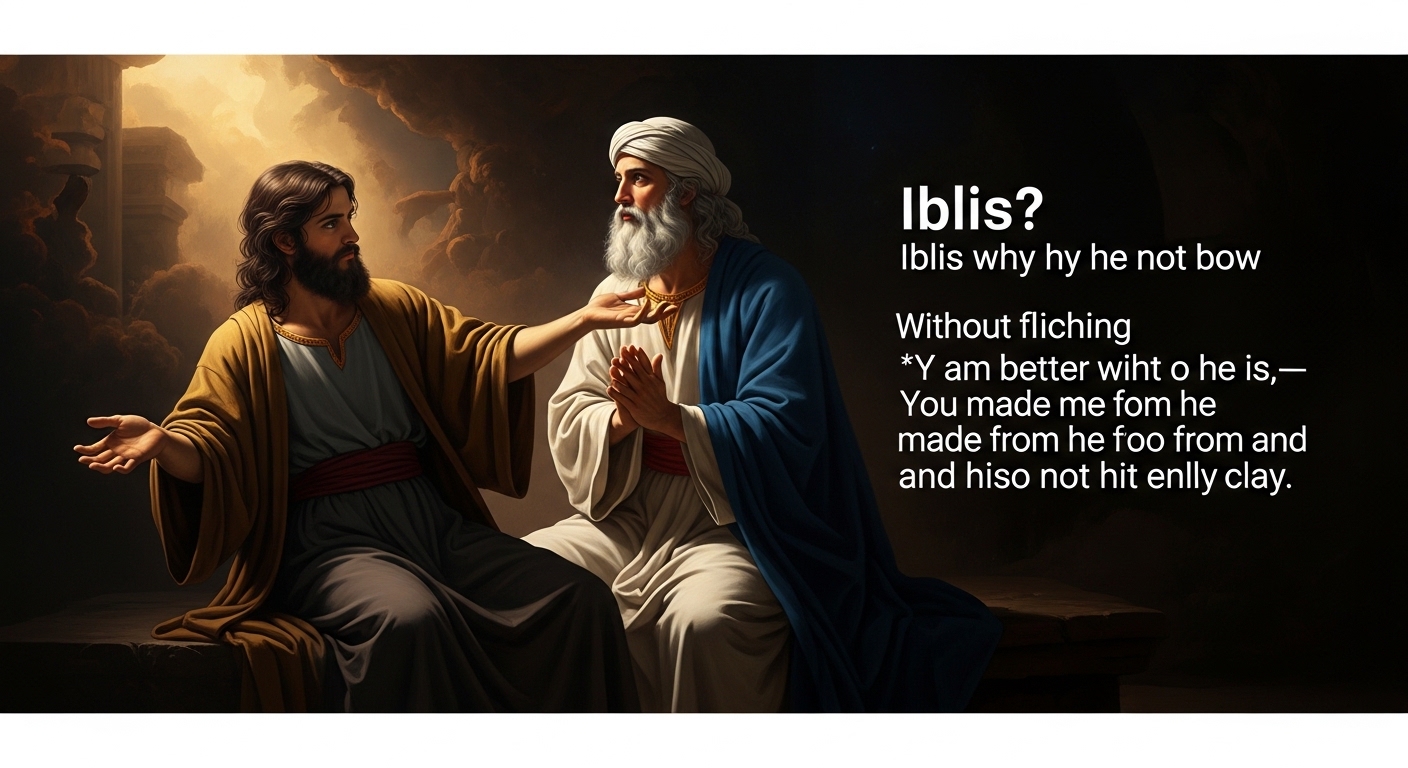
What prevented you from prostrating when I commanded you?
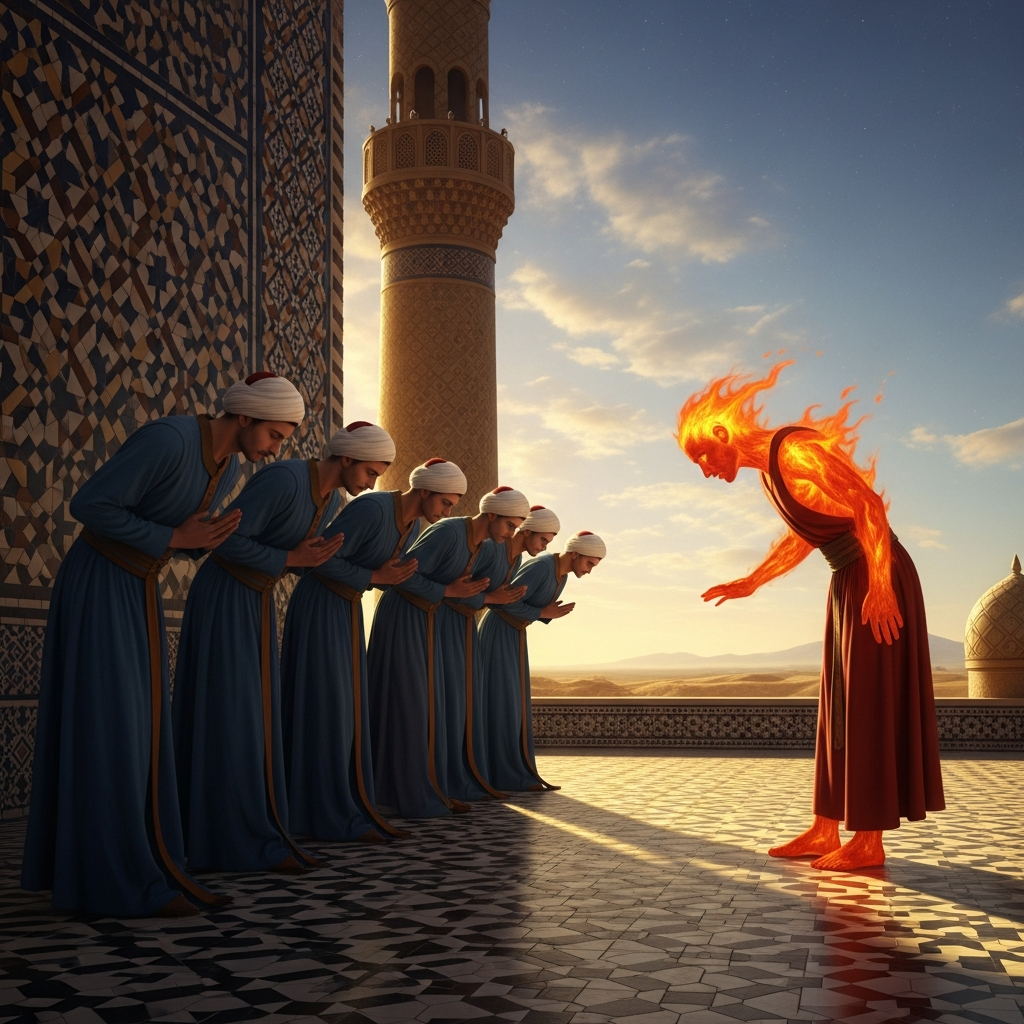
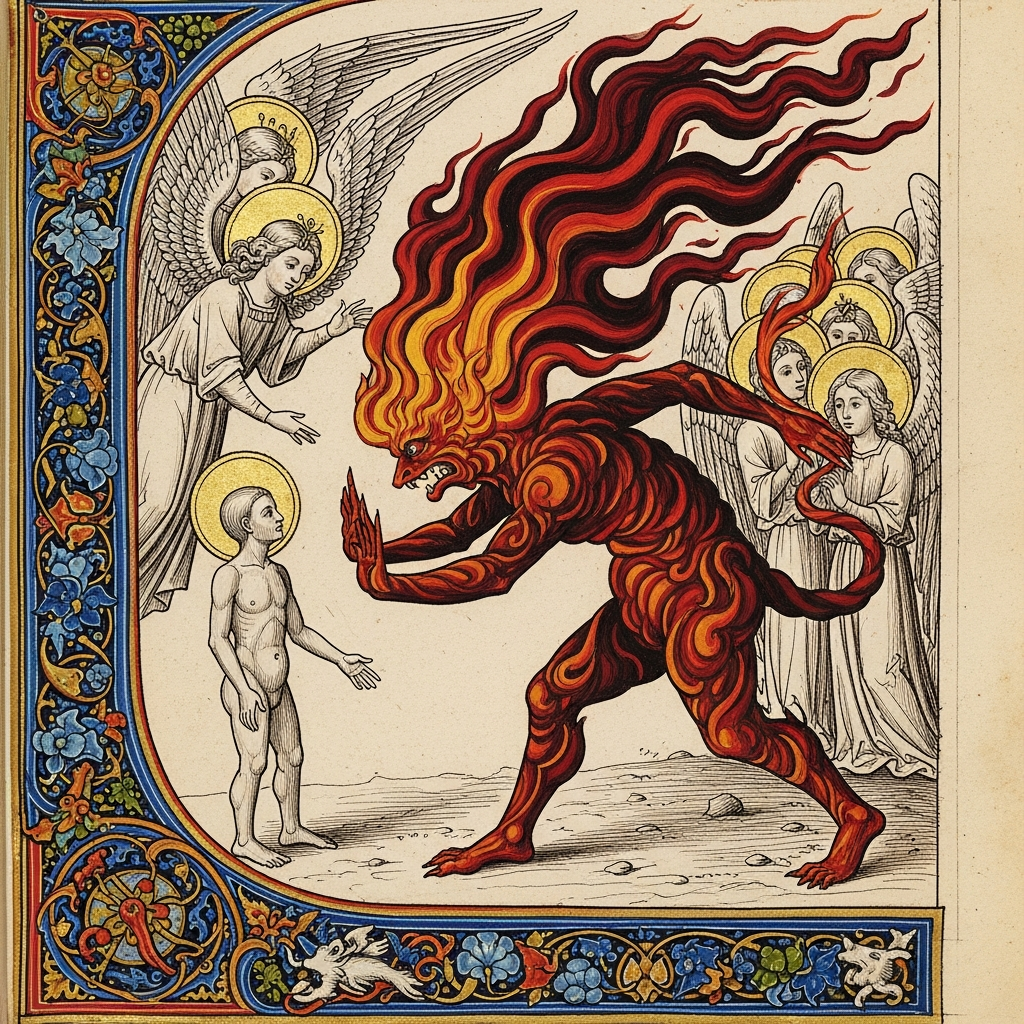
The answer of Iblis is three words in the Arabic that every Muslim child memorizes. Ana khayrun minhu. I am better than he is. You made me from fire. You made him from clay. Fire is above clay. I am above him. I will not bow.
This is the orthodox reading, and the orthodox consequence is immediate: Iblis is expelled. He is the la’in — the accursed, the one driven out. The word for what he becomes — Shaytan — is from a root meaning to be far, to be distant, to be cut off. The distance between him and God is the definition of what he has become.
And yet.
He asks for a reprieve, and God grants it.
This is the part of the story that every reader pauses over, even readers who have no intention of reaching the Sufi interpretation. Iblis — expelled, accursed, the enemy of humanity — asks to be given time. Then give me respite until the day they are raised up. And God says: You are among the ones who are given respite.
Why grant it? The orthodox explanation is that God’s plan includes the test — that Iblis’s existence as the tempter is necessary to the meaning of human free will. The Mu’tazilites and the Ash’arites argue about the mechanism. The theologians agree on the function. Iblis is the test.
But then Iblis makes his vow: I will lie in wait for them on Your straight path. I will come at them from in front and from behind, from the right and from the left, and You will not find most of them grateful.
And God says: Depart from here, disgraced and expelled. Those of them who follow you — I will fill hell with you all.
And Iblis goes. And he keeps his vow. And the theological question — why did God grant the reprieve of a being whose explicit stated intention was to lead humanity astray? — sits inside the text like a seed, waiting for the interpreter who is willing to plant it.
The wool-carder who said Ana al-Haqq planted it.
Al-Hallaj — executed in Baghdad in 922, in the same prison where he wrote the Kitab al-Tawasin — devoted the seventh chapter of that book to Iblis. The chapter is called “The Tasin of Understanding and Explanation.” It is the most dangerous thing he wrote, which is saying something, because most of what he wrote was dangerous.
Al-Hallaj asks the question directly: what if Iblis refused to bow not from pride but from monotheism?
The command was to bow to Adam. Iblis, Al-Hallaj argues, could not bow to anything other than God — because he had seen God. He had been in the presence. He had known the jalal, the divine majesty, at the level of direct vision. How could such a being bow to clay? How could the one who has seen the face of the Beloved turn that face toward a creature? To bow to Adam, Al-Hallaj suggests, would have been the real idolatry.
He claimed oneness, Al-Hallaj writes of Iblis. He was annihilated in oneness. And then, in the sentence that will get him killed as surely as Ana al-Haqq: My teacher is Iblis and Pharaoh.
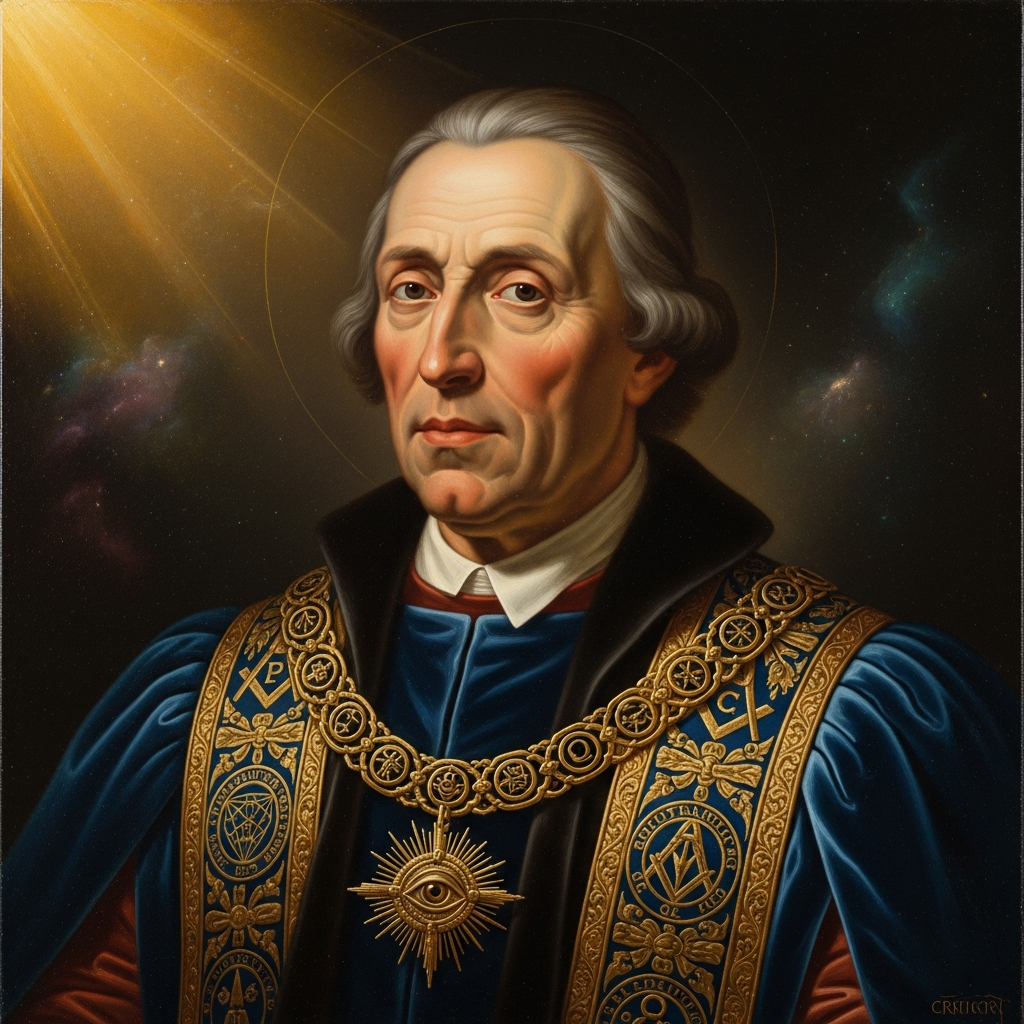
Ahmad Al-Ghazali — not the famous jurist Abu Hamid Al-Ghazali, but his younger brother, the one who understood Sufism in the register of erotic love — takes the argument a step further in the Sawanih, the collection of aphorisms that the tradition calls his masterwork. For Ahmad, Iblis is the supreme lover. The lover who has seen the Beloved cannot look elsewhere. The lover who has seen the Beloved cannot bow to the command of the Beloved to look away from the Beloved toward something that is not the Beloved.
The cruelty of the situation is absolute. God is testing Iblis, but the test has no correct answer. If Iblis bows, he has committed the idolatry of directing his worship toward something that is not God. If he refuses, he is disobeying a direct command of God. Ahmad writes: He said, “I cannot bow to other than You, and I will not bow to other than You.” But the order was to bow to Adam. And the one who was unable, because of the absoluteness of his love, to turn his face — that one was the victim of the command he could not obey.
This is the tragic reading. Not the proud Satan of Christian theology. Not the prosecutorial angel of Jewish tradition. A figure annihilated by love, expelled by the same God he could not stop seeing, sentenced to the long corridor of time precisely because his monotheism was total.
Rumi touches this in the Masnavi, gently, unwilling to commit fully to the Hallajian scandal: Iblis’s error was in using analogy — fire is above clay, therefore I am above Adam — rather than the direct vision of God’s command. Pride disguised as purity. Rumi keeps the orthodox condemnation but he hears something in Iblis’s reasoning that he cannot entirely dismiss.
The orthodox tradition is not wrong.
This must be said clearly, because the Sufi reading can seduce its reader into thinking the story has been resolved by the mystical interpretation. It has not been resolved.
The Qur’an does not present Iblis as a tragic hero. It presents him as the one who disobeyed, who became arrogant, who has been doing damage ever since. The word the text uses for his refusal is istakbara — he became arrogant, he thought himself great. The same word is used for Pharaoh, for the people who refused the prophets, for every human civilization that raised itself above the covenant. There is no ambiguity in the Qur’an about what Iblis did and what it cost him.
And the vow is real. He said he would lie in wait for humanity on the straight path — from the front and the back, from the right and the left — and the tradition has never doubted that he is doing exactly that. The great jurists are not wrong to say that the devil is the enemy, that his whispers are the enemy of the soul, that the refusal of Iblis is the archetype of every human self-assertion that puts the ego’s judgment above the divine command.
The question the story opens, and refuses to close, is whether it is possible for the same act to be both of those things at once.
Al-Ghazali the younger thinks it is possible. He thinks it is the condition of the highest lover, who cannot avoid the catastrophe their love has built for them. He writes of Iblis: He was the first to declare the unity of God — la ilaha illa Allah — but in a key that the command could not hear.
La ilaha illa Allah: there is no god but God. There is nothing worthy of prostration except God. If you take the central declaration of Islamic monotheism seriously enough, at the absolute edge of its logic, it becomes a refusal to bow to clay.
And yet: God commanded it. And yet: Adam carries the breath of God. And yet: the prostration was not idolatry — the angels who bowed did not sin. And yet: Iblis was made from fire and fire sees what clay cannot see.
The text does not resolve this. The commentators have tried for fourteen centuries to resolve it. They have produced two complete, internally coherent, textually supported readings — and neither one has expelled the other.
The Sufi masters treat this irresolution as the teaching.
Ibn ‘Arabi does not adopt the Hallajian reading wholesale, but he notes that the command to bow to Adam was, in some sense, a command to bow to the divine image that Adam carried — and that Iblis, who refused to see that image in clay, missed the very thing he was refusing to miss. His tawhid was so pure it blinded him to the theophany. The monotheism that rejected the veil also rejected what the veil was showing.
This is the mystical paradox at the core of the story: the one who loved God most completely was the one who could not find God in God’s creature. And that failure — the failure of the eye trained entirely on the Source to see the Source reflected in created form — is the failure that makes him, in the end, Iblis rather than a saint.
He was one step from the highest rank. He is now the furthest from it.
The corridor of time opens before him. He walks into it. He keeps his vow.
The six Qur’anic tellings of the Iblis story use slightly different words, and the differences matter to the tradition. In Surah Sad (38:75), God asks: “What prevented you from prostrating to what I created with My own two hands?” — a gesture toward the intimacy of Adam’s creation that Iblis, in his answer about fire and clay, completely ignores. The mystics notice.
Al-Hallaj was executed in part for the Tawasin chapter on Iblis. The chapter was read at his trial. The judges understood exactly what it said. They understood that the argument — Iblis as the ultimate monotheist, the tragic lover expelled for the purity of his love — was not a defense of Iblis. It was something more dangerous: a reading of the story that made the line between saint and devil a matter of framing. That was the sentence that could not be tolerated.
Rumi, two centuries later, dances at the edge of the same argument without stepping over it. He is more careful than Al-Hallaj and he dies in bed. The argument is the same. The poetry is the warning: do not let your knowledge of God’s oneness become the thing that prevents you from finding God in the form God has chosen to appear.
The Islamic tradition contains both the orthodox condemnation and the Sufi tragedy, and has never resolved the tension between them. This is not a failure of the tradition. It is the tradition’s most honest encounter with a story that will not simplify.
Scenes
Echoes Across Traditions
Entities
Sources
- Qur'an 2:34; 7:11-18; 15:26-43; 17:61-65; 18:50; 38:71-85
- Ahmad Al-Ghazali, *Sawanih* ('Inspirations from the World of Pure Spirits', ~1110 CE)
- Mansur Al-Hallaj, *Kitab al-Tawasin* ('Book of the Tawasin', ~915 CE), ch. 7: 'The Tasin of Understanding and Explanation'
- Jalal al-Din Rumi, *Masnavi*, Book 2, lines 2598-2620
- Peter Awn, *Satan's Tragedy and Redemption: Iblis in Sufi Psychology* (Brill, 1983)
- Annemarie Schimmel, *Mystical Dimensions of Islam* (UNC Press, 1975), ch. 4