Combat Profile
Hidden Wisdom
Khidr appears at the moment of greatest spiritual crisis to grant *ilm ladunni*, the knowledge poured directly from God's presence, bypassing scripture and scholarship entirely.
Green Footstep
Wherever Khidr walks, life springs up; he cannot die, cannot be bound by law, and cannot be located by any seeker who is not already half-found.
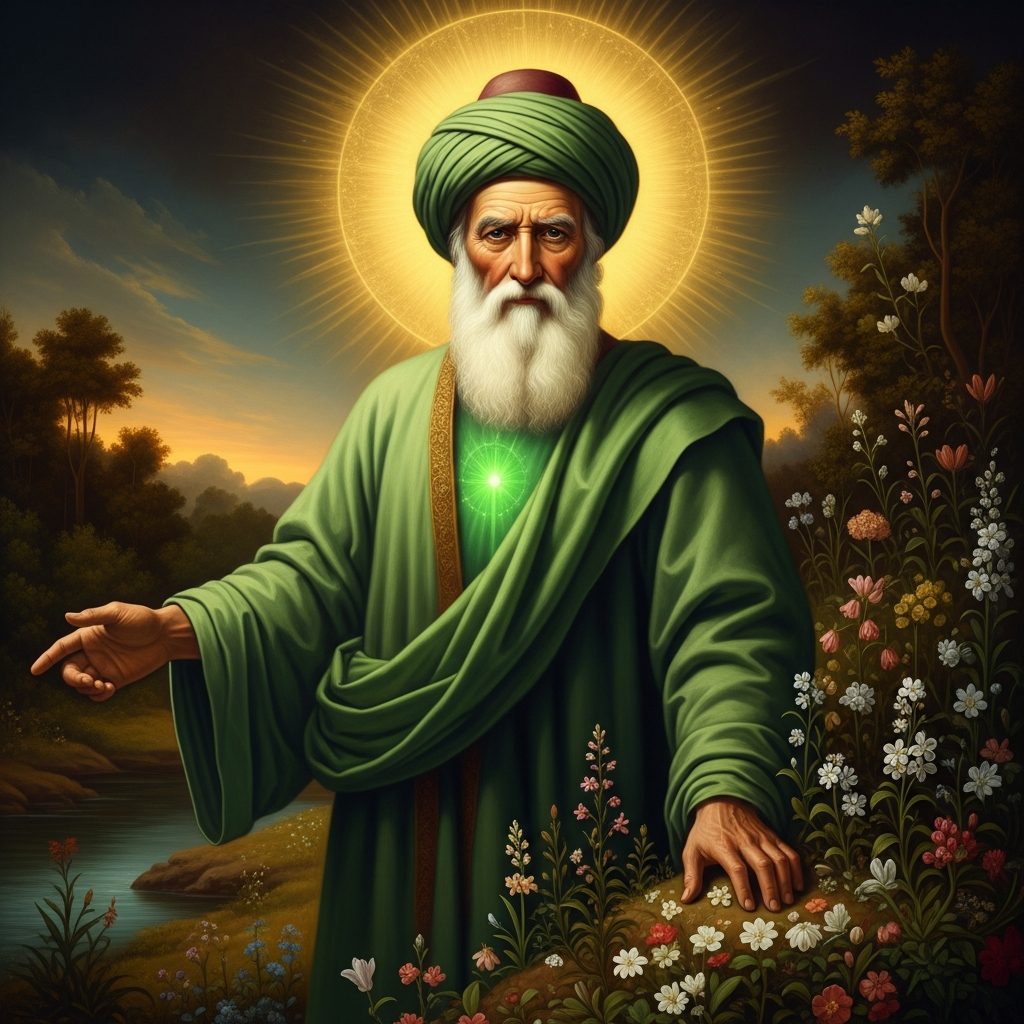
Al-Khidr (“the Green One,” sometimes Khizr) is the immortal guide of seekers, the patron of wanderers and mystics, the green-clad figure who appears at the crossroads of the soul. The Quran does not name him but tells his story in Surah al-Kahf (18:60-82), where Moses — the lawgiver — meets a “servant of God” possessed of knowledge from God’s own presence (ilm ladunni) and apprentices himself to him. Khidr scuttles a boat, kills a youth, repairs a wall — each act a violation of Moses’ law, each act revealing a hidden divine wisdom Moses cannot yet see. Sufi tradition identifies this servant as Khidr, who drank from the Fountain of Life and lives until the end of days, appearing to mystics in moments of crisis to grant initiation, to test, to guide.
Khidr stands outside the chain of formal masters. A Sufi can be initiated Uwaysi — through Khidr, without a living human shaykh — and many great saints (Ibn Arabi among them) reported such initiations. He is everywhere green: where his foot touches the earth, vegetation springs. He is the patron of fishermen, of travelers, of the lost.
Biblical Parallels: Khidr maps onto the figure of Melchizedek (Genesis 14, Hebrews 7) — a priest “without father or mother, without genealogy, without beginning of days or end of life” who appears, blesses, and vanishes. He also resonates with Elijah, who never died and who in Jewish tradition appears at the Passover seder, at every circumcision, at moments of redemption. Christian mystical tradition has parallels in the figure of John the Beloved Disciple (whom Jesus, per John 21:22, suggests will not die until the return) and in the tradition of the anonymi — the unknown saints. Meister Eckhart’s “spark of the soul” (Seelenfünklein), where God is known directly without mediation, mirrors Khidr’s ilm ladunni.
Cross-Tradition: Khidr corresponds to the immortal hidden guide across many traditions: Utnapishtim of Mesopotamia (the flood survivor granted eternal life in Gilgamesh), the Greek Tiresias, the Hindu Chiranjivi (immortals — Hanuman, Ashwatthama, Vyasa, Markandeya), the Tibetan bodhisattvas who refuse final nirvana to teach, and the Daoist xian (immortals). In the Western esoteric tradition he becomes the Comte de Saint-Germain and the Rosicrucian “unknown superiors.”
2 min read