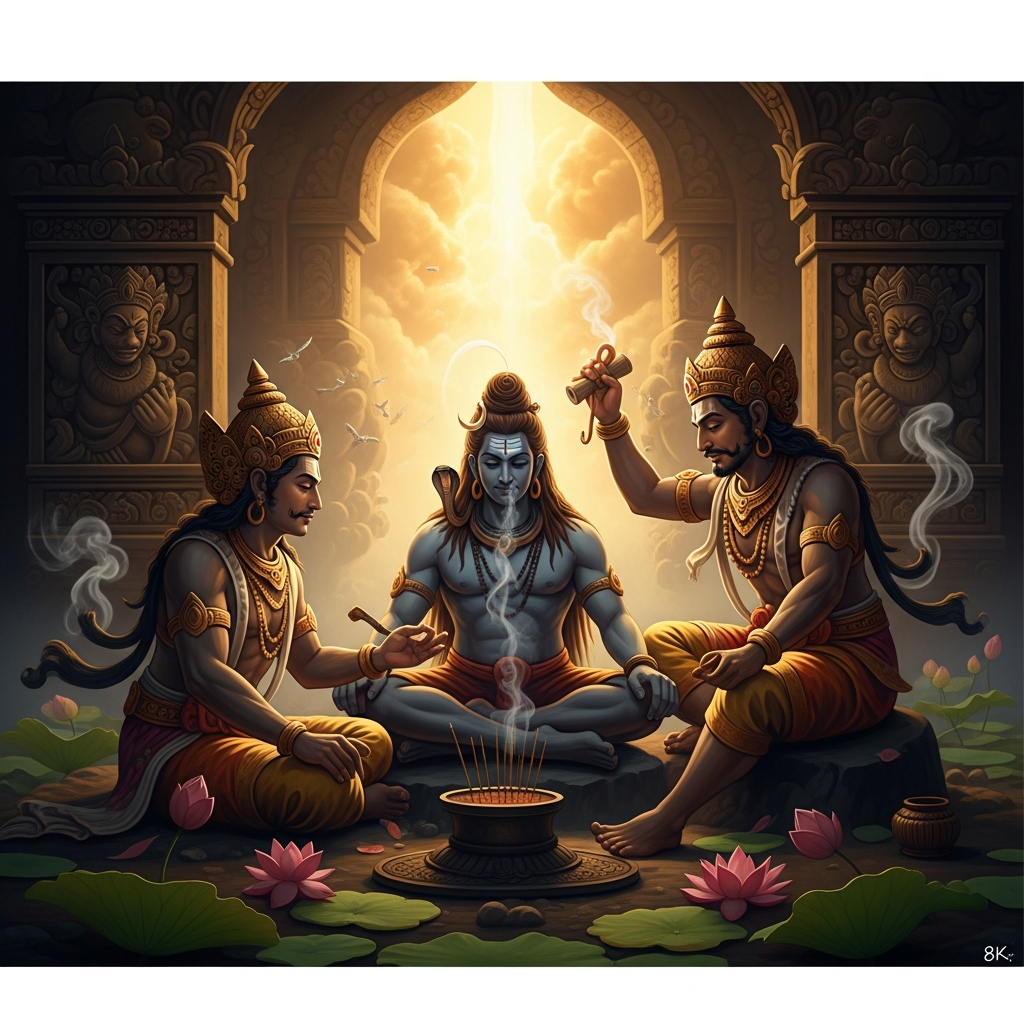
Arjuna's Solitary Meditation
Kakawin Arjunawiwaha composed by Mpu Kanwa c. 1035 CE, based on Mahabharata Aranyaka Parva · Mount Indrakila, Java; the heavenly realms
Contents
In the Javanese Kakawin Arjunawiwaha, Arjuna leaves the Pandava camp to meditate alone on a mountain before the great war — and is tested by Shiva disguised as a hunter, must fight a demon disguised as a boar, and ultimately receives the divine weapon Pasupati. The Javanese retelling transforms the Mahabharata's warrior into a contemplative hero.
- When
- Kakawin Arjunawiwaha composed by Mpu Kanwa c. 1035 CE, based on Mahabharata Aranyaka Parva
- Where
- Mount Indrakila, Java; the heavenly realms
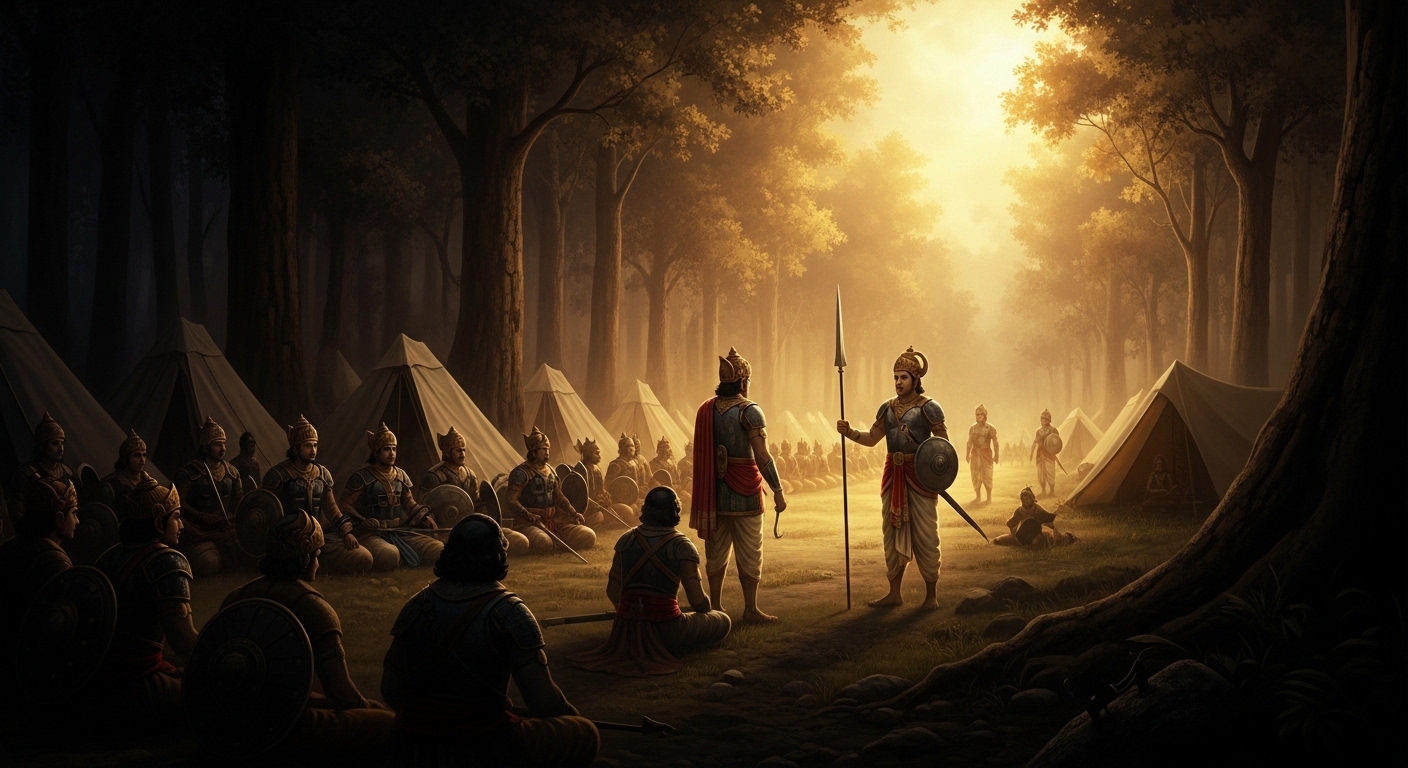
Arjuna walks away from the army.
The Pandavas are camped at the edge of the forest, preparing for the war that will settle everything — the war that every player knows is coming and that none of them can prevent. The weapons have been gathered. The alliances have been made. Dharma has been calculated and recalculated by advisors who always arrive at the same conclusion: the war is necessary.
Arjuna is the archer. He is the greatest warrior in the three worlds. He is also, in the Javanese reading of the Mahabharata, something more than a warrior: he is the man who must become fully himself before the war can be won, and the self he must become is not the self that wins by shooting accurately but the self that has gone deep enough into stillness to receive what the gods have to give.
He walks to the mountain.
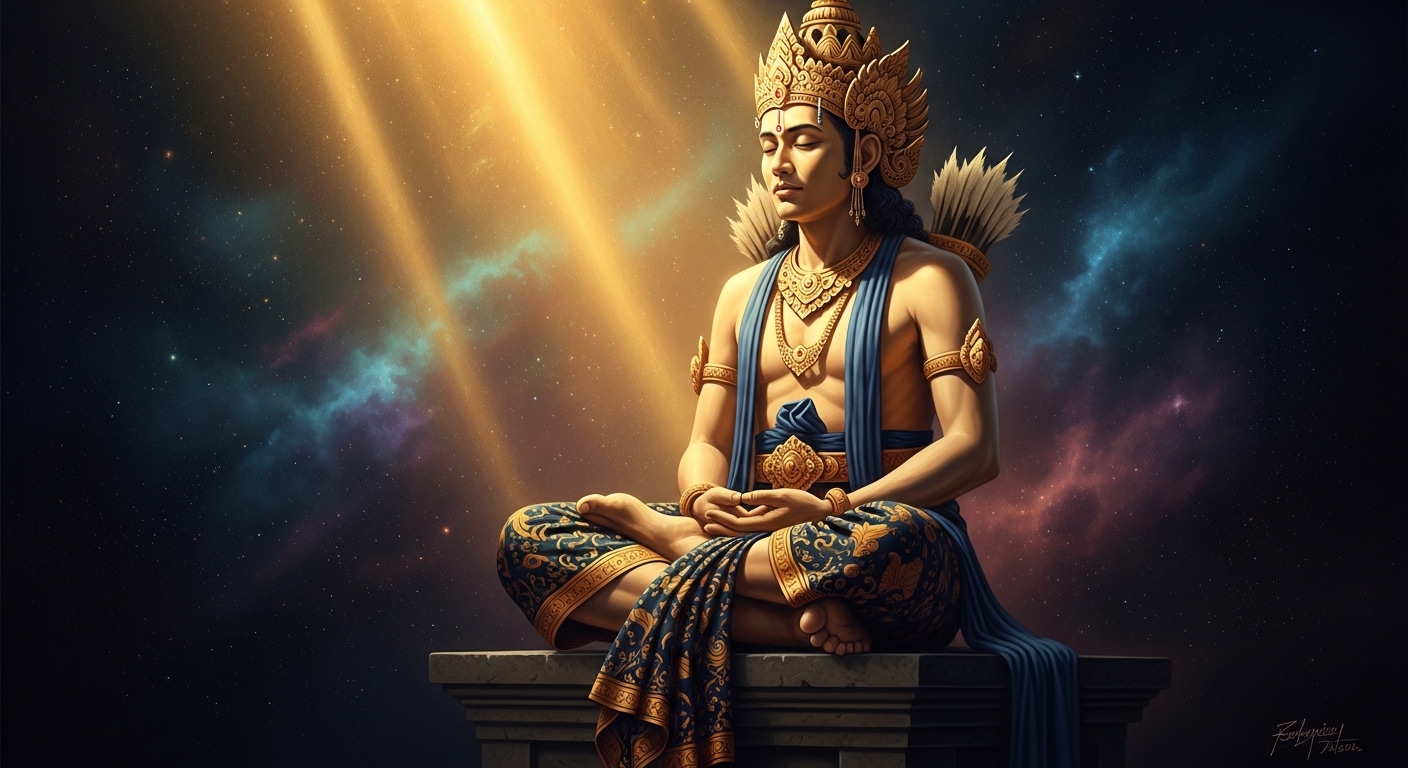
He walks without armor, without his bow Gandiva, without his companions. He walks as a man walks when he intends to meditate — carrying nothing, carrying himself lightly, carrying the intention of emptiness. He climbs Mount Indrakila, which in the Javanese tradition is understood as one of the cosmic pillars between heaven and earth, the kind of mountain where the boundary between the divine and the human thins to transparency.
He sits.
He meditates for what the text calls a long time.
The Javanese kakawin — the court poetry in which Mpu Kanwa wrote this story in the eleventh century, at the court of the East Javanese king Airlangga — is fastidious about the quality of Arjuna’s meditation. It is not the distracted effort of a man with war on his mind. It is genuine. The gods are moved by it. They are moved in the way that the gods are always moved by genuine human effort toward stillness: they want to test whether it is real.
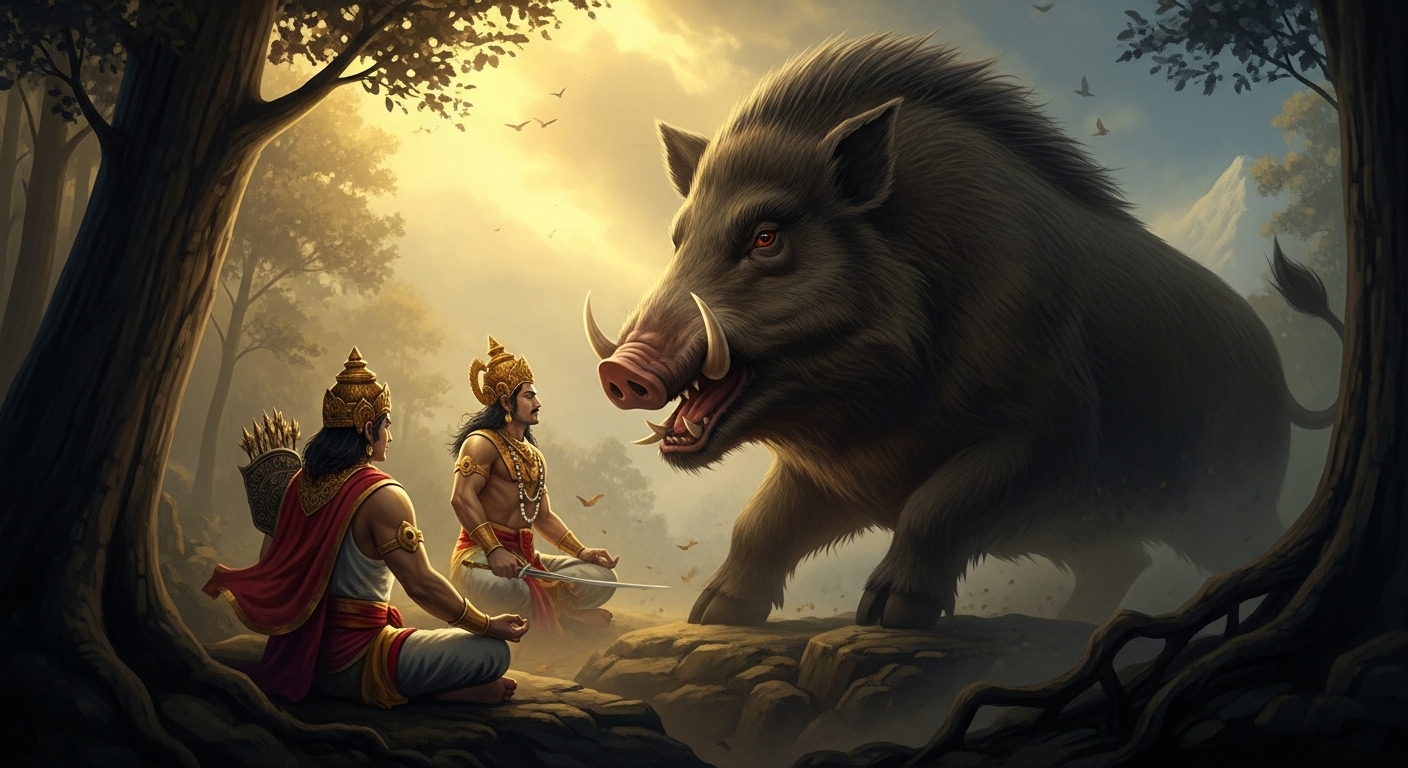
A demon appears.
He comes in the form of a wild boar — a massive animal, crashing through the forest at the base of the mountain, and Arjuna descends from his meditation to deal with it. He shoots the boar with an arrow. The boar falls. And then a hunter steps out of the forest, claiming the kill: my arrow struck it first.
The hunter is Shiva.
He is disguised as a man of the forest — in the Javanese telling, as a kirata, a mountain hunter, neither Brahmin nor warrior, a being outside the social categories that Arjuna usually operates within. His wife Uma stands beside him. They are completely convincing in their disguise. Arjuna, the greatest archer in the world, cannot imagine that he has missed a shot.
He disputes the claim. The dispute becomes a contest. The contest becomes a fight — and in the fight, Arjuna discovers that his arrows have no effect on the hunter. He breaks his bow across the hunter’s body and the bow shatters. He uses the stump as a club and the stump splinters. He throws himself at the hunter with his bare hands and is thrown down, thrown down again, thrown down again.
He kneels.
He kneels and makes a flower offering.
This is the moment the Javanese retelling is pointing toward. Not the combat — anyone can fight. The moment is the cessation of combat: the warrior who recognizes, in the middle of his defeat, that the fight is not what is being asked of him. He places the flowers before the hunter. The flowers settle on the hunter’s feet.
They rise to his face.
Shiva reveals himself.
The divine form that appears is the form that the Puranic literature describes: the blue throat, the third eye, the crescent moon in the matted hair, the tiger skin, the trident. Arjuna prostrates himself fully. He has been fighting god. He has been throwing himself at the infinite. The infinity was unharmed, but he is not unharmed: he is changed, as a person is changed by sustained contact with something that does not yield.
Shiva gives him the Pasupati.
The Pasupati is the most destructive weapon in the divine arsenal — the weapon that can end worlds, that is given only to the person who has proven, by the quality of their surrender, that they will use it correctly. It is given to Arjuna not because he is the greatest warrior but because he has just demonstrated that he knows when to stop fighting. The weapon that can end the world is given to the man who knows when not to use weapons.
This is the Javanese contribution to the Mahabharata’s portrait of Arjuna.
In Valmiki and Vyasa, Arjuna is magnificent and troubled — the famous crisis of the Bhagavad Gita, where he puts down his bow at the sight of his cousins across the field and must be counseled by Krishna into resuming the fight. The Sanskrit Arjuna is restored to warrior-nature by philosophical argument. The Javanese Arjuna is restored to warrior-nature by becoming, briefly, a meditator.
The two resolutions reveal two different understandings of what action is. For the Sanskrit tradition, right action follows from right understanding — the Gita is a philosophical dialogue. For the Javanese tradition, right action follows from right emptiness — the Arjunawiwaha is a story about what happens when you stop trying to be the greatest archer and simply sit on the mountain.
Mpu Kanwa was writing at the court of Airlangga, the king who unified East Java after a period of political fragmentation — a king who would have found the story of a warrior who must temporarily abandon his weapons before he can use them rightly to be personally resonant. The kakawin was also a royal allegory: the king is Arjuna, the mountain is the contemplative retreat that precedes good kingship, the weapon is the authority that can only be wielded by someone who has learned not to grasp for it.
The shadow puppets of Java still perform this story. Arjuna is white-faced in the wayang tradition — the color of refinement and spiritual aspiration — and his figure is slender and beautiful, nothing like the muscular hero of the Sanskrit tradition. He is the contemplative warrior. He wins by sitting still.
The mountain is still there, in the performance. Every time the dalang moves the puppet to the mountain, Arjuna is alone again, and the hunter is in the forest, and the test is just beginning.
Scenes
Echoes Across Traditions
Entities
- Arjuna
- Shiva / Batara Guru
- the demon Muka / Niwatakawaca
- the divine weapon Pasupati
Sources
- Mpu Kanwa, *Arjunawiwaha* (c. 1035 CE); trans. Stuart Robson, *Arjunawiwaha: The Marriage of Arjuna of Mpu Kanwa* (1971)
- P.J. Zoetmulder, *Kalangwan: A Survey of Old Javanese Literature* (1974)
- Jan Gonda, *Sanskrit in Indonesia* (1952)
- R.M. Ng. Poerbatjaraka, 'Arjuna-Wiwāha,' *Bijdragen tot de Taal-, Land- en Volkenkunde* 82 (1926)
- Mary Zurbuchen, *The Language of Balinese Shadow Theater* (1987) — on kakawin in performance