
Nāropa's Twelve Trials
c. 1016–1100 CE — 11th-century India, Bengal and Bihar regions · Nalanda University, Bengal, and the wandering roads of northern India — palace schools, burning ghats, river fords, jungle hermitages
Contents
The renowned scholar Nāropa abandons his post as abbot of Nalanda to find his true teacher Tilopa, and is led through twelve impossible tests of devotion — each one a parable about the difference between understanding and realization.
- When
- c. 1016–1100 CE — 11th-century India, Bengal and Bihar regions
- Where
- Nalanda University, Bengal, and the wandering roads of northern India — palace schools, burning ghats, river fords, jungle hermitages
He knows everything. That is the problem.
Nāropa holds the chair of the northern gate at Nalanda, the greatest Buddhist university in the world. Nalanda in the eleventh century is what Alexandria was to Mediterranean learning four centuries earlier: the place where every significant tradition in Buddhist thought is preserved, contested, and transmitted. Nāropa has mastered them all — Madhyamaka, Yogacara, the Abhidharma, the Prajnaparamita, the tantric cycles. His debates are legendary. Students come from Tibet and China and Southeast Asia to hear him lecture on the nature of mind.
A hideous old woman appears to him one afternoon while he is reading a text.
She asks: do you understand the words of this text? He says yes. She laughs with extraordinary pleasure. Then she asks: do you understand the meaning? He begins to say yes — and stops. He looks at her. He says: no.
She transforms. In the transformation she is not a demon but a message — a compressed instruction from his true teacher, carried in the form no one would choose to carry it. She tells him where to find Tilopa, who lives outside any institution, who moves through the world’s margins.
Nāropa abandons the northern gate chair of Nalanda. He walks south.
Tilopa does not make it easy. He is, when Nāropa finds him, sitting beside the road eating living fish. He stinks. He seems unaware of Nāropa’s existence, and when Nāropa bows and announces himself, Tilopa says: so? Nāropa asks for teaching. Tilopa says: help me with the fish first.
The twelve trials are not a curriculum. They have no logical sequence. They follow a different logic — the logic of whatever habit or obstruction in Nāropa happens to be the most subtle resistance to realization at that moment. The first trial requires him to jump from a cliff. He survives because Tilopa heals him. He does not understand why he jumped. He jumped because Tilopa pointed and he jumped, and the teaching in that is something he cannot yet articulate.
Other trials involve acting against social norms so severe that even his intellectual understanding of non-attachment cannot justify them. Tilopa sends him to steal food from a wedding feast. Tilopa sends him to seduce a woman who turns out to be a queen. Tilopa asks him to cut open a corpse and eat the contents. Each time Nāropa does it and is left with nothing but the action and its consequences — no explanation, no reframing, just the raw fact of having done the thing a scholar from Nalanda could never have imagined doing.
Each time, at the end of the trial, Tilopa heals him and moves on without comment.
The twelfth trial is the one that completes the work.
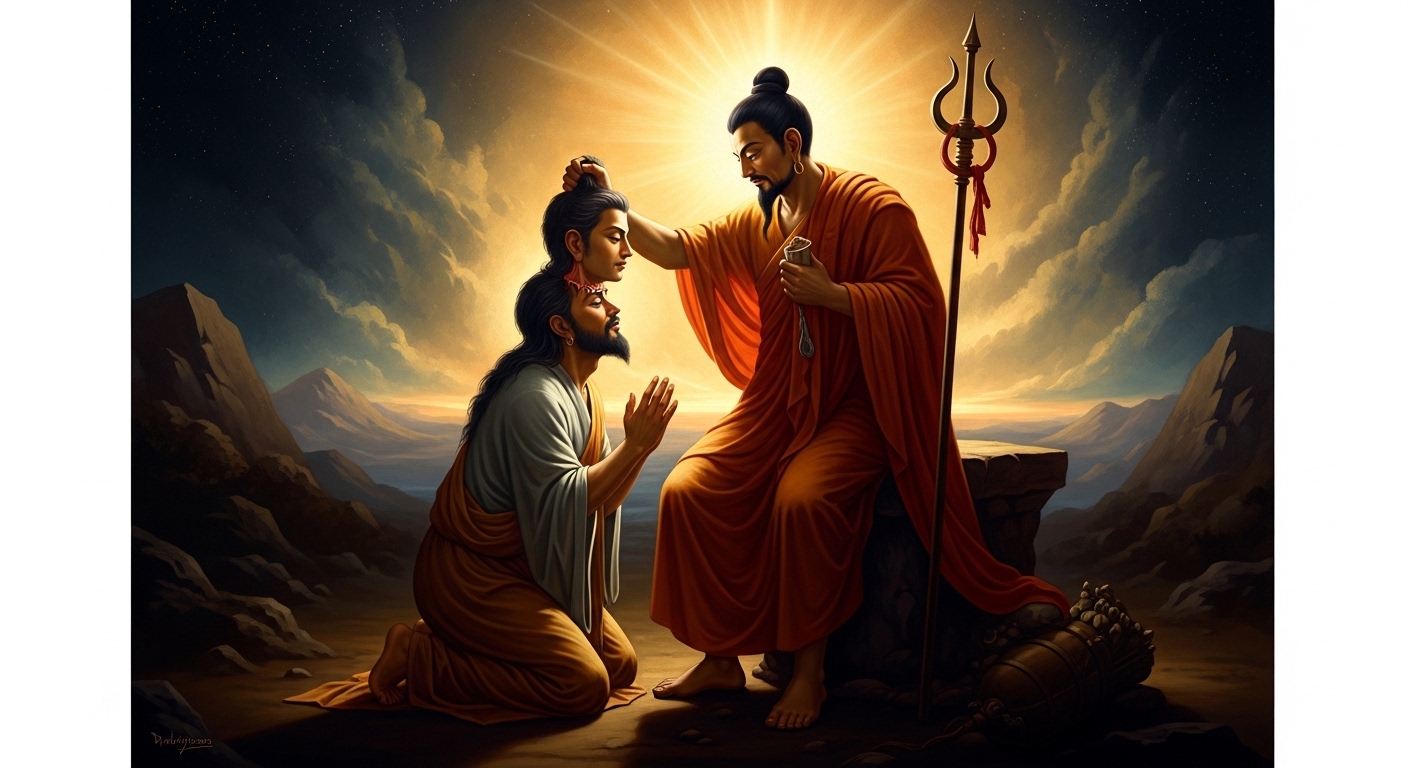
Tilopa takes off his sandal and strikes Nāropa across the face. The blow is firm. Nāropa falls. He experiences what the accounts describe as a complete cessation of ordinary consciousness — and then, in the space after it, a recognition. Not a new recognition: the recognition of something that was always there, obscured by twelve centuries of learning.
He comes back to consciousness. Tilopa is sitting beside him in the ordinary way. The sandal is in his hand. He says nothing. He doesn’t need to.
Nāropa is now a siddha. Not because of the blow — the blow was only the last key in a sequence of eleven locks — but because the twelve trials together accomplished what the northern gate chair at Nalanda could not: they emptied him of the identification with his own understanding. The scholar who knows the words had to be separated from the knower who can transmit the meaning. The separation required twelve trials and a sandal in the face.
He passes the teachings to Marpa the Tibetan. Marpa carries them over the Himalayas. Marpa gives them to Milarepa. The chain holds.
What Tilopa pointed to with the sandal, and with the fish, and with the cliff — the same thing the hideous old woman pointed to with her question — is the nature of mind, direct, unmediated, not found in any text. Nāropa spent years in Nalanda not finding it, and one afternoon beside a road in Bihar, eating stolen fish with a stinking lunatic, finding it.
Scenes


Echoes Across Traditions
Entities
- Nāropa
- Tilopa
- the dakini who appears as a hideous old woman
Sources
- Herbert Guenther, trans., *The Life and Teaching of Naropa* (Oxford University Press, 1963)
- Chogyam Trungpa, *Illusion's Game: The Life and Teaching of Naropa* (Shambhala, 1994)
- Reginald Ray, *Indestructible Truth: The Living Spirituality of Tibetan Buddhism* (Shambhala, 2000)