The Soul's Seven Stages from Enemy to Beloved
9th–14th century CE — the gradual elaboration of nafs psychology across the classical Sufi period · Baghdad, Khurasan, Central Asia — the centers of Sufi psychological thought
Contents
The Sufi psychology of the nafs — the lower self, the ego-soul — maps the soul's journey through seven stages from the commanding self that drives toward destruction to the soul at rest that has returned to God, a map more psychologically precise than any modern personality theory.
- When
- 9th–14th century CE — the gradual elaboration of nafs psychology across the classical Sufi period
- Where
- Baghdad, Khurasan, Central Asia — the centers of Sufi psychological thought
The Quran names the soul in three registers.
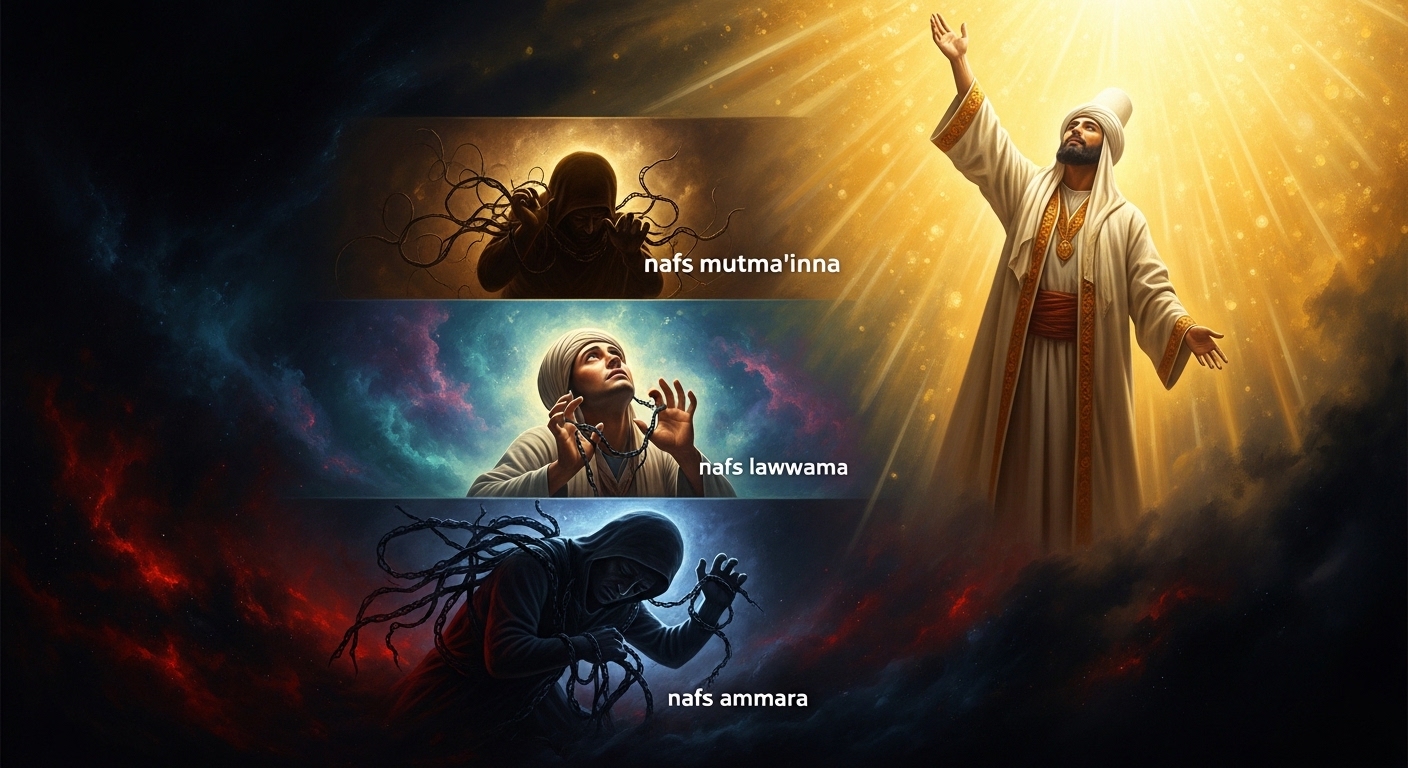
An-nafs al-ammara bil-su’ — the commanding self, the soul that commands evil, that drives toward its own appetites without reference to God or others. An-nafs al-lawwama — the blaming self, the conscience, the soul that condemns itself. An-nafs al-mutma’inna — the soul at rest, the soul that has returned to God and been told enter among My servants, enter My paradise.
Three stages. The Sufi tradition, working from these three foundations and from the extensive psychological observation of eight centuries of practice, elaborated seven.
The first stage: Nafs al-Ammara — the Commanding Self.
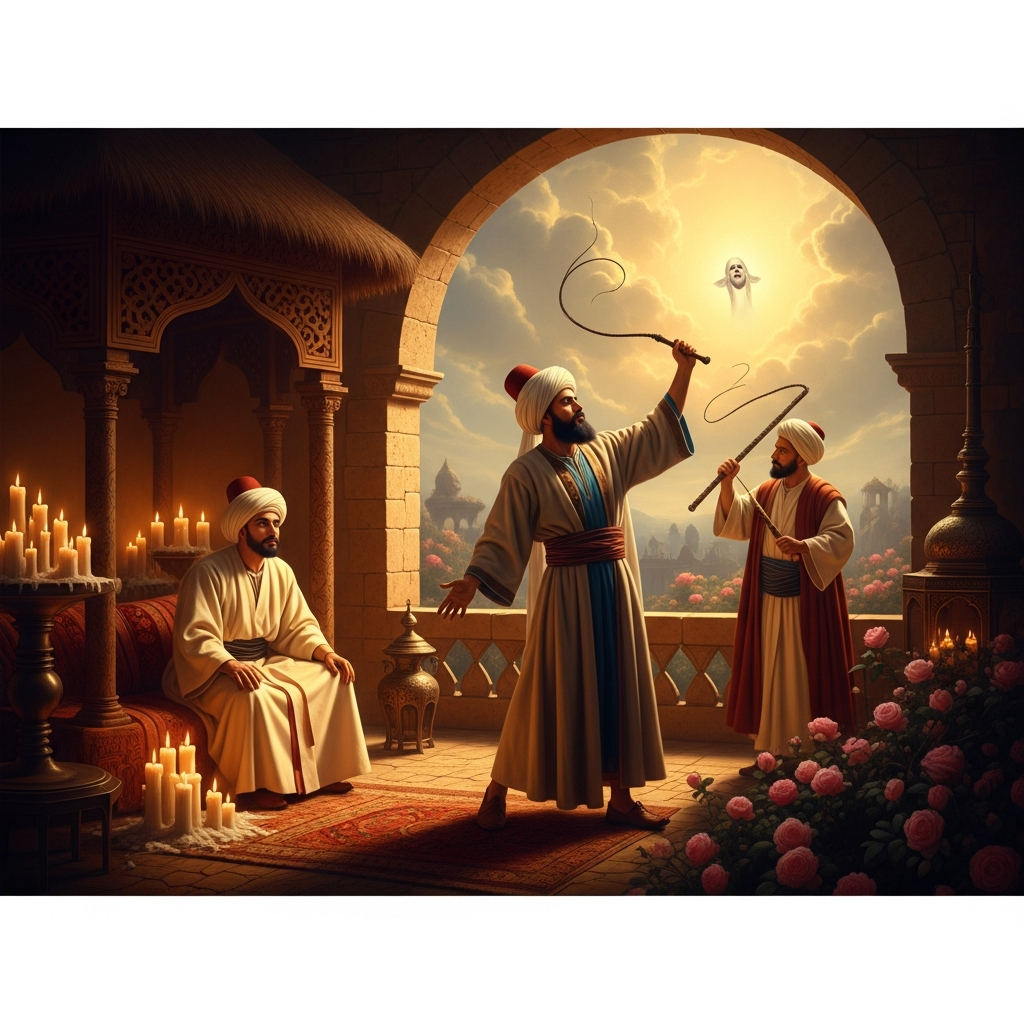
This is the ego in its unreconstructed form. It commands. It drives. It wants, and it wants without self-reflection. Every appetite — food, sex, status, security, revenge — is pursued directly, without the mediating voice that says is this what I should be? The commanding self is not evil in the simple sense. It is pre-moral. It has not yet discovered that there is a question to ask about its own commands.
Most people live here most of the time. This is not condemnation. It is description.
The second stage: Nafs al-Lawwama — the Blaming Self.
The soul discovers conscience. It acts, and then it knows it has acted wrongly, and it blames itself. This is more painful than the first stage and spiritually more advanced. The person in the first stage does not suffer from their selfishness. The person in the second stage suffers acutely — the conscience’s friction is constant. Repentance (tawba) arises here. The desire to be different arises here.
The third stage: Nafs al-Mulhama — the Inspired Self.
The soul begins to receive direct intuitions about right action — not through reasoning, but through a sense that is deeper than reasoning, a faculty that registers what is consistent with one’s deepest nature. This is the beginning of the opening toward divine guidance. The soul is still weak at this stage, still pulled by the appetites of the first stage, but now has access to a guidance that the first two stages did not have.
The fourth stage: Nafs al-Mutma’inna — the Soul at Rest.
This is the Quran’s third nafs, here placed in the fourth position in the seven-stage elaboration. The soul has achieved sufficient stability in its orientation toward God that ordinary temptations no longer produce the anguish they produced in the second stage. The soul rests in the direction it has chosen.
The fifth stage: Nafs al-Radiyya — the Pleased Self.
The soul is pleased with God — not because God is giving it what it wants, but because the soul no longer wants what God is not giving. The will has aligned with the divine will to a degree that contentment is no longer dependent on outcome. What happens is good, not because it is pleasant, but because it comes from God and God’s giving is entirely trustworthy.
The sixth stage: Nafs al-Mardiyya — the Self That Pleases God.
The reversal: now it is not only that the soul is pleased with God but that God is pleased with the soul. The soul has become so transparent to divine intention that its actions, arising from its deepest nature, are consonant with divine will. This is not perfection in the sense of flawlessness. It is alignment in the sense of direction — the soul’s face is fully turned.
The seventh stage: Nafs al-Safiyya — the Pure Self, or sometimes Nafs al-Kamila — the Complete Self.
This is the stage the tradition describes only in paradox. The self that has been purified is no longer the self it was. It is not annihilated — it is present, particular, still embodied — but it is no longer running on the fuel of its own appetite or self-protection. It acts from a source that is not personal. It sees with eyes that have been cleaned of the film of self-interest. It is the soul the Prophet was describing when he said die before you die — not the end of the person, but the end of the person’s separation from their origin.
The soul that began the journey as its own enemy has become the divine Beloved’s home.
The commands are no longer the soul’s commands.
They are the only commands.
Scenes

Echoes Across Traditions
Entities
- The Quran's three nafs formulations
- Al-Ghazālī
- Attar
- Naqshbandi masters
Sources
- Al-Ghazālī, *Ihya Ulum al-Din*, Books 21-40 on the soul's qualities
- Attar, *Conference of the Birds*, especially the Valley of the Self
- Naqshbandi tradition's elaboration of the seven nafs stages
- Laleh Bakhtiar, *Sufi: Expressions of the Mystic Quest* (Thames & Hudson, 1976)