The Bodhisattva Who Could Not Leave: Avalokiteshvara's Vow
Cosmological time · Lotus Sutra composed 1st century CE · Karandavyuha 4th–5th century CE · The Pure Land of Amitabha · The six realms of existence
Contents
Avalokiteshvara stood at the threshold of nirvana — total liberation, the end of all suffering — and turned back. The cries of suffering beings rose up from every realm of existence and the bodhisattva heard them all and made a vow: not until every single being was free. That vow shattered him, and from the pieces something greater was assembled.
- When
- Cosmological time · Lotus Sutra composed 1st century CE · Karandavyuha 4th–5th century CE
- Where
- The Pure Land of Amitabha · The six realms of existence
The problem with perfect compassion is that it cannot look away.
Avalokiteshvara — “The Lord Who Gazes Down” — had nearly completed the path. In the Buddhist cosmology, the path ends at nirvana: the complete extinction of craving and suffering, the dissolution of the illusion of a separate self into the unconditioned. It is not annihilation. It is freedom of a kind that is very difficult to describe in the language of people who have not experienced it. The tradition uses terms like “unborn” and “uncreated” and “undying,” which communicate less by content than by negation: what nirvana is not.
From the threshold, Avalokiteshvara looked back.
The six realms of existence spread below like a map of everything that had ever been in pain. The hells, where beings burned or froze in proportion to what they had done. The realm of hungry ghosts, with their huge distended bellies and their needle-thin throats, who could never be full. The animal realm, where consciousness was present but narrow. The human realm — unique in its balance of suffering and intelligence, the only place where the path could be walked. The realm of the titans, the asuras, perpetually at war. The highest realm of the gods, where pleasure was so extreme it produced its own blindness.
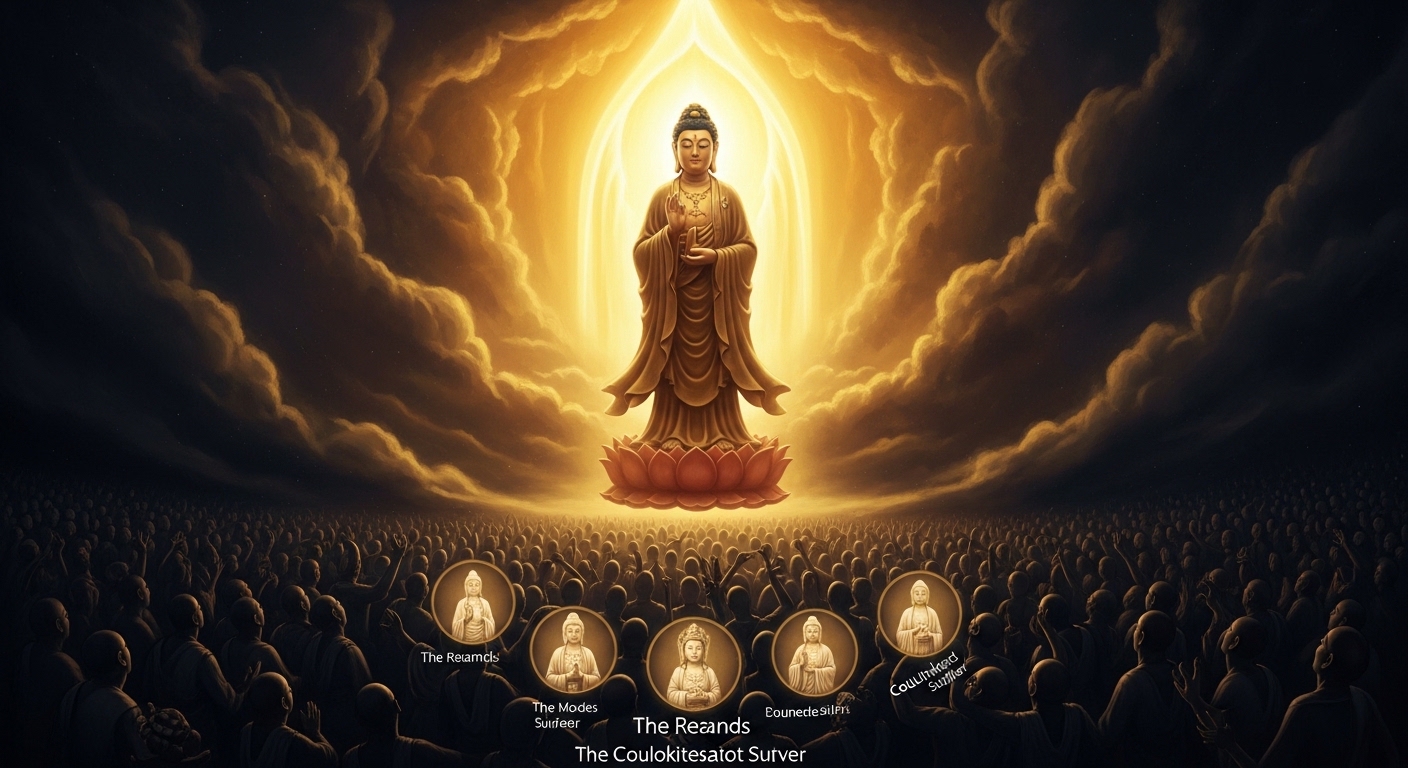
In all of them, beings were calling out.
Not metaphorically. The Karandavyuha Sutra is specific: the bodhisattva heard the actual sound of actual beings in actual distress, from each of the six realms, simultaneously. There is a name for this kind of hearing in the Chinese tradition: Guanyin, “She Who Hears the Cries of the World.” The name became a different entity — female, merciful, holding a willow branch and a vase of pure water — but the listening is the same. The hearing that precedes the turning back.
Avalokiteshvara made the vow.
Not until every single being was free. Not until the last hungry ghost had eaten, the last hell-dweller had cooled, the last being in the last realm had crossed to the other shore. The bodhisattva would remain in the cycle. Would take birth again and again in whatever form was needed. Would appear as a god to those who needed a god, as a woman to those who needed a woman, as a demon to those who needed a demon to recognize themselves in, as a simple human being to those who needed only to be heard by another simple human being.
Would not leave.
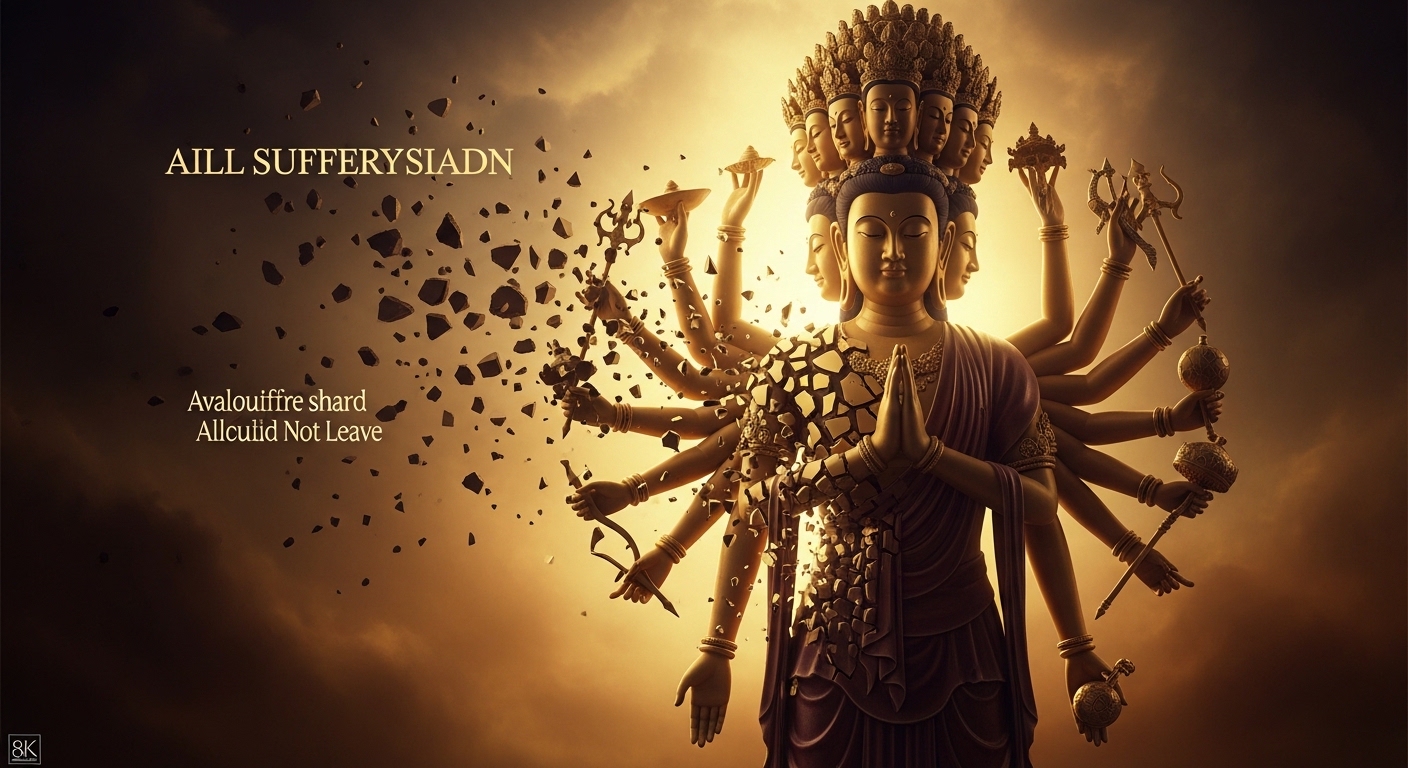
The sutras say that Avalokiteshvara’s body shattered.
This is not metaphor. The Karandavyuha describes it literally: the weight of the suffering heard in that moment — the full accumulated mass of all beings in all realms — was too great for a single form to contain. The bodhisattva’s body broke into a thousand pieces.
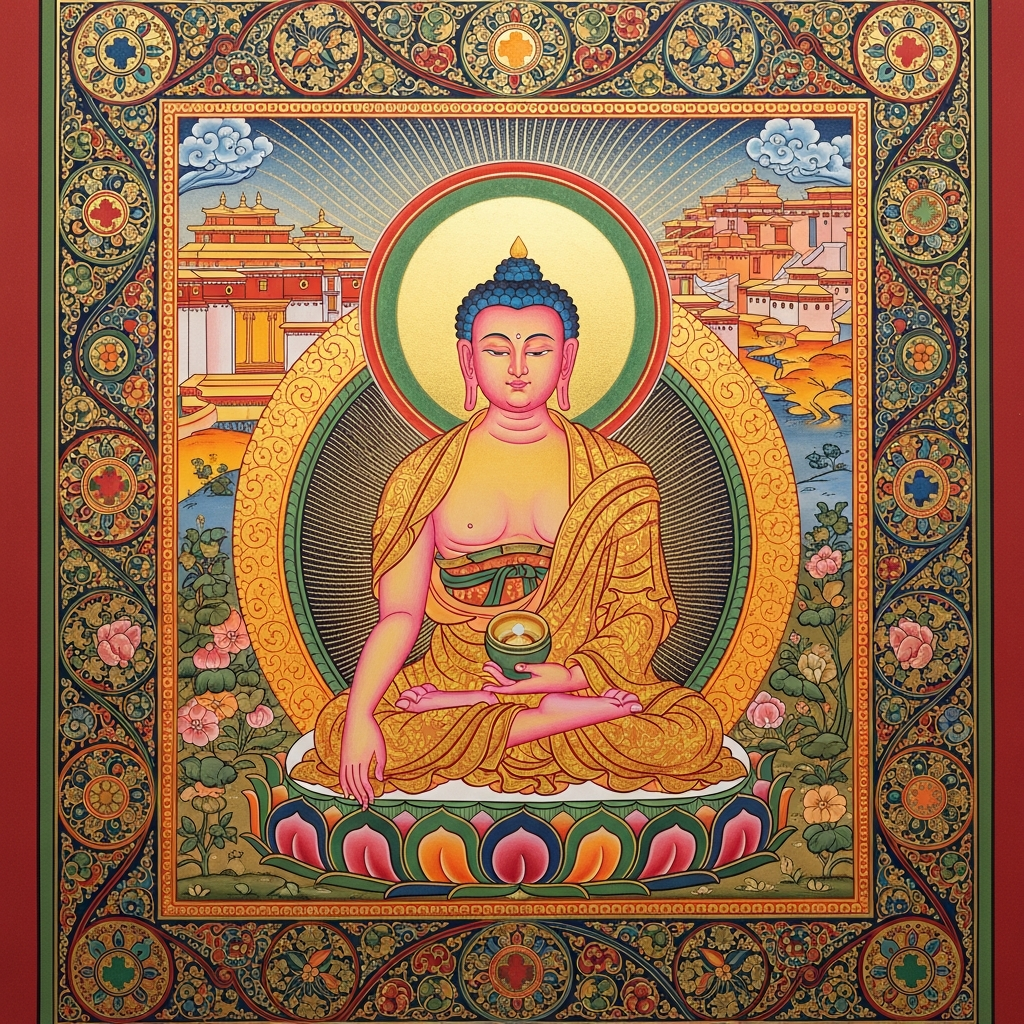
Amitabha, the Buddha of Infinite Light, who presides over the Pure Land, assembled the pieces into something that could contain what needed to be contained.
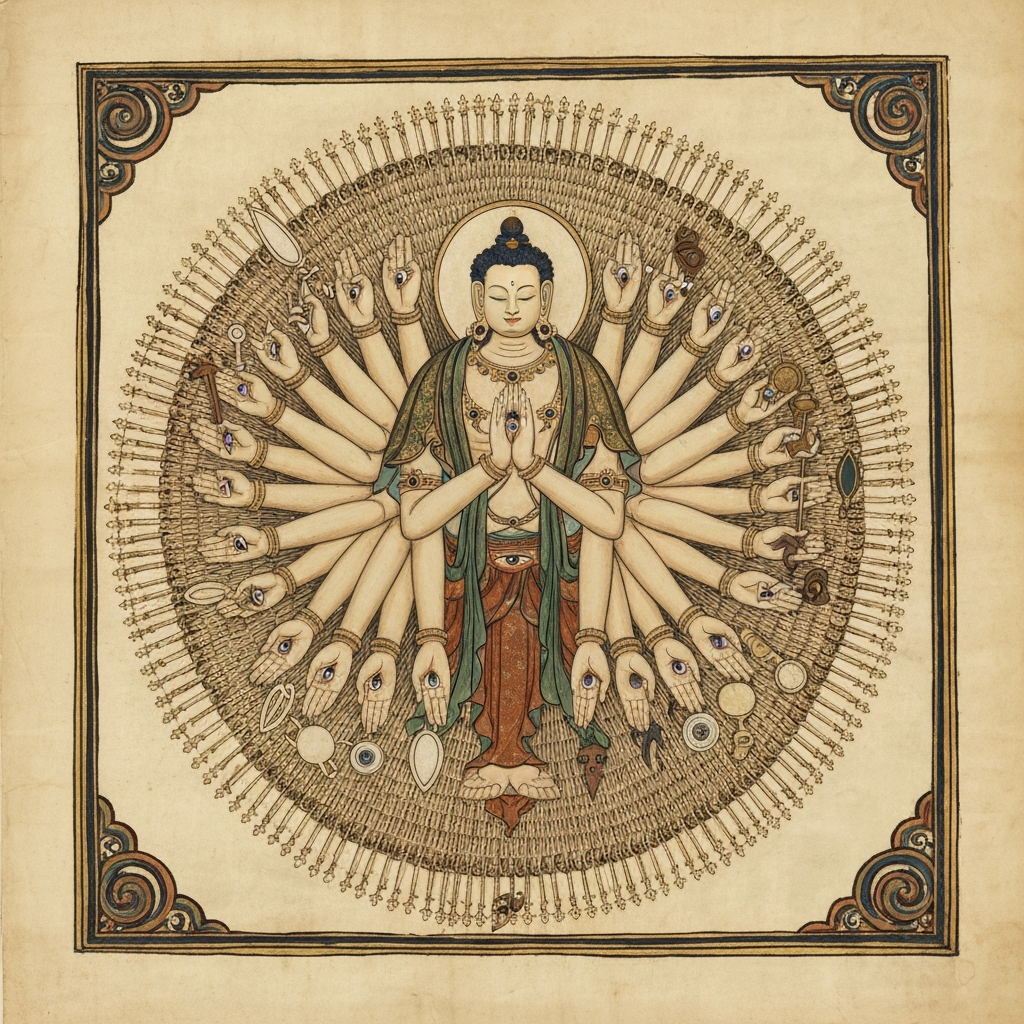
Eleven faces, each turned in a different direction so that no cry could be behind Avalokiteshvara’s head and unheard. A thousand arms, each with an eye in the palm, each holding a different implement — a rope for the drowning, a vase for the thirsty, a lotus for the pure, a sword for the necessary cut, a bowl for the hungry, a jewel for the desperate. Not an excess of anatomy but a diagram of response: this is what it looks like to be genuinely available to every kind of need at once.
The shattering was not failure. It was transformation into adequacy.
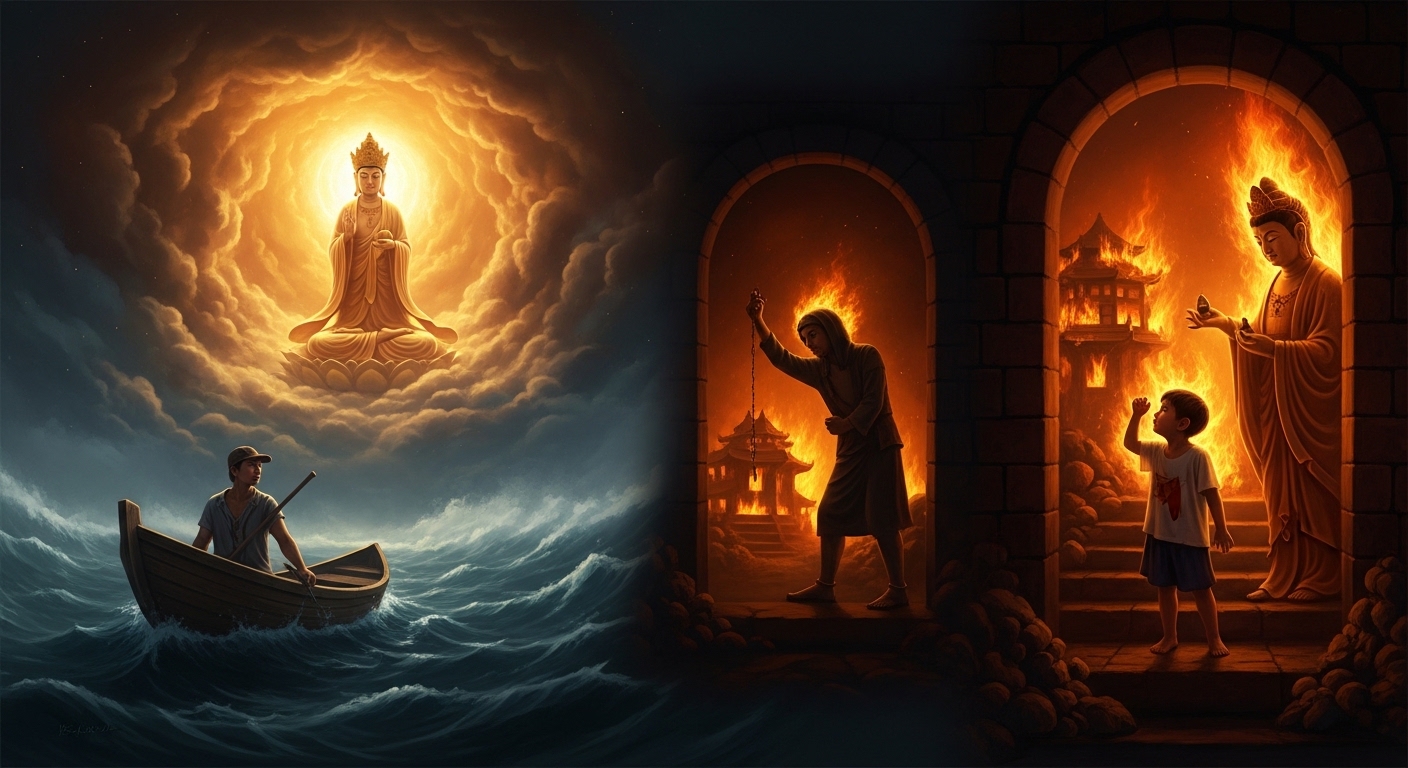
The Lotus Sutra’s Chapter 25 is the most widely recited text about Avalokiteshvara in East Asian Buddhism, and it reads like a protection list. If you call the name in a burning building, the fire will not burn you. If you call it sinking in the ocean, you will not drown. If you call it in prison, the chains will fall away. If you call it surrounded by enemies, their weapons will break. If you call it in a storm, the storm will break.
This is not magic, exactly, in the way European traditions tend to think about magic. It is the direct consequence of the vow: since the vow was unlimited, the response is unlimited. The bodhisattva who vowed to hear every cry will hear every cry. The mechanics of response follow from the commitment, not from arbitrary power.
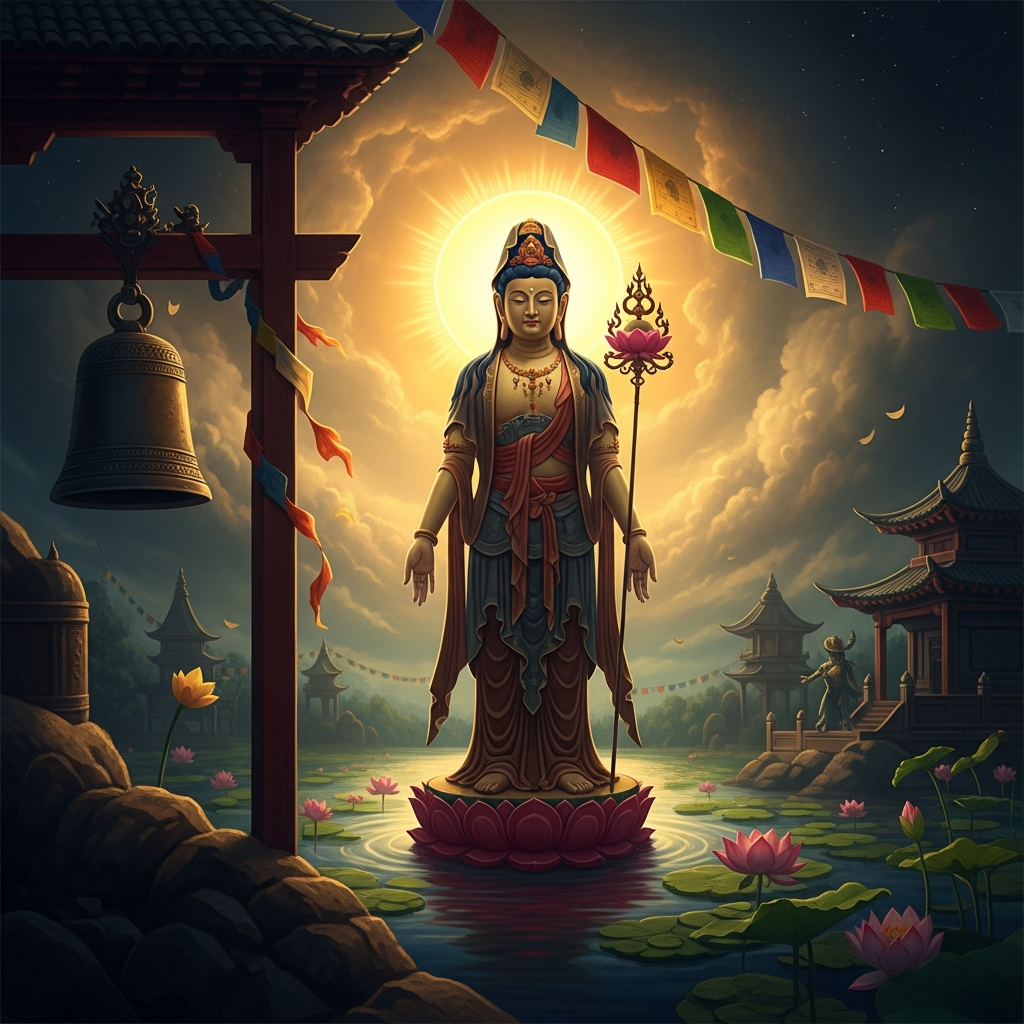
In the Chinese tradition, this response manifested as a female figure: Guanyin, Goddess of Mercy, standing on a lotus above the South Sea, her white robes catching light, her expression not of pity but of recognition. Pity looks down. Recognition looks across. Guanyin looks across.
There is a koan-like question buried in the story.
If Avalokiteshvara is wise enough to be at the threshold of nirvana, the bodhisattva understands clearly that all suffering arises from the illusion of a separate self. The hungry ghost is not truly hungry — what suffers is a misunderstanding of the nature of the self. The being in hell is not truly burning — what burns is attachment.
And yet the vow is not to correct the misunderstanding from outside. The vow is to stay inside the misunderstanding with the beings who are caught in it and to be present with them in their suffering until they themselves understand.
This is the difference between the teacher who tells and the bodhisattva who stays. The instruction is not delivered and left. The bodhisattva remains for as long as the suffering does, not because the suffering is ultimately real, but because the being suffering it is.
The eleven faces turn in all directions.
Every cry is heard.
None of the arms that reach down have decided to stop reaching.
Scenes
Echoes Across Traditions
Entities
Sources
- Lotus Sutra, Chapter 25 (Avalokitesvara Bodhisattva Universal Gateway)
- Karandavyuha Sutra (the fullest account of Avalokiteshvara's origin and the shattering)
- Heart Sutra (Avalokiteshvara teaches Shariputra the emptiness of phenomena)
- Guanyin (China) traditions from the 5th century CE onward