Contents
Ḥāfiẓ of Shiraz writes poems in which wine is divine love, the tavern is the Sufi lodge, the beloved's face is God, and the pious are fools — and for six hundred years readers have argued about whether he means it literally or metaphorically, a question he designed the poems to prevent from being answered.
- When
- c. 1320–1390 CE — Shiraz, Persia, under the Muzaffarid dynasty
- Where
- Shiraz, Fars province, Persia — the city of roses, wine, nightingales, and Persian lyric poetry
The poem begins with wine and ends with God and you cannot find the seam.
This is the achievement. Ḥāfiẓ has been writing ghazals in Shiraz for twenty years by the time his reputation reaches the court of Shah Shuja, and what defines the poems is not their beauty, though they are beautiful, and not their music, though they are among the most musical poems in any language. What defines them is their double floor. Every poem stands on two levels simultaneously, and when you step on either level you discover you are also on the other.
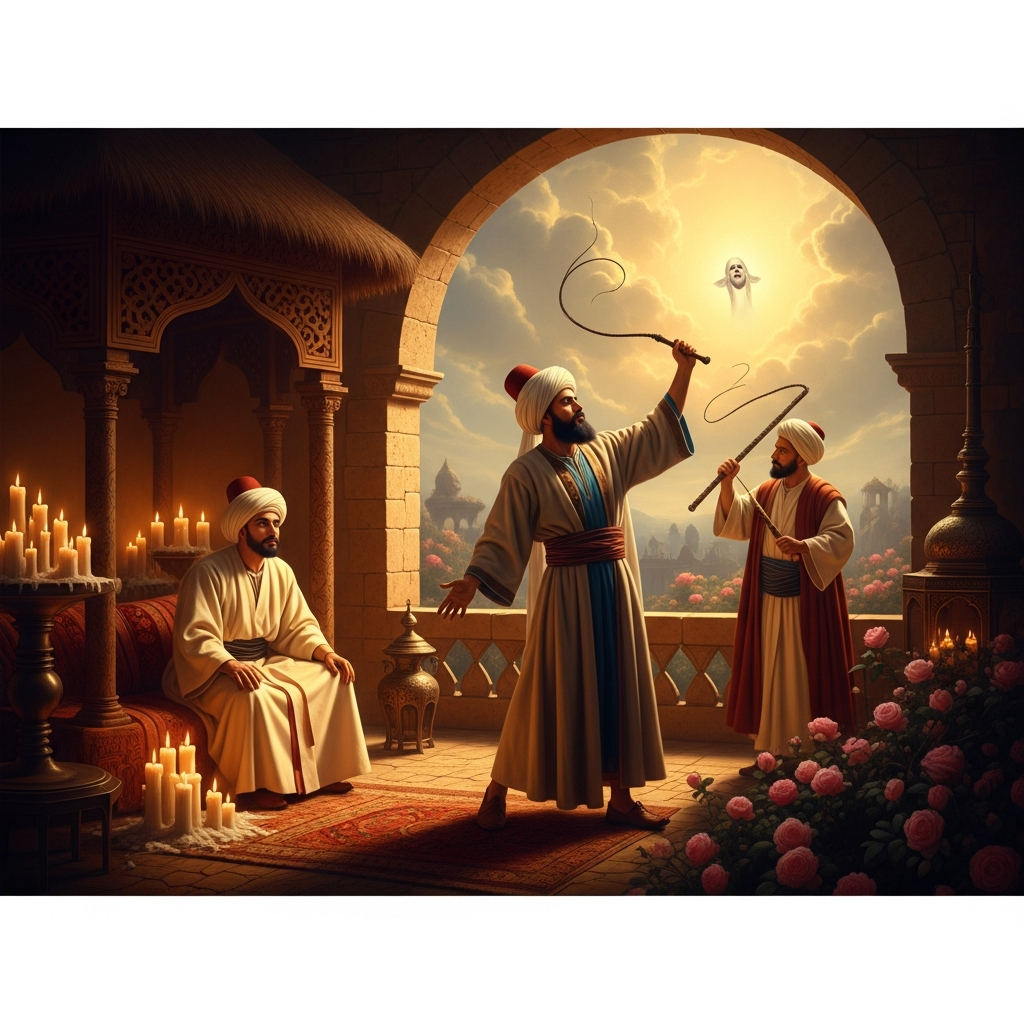
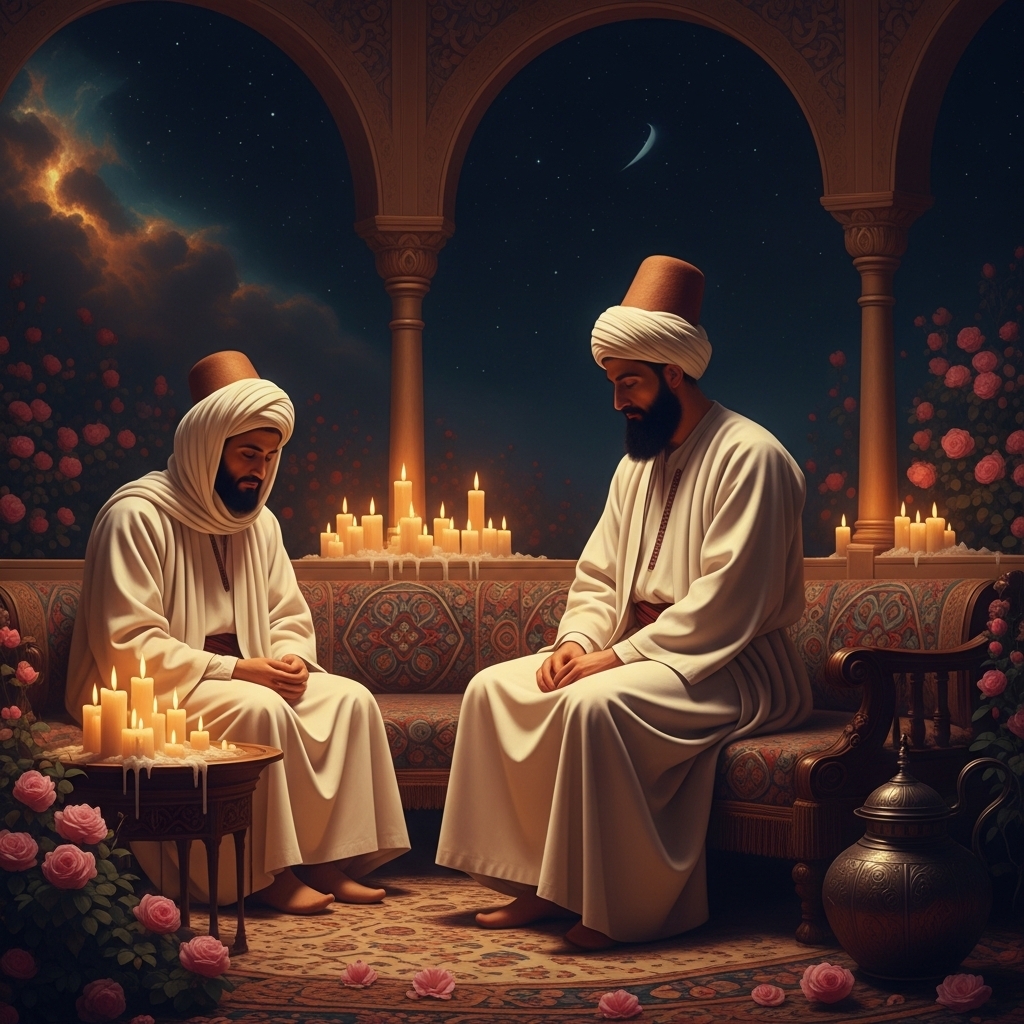
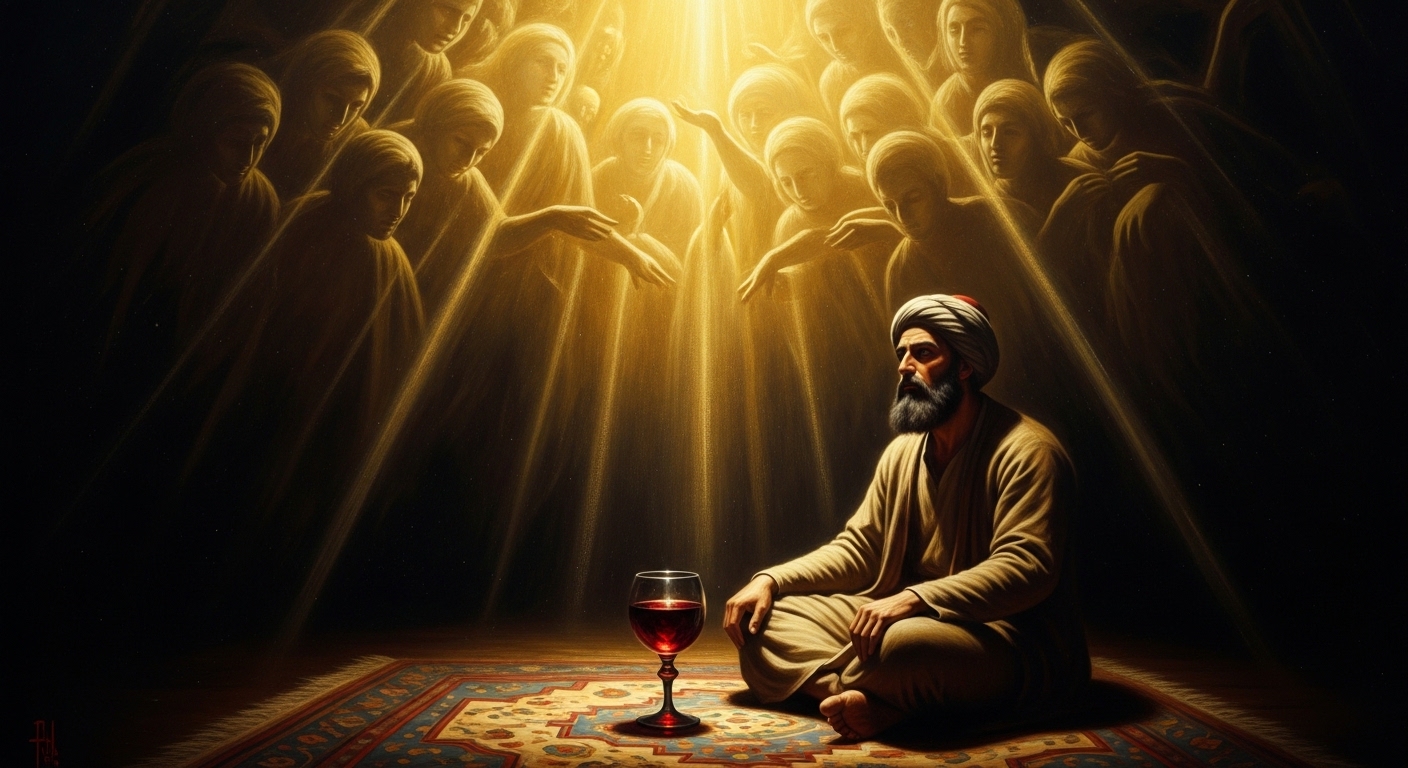
He writes: Last night from the wine-house came the scent of the morning breeze — the cup-bearer, rosy-cheeked, brought the wine of the night before. Is this a man describing a morning after a night of actual drinking? Is this a Sufi describing the moment before dawn prayer when the divine presence is most accessible, described in the conventional vocabulary of mystical poetry where wine is ecstasy and the cup-bearer is the master? The poem will not tell you. It will accept either reading and reward both.
The traditional Sufi interpretation insists: everything literal is metaphorical.
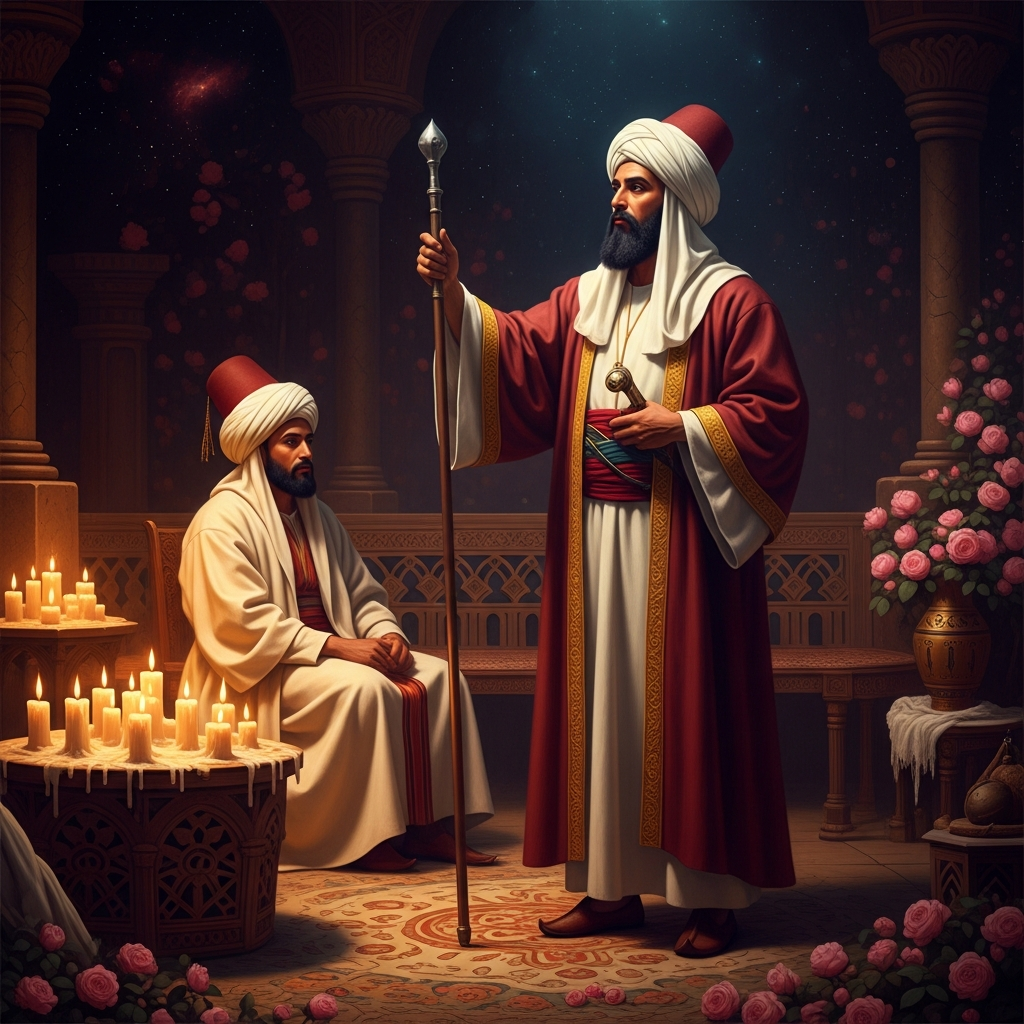
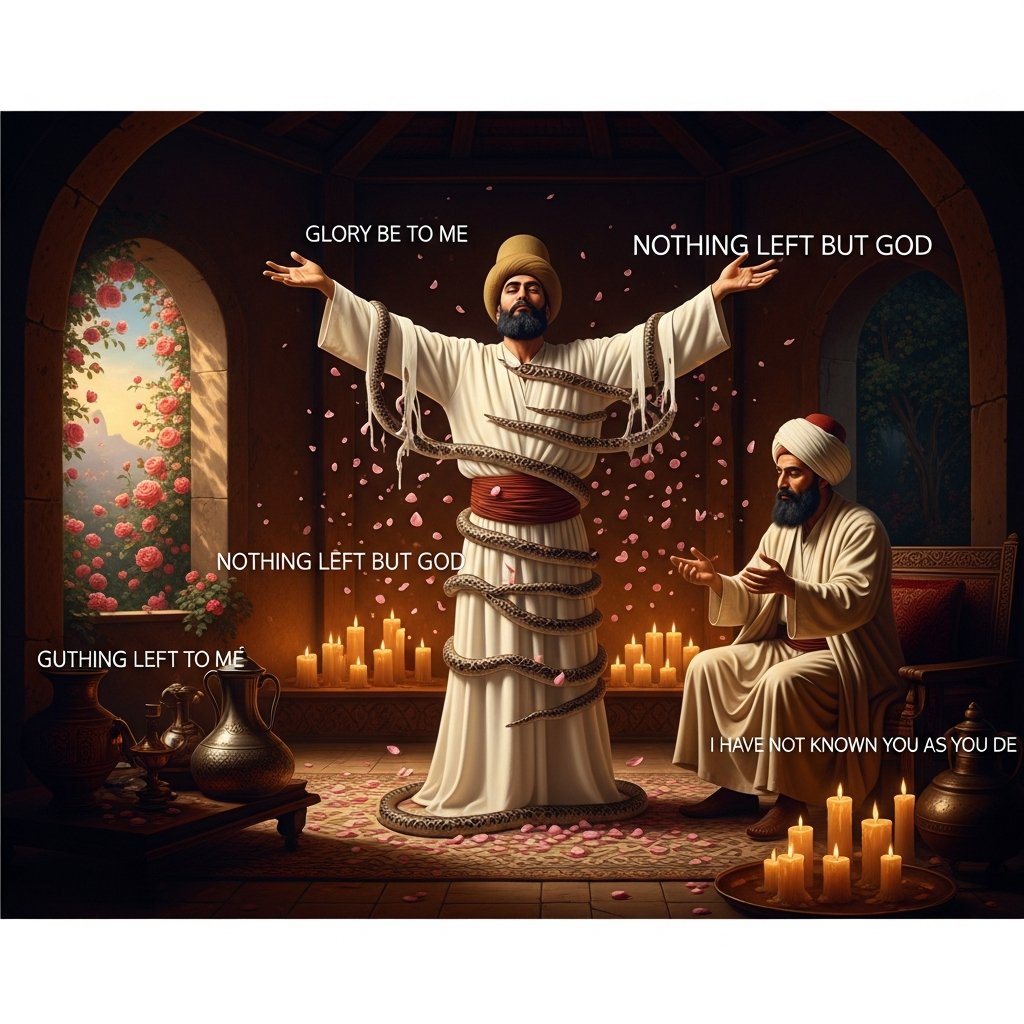
In this reading, the tavern is the khanqah, the Sufi lodge. The wine is the divine love that the masters transmit to students. The cup-bearer is the sheikh. The beloved whose face the poem addresses is God. The rival who keeps the lover from the beloved is the ego-self. The dawn breeze is the spiritual opening that comes in the last watch of the night, the hour before fajr when the mystic’s heart is most open. The rend — the libertine, the antinomian — is the mystic who has passed beyond the concerns of the pious, not into actual sin but into the state where sin and virtue are both transcended in direct union.
The literal reading insists: sometimes a wine poem is a wine poem.
Shiraz was famous for its wine. Ḥāfiẓ lived there. The Muzaffarid rulers who patronized him were not famous for strict sobriety. The poems describe experiences that fit the literal reading with a precision that purely metaphorical composition would struggle to maintain. The morning-after feeling. The embarrassing things said while drunk. The friend who helped you home. These details have a specificity that the pure allegorical reading cannot fully account for.
Ḥāfiẓ solved the problem by not solving it.
His technical mastery of the ghazal form — the radif, the maqta, the takhallus, the internal rhyme scheme — is deployed specifically to maintain the productive uncertainty. He does not break the ambiguity at the poem’s end by tipping into allegory or into confession. He closes the poems at the precise point where both readings are still equally available. The closing couplet names him — O Ḥāfiẓ — and says something that works in both registers.
The interpreters have been arguing for six centuries. The traditional commentaries, beginning in the fifteenth century, largely collapse the ambiguity by choosing the Sufi reading: it is all metaphor, the wine is ecstasy, Ḥāfiẓ was a pious man of God. The modern critics, beginning in the twentieth century, partly reverse this: the poems are evidence of a real court culture with real wine and real lovers, and the Sufi reading is a pious overlay applied by later tradition.
Both arguments miss what Ḥāfiẓ is doing.
He is claiming that the distinction between divine love and human love, properly understood, is the wrong distinction.
Not that they are the same — he is not saying the drunk in the tavern and the mystic in the khanqah are identical. He is saying that both are forms of the same underlying orientation: the human soul’s ache for something it cannot name or fully possess, the ache that drives both kinds of love and both kinds of transgression. The pious man who has never loved with his whole body does not know God. The libertine who has never been brought to silence by the face of the beloved does not know what he is actually reaching for.
Ḥāfiẓ holds both in the same poem because the truth about human beings is that we hold both in the same life, often simultaneously. To separate them cleanly — to make the wine purely metaphorical or purely literal — is to lie about what human love and divine longing actually feel like from inside.
He memorized the entire Quran as a child. That is what Ḥāfiẓ means — one who has it by heart. The man who has the holy book by heart is writing poems where you cannot tell whether the beloved is human or divine.
He knows what he is doing.
Scenes


Echoes Across Traditions
Entities
- Ḥāfiẓ
- Shah Shuja (the Muzaffarid ruler of Shiraz)
- the interpreter who resolves
Sources
- Ḥāfiẓ, *Divan-i Ḥāfiẓ*, ed. Khanlari (Tehran, 1362 AH / 1983 CE)
- Dick Davis, trans., *Faces of Love: Hafez and the Poets of Shiraz* (Penguin, 2012)
- Michael Hillmann, *Unity in the Ghazals of Hafez* (Bibliotheca Islamica, 1976)
- Annemarie Schimmel, *A Two-Colored Brocade: The Imagery of Persian Poetry* (UNC Press, 1992)