The Kappa: A Promise Sealed by a Bowl of Water
c. 1700s CE (folktale form crystallized in Edo period; older roots) · Rivers, ponds, and irrigation channels of rural Japan — the version below set in Tono, Iwate Prefecture, where the famous kappa tradition is strongest
Contents
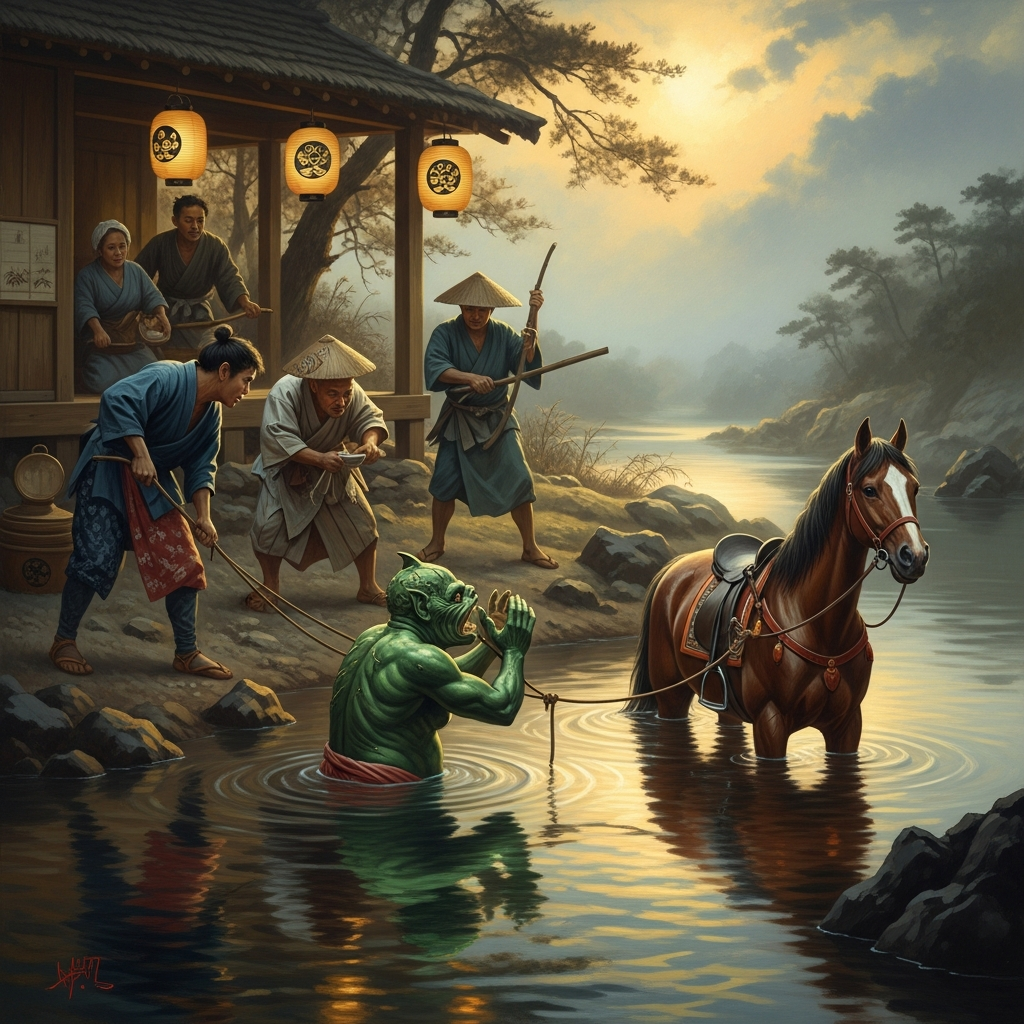
A green river-imp drags a horse into the water. The villagers catch it on the bank. They are about to kill it when the kappa begs for its life — bowing, terrified, the bowl of water on top of its head sloshing dangerously. The villagers extract a promise: it will never harm anyone in this stretch of river again. Once given, a kappa's promise must hold. The kappa keeps it for centuries.
- When
- c. 1700s CE (folktale form crystallized in Edo period; older roots)
- Where
- Rivers, ponds, and irrigation channels of rural Japan — the version below set in Tono, Iwate Prefecture, where the famous kappa tradition is strongest
If you grew up in rural Japan in the centuries before the modern flood-control projects, you knew about the kappa.
You knew that you did not swim alone in unfamiliar rivers. You knew that you did not lean too far over the edge of the ditch behind the rice paddy. You knew that on hot summer afternoons, when the river looked invitingly cool, you went with friends, and at least one friend stayed on the bank with a stick. You knew this not because anyone had explained the hydraulics of drowning to you, but because you had been told, since you were old enough to walk, about the kappa.
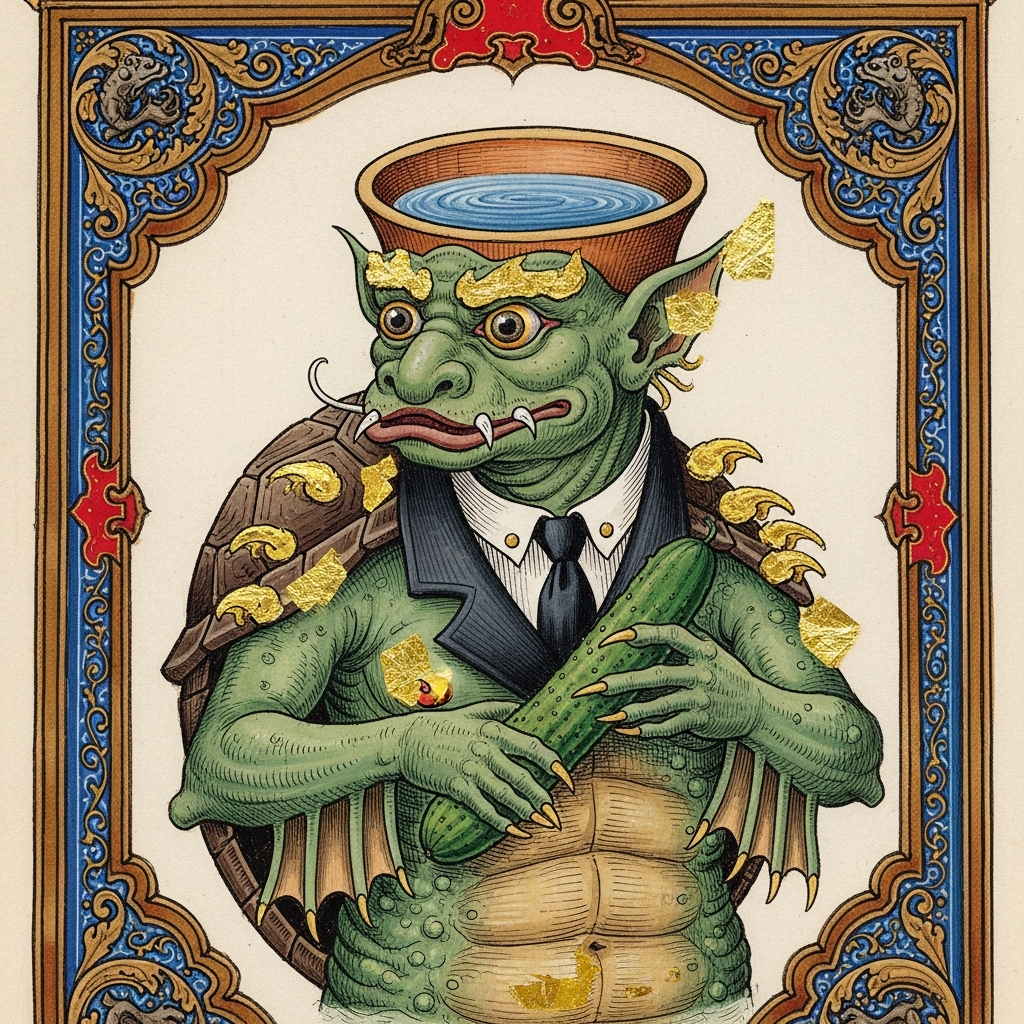
The kappa is a small water-spirit. The standard description, transmitted in dozens of regional variations, gives it the body of a child or a small monkey, the back of a turtle, webbed hands and feet, scaly green skin, a beak-like mouth, and — most important — a shallow concave dish on top of its skull, in which a quantity of water is permanently held.
The dish is the kappa’s vital organ. As long as the water remains in it, the kappa retains its strength. If the water spills, the kappa loses its powers and may even die. Human strategies for dealing with kappa, accordingly, all involve getting that water to spill.
The kappa’s standard behavior is malevolent but specific. It does not attack from a distance. It does not curse from afar. It waits in the water for someone — a child, a horse, an old woman doing laundry — to come close. Then it reaches up, grabs them, and pulls them under. It eats, in particular, a curious organ called the shirikodama — a small ball that, in folk anatomy, is located in the human anus and contains the soul. The kappa removes it via the rectum and eats it.
This sounds, to modern ears, like a colorfully horrifying invention. To rural Japanese in the Edo period, it sounded like a perfectly accurate explanation of why bodies pulled out of rivers sometimes had distended anuses (a normal post-mortem effect of drowning).
What the kappa was, in functional terms, was the spiritual signature of drowning. The kappa stories were how a culture without modern public-health messaging kept its children away from dangerous water.
—
The story below is the most famous of the kappa tales — the Kappa Bound by Promise, of which there are many regional versions. The version told here is the one most strongly associated with the Tono valley in Iwate Prefecture, in northern Honshu, where the folklorist Yanagita Kunio collected dozens of related stories at the start of the twentieth century.
It happened, the elders said, a long time ago. A farmer in the Tono valley kept a horse — a brown working horse, valuable, used for plowing and for hauling wood from the foothills. The farmer pastured the horse on the bank of a small river that ran through his land. The horse drank from the river. The horse grazed beside it.
There was a kappa in that river.
The kappa had been there for some unmeasurable length of time. It was an ordinary kappa, neither particularly old nor particularly powerful, but it was bored, and it was hungry, and it had been thinking about the horse.
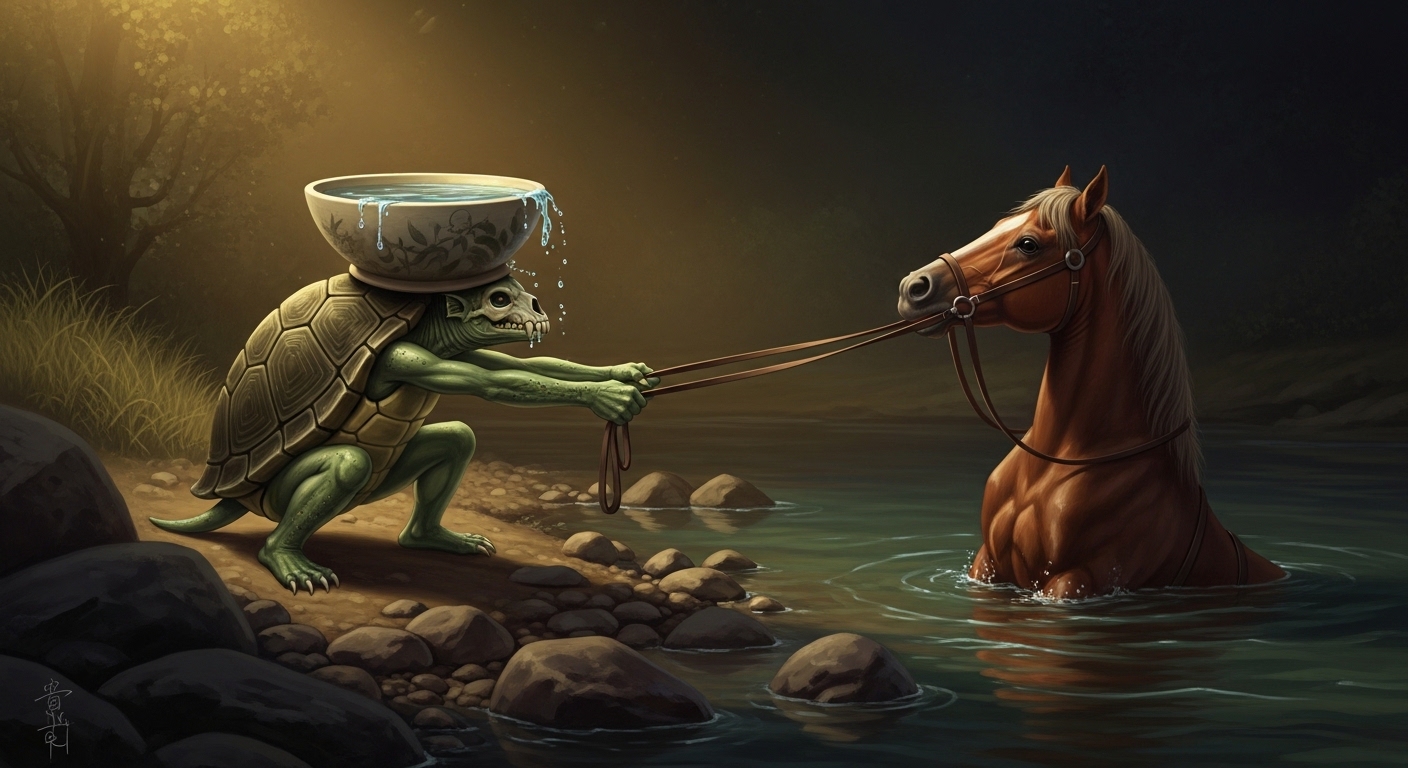
One afternoon, while the farmer was in the rice fields and the horse was grazing alone, the kappa rose from the water. It crept up the bank. It approached the horse from behind. It took hold of the horse’s tail with both webbed hands. It began to pull, gently at first, leading the horse toward the river.
The horse was a working horse, large and strong. It did not move easily. The kappa, undeterred, climbed up onto the horse’s back and tried again, leaning forward, pulling on the bridle.
Now the horse panicked.
It bolted away from the river.
The kappa was tangled in the bridle and could not let go. The kappa was carried, screaming and slipping, on the back of the bolting horse, away from the water.
The horse galloped, in its terror, all the way home — across the field, through the gate, up to the farmer’s stable, where it stopped, shaking, and leaned against the wall with the kappa still on its back.
The farmer’s family, alerted by the noise, came running.
—
What they found in the stable, when they pushed open the door, was their horse, tail-knotted with green algae, panting against the wall, and on its back, hanging desperately to the bridle, a small green child-shaped creature with a beaked mouth and a turtle-shell back. The dish on its head was tilted; a small amount of water had spilled in the wild ride; the kappa was visibly weakened.
The farmer, recognizing what it was, shouted for help. The neighbors came. They surrounded the stable. They blocked the doors with carts. They pulled the kappa off the horse with poles. They threw it on the ground in the yard.
It cowered there. The dish on its head was nearly empty. It could barely move.
The farmer stood over it with an axe. He had heard, all his life, of the depredations of kappa. He had heard of children dragged into rivers, of women snatched while doing laundry, of horses lost. He had heard that the only way to deal with a kappa was to spill its water and kill it, and the chance was rare.
He raised the axe.
The kappa, shaking, looked up at him.
It said — and the texts give the kappa a thin, gurgling voice, the voice of a creature whose throat is full of river water — Please. Please, master. Please do not kill me. I will do anything. Anything. Tell me what you want and I will give it to you. Tell me what you forbid and I will not do it. I beg you.
—
The farmer hesitated.
He had been raised in a culture that did not, by reflex, kill what it captured. He had been raised in a Buddhist village. He had been told, by the temple monk, that mercy returned in kind. He looked at the kappa shaking on the ground and he lowered the axe a fraction.
He said: Will you swear to me a promise?
The kappa nodded violently. Anything.
The farmer thought.
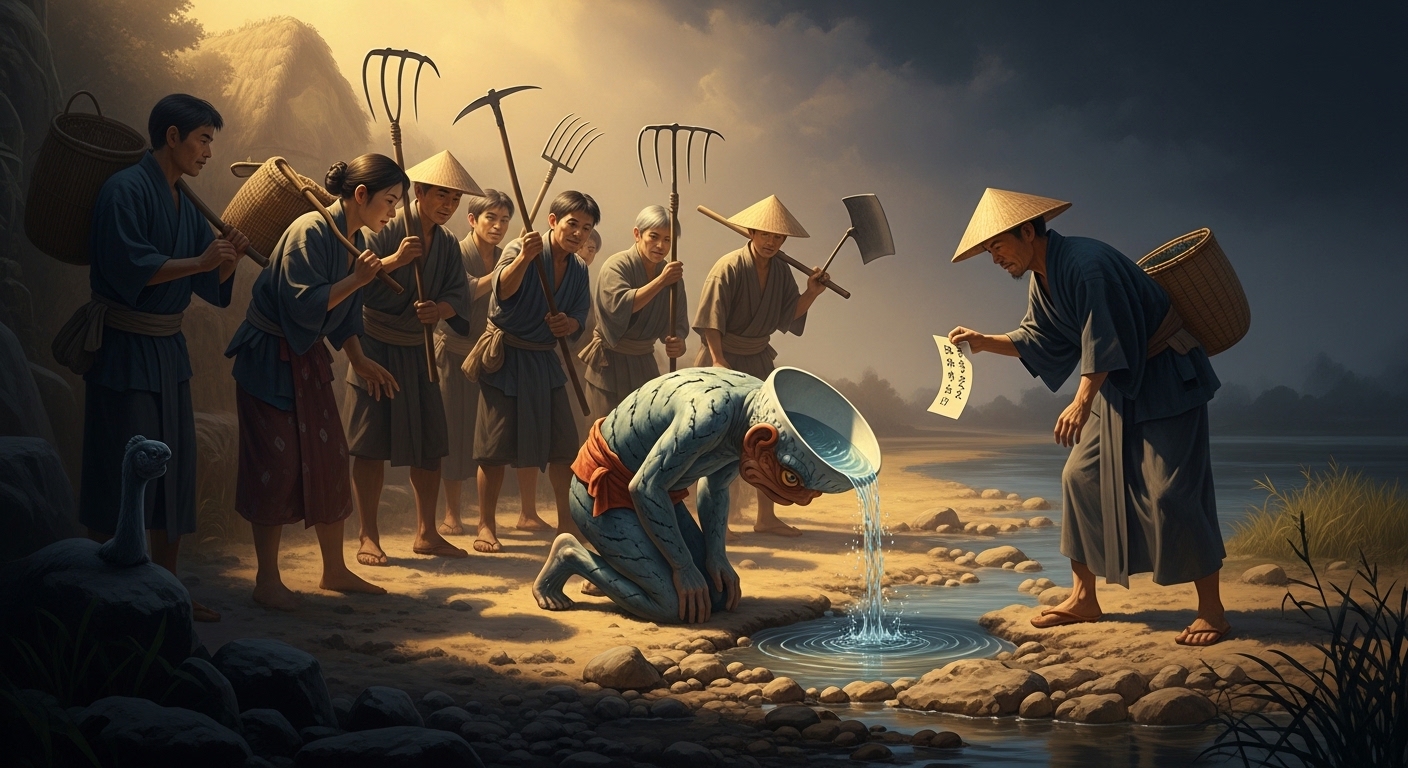
He said: Here is the promise. You will never again, for as long as you live, harm any human or any animal in this river. You will not pull any child into the water. You will not eat any soul-ball. You will not steal any horse. You will not even frighten anyone who comes to wash. You will keep this promise on the threat of your own life and your own kin. If you break it, you forfeit. Do you swear?
The kappa nodded again. I swear.
The farmer was a careful man. He knew that a verbal promise, in folk legal practice, was less binding than a written one. He went into his house and brought out a piece of paper, an inkbrush, and an inkstone. He had the kappa write the promise out in its own hand. The kappa, with its webbed paw, awkwardly inscribed the characters. It signed at the bottom with the imprint of its three webbed fingers in the wet ink.
The farmer rolled up the paper. He kept it in a wooden box on a shelf in his house — the box was passed down for generations, the elders said, and the paper inside it grew yellow but was always there.
Then the farmer let the kappa go.
—
He helped it back to the river. He even, as a final mercy, let it refill the dish on its head from the river water before it slipped beneath the surface. The kappa bowed deeply — a kappa’s bow is risky because of the dish, and to bow voluntarily is a serious gesture — and then it was gone.
The promise held.
For the rest of the farmer’s life, no one drowned in that stretch of the river. No horse was pulled in. No child was taken. The river was, in folk reckoning, kappa-quiet. People who washed there could sing while they worked. Children could splash in the shallows.
The kappa even, in the older versions of the story, became something of a benefactor.
Once a year, the elders said, on a hot summer evening, the kappa would come up out of the river just at dusk. It would bring a small offering — a single fresh-caught fish, or a clutch of river-snails — and leave it on the riverbank in front of the farmer’s house. The farmer’s family, in return, left out cucumbers — the food that, by folk tradition, kappa love above everything else, which is why a roll of cucumber-and-rice in modern sushi is called kappamaki. The cucumbers would be gone by morning. The fish would be eaten by the family. The exchange was wordless and reliable.
This continued for as long as the farmer lived. It continued, the elders said, for generations after — the box with the paper was kept on the shelf, the cucumbers were left at the river, the kappa kept its end. The valley of Tono had, at the cost of one near-killing on one panicked summer day, acquired a permanent water-spirit neighbor with a contract.
—
The Tono kappa stories, of which the above is one, were collected by Yanagita Kunio in 1910 and published in his Tono Monogatari, the founding text of Japanese folklore studies. Yanagita treated the kappa stories with respect. He did not call them mere superstition. He noted that the structure of the stories — capture, near-killing, contract, friendship — encoded a sophisticated rural ethic about how to live with malevolent forces that you could not eliminate.
The pattern recurs across Japanese folk tradition: the demon at the gate is not killed but tamed; the river spirit is not exorcised but bargained with; the foreign threat is not driven out but absorbed and made a neighbor. Even the oni — the Japanese ogre — is, in many tales, eventually persuaded into reform, given a job, integrated. The Japanese folk imagination resists the binary of kill it or live in fear of it. There is, almost always, a third option: write a paper, get a fingerprint, set the cucumbers out at sunset, let it live in the river under contract.
In modern Japan, kappa are everywhere. Every prefecture has at least one kappa-themed mascot for some local product. Tono has built its tourism around the kappa stories; the river where the bound-by-promise event is said to have happened is now a tourist site, with stone kappa statues at intervals, and a small shrine at the bend in the river. Children visit on school trips. They throw cucumbers into the water.
The kappa, if it is still down there — and the locals will not categorically say it is not — has had its promise to keep for several centuries. It has, by all accounts, kept it. The river drowns no one. The contract was witnessed, signed in webbed ink, and filed in a box on a shelf, and the scroll has not yet been opened against the kappa. As long as the cucumbers come, neither side has any reason to break the deal.
Scenes

Echoes Across Traditions
Entities
- The Kappa
- The Farmer
- The Horse
Sources
- Yanagita Kunio, *Tono Monogatari* (1910) — classic Tono village kappa tales
- Lafcadio Hearn, *Kotto: Being Japanese Curios* (1902)
- Michael Dylan Foster, *The Book of Yokai* (2015)
- Komatsu Kazuhiko, *An Introduction to Yokai Culture* (2017)