The Tanuki of Morinji Temple: A Tea-Kettle with Legs
c. 1600s CE (Edo period — folk tale crystallized in this form) · Morinji Temple in Tatebayashi, Gunma Prefecture, central Honshu — a real temple where a tea-kettle, said to be the original, is still on display
Contents
A traveling tinker buys a strange old tea-kettle at a temple junk-sale. Back at his stall, the kettle suddenly grows a furry head, four little legs, and a striped tail — it is a tanuki, a shape-shifting raccoon-dog. The tinker is terrified, then delighted: he begins charging admission. Audiences gather to watch the kettle dance on a tightrope. The tanuki and the tinker become friends.
- When
- c. 1600s CE (Edo period — folk tale crystallized in this form)
- Where
- Morinji Temple in Tatebayashi, Gunma Prefecture, central Honshu — a real temple where a tea-kettle, said to be the original, is still on display
The temple is called Morinji.
It sits in a stand of cedars on a low hillside in the Tatebayashi district of what is now Gunma Prefecture, central Honshu, an hour and a half north of Tokyo by train. It is a Soto Zen temple, founded in the early sixteenth century. It is a small temple, locally important but not famous — except for one possession, a battered old iron tea-kettle, which the temple still displays in a glass case as the original tea-kettle from the story I am about to tell you. Pilgrims still visit specifically to see it. Whether or not it is the actual kettle is a matter on which the temple keeps a discreet, smiling silence.
The story is Bunbuku Chagama — The Lucky Tea-Kettle, more or less; bunbuku is the onomatopoeic sound of the kettle bubbling cheerfully on the fire — and the form below is the version most often told to Japanese children, the form Lafcadio Hearn first transmitted to the English-speaking world in 1894.
—
A long time ago, in the days of the Edo shoguns, there was an abbot at Morinji Temple who was particularly fond of tea.
He drank a great deal of it. He took tea in the morning, in midmorning, before the noon meal, after the noon meal, in midafternoon, and at every interval where conversation might want a cup. He had a beautiful collection of tea utensils. He held tea ceremonies in the small chashitsu of the temple. He was, in his quiet way, a connoisseur.
One day he was browsing in a junk-shop in the nearest town, and he found, in a corner among the old farmer’s tools, an iron tea-kettle. It was unsigned. It was clearly old. The patina on it was a dark luminous gray that only forms after centuries of use. He bought it without bargaining, brought it back to Morinji, and set it on a shelf in his tea-room, intending to use it for the next ceremony.
That evening, after the bath, the abbot returned to the tea-room to admire his new acquisition. He sat on the tatami in front of it. He picked it up. He turned it in his hands. He noted the small repair on the spout, the texture of the cast iron, the balance of the weight. He set it down.
Then he set water in it, set it on the brazier, and lit the charcoal underneath.
—
What happened next is the part of the story that Japanese children always wait for.
As the water began to warm, the kettle changed.
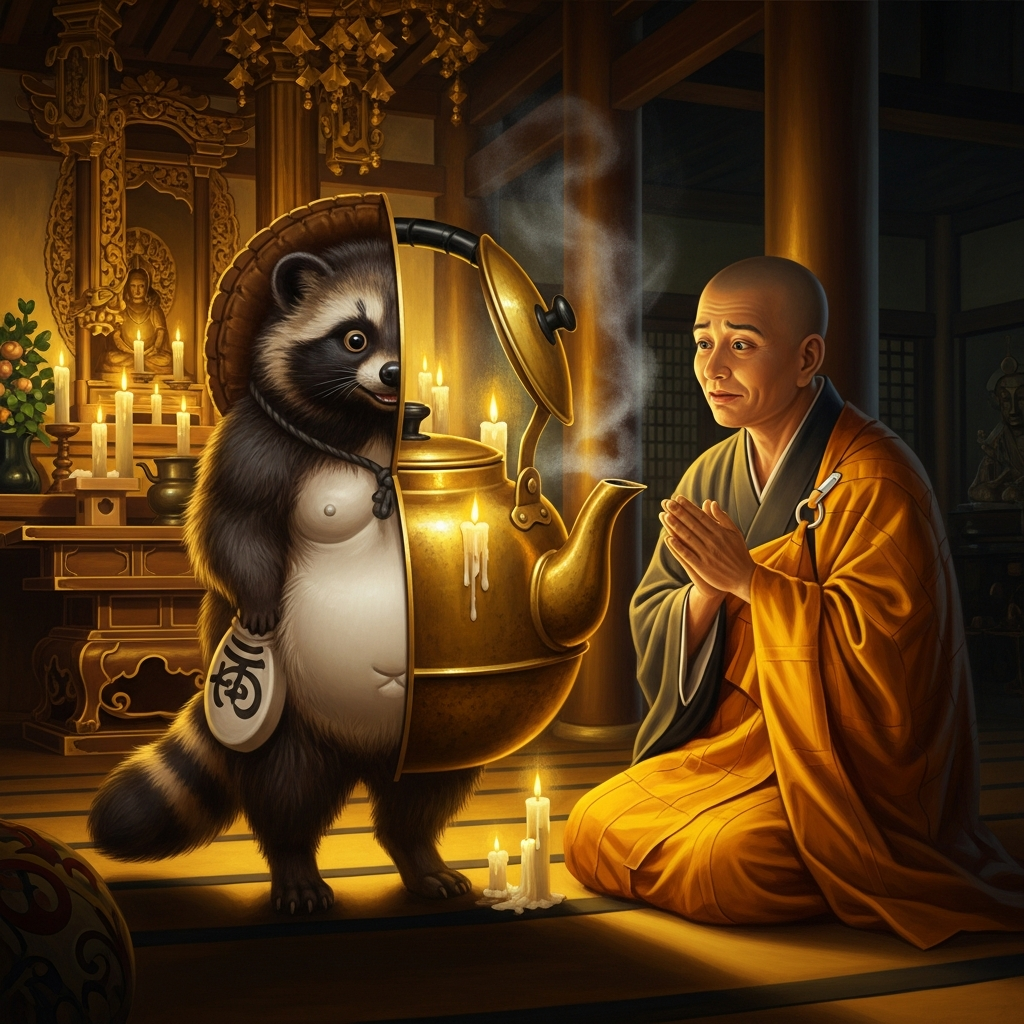
A small striped head emerged from the lid. Two pointed black ears stood up on top of the head. Four small furry legs poked out of the kettle’s belly. A bushy striped tail came out of the spout. The kettle, on its little legs, stood up.
It looked at the abbot.
The abbot stared back.
The tanuki — for that is what it was, a tanuki, the round-bellied raccoon-dog of Japanese folklore, master of disguise, lover of comfort, eater of food meant for others — opened its mouth and grinned.
Then the kettle ran.
It ran on its four little legs around the tea-room. It dodged the abbot’s lunging hands. It scuttled under the tea-shelf. It ducked behind the brazier. It ran in circles. The abbot, shouting, summoned the other monks. They came in their robes and tried to catch it. The kettle was uncatchable. It feinted left, dashed right, leapt onto a windowsill, jumped down, and finally — with everyone closing in on it — it sat down suddenly and turned back into an ordinary kettle.
The water inside it was now boiling. The lid clattered. The spout steamed innocently.
The monks panted. They looked at each other. They looked at the abbot.
The abbot looked at the kettle.
He had — the texts make this clear — not enjoyed the experience. He was an old man with a fondness for routine. He had no patience for kettles that came alive. He decided, on the spot, that this kettle was a bakemono — a spirit-thing, a spook — and that he wanted nothing more to do with it.
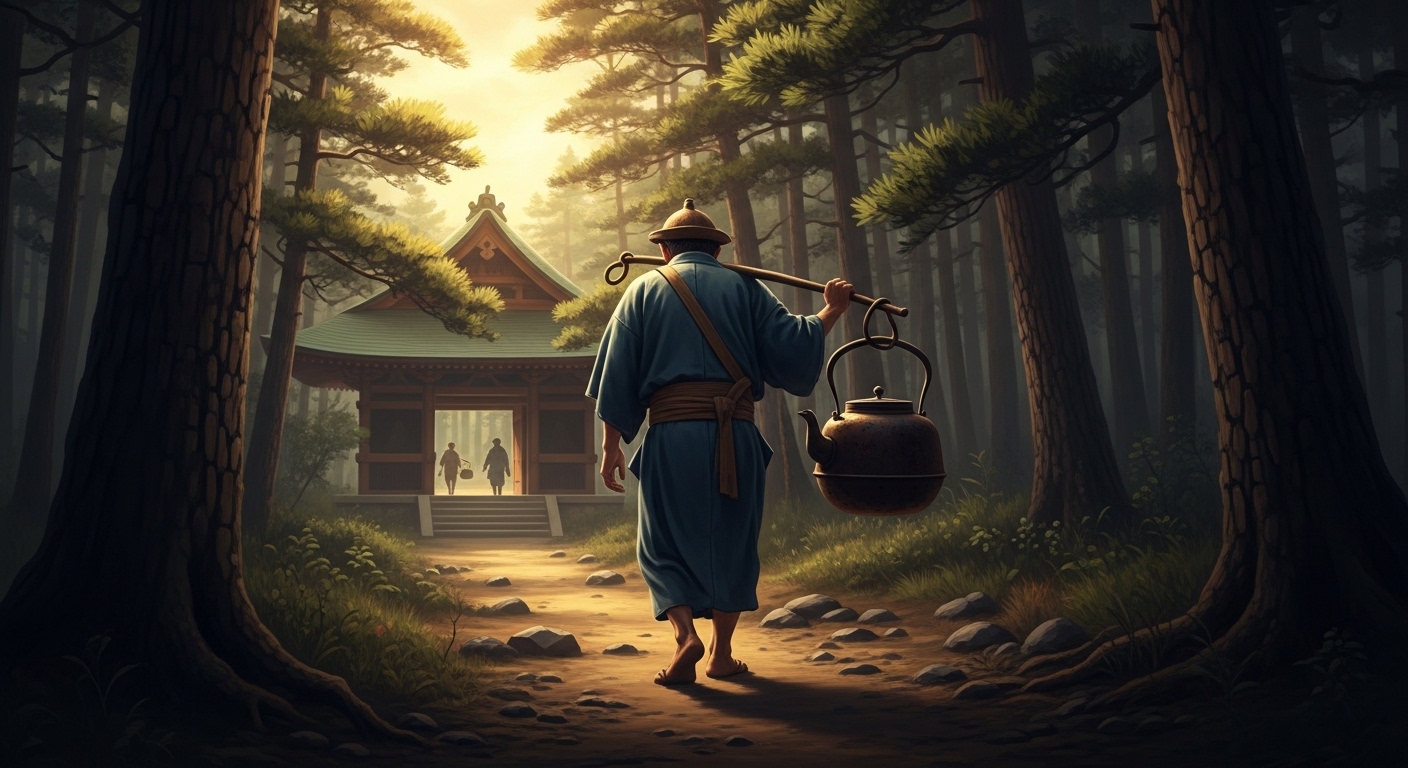
He picked up the kettle, by its handle, very carefully. He carried it out of the temple. He walked to the gate. The first peddler who came up the road was a traveling tinker — a man who fixed pots and kettles and sharpened knives, walking from village to village with his tools on a shoulder pole. The abbot stopped him.
Friend, the abbot said. I have a kettle here. It is, as you can see, a very fine kettle. I have no further use for it. I will sell it to you for whatever modest sum you can offer. I would like the matter concluded today.
The tinker, who had been having a slow week, looked at the kettle. It was a beautiful kettle. He named a price. The abbot accepted without bargaining. The tinker handed over the coins. The abbot bowed and went back into the temple as fast as dignity allowed.
—
The tinker walked away with his new kettle.
He carried it about a mile. Then, because he was tired and because the road was empty, he set down his shoulder pole and stopped to rest under a tree. He set the kettle on the grass beside him. He took out a small flask of sake. He drank. He looked at the kettle. He had begun, vaguely, to feel pleased with his bargain. The kettle was clearly worth much more than what he had paid for it. He thought about polishing it later that evening and selling it on at a profit in the next town.
The kettle’s lid lifted, slightly. The tanuki’s head emerged.
The tinker, who was not as old or as routine-bound as the abbot, looked at the tanuki-kettle with surprise but not fear.
Hello, he said.
Hello, said the tanuki.
The tinker, the texts emphasize, was a sensible man. He did not panic. He did not try to catch the tanuki or run from it. He sat where he was. He took another sip of sake. He waited.
The tanuki, sensing it was being treated calmly, climbed all the way out of the kettle — the kettle still in its kettle-form on the grass; the tanuki standing beside it, fully a tanuki, round-bellied, striped — and explained itself.
It said: Old man, please listen. I am a tanuki. I have lived for a very long time in the woods near Morinji Temple. I learned, when I was young, to take the form of various objects, and the form I do best is the tea-kettle. I had been pretending to be that kettle in a certain shop where I knew an old abbot was likely to come and buy me. I wanted to live in the temple — temples are warm and quiet and full of food offerings. But the abbot put me on the fire. I cannot stand fire. The form of a kettle is not designed to be heated; it hurts. I had to come out. The abbot was frightened of me and got rid of me. Now I am with you. You seem a kind man. I will make you a deal.
The tinker listened. He nodded. He asked, What deal?
The tanuki said: You will not put me on the fire. You will treat me kindly. You will feed me — anything will do, leftovers, dumplings, sake — and in return I will help you make money. I can perform. I can dance. I can balance on a rope. I can do tricks no one has seen before. You set up the show. I will provide the act. We will split the takings.
The tinker, who was a bit of a businessman as well as a tinker, agreed at once.
—
They went into business together.
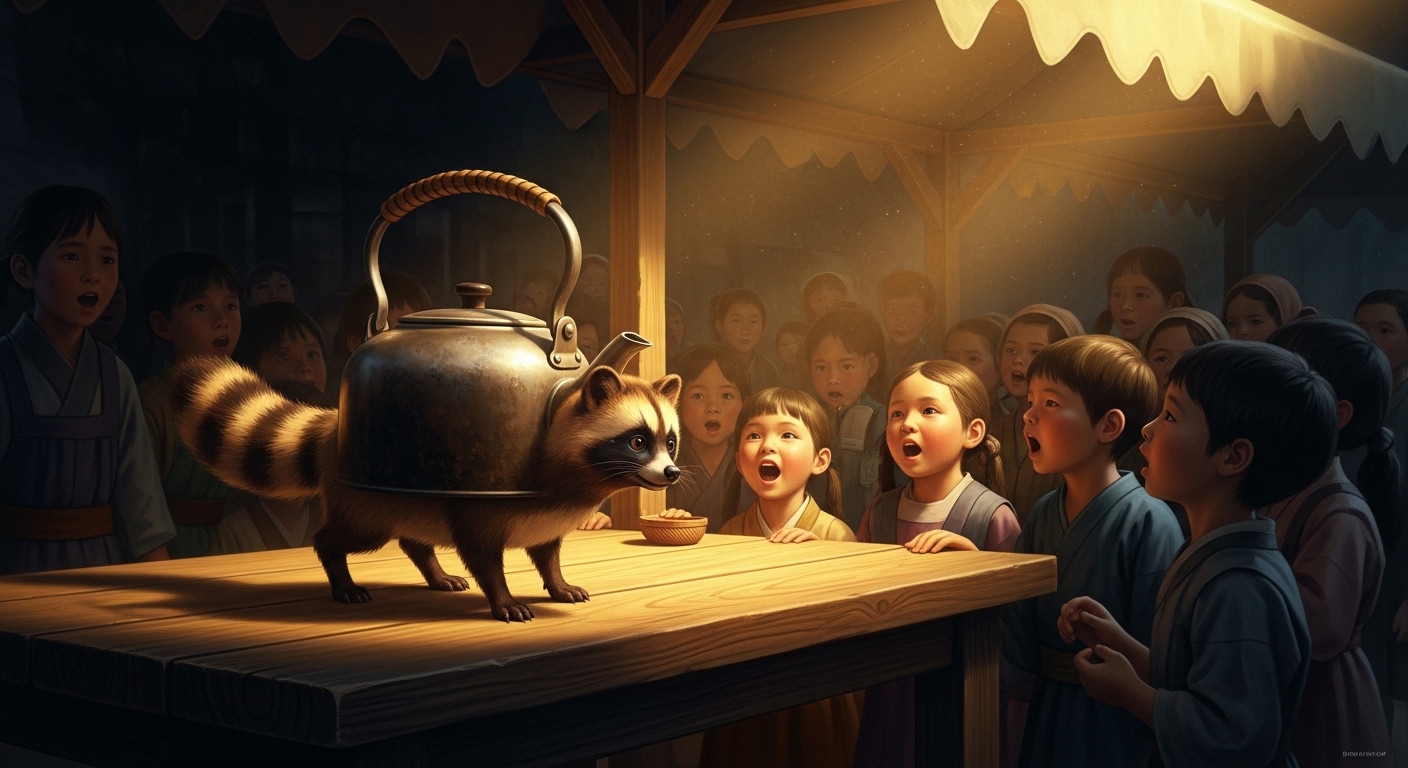
The tinker rented a small open space in the next town’s market square. He hung up cloth banners. He beat a small drum. He shouted out an announcement to the crowd: Come, come, come! See the marvel of the Bunbuku Chagama! The kettle that comes alive! The kettle that dances! Five mon for adults, two mon for children!
The crowd came. They were skeptical but curious. Skeptical Japanese market-crowds, then as now, demand a high standard.
The tinker set the kettle on a wooden table. He clapped his hands. The kettle, on cue, sprouted its head and tail and four legs, and stood up. The crowd gasped.
The tinker, who had been rehearsing with the tanuki for a week, beat a slow rhythm on his drum. The tanuki-kettle began to dance. It tapped its little feet on the table. It twirled. It bowed. It lifted its tail high and waggled it. The crowd laughed.
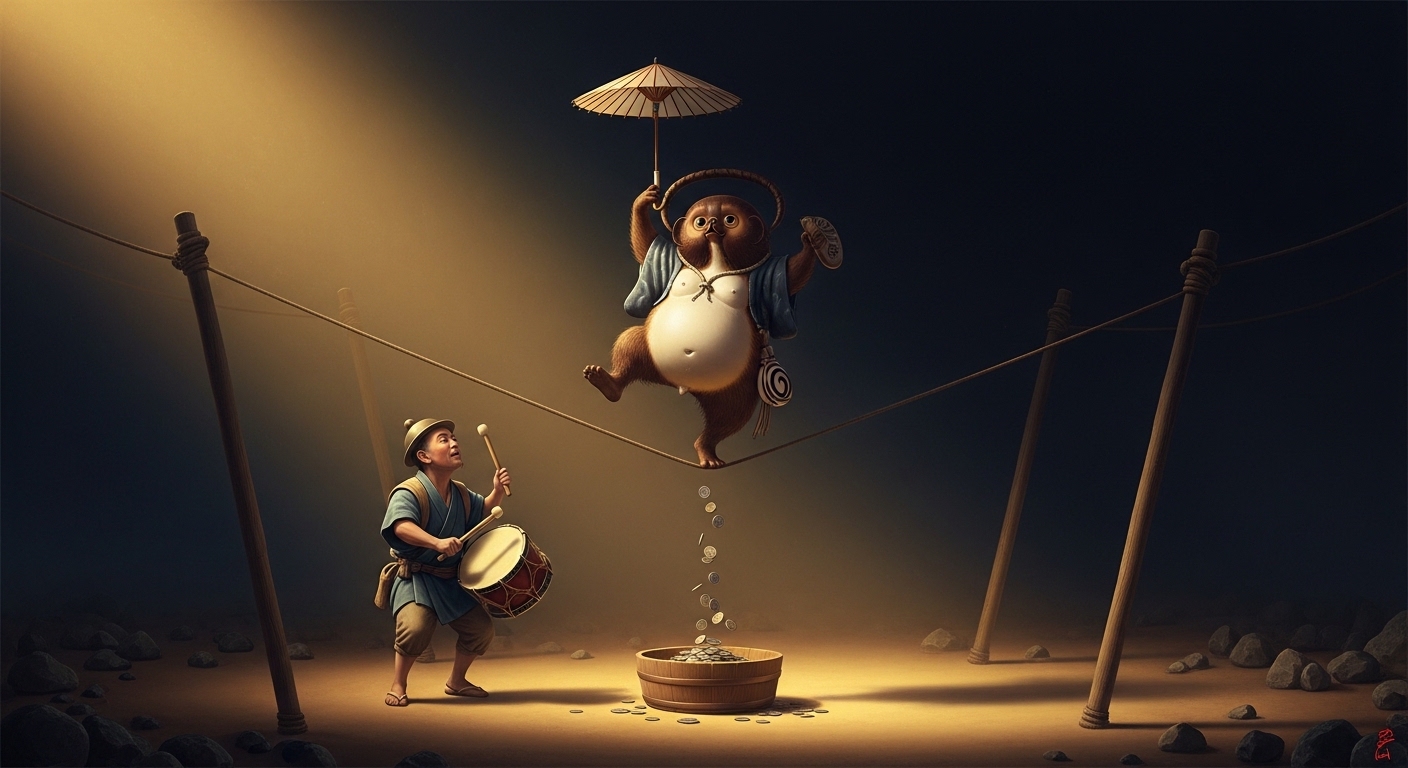
The tinker stretched a tightrope between two poles at table height. The tanuki-kettle climbed up onto it and walked across, balancing a tiny paper umbrella in its mouth. The crowd applauded.
The tanuki-kettle did acrobatics. It hopped on one foot. It did a backflip. It balanced on its head with all four legs in the air. The crowd shouted with delight.
By the end of the show, the tinker’s wooden bowl on the ground was full of coins.
—
They performed in town after town.
The fame of the Bunbuku Chagama spread fast. Provincial lords sent for them. The performance was demanded at festivals. The tinker, who had begun the year as a poor tinker walking from village to village, ended the year as a moderately wealthy man with a small house, two servants, and a comfortable stipend from a regional daimyo who had taken a liking to the act. The tanuki-kettle ate well — extra dumplings, sweet bean cakes, sake on cool evenings — and was, by all accounts, content.
This is the part of the story that Japanese audiences love best. The trickster has been treated decently and has decided to behave well in return. The man and the spirit are not adversaries. They are partners.
—
After several years, the tanuki began to slow down.
It told the tinker, one evening, that it had grown old. Tanuki, even shape-shifting tanuki, do not live forever. The kettle-form was tiring it more each performance. It wanted, before its strength gave out, to retire.
The tinker, who was now a wealthy man and had no further need to perform, agreed at once. He told the tanuki, Stay with me. Eat what you like. Sleep where you like. I will not put you on the fire.
The tanuki appreciated this. But it had a request.
It asked the tinker to take it back to Morinji Temple.
The tinker was puzzled. Back to the abbot who tried to boil you?
The tanuki nodded. That abbot is dead now. Many years have passed. The temple has a new abbot. I would like to spend my last years there. The temple is warm and quiet. I have always wanted to live there. The tinker has been kind, but a kettle is a kettle, and a temple is the right place for an old kettle to rest.
The tinker took the tanuki back to Morinji.
He gave a substantial donation to the temple — enough to fund the rebuilding of the main hall — and asked, in return, that the kettle be displayed in a place of honor. The new abbot agreed gratefully. He had heard of the famous Bunbuku Chagama. He was honored to receive it.
The tanuki settled on a small lacquered stand in the temple. It assumed its kettle-form and stayed in it. It was no longer used for boiling water. It was treated as a relic — a sacred kettle, an object of pilgrimage. Visitors came to see it. Children stared at it through the lattice screen. Sometimes, very late at night, the temple monks said, the kettle could be heard chuckling softly to itself, but no one ever again saw it sprout its head and tail. The tanuki was old. Performance was finished. Rest was deserved.
—
The kettle is still there.
You can travel today to Morinji-ji, the temple, in Tatebayashi city, by local train from Tokyo. The temple is a peaceful Soto Zen complex set in a stand of cedars. There are stone tanuki statues all along the path leading up to the main gate — round-bellied, big-testicled (this is a feature of tanuki iconography, a comic exaggeration), wearing little straw hats. The temple sells tanuki-themed amulets at the gift shop. The kettle itself is in a glass case in the side hall, dim under indirect lighting. It is a real iron tea-kettle, dark with patina, modest in size, sitting on a small wooden stand.
It does not move. The monks will not heat it. It has been in that case for a very long time.
The story has not stopped being told. Bunbuku Chagama is part of every Japanese child’s nursery education. Versions appear in school readers, in puppet plays, in animated films, in ceramic tea-set illustrations. The phrase bunbuku — that bubbling sound of a happy kettle on a brazier — has entered the language as a general indicator of good fortune. To say a tea-kettle is making a bunbuku sound is to say a household is prospering.
The deeper teaching of the story, the older Japanese say, is that prosperity should be shared with the spirits who bring it, that strange visitors should be treated with kindness, that fire is not the right answer to a problem that can be talked to instead. A tinker who took an inexplicable kettle home from an angry abbot, calmly drank his sake, and offered to feed it, is the model citizen the folk tradition is endorsing. He prospered. The spirit prospered. Even the abbot, eventually, got his temple’s most famous treasure. Everyone, in the long run, benefited from one cool head on a country road.
Scenes
Echoes Across Traditions
Entities
- The Tanuki
- The Tinker
- The Abbot of Morinji Temple
Sources
- *Bunbuku Chagama* — Japanese folktale, recorded in collections from the Edo period (c. 1600s onward)
- Lafcadio Hearn, *Glimpses of Unfamiliar Japan* (1894) — early English transmission
- Yanagita Kunio, *Japanese Folk Tales* (1948)
- Royall Tyler (trans.), *Japanese Tales* (1987)