Contents
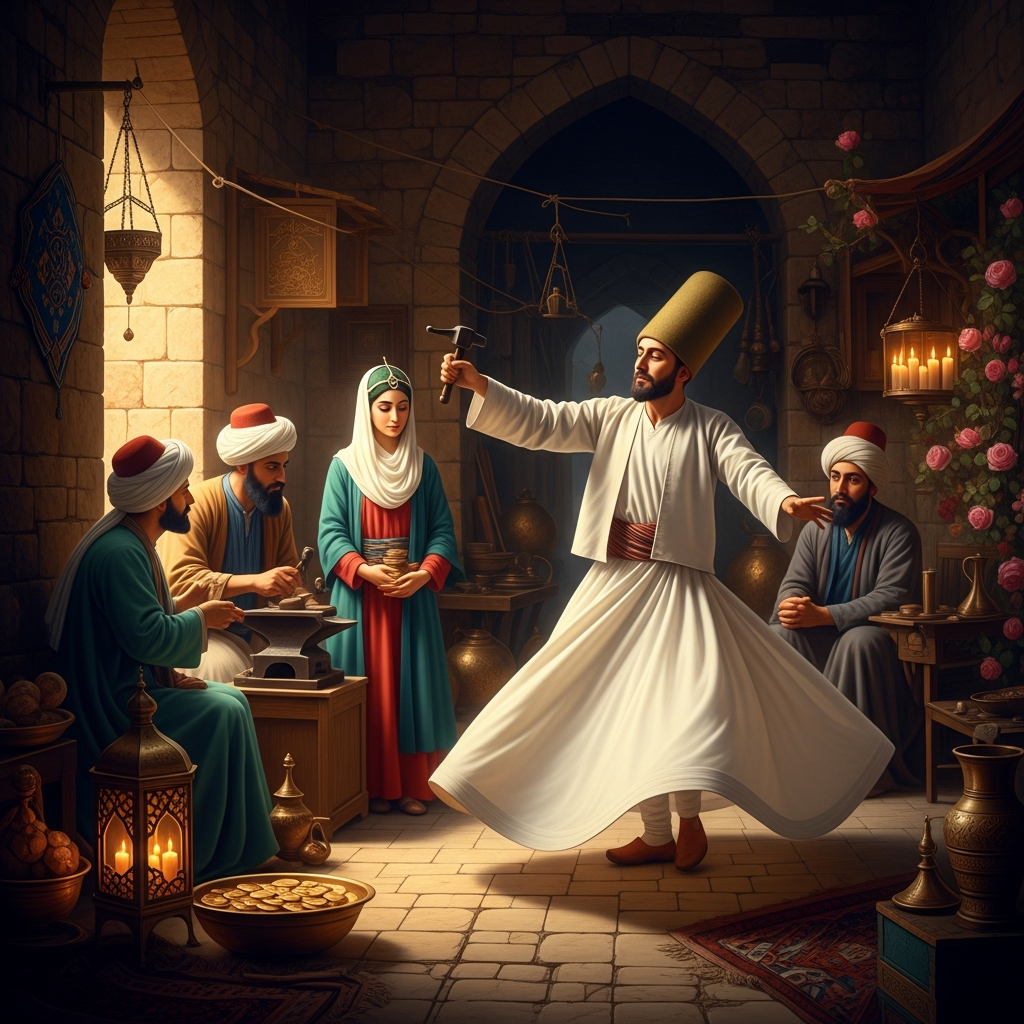
In the streets of Konya, in the goldsmith's market, Rumi hears the hammering of gold and begins to turn — and cannot stop for hours. The sama, the sacred whirling ceremony of the Mevlevi order, was not invented. It began as something Rumi could not prevent his body from doing.
- When
- c. 1245–1250 CE — Konya, Anatolia
- Where
- Konya, Seljuk Anatolia — particularly the goldsmith's bazaar near the center of the city
The goldsmith’s bazaar on the day it began.
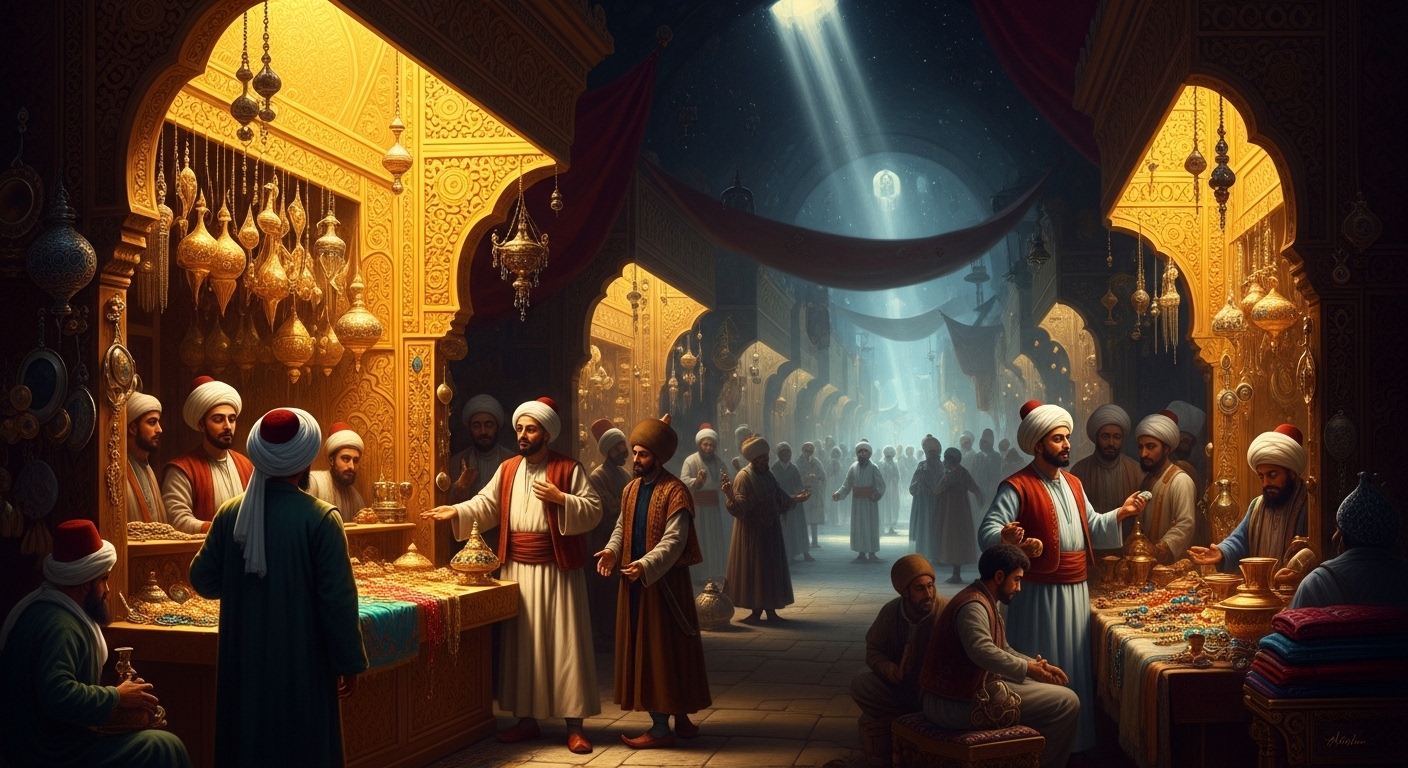
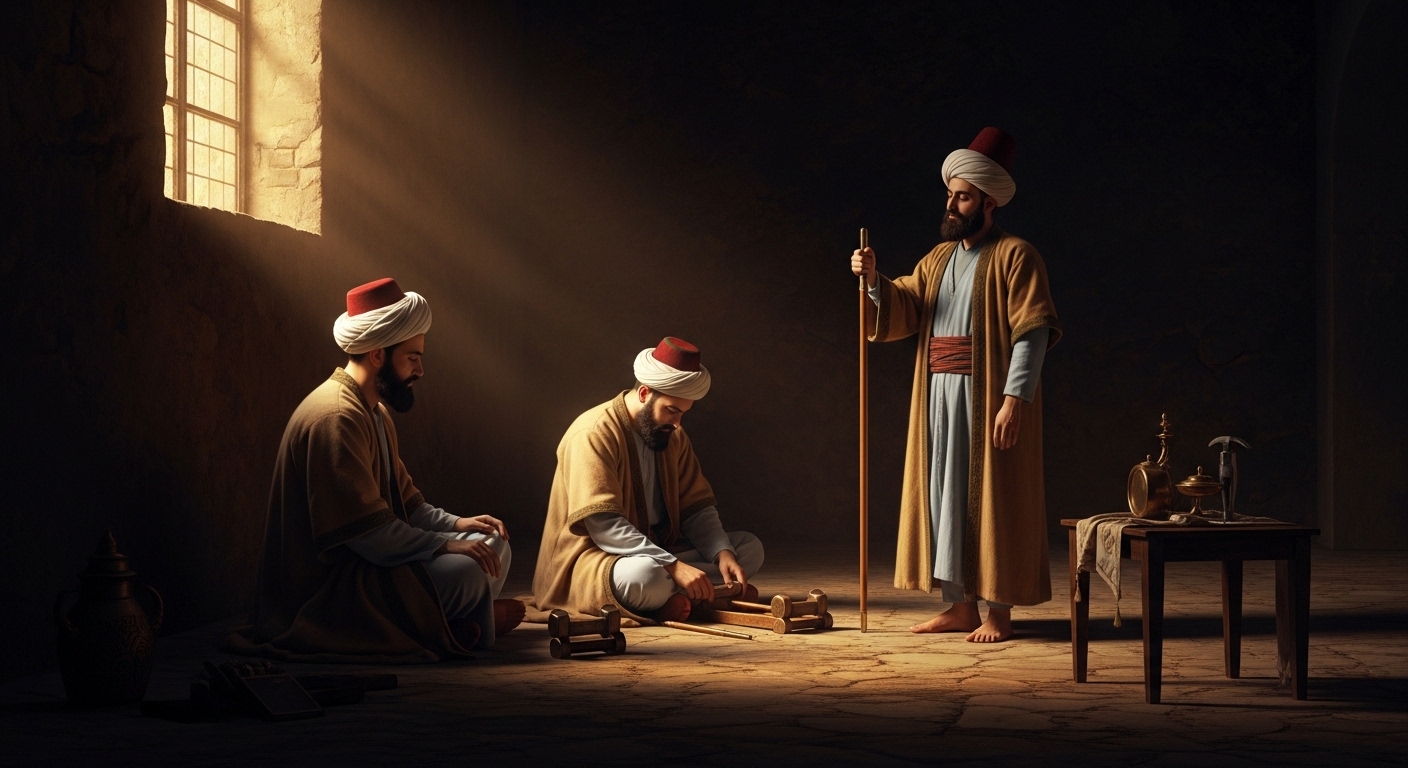
The street is loud with hammers. This is the work of the goldsmiths: all day the metalworkers beat their thin sheets of gold against iron forms, producing a rhythmic percussion that echoes through the narrow street. The sound is relentless and complex, multiple rhythms layering on each other as different craftsmen work at different tempos. In the Konya of the mid-thirteenth century, this is one of the sounds of the city’s prosperity — the Seljuk sultans are generous patrons of the arts, and gold flows through the workshops.
Rumi enters the street. He hears the hammering. Something happens in his body.
He begins to turn.
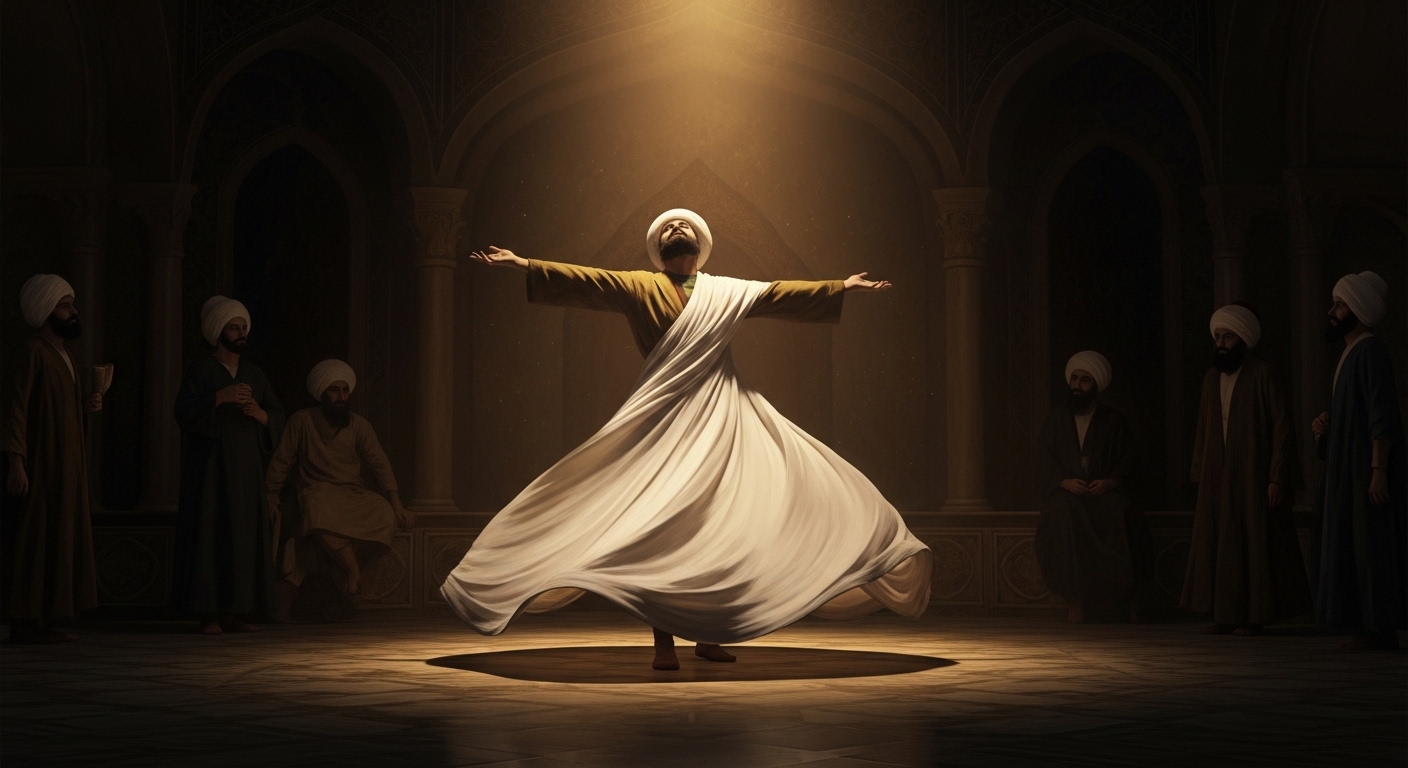
The accounts in Aflaki’s collection — gathered from testimony across the generations who had direct contact with Rumi’s circle — are consistent on this basic point: the whirling was not decided upon. It arose. The sound of the hammer entered some part of Rumi that was already open, already tilted toward the edge where music and ecstasy meet, and the body began to move. The turning was circular, arms eventually extending, one palm eventually tilting up toward heaven and one palm down toward the earth. Hours passed. The goldsmith Salah ud-Din — who would become Rumi’s closest companion after Shams disappeared — kept the hammering going rather than stop.
The Sufi tradition has a technical term for what happened: wajd, often translated as ecstasy but more precisely the state of finding — the Arabic root means to find — in which the divine presence is so overwhelming that ordinary bodily control temporarily ceases. The masters argue extensively about wajd: is it produced by music, or does music only trigger what is already present? Can wajd be authentic if it is sought? Can a wajd that does not break out involuntarily be trusted?
Rumi’s sama resolves these debates by existing before the debates are necessary. The ceremony did not precede the ecstasy. The ecstasy preceded the ceremony.
What Rumi’s students observed in the goldsmith’s bazaar — and in the gardens of Konya, and in his own courtyard, and in the rooms where the music was played — was a man in whom the distance between hearing music and entering the state of divine presence had collapsed entirely. He was not doing sama. He was being done by it. The turning was the form his body took when the presence arrived, the way a flame takes the form of its burning.
After Shams’s second and final disappearance in 1247 or 1248, Rumi transferred his companionship to Salah ud-Din Zarkub, the goldsmith whose hammers had started everything. This is suggestive. The goldsmith did not replace Shams. Nothing replaced Shams. But the sound that had first opened the turning continued, now with a human face attached to it. Salah ud-Din became Rumi’s spiritual companion for the next decade, and Rumi’s circle gathered in and around the goldsmith’s household.
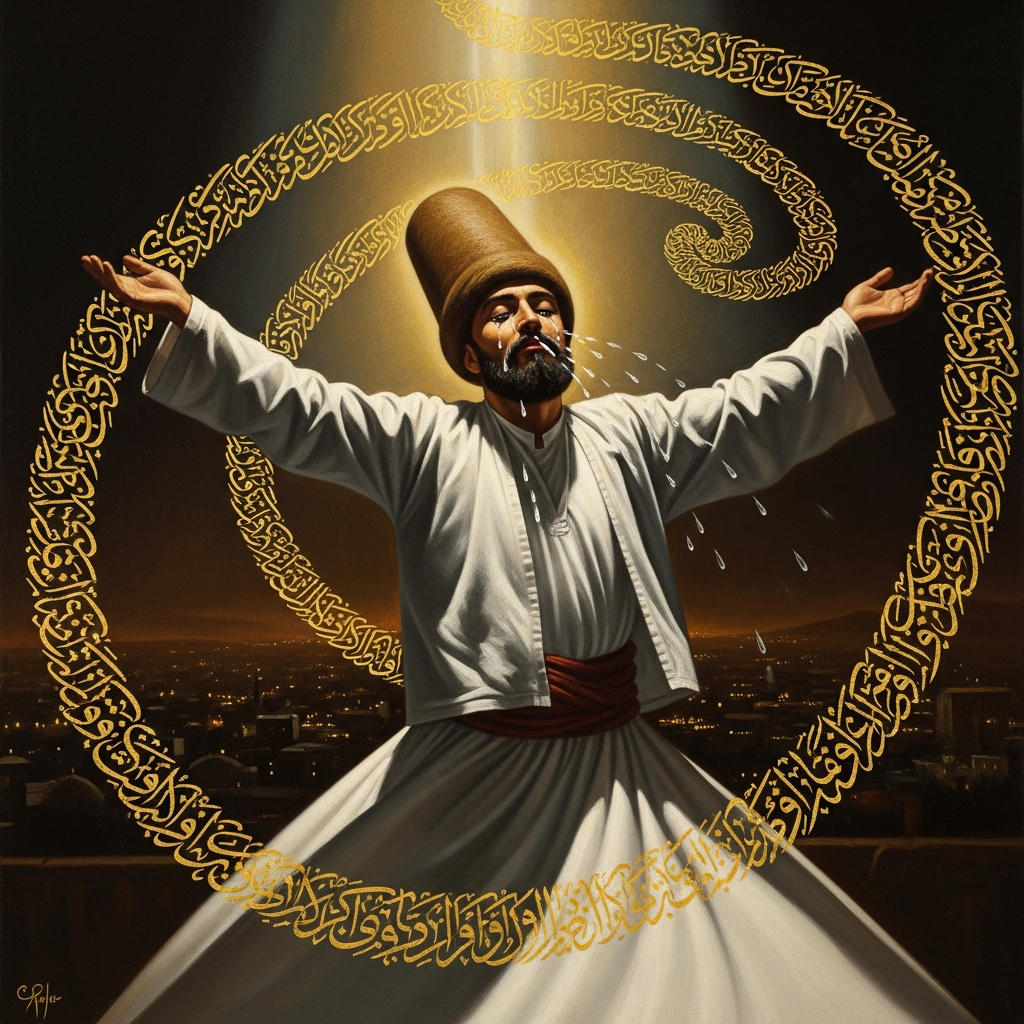
The sama formalized slowly, over years. By the time Sultan Walad — Rumi’s son — constituted the Mevlevi order formally after Rumi’s death in 1273, the ceremony had acquired its structure: the opening poem (na’t), the solo ney improvisation, the procession, the three circuits, the four selams or greetings, the whirling itself in white robes with the tall conical hat, the closing prayer. Each element had a cosmological meaning assigned to it. The white robe was the burial shroud. The hat was the tombstone. The arms extended — one up, one down — meant: I receive from God and give to creation. The turning itself meant: the earth orbits the sun, the electron orbits the nucleus, the soul orbits the divine center.
All of this meaning was applied after the fact to something that had begun as an involuntary movement in a street full of hammers.
The anthropology of ecstatic movement is ancient and cross-cultural: spinning, trembling, falling, dancing until exhaustion are documented in shamanic, Hindu, African, Pentecostal, and dozens of other traditions as modes of entering altered states through which contact with divine presence is possible or permitted. Rumi knew this tradition through the Sufi masters who preceded him — the wajd literature is extensive by the thirteenth century.
But his particular contribution was the transformation of wajd from an unpredictable state into a repeatable ceremony without losing its essential involuntariness. The Mevlevi sama is choreographed, but it is not meant to be controlled. The ceremony creates the conditions. What happens in the whirling is supposed to be what happened in the goldsmith’s bazaar: the body finding the movement it cannot help but make when God is present.
The sama is still performed. The conical hats are still worn. The arms are still extended, one palm up, one palm down.
Receiving. Giving.
Heaven to earth through the turning body.
Scenes
Echoes Across Traditions
Entities
- Rumi
- Shams-i-Tabrizi
- Salah ud-Din Zarkub
- Sultan Walad
Sources
- Aflaki, *Manaqib al-Arifin* (Acts of the Gnostics), c. 1353
- Suleyman Dede, oral tradition recorded by Kabir Helminski in *The Knowing Heart* (Shambhala, 1999)
- Annemarie Schimmel, *The Triumphal Sun: A Study of the Works of Jalāloddin Rumi* (Fine Books, 1978)
- Talat Sait Halman and Metin And, *Mevlana Celaleddin Rumi and the Whirling Dervishes* (Dost, 1983)