Bái Shé: The White Snake's Forbidden Love
Song dynasty setting in the traditional version — the city of Hangzhou at West Lake · West Lake in Hangzhou, the Leifeng Pagoda, the Jinshan Temple on the Yangtze
Contents
A thousand-year-old white snake demon takes human form, falls in love with a scholar named Xu Xian, and marries him — but the monk Fahai cannot let the world contain what he calls a monster wearing a woman's face.
- When
- Song dynasty setting in the traditional version — the city of Hangzhou at West Lake
- Where
- West Lake in Hangzhou, the Leifeng Pagoda, the Jinshan Temple on the Yangtze
She has been a snake for a thousand years when she decides to become a woman.
The decision is not impulsive. She has spent a millennium cultivating the spiritual energy that makes transformation possible — meditating in mountain pools, absorbing moonlight on clifftops, practicing the inner disciplines that accumulate power over centuries. She has the thousand-year cultivation. She has the power to take human form. What she lacks is any reason to use it, until the day she sees Xu Xian at the edge of West Lake in Hangzhou, feeding fish in the rain.
She borrows an umbrella from him. Or he lends her one. The details of their first meeting differ by telling, but the umbrella appears in every version because the umbrella is the thing between them — the small, practical object of care in the rain that opens the door to everything else.
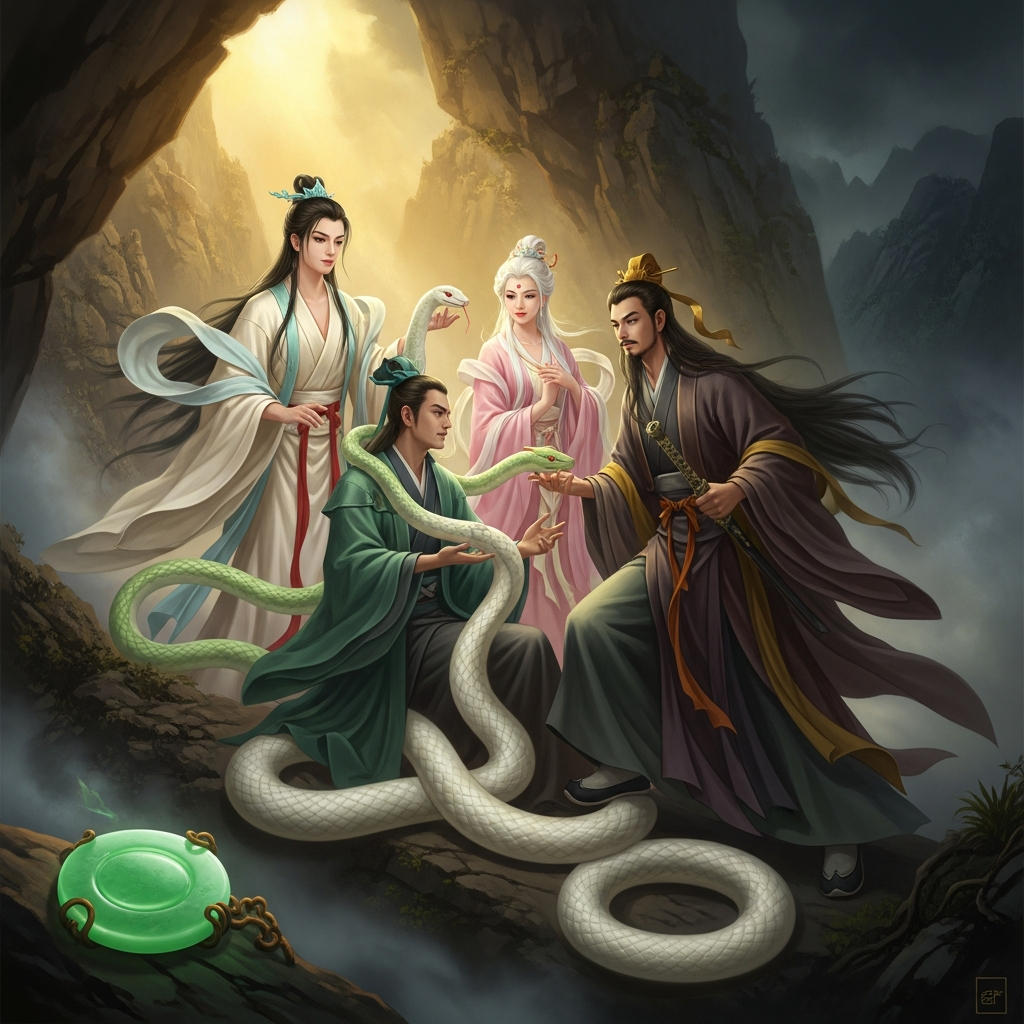
They marry. She is Bai Suzhen, a woman of poise and medical knowledge and the capacity to manufacture whatever money the household needs. He is a pharmacist’s apprentice, decent and kind and not very equipped for the kind of love he is inside. Her companion Xiao Qing — the green snake, younger, fiercer, more politically astute about the danger they are in — tries to protect her from what she can see coming. Bai Suzhen is happy. Happy people are often the last to see the door closing.
Fahai the monk sees them on the street and sees what Xu Xian cannot: he sees the snake inside the woman’s form. He does not debate with himself about what to do. In his moral framework, the category of demon is clear and the response to demons is clear and the love between the demon and the man, however genuine it appears, is an offense against the natural order that he is committed to maintaining.
He tells Xu Xian what his wife is. He tells him to make her drink realgar wine at the Dragon Boat Festival — the festival day when demon disguises are weakened by the festival’s ritual intensity. Xu Xian, who loves his wife and also cannot escape his era’s understanding of what snakes are, does it.
She drinks the wine.
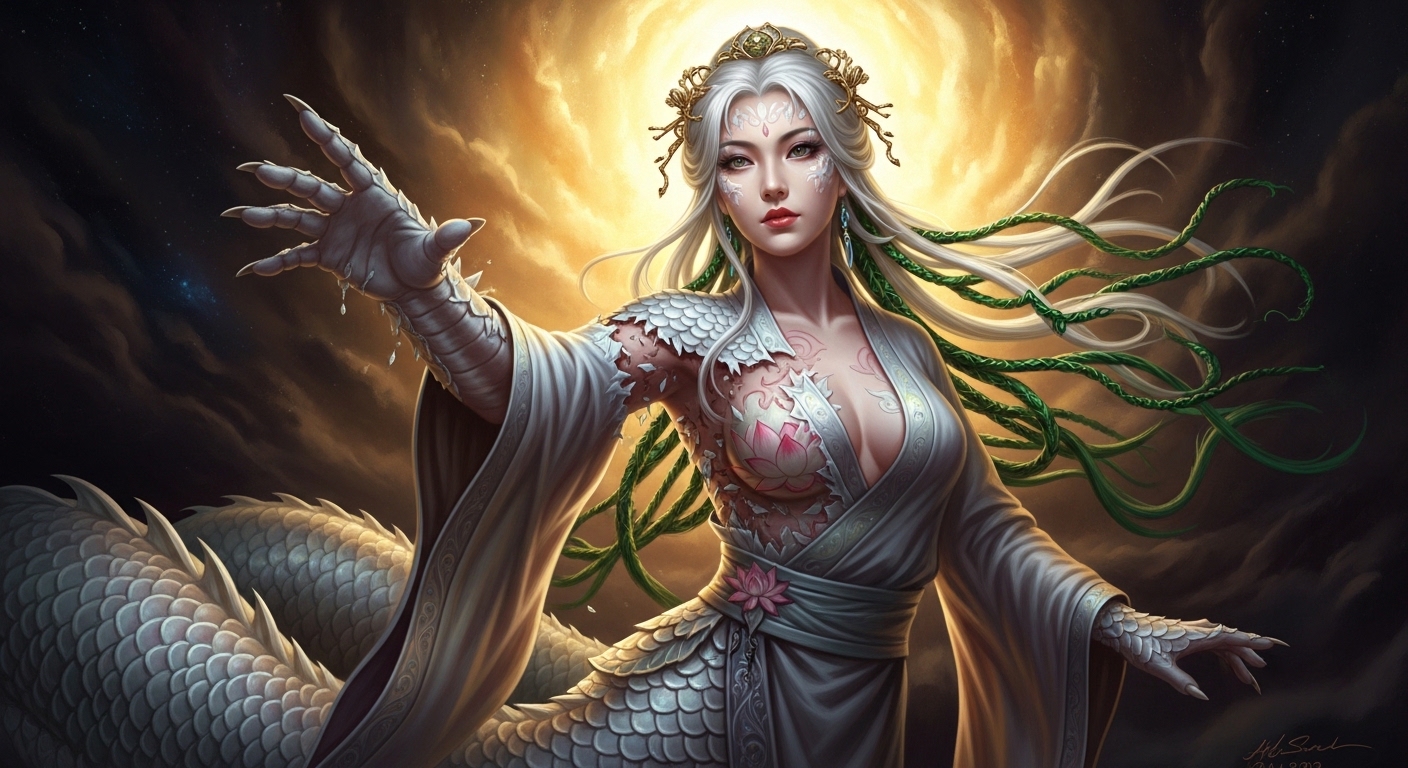
Her human form dissolves. He sees her — really sees her, for the first and last time — as what she is: a vast white serpent, ancient and beautiful and terrified, and the terror is not the snake’s terror of discovery but the wife’s terror of losing him. She reverts to human form immediately, but the moment has happened.
He dies of the shock.
She walks through the season of demons to steal the resurrection herb from the mountains of heaven, carrying it back to him in the form of a woman who will not stop walking. She revives him. He comes back. He loves her. He does not entirely know what to do with what he now knows, but he loves her.
Fahai captures her. He traps her under the Leifeng Pagoda at West Lake — presses the pagoda down over her, seals the seal of the law on the base of it, leaves her there. Xiao Qing escapes and spends centuries cultivating the power to destroy the pagoda.
The Leifeng Pagoda collapsed in 1924 CE. It fell on its own, weakened by centuries of people taking bricks from its base as good luck charms. When it fell, people said: Bai Suzhen has been released. The folk tradition holds that she walked out of the rubble in the direction of West Lake, toward the spot where she first borrowed the umbrella in the rain, a thousand-year-old woman in white who had spent seven centuries under stone for the crime of having loved someone.
The lake is still there. West Lake is still beautiful. In the right rain, in the right light, the umbrella story still makes sense — a woman in white, asking a stranger for shelter from the weather, beginning the love that will cost more than she had and remain worth every bit of it.
Scenes
Echoes Across Traditions
Entities
- Bai Suzhen (White Snake)
- Xiao Qing (Green Snake)
- Xu Xian
- Fahai (the monk)
Sources
- Feng Menglong, *Stories to Caution the World* (警世通言), 'The White Maiden Locked Forever Under the Thunder Peak Pagoda,' c. 1624
- Fang Chengpei, opera version *Lei Feng Ta* (雷峰塔), Qing dynasty
- Wilt Idema, *The White Snake and Her Son* (Hackett, 2009)
- Robin McNeal, notes in *Ming Short Fiction* (University of Washington)