Hiawatha and the Peacemaker's Great Law
Traditional date c. 1450–1600 CE; some scholars argue as early as 1100 CE · The lands of the Haudenosaunee Confederacy (New York State / southern Ontario)
Contents
Deganawida, the Peacemaker, comes from across the lake with a message of peace among the warring Haudenosaunee nations. He cannot speak clearly enough to convince them alone — but Hiawatha, a man transformed by grief into a cannibal and then back into a man by the Peacemaker's words, becomes his voice. Together they bind five (later six) nations under the Great Law of Peace, which becomes the longest-surviving democracy in North America.
- When
- Traditional date c. 1450–1600 CE; some scholars argue as early as 1100 CE
- Where
- The lands of the Haudenosaunee Confederacy (New York State / southern Ontario)
Before the Peacemaker arrives, there is only war.
Not war as a season or a campaign — war as the condition of life itself. The five nations of the Haudenosaunee have been fighting each other for so long that no one alive remembers a time when they were not. The Mohawk fight the Oneida. The Onondaga war against the Cayuga. The Seneca are a people perpetually in motion between truces. In the longhouses, the women grieve the dead. At the council fires, the chiefs settle nothing. The whole great forest of the northeast is a place where the sound of drums means danger rather than ceremony.
Into this world, a man is born across the lake.
His birth is strange — some say miraculous, that he had no father, that his mother conceived him without a man — and his people know from the beginning that he is different. His name is Deganawida. He carries a message: that it is possible to end the killing. That the nations could be one people. That peace is not weakness but its own kind of power, and the power it confers is larger than anything that can be taken by the knife.
But Deganawida speaks with difficulty.
He has a stutter, or some impediment of speech that makes it impossible for him to deliver his message with the force it needs. The message is real — the tradition never doubts that — but a message that cannot be spoken clearly is a message that does not arrive. He crosses the lake in a white stone canoe, which does not sink, which is its own kind of testimony, and he begins to work. But he is going to need a voice.
The voice is Hiawatha, and the voice is not ready.
Hiawatha is an Onondaga man — some traditions say Mohawk — and when Deganawida finds him, he is not a leader. He is a man destroyed by grief.
The grief arrived in sequence. His daughters have been killed — three of them, four of them, the traditions disagree on the number — killed by violence, killed perhaps by the sorcerer Atotarho, whose malevolence extends throughout the Onondaga nation like a root system beneath the ground. Hiawatha’s wife is dead too. He is alone in the world in the specific way of a man who had a large life and watched it taken from him one loss at a time, each one a wound that did not close before the next one opened.
He has wandered into the forest. He is eating what the forest offers, and the forest in this story offers something terrible: flesh. He has become a cannibal. Not a monster — a man so undone by grief that he has lost the boundary between what nourishes and what destroys, the boundary that is, in some ways, the foundation of civilization. He sits by a pot. He does not know himself anymore.
Deganawida finds him.
The meeting at the pot is the center of the story.
The Peacemaker sees Hiawatha and does not recoil. He does not judge. He climbs to the roof of Hiawatha’s shelter and looks down through the smoke-hole, and his face is reflected in the water of the pot below. Hiawatha looks into the pot and sees the face — sees it as his own face, but a face of clarity and purpose, a face that remembers who it is — and is shaken out of himself.
He takes the pot and empties it.
This is the rite of condolence. Deganawida descends and performs it fully — the ceremony that the Haudenosaunee will later institutionalize into the requickening ceremony, the formal wiping of grief from a person’s eyes, ears, and throat so that they can see again, hear again, speak again. He speaks words that clear the grief from Hiawatha’s eyes so he can see clearly. He clears his ears so he can hear the living. He clears his throat so he can speak with his own voice.
Hiawatha stands up.
He is not healed in the sense of having forgotten. He is healed in the sense of having been put back in contact with the world. And what he finds in that contact is purpose — the same purpose that Deganawida carries, but where the Peacemaker cannot speak it with sufficient force, Hiawatha can. He has suffered everything the war-culture can do to a person. He knows the price from the inside. When he speaks of peace, he speaks as a man who understands, in his body, what the alternative costs.
They work together for years.
Nation by nation. The Mohawk first — they are skeptical, and Deganawida demonstrates his message by climbing a tree at the edge of the waterfall and having it cut down. He survives. The Mohawk listen. The Oneida, the Cayuga, the Seneca follow through persuasion, demonstration, and the long work of traveling to council fires where the message is repeated until it takes root.
The hardest is Atotarho.
Atotarho is the great obstacle, the Onondaga sorcerer whose hair is said to be tangled with snakes, whose mind is twisted with malice, whose resistance to the Great Law is the last wall the Peacemaker must move. Atotarho has benefited from the war. His power depends on conflict. He is not simply evil in the story’s logic — he is the embodiment of what a person becomes when power has replaced every other value.
Deganawida and Hiawatha go to him.
They sing to him. They comb the snakes from his hair — literally, in some accounts; metaphorically in others; in the best tellings, both. They offer him something that war could never give him: a permanent role. He will be the Firekeeper of the Confederacy, the central chief, the one who calls the council and tends the central fire of the five nations. His power will be real and lasting and recognized — not the power of fear, which is always temporary, but the power of legitimacy, which endures.
Atotarho accepts.
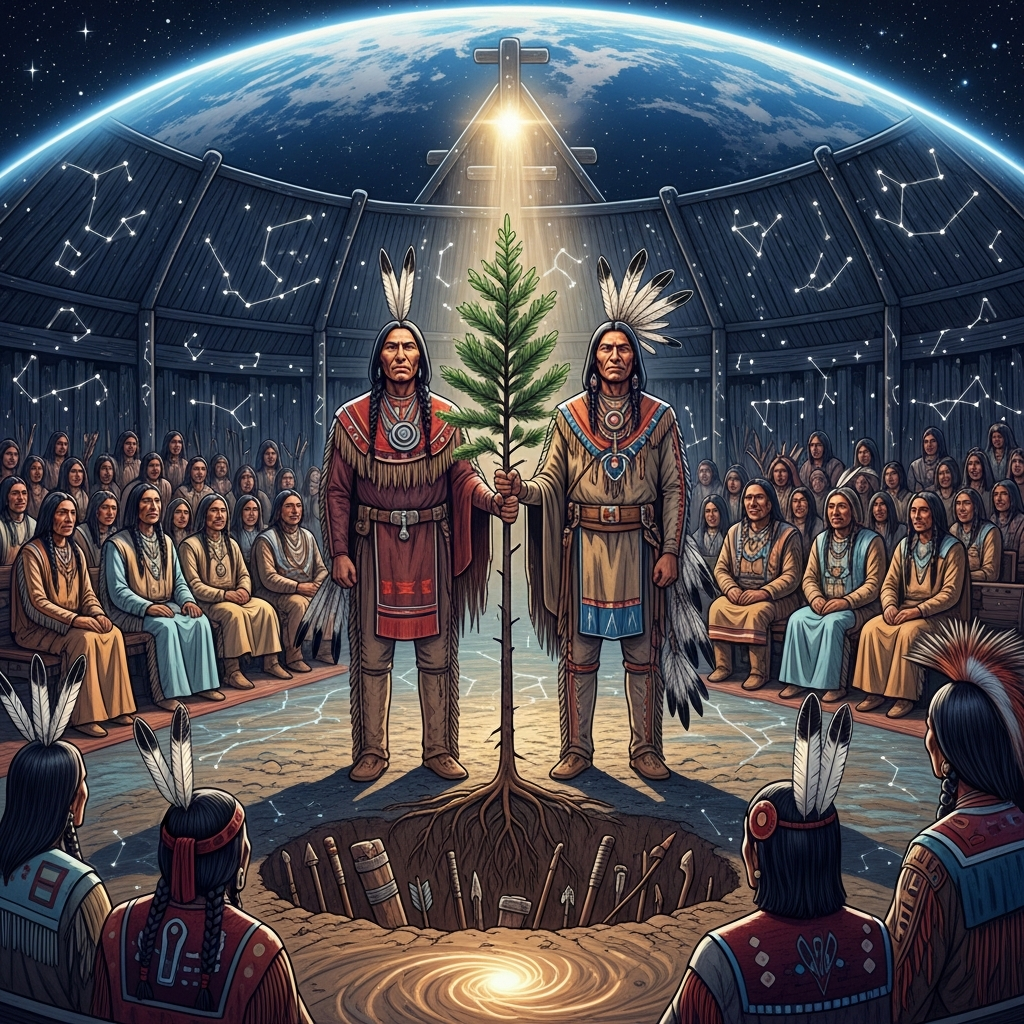
Under the Great Tree of Peace — a white pine, whose roots spread in four directions toward the four corners of the earth — the five nations bury their weapons. They plant the Tree of Peace at Onondaga, where Atotarho keeps the fire. The Great Law is spoken, and then spoken again, and then memorized by the men appointed to remember it, and then practiced.
The Law is specific. It governs how decisions are made: by consensus, not majority. It specifies the role of the Clan Mothers, who hold the real authority — who appoint the chiefs and can remove them. It establishes the forty-nine seats of the Grand Council, arranged not by power but by function. It builds in mechanisms for mourning, for condolence, for the reconstitution of leadership after loss. It has been in operation, in one form or another, for between five hundred and nine hundred years.
The wampum belt that records it — the Hiawatha Belt — is white and purple shells woven into a pattern of five nations joined: four squares connected to a central tree. It is not decoration. It is the constitution. Every clause has its corresponding pattern of shells, and the shell-pattern is the law.
Hiawatha leaves after the Great Law is established.
He paddles away in a canoe, across the water, and ascends into the sky. The tradition gives him this departure — the man who was made by grief into something terrible, and then by compassion into something essential, is taken up. He does not die in the ordinary sense. He is completed.
The Peacemaker’s message was true: peace is more powerful than war. But the messenger of that message was not a perfect being, untouched by the world’s violence. It was a man who had eaten grief until he became the grief, and then been found by someone who refused to see only the grief, and spoken back into himself.
This is the political theology of the Great Law: that the authority to speak of peace comes from having suffered war, and that the condolence ceremony — the wiping of tears, the clearing of ears and throat — is not incidental to governance but is its foundation. You cannot govern until you can see, hear, and speak. You cannot make peace until someone has helped you put down your pot.
The fire at Onondaga still burns.
Echoes Across Traditions
Entities
- Deganawida (the Peacemaker)
- Hiawatha
- Atotarho (the serpent-haired sorcerer)
- The Five Nations (Mohawk, Oneida, Onondaga, Cayuga, Seneca)
Sources
- Paul A.W. Wallace, *The White Roots of Peace*, 1946
- Arthur C. Parker, 'The Constitution of the Five Nations,' *New York State Museum Bulletin*, 1916
- John Mohawk, 'The Iroquois Great Law of Peace,' in *Akwesasne Notes*, 1978
- Oren Lyons and John Mohawk, eds., *Exiled in the Land of the Free: Democracy, Indian Nations, and the U.S. Constitution*, 1992
- Barbara Alice Mann and Jerry L. Fields, 'A Sign in the Sky: Dating the League of the Haudenosaunee,' *American Indian Culture and Research Journal* 21:2, 1997