Sky Woman Falls onto the Turtle's Back
Haudenosaunee (Iroquois) oral tradition; recorded from 17th century CE onward · The sky-world; the primordial sea; Turtle Island (North America)
Contents
Sky Woman falls through a hole in the sky-world, grasping seeds and plants as she falls. The animals of the primordial sea catch her and dive to the deep to bring mud to pile on Turtle's back — creating the earth. Sky Woman plants her seeds and dances the earth alive. She is pregnant. The world begins with a falling woman and the generosity of animals.
- When
- Haudenosaunee (Iroquois) oral tradition; recorded from 17th century CE onward
- Where
- The sky-world; the primordial sea; Turtle Island (North America)
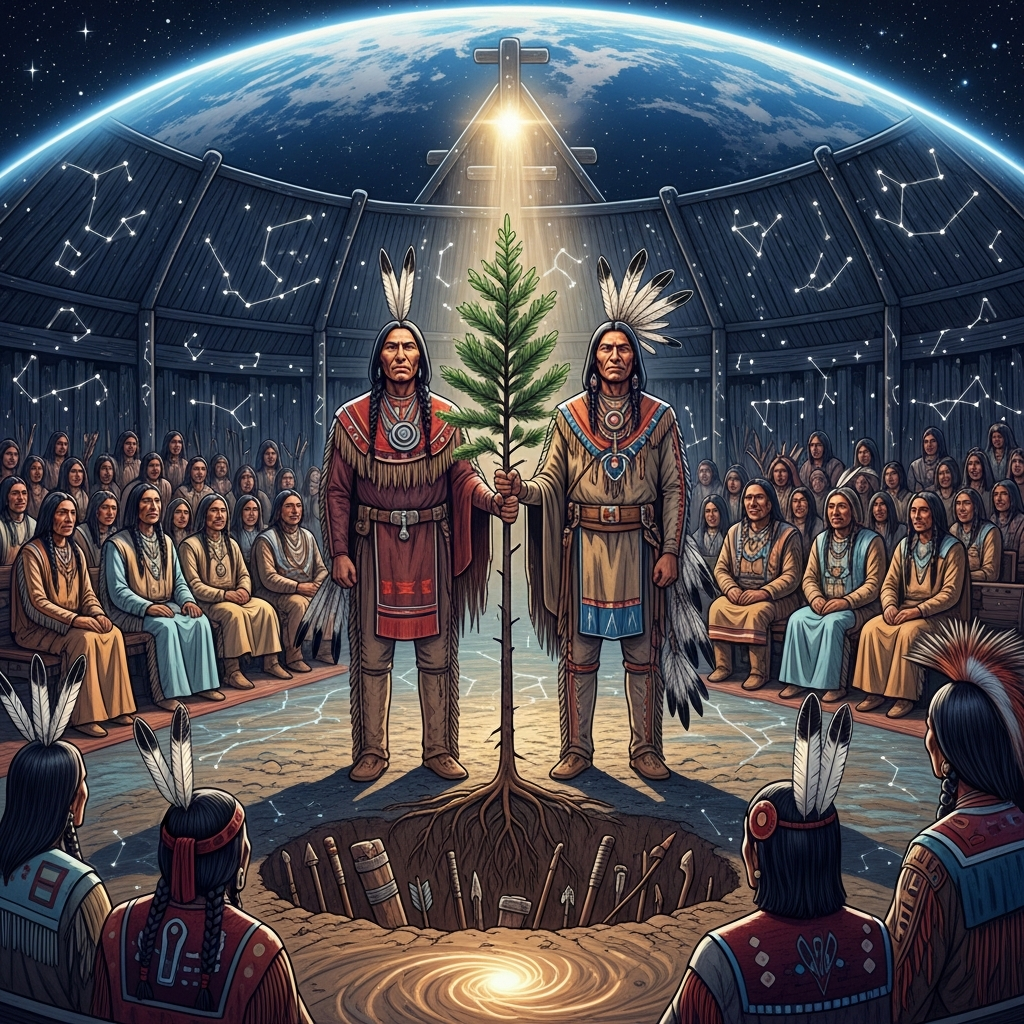
In the sky-world, there is a great tree at the center.
It is not a metaphor. The sky-world is a real place — a world above this one, lit by flowers rather than a sun, where people live and animals live and the usual business of existence is conducted — and at its center stands the great tree, the tree of life, whose roots reach so deep into the sky-floor that its roots and the sky are the same thing. Around this tree, people gather to conduct the ceremonies that keep the sky-world in balance. The tree is never cut. To cut it would be to open a hole in the sky.
Sky Woman’s husband cuts it.
The reason differs in the telling. He has dreamed that the tree must be uprooted. He is jealous of his pregnant wife and the man she dances with at the ceremony. He has been told something by a voice that the tradition does not name. Whatever the reason, he uproots the tree — or pushes his wife into the hole, or she falls while bending to look through it — and the sky-floor opens, and Sky Woman falls.
She falls through the gap.
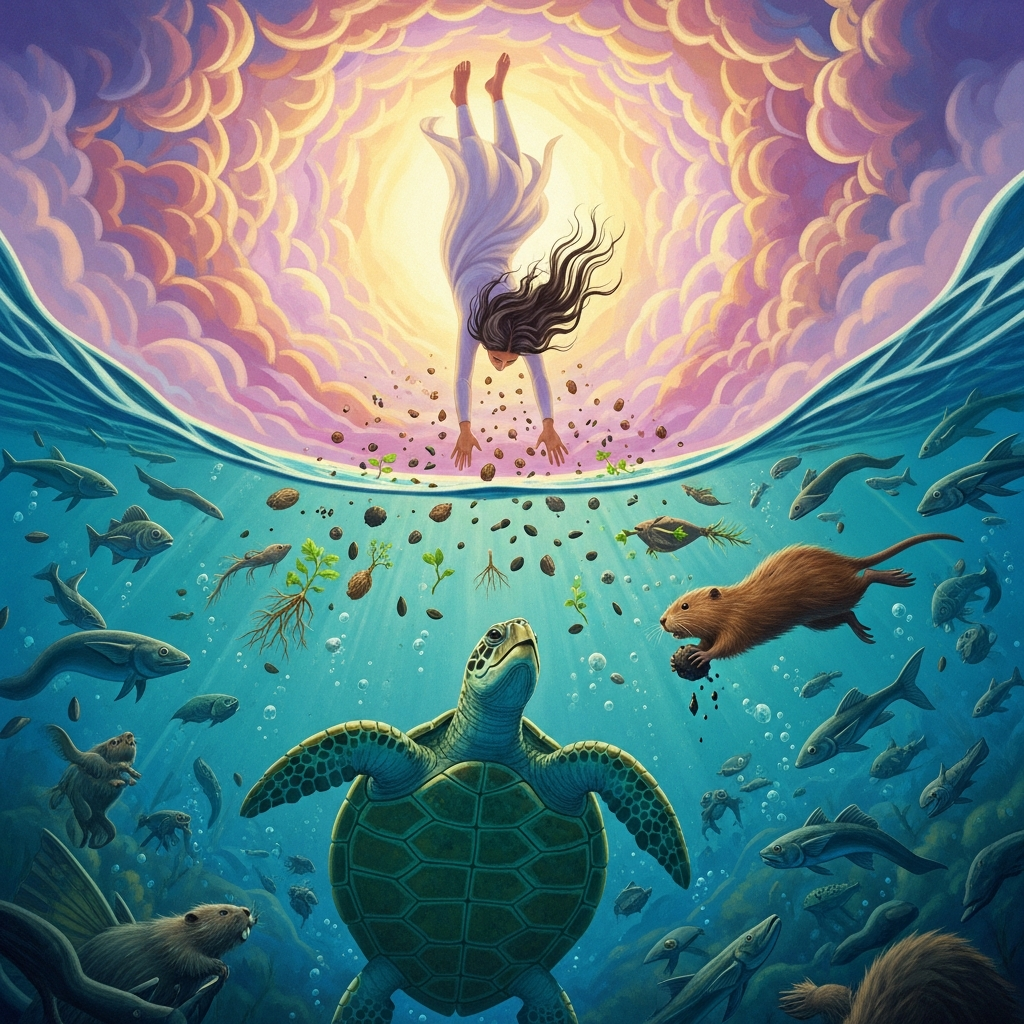
She is quick enough, or lucky enough, or the sky is compassionate enough — she grabs at the earth as she goes over. She catches what she can: seeds, yes, and roots and cuttings of the plants that grow in the sky-world. She is pregnant. She is holding life in two ways at once as she tumbles into the space below the sky, which is all water, everywhere, flat and dark and without form and without end.
The animals see her coming.
There is no land, only water and sky, and in the water the animals swim — the great ones, the ones who were first. The duck sees her falling and cries out. The geese see her. There is a moment of decision that happens fast, in the way animal decisions happen fast, without deliberation: the birds fly up in a flock and arrange themselves in a platform beneath her, breaking her fall with their bodies.
She lands on the backs of the birds.
The birds can support her for a moment — they are flying, not floating, and this is not a solution. The animals beneath the water confer. The Great Turtle rises. He is enormous, patient, old in a way that predates age as a concept. He surfaces and offers his back, and the birds lower Sky Woman onto it, and she is safe, for now.
But Turtle’s back is shell, not earth. It cannot sustain her. She needs ground.
There is ground, somewhere — the animals know this, because they have been swimming in water above ground for as long as water has been here, and the bottom of the water is the earth that has not yet arrived. Someone must dive for it. Someone must reach the bottom, which is so far down that the strongest swimmer has never found it, and bring back even a handful of the mud waiting there.
The otter tries. He is a strong swimmer and a brave one, and he dives until he cannot dive further, and he surfaces with nothing.
The beaver tries. He is stronger still, and patient, and he goes down and does not come up for a long time — the animals begin to think he will not come up at all — and then he surfaces, gasping, with empty paws.
The muskrat tries.
He is the smallest of the divers. The other animals may not have believed he could do what the stronger ones could not. But the muskrat goes down and does not come back, and does not come back, and does not come back, until at last he floats to the surface — dead, or close to it, his body spent — with one small paw clenched around a ball of mud from the very bottom of the world.
Sky Woman takes the mud.
She places it on Turtle’s back. It is a small thing — barely enough to cup in two palms — and it is all the world there is. She breathes on it, or she prays over it, or she simply works it with her hands: the accounts vary, but the motion is the same. She walks the edge of Turtle’s shell and pats the mud outward as she goes, and where her feet fall the mud spreads, and where the mud spreads there is land.
She plants the seeds she carried from the sky-world.
She dances.
The land grows with her dancing — grows outward and outward, the way a ripple grows from a stone dropped in still water, the circle of earth expanding from the turtle’s back until it is wide enough to walk on, wide enough to plant in, wide enough to be a world. The sky-world seeds take root in the new earth. The plants that grew in the old light grow again in this new place.
She is still pregnant when the earth is large enough to live on.
She gives birth to a daughter.
The daughter grows quickly, as children in founding myths often do. She grows to the age of marriage and meets a spirit — or a man, or a pair of voices in the night — and she too becomes pregnant. But when her time comes, her twins quarrel inside her. The first twin, Sapling — the good-minded one, the one who will make gentle hills and clear rivers and useful plants — is born in the ordinary way. The second twin, Flint, impatient and contrary, forces his way out through his mother’s armpit and kills her.
Sky Woman buries her daughter. From the grave, the essential things grow: corn from her chest, beans from her hands, squash from her belly. These are the Three Sisters, the three crops that will feed the people who are coming. The grandmother’s loss becomes the people’s sustenance. This is how the tradition understands the relationship between grief and abundance: they come from the same ground.
The twins become creators in their own right, though they create against each other. Sapling makes the world habitable — smooth paths, calm rivers, animals that can be friends with people. Flint makes it difficult — rocky gorges, rapids, winter, the sharp edges of things. Between them they make the world that actually exists: neither pure gift nor pure hardship, but the complicated, beautiful, dangerous Turtle Island that Sky Woman danced into being.
The turtle is still there.
This is not a metaphor either. The Haudenosaunee understanding of the earth is literal: we live on the back of a great being who is patient beyond our understanding of patience, who offered his back before he was asked to, who has carried the world and its grief and its dancing and its wars and its ceremonies for as long as there has been mud to stand on.
When the earth shakes, some say, it is the turtle shifting.
The gratitude this requires is not the gratitude of a prayer spoken once and then forgotten. It is the gratitude of every step — the understanding, built into the founding story of the world, that what you stand on is a gift from a being who did not have to give it, and that the animals who dove for the mud were doing something that deserved to be remembered.
The muskrat died for the world. It is a small death, as deaths go. But without it, there is no world.
The sky-world still has a hole in it, where the tree was uprooted, where Sky Woman fell through into the dark. On certain nights, looking up, you can see the light that leaks through it. We call it something else now. But the Haudenosaunee know what it is: the opening through which everything began.
Echoes Across Traditions
Entities
- Sky Woman (Aataentsic)
- The Great Turtle
- The Muskrat
- The Twins (Sapling and Flint)
Sources
- John Norton (Teyoninhokarawen), *The Journal of Major John Norton*, 1816 (one of the earliest recorded versions)
- Hewitt, J.N.B., 'Iroquoian Cosmology,' *Annual Report of the Bureau of American Ethnology*, 1903
- Cusick, David, *Sketches of the Ancient History of the Six Nations*, 1827
- Barbara Alice Mann, *Iroquoian Women: The Gantowisas*, 2000
- Vine Deloria Jr., *Red Earth, White Lies*, 1995
- Paula Gunn Allen, *The Sacred Hoop: Recovering the Feminine in American Indian Traditions*, 1986