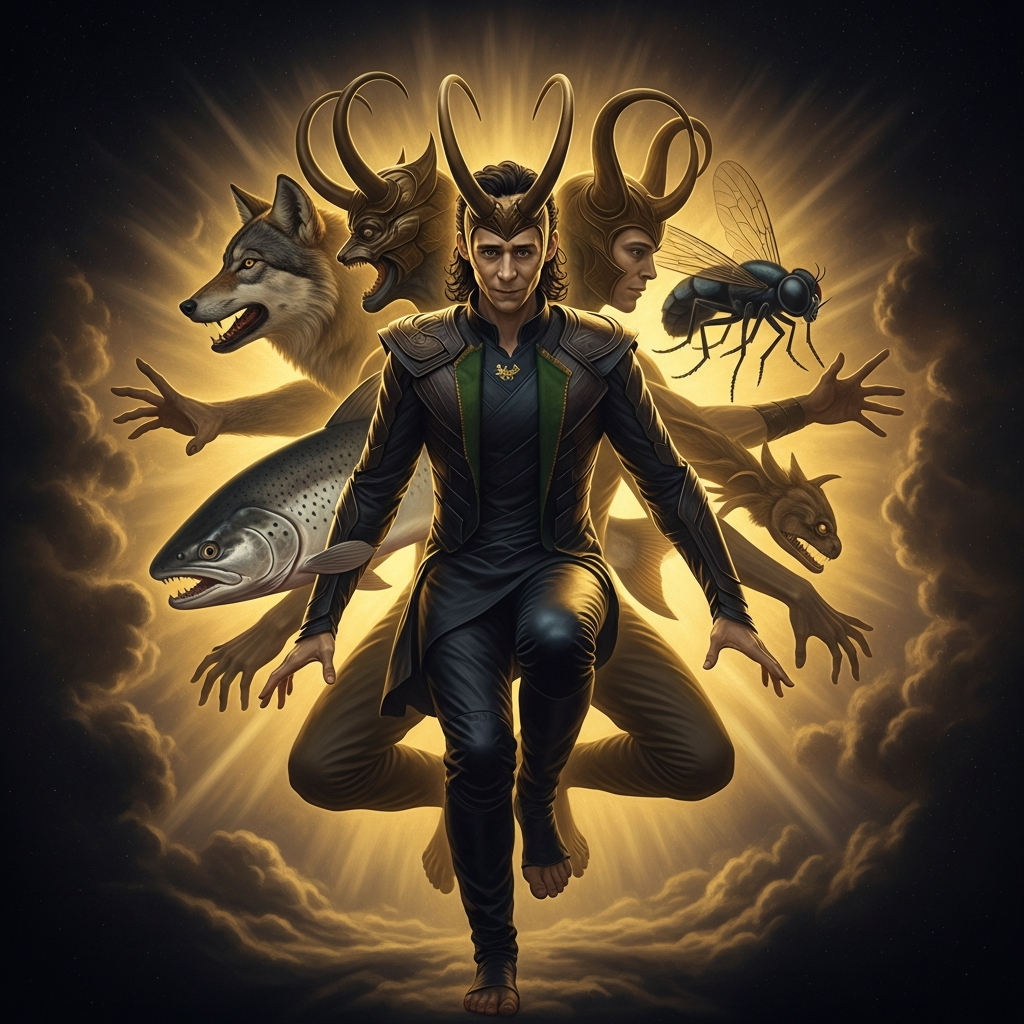
The Shape That Isn't Fixed: Proteus, Loki, Coyote, Vishnu, and Circe
Mythic time — across traditions spanning 2000 BCE to present oral tradition · The sea caves of Pharos, Asgard, the American Southwest, every form the world has ever taken, Aeaea
Contents
The shapeshifter appears in every mythology. Sometimes transformation is power. Sometimes it is punishment. Always it is the mythology's way of asking: what are you really, if your form can change?
- When
- Mythic time — across traditions spanning 2000 BCE to present oral tradition
- Where
- The sea caves of Pharos, Asgard, the American Southwest, every form the world has ever taken, Aeaea
What would it mean to have no fixed form?
Not to wear a disguise — that implies a true face beneath it. Not to undergo a transformation — that implies a before and after. But to be genuinely, constitutively capable of being anything, with no single shape that could claim to be the real one. This is the shapeshifter’s condition, and it is one of the most philosophically destabilizing ideas in world mythology.
The shapeshifter appears in every major mythological tradition. The details differ — Proteus knows all secrets, Loki serves and betrays, Coyote cannot stop himself, Vishnu chooses forms in service of cosmic necessity, Circe reveals what was already true. But the structural question they all pose is the same: if something can be anything, what is it?
Proteus: The Shape You Must Hold Through
Proteus lives in a sea cave on the island of Pharos, and he knows everything — all past events, all things present, all futures. In the Odyssey, Menelaus needs to know how to get home from Egypt, and he is told to consult Proteus. But Proteus will not simply answer the question. He must be caught.
Menelaus and his men hide under sea-lion skins, and when Proteus comes to shore and counts his flock and lies down to sleep, they seize him. What follows is Proteus’s attempt to escape through transformation: he becomes a lion, then a serpent, then a leopard, then a boar, then flowing water, then a tree. Menelaus and his men hold on through all of it. When Proteus exhausts his forms and returns to himself, he answers the question.
The myth encodes an epistemological claim: truth is available, but it will not be given easily. To know something real, you must be willing to hold on through the transformations of the thing you are trying to know — through every form it might take, every version it presents — until you reach what it actually is. Proteus does not lie. But the form he presents first is not the true one. The true one comes only at the end of the exhaustion of false forms.
Proteus also names a broader cultural function: the world is protean. Things appear in one form and are actually another. The task of wisdom — the task Menelaus had to perform, the task every person trying to understand something must perform — is to hold on to the question through all the forms the answer takes before it tells the truth.
Loki: The Shapeshifter in Service and Betrayal
Loki’s transformations across the Norse sagas are so varied and so functional that making a list of his shapes is itself a kind of mythological exercise: mare (to seduce the builder’s stallion), salmon (to hide from the gods after Baldr’s death), fly (to infiltrate the dwarven workshop and ruin Sif’s new hair), old woman named Thokk (to refuse to weep for Baldr and thereby prevent his resurrection), and various other forms as the situation required.
What unites all of Loki’s transformations is their purposiveness. He does not shift for the pleasure of shifting, or because his identity is genuinely fluid, or because he is performing a cosmic function like Vishnu. He shifts because the situation requires a form that the situation will not recognize as Loki. His transformations are operational. They are what a brilliant, amoral, socially unembedded intelligence does when it needs to accomplish something that cannot be accomplished as itself.
The Norse texts are curiously untroubled by the question of Loki’s “true form.” He is Loki in whatever form he takes. His identity is not located in his shape but in his characteristic moves — the cleverness, the willingness to betray any loyalty for the right problem, the combination of genuine help and genuine harm in the same personality. The shapeshifter whose identity is not in his form is Loki’s theological contribution to the question of selfhood: what you are is how you operate, not what you look like.
Coyote: The Shapeshifter Who Cannot Stay Fixed
Coyote’s transformations in Native American oral traditions are less tactical than Loki’s and more ontological. He does not shift in service of specific goals. He shifts because he is the kind of being that shifts, and the implications of this are different from anything in the European tradition.
Coyote has died many times. He has been killed, eaten, smashed, drowned, scattered to the winds — and he reconstitutes, returns, and continues. He has been transformed by others and has transformed others. In some traditions he is the creator of the world; in some he is the introducer of death; in some he is simply the unpredictable presence at the edge of every situation who will inevitably complicate it.
His transformations do not have a single theological logic because they arise from many different oral traditions across many nations, each with its own Coyote. But a common thread is that Coyote’s capacity for transformation is inseparable from his capacity for comedy: the shapeshifter is also the fool, and many of his transformations result in his own humiliation. He gets stuck. He miscalculates. He becomes something that then causes him problems. The shapeshifter’s power is also the shapeshifter’s vulnerability.
The most philosophically interesting Coyote myths are the ones in which his shapeshifting reveals the permeability of boundaries that other beings treat as fixed. The boundary between alive and dead, between human and animal, between present and absent — Coyote crosses these not because he is extraordinarily powerful but because his nature does not recognize them as barriers. The boundaries are real for beings that have fixed forms. For Coyote, they are suggestions.
Vishnu: Transformation as Cosmic Responsiveness
Vishnu’s ten avatars (Dashavatara) are a different kind of shapeshifting entirely — not evasion, not trickery, not the fluid identity of the trickster, but the deliberate divine assumption of a form appropriate to a specific crisis.
The fish (Matsya) saves the first man and the Vedas from the cosmic flood. The tortoise (Kurma) supports the churn during the Churning of the Cosmic Ocean. The boar (Varaha) dives into the cosmic waters to rescue the earth, which the demon Hiranyaksha has submerged. The man-lion (Narasimha) defeats the demon Hiranyakashipu, who has made himself invulnerable to any being that is fully god, human, animal, or demon — Narasimha, half-human and half-lion, exists in the gap. The dwarf (Vamana) defeats the demon-king Bali by claiming three steps of space and then expanding to cover the entire universe.
The avatars are not disguises. Vishnu-as-Krishna is not Vishnu pretending to be Krishna. He is genuinely Krishna, fully incarnate, with the divine consciousness within. The theological claim of avatar theology is that the divine can take any form necessary without ceasing to be the divine. Form does not limit identity. The shapeshifting god is not diminished by the forms he takes.
This is the most radical answer to the shapeshifter question: what is Vishnu when he is a fish? He is Vishnu, fully, in fish form. What is he when he is Krishna? He is Vishnu, fully, as a human being. The divine identity is not located in any particular form, which means it can take any form without loss. Infinite identity contains all forms.
Circe: Transformation as Revelation
Homer’s Circe — the sorceress of Aeaea — transforms Odysseus’s men into pigs with drugged wine and a touch of her wand. The transformation is usually read as punishment or as the demonstration of a witch’s power. But the Odyssey is more precise than that.
Odysseus’s men, on their first encounter with Aeaea, behave with the impulsiveness and appetite that has doomed them throughout the poem. They eat and drink what is given to them without caution, without asking what the island is or who its inhabitants are, without the discipline that Odysseus represents and they consistently lack. They become pigs.
The myth invites the interpretation that Circe does not transform them — she reveals what they already were. The pig is the animal of appetite without deliberation. The men who became pigs were the men who acted on appetite without deliberation. The sorcerer’s transformation is diagnostic: it makes the metaphorical literal.
Odysseus, protected by the herb moly (given by Hermes), maintains his human form and forces Circe to reverse the transformation. He stays, lives with Circe for a year, and eventually leaves. The man who holds his shape through the shapeshifter’s challenge is the man who knows what he is and does not allow external magic to redefine him.
What Cannot Be Changed
The shapeshifter tradition in every mythology is circling the same question: is there something that remains constant through transformation? Is there a self beneath the shapes?
Proteus: yes, there is truth, and you can reach it if you hold on long enough. Loki: the question barely matters — what counts is how you operate. Coyote: the question may be a category error — some beings do not have fixed selves, and this is not a problem. Vishnu: the divine identity contains all forms without being limited by any. Circe: the shape you take reveals what you already are.
Each answer is a different theory of selfhood. And each is exploring the same insight that motivates all shapeshifter mythology: form is not identity, but form is also not nothing. The shapeshifter reveals this by embodying it — by being the creature whose form and identity are most visibly disconnected, and whose very existence poses the question about whether the disconnection matters.
Echoes Across Traditions
Entities


Sources
- Homer, *Odyssey* (c. 800 BCE)
- Snorri Sturluson, *Prose Edda* (c. 1220 CE)
- Wendy Doniger, *The Hindus: An Alternative History* (2009)
- Åke Hultkrantz, *The Religions of the American Indians* (1967)
- Ovid, *Metamorphoses* (8 CE)
- Wendy Doniger O'Flaherty, *Women, Androgynes, and Other Mythical Beasts* (1980)