The Mantis Who Created the Eland
Oral tradition of the |Xam and other San peoples; recorded by Wilhelm Bleek and Lucy Lloyd, 1870s–1880s · The Kalahari; the dry plains of southern Africa; the spirit world that overlaps them
Contents
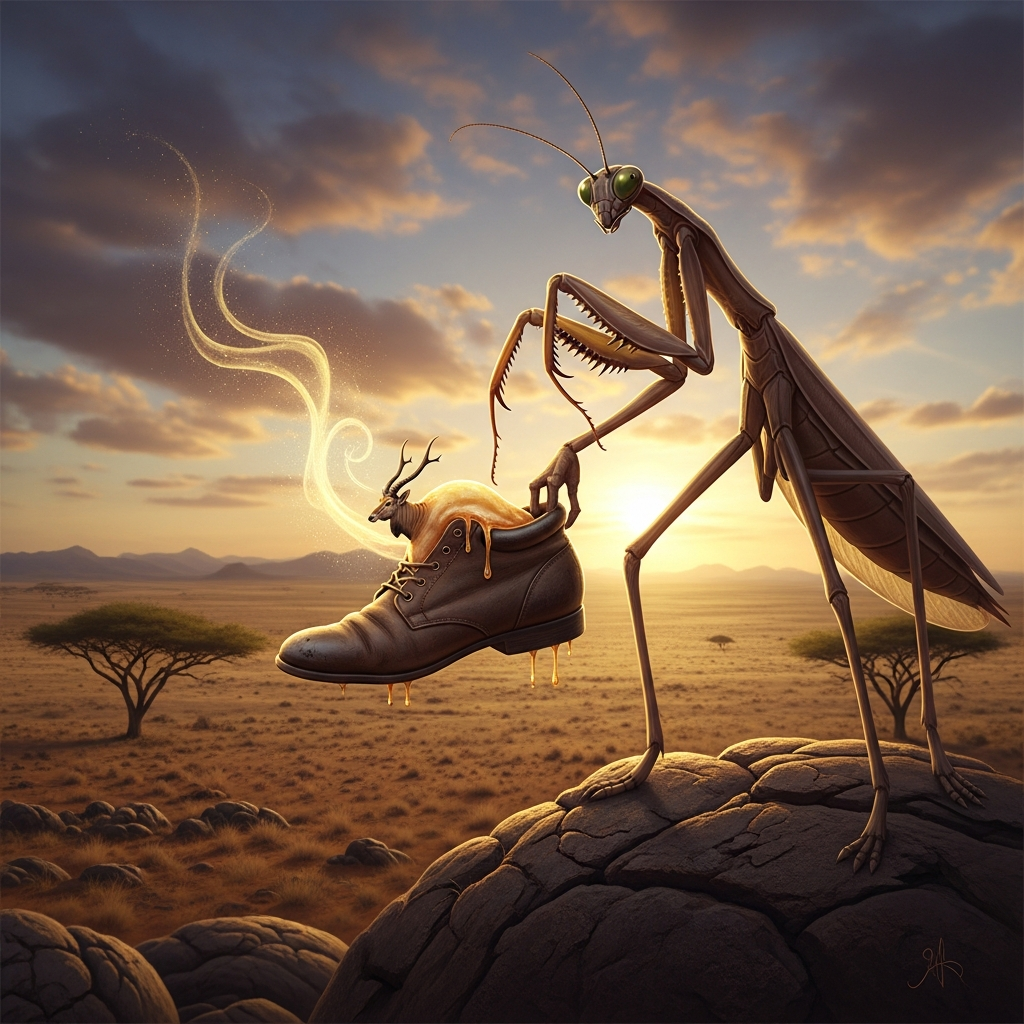
The great trickster Kaggen, who is also the praying mantis, makes the first eland from a shoe — rubbing fat and honey into the leather until it grows hair and horns and stands and walks. The eland is Kaggen's beloved creation, his connection to the spirit world. When hunters kill it, Kaggen weeps, and from his tears new eland are born.
- When
- Oral tradition of the |Xam and other San peoples; recorded by Wilhelm Bleek and Lucy Lloyd, 1870s–1880s
- Where
- The Kalahari; the dry plains of southern Africa; the spirit world that overlaps them
Kaggen found an old shoe.
It was not his shoe — Kaggen acquired things through means that did not always involve ownership — but it was the right material for what he had in mind. Leather, cured, worked soft by years of use, still holding something of the animal it had been. He took it to the waterhole where the reeds were thick and the ground was soft, and he laid it down carefully on the mud.
He began to rub it.
He rubbed fat into the leather — the kind of fat that accumulates around the kidneys of large animals, the richest fat, the fat that burns longest and smells sweetest when it renders. He rubbed honey into it, the wild honey from the nests in the termite mounds, dark and thick and slightly fermented. The leather began to change color. It began to soften in a different way — not the way worked leather softens but the way living skin softens, from the inside.
Kaggen talked to it while he worked. He talked the way you talk to something when you want it to become what you are imagining. He said words the |Xam informants who told this story to Lucy Lloyd did not always repeat — sacred words, words in the register of creative speech, words that had the quality of instruction rather than description. He said: grow. He said: become what I am making you into.
Hair appeared first.
Not all at once — in patches, the way fur grows back over a wound, tentative and then committed. The hair came in the eland’s characteristic tawny-grey, the color that makes them disappear at dusk into the long grass. Then the neck thickened. Then the shoulders rose into the distinctive hump. The horns came last, spiraling up from the forehead the way eland horns spiral: not curved like a kudu, not swept back like an impala, but a slow tight rotation, almost architectural.
By the time the sun moved to late afternoon, there was an eland where the shoe had been.
It stood on the soft ground at the waterhole on new legs, surprised by its own weight, finding its balance in the careful way of newly made things. Kaggen watched it. He was very pleased. He was perhaps more pleased by this eland than by anything else he had ever done, which was considerable — he had done a great deal, some of it on purpose.
He came back the next day, and the eland had grown.
He came back again and again. He rubbed more honey into the eland’s sides, which it seemed to enjoy — it would stand patiently while Kaggen worked the honey into the fold of skin behind its shoulder, the way a horse stands patiently for a person it trusts. The eland grew large. The eland became the thing it was supposed to become.
Kaggen visited it at the waterhole in the evenings. He sat with it in the reeds.
The hunters found it.
This is Ichneumon’s fault, or Kwammanga’s — the versions differ on which member of Kaggen’s complicated family first located the eland and failed to leave it alone. They were hungry. There was a large eland in the reeds by the waterhole. The calculation that followed was the calculation hunters make: a large eland is meat for many days, fat for cooking, hide for clothing, sinew for bowstrings, bones for tools.
They killed it.
By the time Kaggen arrived at the waterhole, the eland was already down and the family was already butchering it with the practiced efficiency of people who had done this many times. They knew how to work quickly. They had already separated the best parts.
Kaggen stood at the edge of the reeds and looked at what had been his eland.
He wept.
This is the part of the story the |Xam tellers returned to again and again in Lloyd’s notebooks — the weeping, which surprised them even as they told it. Kaggen was a trickster. He was not supposed to weep. But he wept for his eland the way a parent weeps for a child: entirely, without reservation, the kind of weeping that is not embarrassed by itself.
His tears fell on the ground. Where each tear fell, something moved in the earth. From the tears, new eland were born — not the first eland, that specific beloved creature, but the category of eland: the animal as a species, the eland as a permanent feature of the world, plural and ongoing, running into the distance faster than Kaggen could follow.
This is why the eland is sacred.
Not because eland are rare — they were, in the time of the |Xam, abundant enough that people ate them regularly. But because the eland came from Kaggen’s grief, which means that every eland carries inside it the substance of a creator’s love and loss. The fat of the eland is sacred fat. The blood is sacred blood. The trance-dance that San healers perform to enter the spirit world uses the eland as its central symbol: the dying healer is compared to a dying eland, the entering of the spirit world is the entrance into the eland’s death.
David Lewis-Williams has argued, from studying the rock art sites across southern Africa, that the eland paintings are not records of hunts but records of trance — that the phosphene patterns that appear around painted eland are the geometric hallucinations of the deep trance state, and that the eland images are the spirit world depicted from inside the spirit world, with the eland as the threshold creature through which the shaman’s consciousness crosses.
If this is right, then every time a San healer dances into trance and enters the spirit world through the eland’s death, they are repeating Kaggen’s original act: making something new from something ordinary, in the soft ground by the waterhole, rubbing honey into leather until it starts to breathe.
Kaggen did not stop.
After the first eland was killed and the tears had made the species, he made other things — he was always making other things, the |Xam stories are full of his projects, most of them impulsive, some of them disastrous, all of them real. He made the moon from his shoe. He argued with his family and lost. He was eaten by a caterpillar and reconstituted himself from scraps.
He is still the mantis. The actual praying mantis, the insect: green, angular, still, turning its triangular head with that uncanny deliberateness that seems like thought. The |Xam would not kill a mantis. If one landed on you, you spoke to it carefully.
You never knew who you were speaking to.
Echoes Across Traditions
Entities
- Kaggen (the Mantis)
- the eland
- Kwammanga (the Rainbow)
- Ichneumon (the mongoose)
Sources
- Wilhelm Bleek and Lucy Lloyd, *Specimens of Bushman Folklore* (1911)
- David Lewis-Williams, *The Mind in the Cave* (2002)
- Mathias Guenther, *Tricksters and Trancers: Bushman Religion and Society* (1999)
- David Lewis-Williams and David Pearce, *San Spirituality: Roots, Expression and Social Consequences* (2004)
- Dorothea Bleek, *The Mantis and His Friends* (1924)


