The Axis of Heaven: Sacred Mountains Across Six Traditions
Ancient, across all periods — Greek archaic period through contemporary pilgrimage traditions · Mount Olympus (Greece), Mount Meru (Hindu/Buddhist cosmology), Mount Sinai (Sinai Peninsula), Mount Kailash (Tibet), Mount Fuji (Japan), Mount Ararat (Armenia/Turkey)
Contents
Mountains are where gods live, where prophets receive revelation, and where earth meets sky. Olympus, Meru, Sinai, Kailash, Fuji, and Ararat are different peaks encoding the same theology: height is holiness, and the mountain is where the human world and divine world touch.
- When
- Ancient, across all periods — Greek archaic period through contemporary pilgrimage traditions
- Where
- Mount Olympus (Greece), Mount Meru (Hindu/Buddhist cosmology), Mount Sinai (Sinai Peninsula), Mount Kailash (Tibet), Mount Fuji (Japan), Mount Ararat (Armenia/Turkey)
Every civilization that has ever built itself in the shadow of a mountain has eventually called the mountain holy.
The pattern is so consistent across cultures and continents that the historian of religion Mircea Eliade made it one of his central theoretical concepts: the axis mundi, the world’s vertical center, the point where earth, heaven, and underworld connect. The mountain is the most physically immediate version of this axis — it goes up, and before aircraft and satellites and the Hubble telescope, up was the direction of the divine. The gods lived above the clouds, which was visible fact to any ancient observer: the cloud layer obscured the mountain’s peak and the cloud layer was where storms came from and storms were divine. The vertical axis was not metaphor. It was geography.
What different traditions did with their sacred peaks — who they placed on them, what rituals they performed there, whether the mountain could be climbed or only circled — reveals the theological grammar beneath the shared structure.
Mount Olympus: Where the Gods Actually Live
The Greek divine court is located on a real mountain.
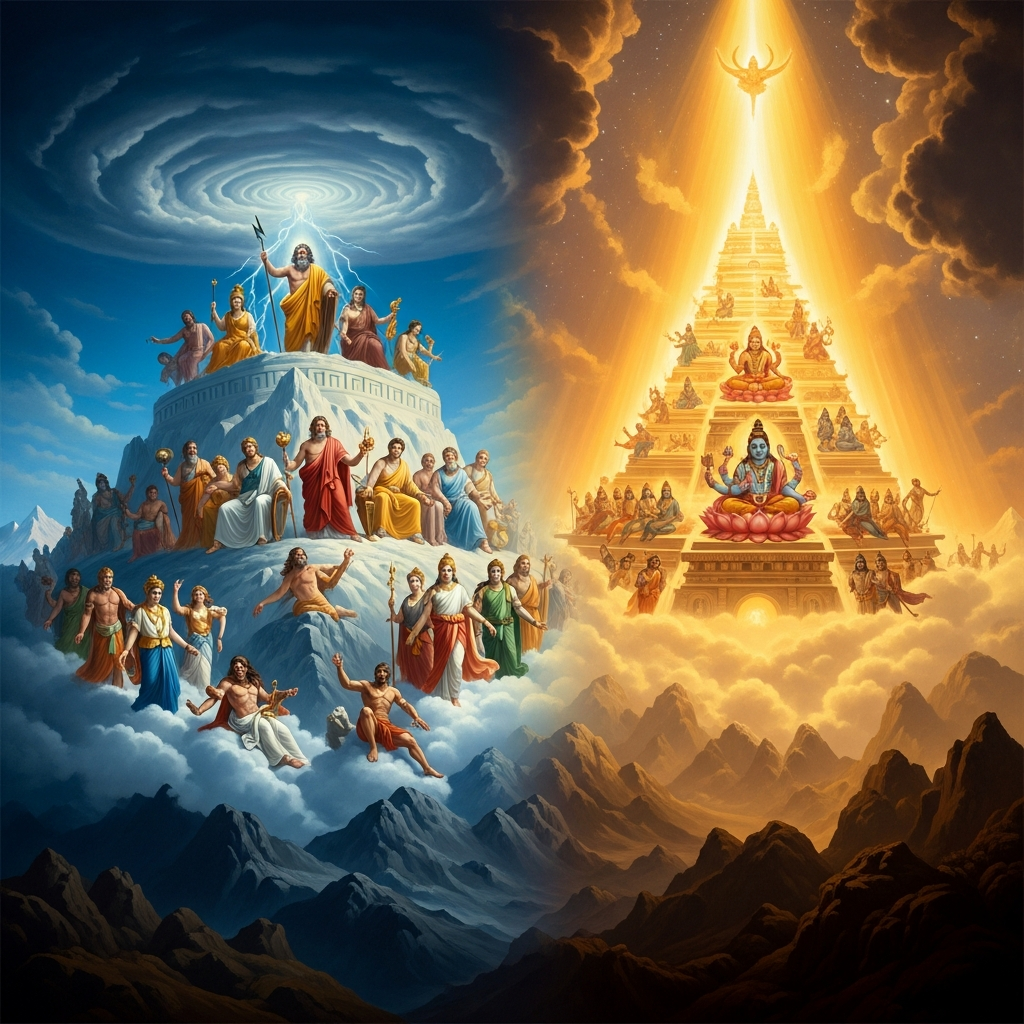
Mount Olympus in northern Thessaly is the highest peak in Greece, 2,917 meters, frequently obscured by clouds in its upper reaches. The Greeks did not say that the gods lived on a mountain that resembled Olympus, or that the divine realm was accessible at Olympus, or that Olympus was the symbolic home of the gods. They said the gods lived there. The divine court was physically above Greece, physically inaccessible (the ancient Greeks did not have technical mountaineering equipment), physically above the cloud layer that they could observe from below.
The theology flows directly from the geography: the gods are above you. When they intervene in human affairs, they descend. When humans try to reach the gods, they ascend (metaphorically or through ritual). The vertical axis between human and divine is spatial before it is theological.
What living on a mountain means for divine character: the Olympians can see everything below them. Their perspective is literally elevated. Their decisions affect the world below. Their conversations and politics happen in the zone above the clouds that no human being can ordinarily enter. The divine is not invisible or immaterial; it is simply higher. The vertical gap between gods and humans is the gap between the peak above the clouds and the plain below them.
The Oracle at Delphi was located partway up the slopes of Mount Parnassus — not on the summit, but elevated, in a cleft in the rock, in the domain of Apollo. The sacred mountain was also the site of prophetic revelation, and the geographic reasoning is similar: higher means closer to divine knowledge.
Mount Meru: The Mountain That Is the Universe
Hindu, Buddhist, and Jain cosmology places Mount Meru (or Sumeru) at the physical center of the universe, rising from the cosmic ocean to a height that exceeds physical reality entirely.
In the standard Hindu cosmological account, Meru rises 84,000 yojanas above the earth (a measurement that varies in different texts but in all cases exceeds any physical mountain by several orders of magnitude). Its four sides are of different colors — white, yellow, red, and black — corresponding to the four directions. The Ganges and other sacred rivers flow from its summit. The gods and celestial beings dwell on its slopes. The sun, moon, and stars orbit around it.
Meru is not identifiable with any real mountain. Proposals have been made (the Pamir plateau, Mount Kailash, even the North Pole), but Meru’s sacred significance does not depend on geographic identification. Meru is the principle of the cosmic center — the point around which everything else organizes, the axis that the universe’s structure depends on. Every city, every temple, every Hindu monastery that builds a central tower is constructing a Meru in miniature. The principle is architectural as well as cosmological.
This is the sacred mountain at its most abstract: not a physical location where the divine can be encountered but a geometric concept that the physical world is organized around. The world is a universe with a center, and the center is high, and height is the direction of the sacred.
Mount Sinai: The Mountain of Revelation
Sinai is not where God lives. It is where God spoke.
The theological structure of the Sinai revelation in Exodus is carefully constructed to distinguish the Abrahamic sacred mountain from the Greek model. Yahweh is not localized to Sinai — he was present before Moses climbed it, active in Egypt during the plagues, visible in the pillar of cloud and fire during the desert journey. Sinai is not his home. It is the place where the relationship between Yahweh and Israel was formalized in the most intense recorded encounter.
The Sinai theophany is terrifying precisely because it is uncontrolled. The mountain smokes and shakes. The people cannot approach the base without dying. Even Moses approaches the divine presence with fear. What happens at Sinai is not a comfortable divine visit but a cosmic confrontation between infinite power and human frailty — mediated by Moses, separated by distance, structured by the warning that ordinary people must keep their distance.
The Sinai model of the sacred mountain is: the mountain as a boundary between what humans can survive and what they cannot. The divine does not live there; it appears there. The revelation is the event, not the place. And the revelation produces an obligation — the Torah, the covenant, the structure of religious life — rather than ongoing access.
This is the Protestant instinct already built into the Hebrew original: the mountain is important because of what happened there, not because of what is perpetually available there.
Mount Kailash: The Peak That Must Not Be Climbed
Mount Kailash in the Tibetan Himalayas has never been climbed. This is not for lack of technical capability — mountaineers have surveyed routes, and the peak at 6,638 meters is not technically exceptional by Himalayan standards. It has not been climbed because every tradition that regards it as sacred — Hindu, Buddhist, Jain, and Bon — holds that climbing it would be a desecration.
The Hindu tradition places Kailash as the throne of Shiva, his cosmic mountain home where he sits in eternal meditation. Circling the mountain — the kora, 52 kilometers — is among the most important pilgrimage acts in Hinduism. A single circuit is said to erase a lifetime’s sins. Thirteen circuits breaks the cycle of death and rebirth. One hundred and eight circuits produces enlightenment in this lifetime.
The Buddhist tradition identifies Kailash as the home of Demchog (Chakrasamvara), a tantric deity who represents supreme bliss. Tibetan Buddhist pilgrims perform the same kora as the Hindu pilgrims, prostrating every step of the way in the most extreme form of the circuit.
What makes Kailash theologically distinctive is the inviolability. The mountain is holy in part because it cannot be conquered. Its sacredness is maintained by the refusal to reach the summit. This is the opposite of the Olympus model, where the mountain’s inaccessibility was a physical fact (no ancient Greek had the equipment to climb it) rather than a religious requirement. Kailash’s inaccessibility is a theological choice maintained against available technical means.
The sacred mountain that must not be climbed asks a question that the accessible sacred mountain does not: is sacredness something that increases the higher you go, such that the summit is the most sacred place of all? Or is the summit precisely the place that must be protected from human presence, whose sacredness depends on its not being reached?
The Logic of High Places
The axis mundi theology behind sacred mountains is not complicated once you see it: height is the direction of transcendence in almost every culture, because height is where the sky is, the sky is where divinity lives, and the mountain is the one place on earth where you can get demonstrably, measurably closer to it.
What makes the sacred mountain theology interesting is the question each tradition answered differently: what do you do with the height? Do you live on the mountain (Olympus)? Circumambulate it forever without ascending (Kailash)? Receive revelation there once, in terror (Sinai)? Map the universe’s structure onto it (Meru)? Make it a pilgrimage goal of beauty and form (Fuji)?
The theological grammar is shared. The vocabulary is entirely each tradition’s own.
Echoes Across Traditions
Entities
- Zeus
- Shiva
- Moses
- Yahweh

Sources
- Mircea Eliade, *The Sacred and the Profane: The Nature of Religion* (1959)
- Walter Burkert, *Greek Religion* (1985)
- Wendy Doniger, *The Hindus: An Alternative History* (2009)
- William Dalrymple, *Nine Lives: In Search of the Sacred in Modern India* (2009)
- Edwin Bernbaum, *Sacred Mountains of the World* (1990)