The Peacemaker and the Great Law
c. 1000-1450 CE — the founding of the Haudenosaunee Confederacy · Onondaga Lake; the territories of the Mohawk, Oneida, Onondaga, Cayuga, and Seneca Nations
Contents
The Peacemaker and Hiawatha travel through the warring nations of the northeast, uprooting the Tree of Peace on the shore of Onondaga Lake, and beneath its roots they bury the weapons of war — giving the Haudenosaunee Confederacy its constitution.
- When
- c. 1000-1450 CE — the founding of the Haudenosaunee Confederacy
- Where
- Onondaga Lake; the territories of the Mohawk, Oneida, Onondaga, Cayuga, and Seneca Nations
Before the Great Law, the nations are at war.
The Haudenosaunee peoples — who will become the Mohawk, Oneida, Onondaga, Cayuga, and Seneca — are fighting each other in the endless spiral of revenge that begins with a killing and requires a killing to answer and requires another to answer that, generation after generation, until the violence has its own logic that has nothing to do with the original cause.
A man is born across the lake, in the Huron country, who comes to end it.
He is called the Peacemaker, because the traditions hold his name too sacred to speak casually.
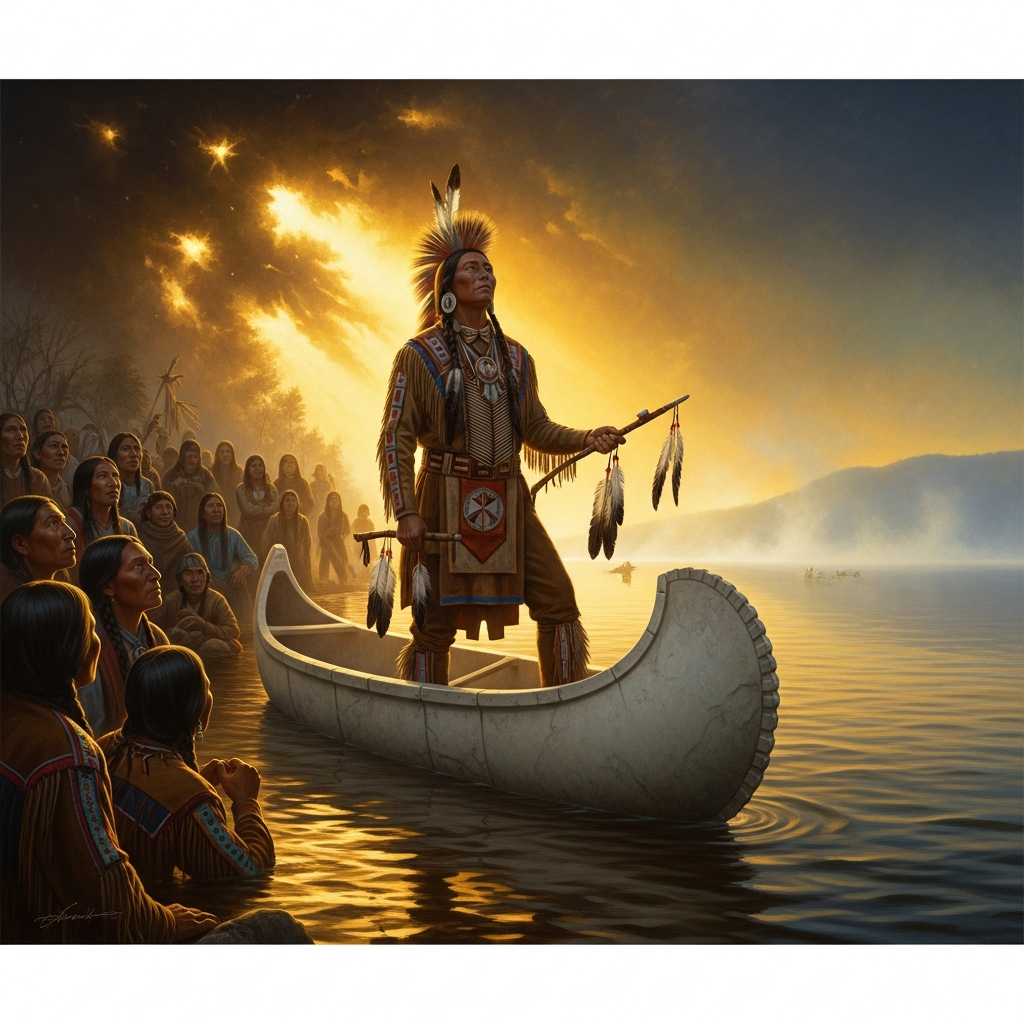
He comes in a white canoe — white stone, some versions say, impossible and buoyant — and he arrives first at the house of Jigonhsasee, the Mother of Nations, the woman who feeds the war parties from both sides as they travel. She is the first to accept his message: the Good Mind, the Good Word, the Good Power that is the foundation of the confederacy he is building.
The Peacemaker travels to each nation in turn, speaking his message of peace. He finds them locked in grief and revenge. He finds chiefs whose grief has twisted them into sorcerers, into men who carry so much unhealed pain that their hair has become snakes — this is Atotarho, the Onondaga chief, the last and most powerful holdout, the man most deeply transformed by violence.
He cannot confront Atotarho with argument. He enlists Hiawatha.
Hiawatha is a man who has lost everything.
His daughters have been killed, one by one, by Atotarho’s sorcery. He is in the kind of grief that makes a person unable to do anything, unable to speak, unable to eat, unable to go forward. He is sitting on the shore of the lake when the Peacemaker finds him.
The Peacemaker performs the first condolence ceremony: the wiping of tears, the clearing of the ears, the opening of the throat. He uses strings of wampum — the white and purple shell beads that will become the language of Haudenosaunee diplomacy — to speak to each part of Hiawatha’s grief and address it. He gives Hiawatha back his voice.
Hiawatha becomes the Peacemaker’s speaker — the one who carries the words to those who cannot hear them directly.
Together they go to Atotarho.
They sing to him. The Peacemaker reaches out and untangles the snakes from his hair, the visible sign of his transformation by grief and anger, combing them out with his hands. They offer him something no one has offered before: not defeat, but a role. The most powerful holdout will be the first among equals — the firekeeper, the one who calls the confederacy’s council to order. His power is acknowledged, not destroyed.
Atotarho accepts.
The five nations come together at Onondaga Lake. The Peacemaker plants the Great White Pine — the Tree of Peace — and beneath its roots he buries the weapons of war. The four white roots of the tree extend to the four directions, so that any nation seeking peace can follow the roots back to the source. An eagle sits at the top, watching for threats to the peace.
He tells them: the law is not mine. It belongs to all of you together. No nation is more powerful than the others. The confederacy requires agreement. The women choose the chiefs. The chiefs serve at the pleasure of the women who chose them. If a chief cannot carry the Good Mind, the women put the antlers of office aside.
The Great Law.
It has held for six hundred years.
It holds now.
Echoes Across Traditions
Entities
- the Peacemaker (Deganawida)
- Hiawatha (the Peacemaker's speaker)
- Jigonhsasee (the Mother of Nations)
- Atotarho (the serpent-haired chief)
- the Great White Pine
Sources
- Paul Wallace, *White Roots of Peace: The Iroquois Book of Life* (Clear Light, 1994)
- Barbara Mann and Jerry Fields, 'A Sign in the Sky: Dating the League of the Haudenosaunee,' *American Indian Culture and Research Journal* (1997)
- John Mohawk, *Thinking in Indian* (Fulcrum, 2010)