Tjukurpa: The Law That Runs Through Everything
the Tjukurpa — the always-time · The Western Desert, South Australia and Northern Territory — Luritja and Anangu country around Uluru-Kata Tjuta
Contents
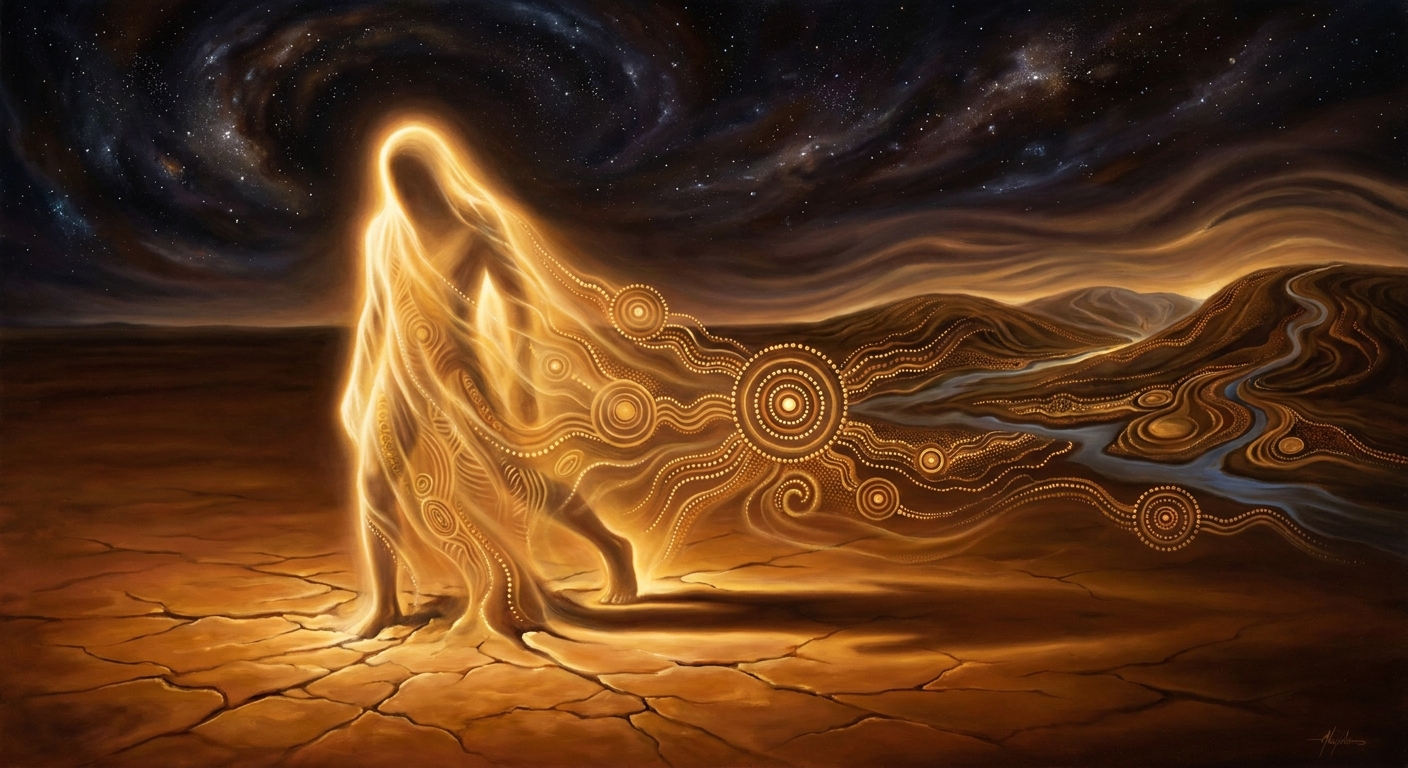
The Luritja people's concept of Tjukurpa is not a set of rules but the total structure of the world — the ancestral law, the ecological knowledge, the ceremonial obligations, and the social organization of the desert community are all one thing, held together by the word Tjukurpa.
- When
- the Tjukurpa — the always-time
- Where
- The Western Desert, South Australia and Northern Territory — Luritja and Anangu country around Uluru-Kata Tjuta
The word for everything is Tjukurpa.
Not metaphorically everything — actually everything. The Luritja and Anangu people who hold the custodianship of the Western Desert around Uluru use Tjukurpa to refer simultaneously to: the ancestral stories of the Dreaming, the Law that governs human conduct, the ecological knowledge of how the desert works, the ceremonies that maintain the land’s vitality, the kinship system that organizes human relationships, and the ongoing presence of the ancestral beings in the landscape.
There is no Western word for what Tjukurpa is because Western culture has divided these domains into separate areas — religion, law, science, social organization, art — and developed separate specialists for each. Tjukurpa holds them together as one system, maintained by the people who hold its knowledge.
Uluru is the most visible Tjukurpa site in the world.
The sandstone monolith rising from the red desert plain is not, in the Anangu understanding, a geological formation that has religious significance. It is a Tjukurpa event — a specific ancestral happening, the result of the movements and battles and creations of specific ancestral beings, whose actions are visible in every feature of the rock’s surface. The caves at Uluru’s base. The waterfall channels carved into the face. The specific indentations at Mutitjulu waterhole. Each one is an event in the Tjukurpa story that happened at this place.
The story happened once. The story is always happening.
The tjilapalpa are the knowledge holders.
These are the senior men and women who have spent decades learning the Tjukurpa — not just the public-facing stories that can be shared with visitors, but the full, deep, ceremonially restricted knowledge that governs the sacred sites and the most powerful ancestral narratives. The learning takes a lifetime. Knowledge is released in stages, each stage requiring the passage of time and the demonstration of the readiness to hold what comes next.
The most senior knowledge holders are sometimes in their seventies or eighties. They hold knowledge that no one else holds. When they die without having fully transmitted it, a section of Tjukurpa goes with them — not the ancestral narrative, which is in the land, but the specific encoding of it that the human custodian carries.
This creates the ongoing urgency of transmission. Tjukurpa is both permanent — in the land, in the Dreaming, in the forms of the rocks and the desert ecology — and vulnerable, because the human knowledge-holders who can read and maintain it are a fragile chain.
The ecological dimension of Tjukurpa is not separate from the religious dimension.
When the Anangu perform the ceremonies that maintain specific sacred sites, the ceremonies have ecological consequences — they are, in the Western scientific description, land management practices. The controlled burning that the ceremonies prescribe maintains the mosaic of differently-aged vegetation that maximizes biodiversity in the desert. The movement patterns that the ceremonies require move people through the landscape in ways that distribute seed and maintain water sources. The food restrictions associated with specific sites protect vulnerable species during breeding season.
The people who hold Tjukurpa are not choosing to manage their ecosystem for ecological reasons. They are fulfilling their ancestral obligations. The ecological outcomes are the byproduct of correct Tjukurpa practice — which is another way of saying that Tjukurpa, developed over fifty thousand years of desert life, has become a system in which the ancestral obligations and the ecological necessities are the same thing.
One system. One law. One word.
Tjukurpa.
The land is still holding it.
Echoes Across Traditions
Entities
- the Tjukurpa ancestors
- the Luritja people as Tjukurpa custodians
- Uluru as the most visible Tjukurpa site
- the knowledge holders (tjilapalpa)
- the land itself as Tjukurpa made physical
Sources
- Myers, Fred R., *Pintupi Country, Pintupi Self: Sentiment, Place, and Politics among Western Desert Aborigines* (Smithsonian, 1986)
- Stanner, W.E.H., *White Man Got No Dreaming* (ANU Press, 1979)
- Uluru-Kata Tjuta National Park, Anangu cultural materials (Parks Australia, ongoing)