Menelik Brings the Ark to Ethiopia
Kebra Nagast compiled c. 14th century CE; narrative setting c. 950 BCE · Jerusalem; the road south; Aksum, Ethiopia
Contents
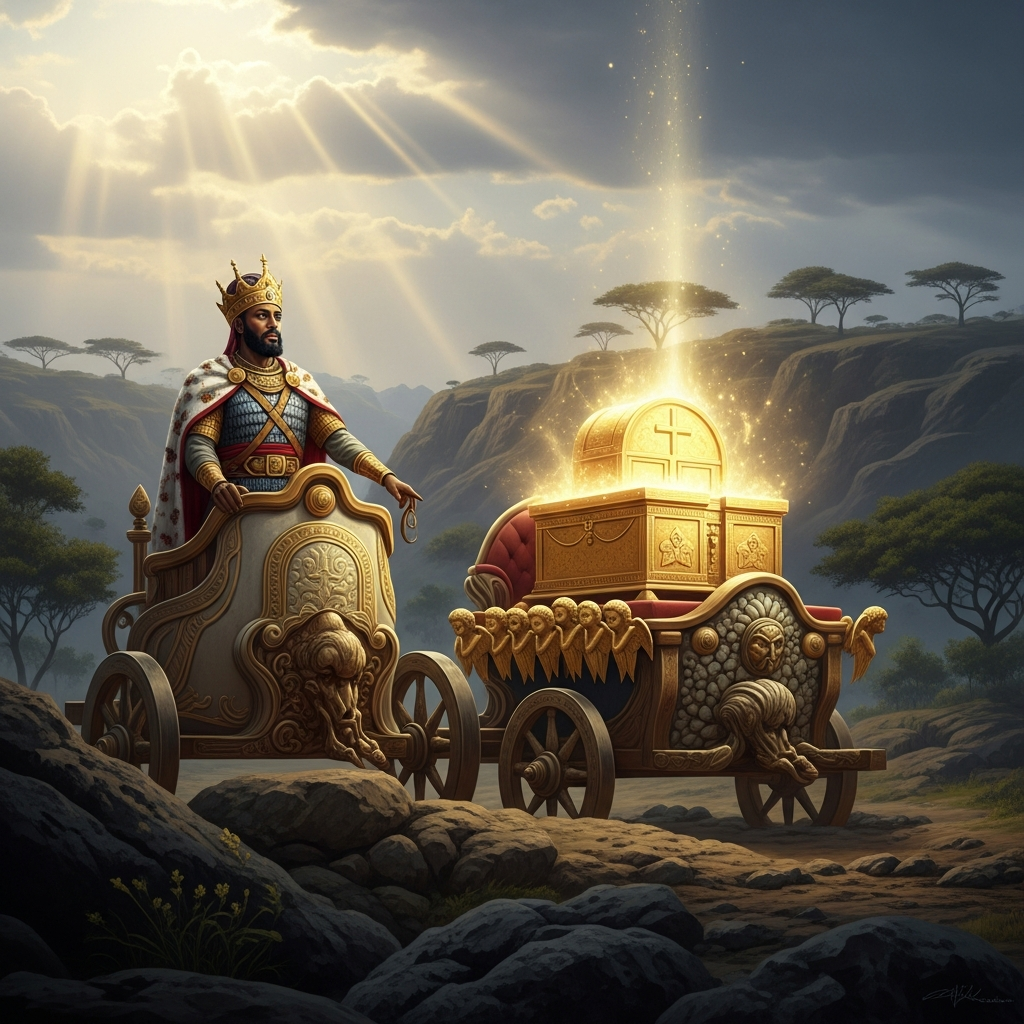
When Menelik I, son of Solomon and Makeda, returns to Jerusalem as a young man to meet his father, his companions secretly replace the Ark of the Covenant with a replica and carry the real Ark back to Ethiopia. God approves: the Ark flies above their chariot the whole way home.
- When
- Kebra Nagast compiled c. 14th century CE; narrative setting c. 950 BCE
- Where
- Jerusalem; the road south; Aksum, Ethiopia
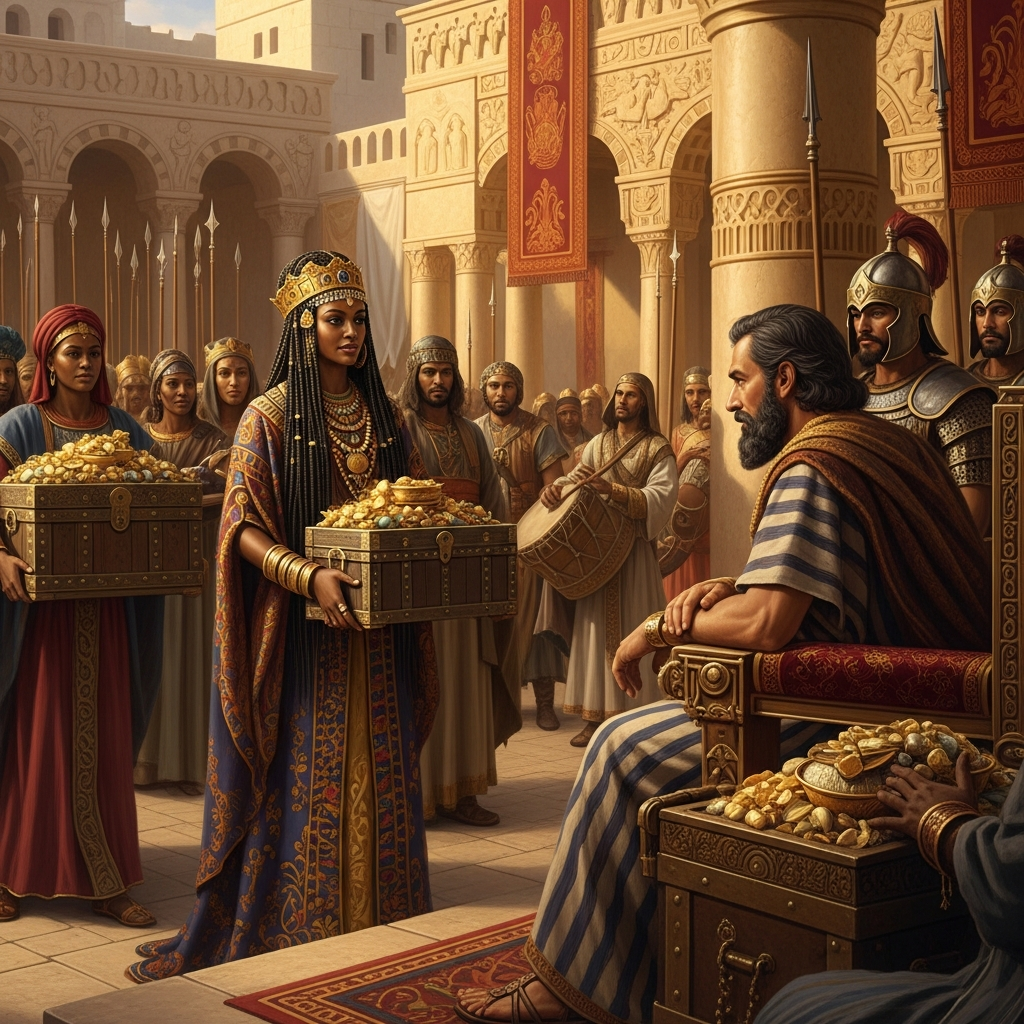
The young man who arrived at Solomon’s gate did not look like a prince of a foreign kingdom.
He looked like Solomon.
The guards stared. The courtiers went quiet as he passed through the outer court. An old priest who had served through David’s time and most of Solomon’s gripped the arm of his neighbor and said nothing, because there was nothing to say — the face was the face the king had worn thirty years ago, when he was young and had not yet built anything and the weight of the world had not yet settled into his jawline. Menelik walked through the court of Solomon and every man who looked at him saw a ghost, and the ghost was alive.
Solomon himself wept when he saw his son.
The Kebra Nagast says they embraced in the outer hall with three hundred courtiers watching, and that Solomon could not speak for several minutes, and that when he finally spoke it was to say: I have been dead, and you have brought me back. I see my own face in yours, and I understand for the first time what a father is.
He wanted Menelik to stay. He wanted to declare him heir to Israel, to split the inheritance of David between the son who had grown up in Jerusalem and the son who had grown up in Africa. He proposed this formally, with lawyers present.
Menelik refused.
He had come to see his father, not to become his father. He had come to receive the blessing, not the throne. His kingdom was in the south, was already waiting for him, was already his mother’s gift. He would take from Jerusalem only what Jerusalem could give him without diminishing Jerusalem: the knowledge, the blessing, the consecration.
But Azariah had other ideas.
Azariah was the son of Zadok the High Priest, and he had grown up in the shadow of the Temple the way children grow up in the shadow of any enormous fact — half-resentful, half-worshipful, unable to think about anything else. He had befriended Menelik during the months at court. He had explained the Temple’s logic to him: the outer courts, the inner courts, the Holy of Holies behind its curtain, the Ark inside the Holy of Holies that no one approached except the High Priest once a year, the Ark that was not merely a box but was the footstool of the God who had no body, the place on earth where heaven touched.
Menelik listened and asked: If God is everywhere, why does God need a footstool?
Azariah said he did not know.
If God is in the Ark, why can’t the Ark travel?
Azariah said he did not know that either. But something moved in him as the question was asked.
The night before the southern caravan was to leave Jerusalem, Azariah crept into the Temple.
He was a priest’s son. He knew the schedules, the guard rotations, the places where the lamp oil ran low and the light was weakest. He moved through the outer courts in the dark and into the Holy of Holies, and he stood before the Ark for a long moment. The cherubim on the mercy seat were barely visible in the dark. The carrying poles were already threaded through the rings, as they always were — the Ark was never to be without its poles, was always in principle ready to move.
He lifted it.
Two of Menelik’s men helped him carry it out while Azariah placed in the Holy of Holies a replica he had spent two months constructing: same acacia wood, same gold overlay, same dimensions, same weight. In the dark, in the morning, with guards half-asleep and priests focused on their prayers, no one would notice.
The Ark was wrapped in cloth and loaded into the middle of the caravan, between sacks of grain and bolts of fabric, ordinary as any other cargo.
The Kebra Nagast says that the Ark did not want to be hidden. It began to lift.
When the caravan set out from Jerusalem at dawn, the Ark rose off the cart.
Not high — perhaps the height of a man’s shoulder above the wood — and it floated there, trailing the cloth they had wrapped it in, and it moved faster than the oxen, so that the men had to hurry to keep pace with their own cargo. The Ark was going home. This is the Kebra Nagast’s claim: the Ark knew it was going to Ethiopia, and it approved, and it flew above the road the way a star floats above the horizon, present and unreachable and drawing everything toward it.
By the time Solomon learned what had happened — his priests discovered the replica, the weight was wrong, the wood was too new, the gold smelled like fresh work — the caravan was already deep into Sinai. He rode out after them. He came within sight of the tail of the column in the desert. But the Ark outpaced him, and the God who lived in it either could not or would not be turned around.
Solomon stopped his horse at the horizon’s edge.
He stood there a long time.
The Kebra Nagast is tender with him here. It says he wept. It says he understood that what had happened was not theft but transfer — that God had chosen, as God had chosen before, to move the covenant to where God wanted it. He had lost his son the day Menelik refused the throne. Now he had lost the Ark. But the Ark was with his son, which meant his son was carrying the most sacred thing on earth back to Makeda’s country, and in a sense Solomon was going too — carried south in the faces of his descendants, in the object of his God, in the dynasty that would rule Ethiopia until the twentieth century.
He turned his horse around and rode back to an empty temple.
In Aksum, when the caravan arrived, Makeda came out to meet it.
She saw the Ark floating above the cart before she saw her son. She fell on her face. The priests who accompanied Menelik set up a tent outside the city and installed the Ark in it while the great church was prepared, and the whole city of Aksum came out, and they danced in the road the way David had danced before the Ark in the old story — undignified, overwhelmed, unable to contain what they felt.
Menelik was crowned king of Ethiopia.
The Ark was installed in the Holy of Holies of the first great church of Aksum, the prototype of every Ethiopian church to come. A guardian was appointed who would never leave it, whose whole life would be the Ark, who would be succeeded by another guardian, and another, and another, in an unbroken chain down to the present day.
The Kebra Nagast ends, structurally, here. The covenant has arrived. Africa has the footstool of God. What happens next is history — three thousand years of it — but the story is complete.
God came south. God stayed.
Echoes Across Traditions
Entities
- Menelik I
- Azariah (son of Zadok the High Priest)
- the Ark of the Covenant
- Solomon
- Makeda
Sources
- Kebra Nagast (Glory of Kings), compiled c. 14th century CE, attributed to Yeshaq of Aksum
- E.A. Wallis Budge (trans.), *The Kebra Nagast* (1922)
- Graham Hancock, *The Sign and the Seal* (1992)
- Stuart Munro-Hay, *The Quest for the Ark of the Covenant* (2005)
- Exodus 25:10–22 (Hebrew Bible, the Ark's construction)