Contents
A queen from a far country has heard rumors of the Israelite king's wisdom. She arrives in Jerusalem with a caravan of camels carrying spices, gold, and a list of hard questions. He answers everything. She gives him a hundred and twenty talents of gold and goes home — but not before saying the half had not been told her.
- When
- c. 950 BCE
- Where
- Jerusalem at the height of Solomon's reign, the throne room and the temple courts, the long road from Sheba (Yemen)
The text is short and almost reportorial.
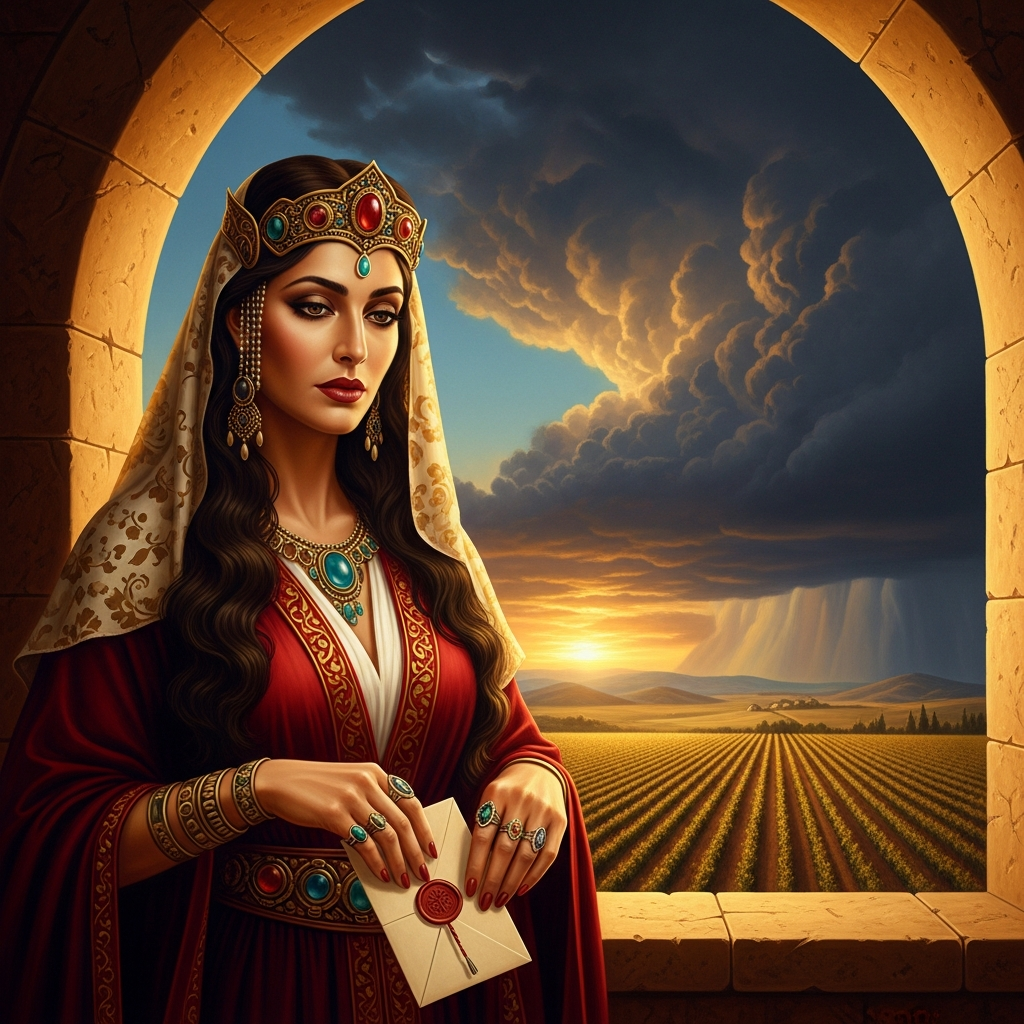
The Queen of Sheba had heard about Solomon. She had heard of his wisdom — about his judgments, about his proverbs, about his songs, about the temple he had built — and she had heard of his wealth. She had heard about it where she lived, which was Sheba, far to the south, in what is now Yemen — a kingdom on the spice route, ruling the southern terminus of the trade in frankincense and myrrh and gold and ebony, controlling the access points to the Red Sea and the Indian Ocean.
The reports had come up to her along the same routes her caravans went down. Israel was the northern terminus of the same trade. Solomon’s ships, working out of Ezion-geber, were sailing the Red Sea. Sheba’s ships were doing the same thing from the southern end. The two kingdoms had a commercial interface; Solomon’s expansion of trade had begun to compete with, or perhaps to threaten, Sheba’s monopoly.
The queen decided to come and see for herself.
She came with what the text calls a very great train — a caravan of camels carrying spices, gold, and precious stones. The Hebrew gives the gold figure later: a hundred and twenty talents — perhaps four tons of gold, the largest single gift recorded in the Hebrew Bible. The spices were of a quantity, the text notes pointedly, that no later visitor would ever match. There came no more such abundance of spices as those which the Queen of Sheba gave to King Solomon.
The journey was long. Sheba to Jerusalem is fifteen hundred miles overland. The caravan would have moved fifteen miles a day. The journey would have taken months.
She arrived in Jerusalem.
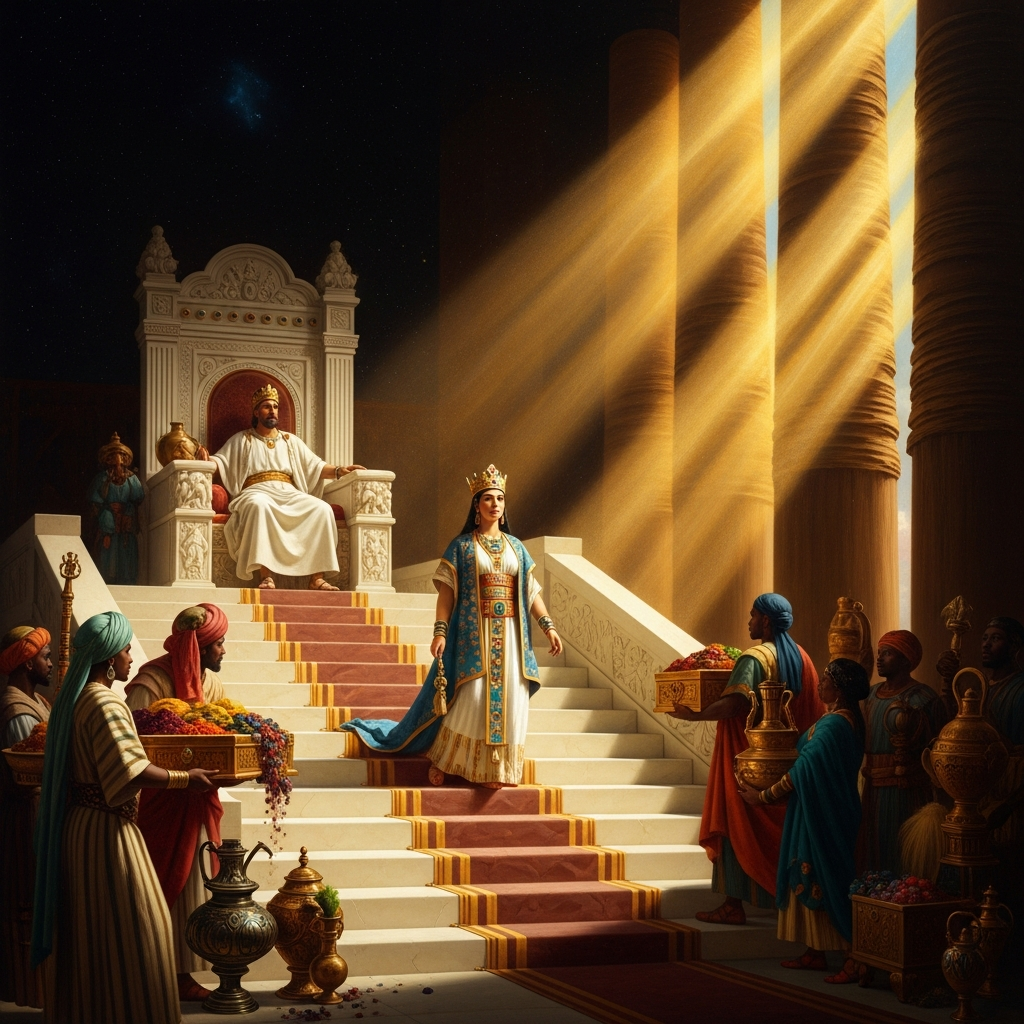
She was received in the palace. The text describes the encounter in a single Hebrew sentence that has fascinated commentators for three thousand years: she communed with him of all that was in her heart.
She tested him with hard questions. The Hebrew word is hidot — riddles, hard sayings. The Targum and the Talmud expanded these into specific puzzles: legal cases, logic puzzles, riddles about gender (a group of girls and boys made to look identical, presented to Solomon, who told them apart by how they reacted to nuts thrown to them — boys catching them with the hem of their tunics, girls with their open palms). The Qur’anic and Ethiopic versions added still more. Whatever the riddles were, Solomon told her all her questions; there was not anything hid from the king which he told her not.
Then she looked around.
The Hebrew Bible is rarely so generous to a foreign monarch. The text walks her through what she saw, slowly, item by item, in the way of a person trying to convey awe. She saw the wisdom of Solomon, and the house that he had built, and the food of his table, and the seating of his servants, and the attendance of his ministers, and their apparel, and his cupbearers, and his ascent by which he went up to the house of the LORD.
The list is significant. She is not impressed only by gold. She is impressed by the organization — the seating, the attendance, the apparel, the cupbearers — the working machinery of a sophisticated court. She is impressed by the wisdom in the answers, the food, the temple. She is impressed by the way the small details fit together into a system. She is, the text says, breathless.
Literally breathless. There was no more spirit in her.
She finds her voice eventually. She makes a speech.
The report was true, she says, which I heard in mine own land of your acts and of your wisdom. Howbeit I believed not the words until I came, and mine eyes had seen it: and behold, the half was not told me. Your wisdom and prosperity exceeds the fame which I heard.
It is the speech of a sovereign acknowledging a peer. She does not flatter. She reports what she sees.
She continues: Happy are your men, happy are these your servants, who stand continually before you and hear your wisdom. Blessed be the LORD your God, who delighted in you to set you on the throne of Israel, because the LORD loved Israel forever, therefore made he you king to do judgment and justice.
This last is the key sentence. The Sabaean queen — coming from a polytheistic kingdom in southern Arabia, probably herself a worshipper of the sun and other astral deities — explicitly blesses the LORD, the God of Israel. Whether the historical queen actually said any such thing or whether the editors of Kings inserted it, the literary effect is to claim that even foreign rulers, encountering the achievement of Israel, recognize its God.
She gives him the hundred and twenty talents of gold. She gives him spices in unprecedented quantity. She gives him precious stones. The economic exchange is real: this is a trade summit, sealed with extravagant gifts on both sides. Solomon, the text adds, gave to the Queen of Sheba all her desire, whatever she asked, beside that which Solomon gave her of his royal bounty. The phrase has been read for three thousand years as carrying a double meaning. The biblical text leaves it innocent. Later traditions did not.
She turned and went back to her own land, with her servants.
That is the entire biblical account. Twelve verses.
What the traditions did with these verses is one of the great cross-cultural expansions of any biblical narrative.
In Ethiopia, the queen — named Makeda — became the founder of an imperial dynasty. The Kebra Nagast tells the story at vast length. Makeda comes to Jerusalem. She is converted to the worship of the LORD. Solomon, her host, desires her. She makes him swear not to take her by force; he agrees, on condition that she will not take anything of his without asking. He has her dine on rich, salty foods. In the night, parched, she rises to drink water from a jar by her bed. He emerges from concealment and points out that she has taken his water. She has broken the oath. He claims his right. She conceives a son. She returns to Ethiopia and bears Menelik, who at fourteen visits his father in Jerusalem, takes the Ark of the Covenant home with him to Aksum, and founds the Solomonic line. The Ethiopian Orthodox Church teaches the Ark is still in Aksum, in a chapel watched by a single dedicated monk.
In Islam, Surah An-Naml of the Qur’an tells the story differently. Sulaiman commands the wind and understands the speech of birds. The hoopoe brings him news of Bilqis, queen of Sheba, who worships the sun. He sends her a letter; her counselors urge war; she chooses diplomacy. Sulaiman has her throne transported to his palace by the magic of a djinn. He shows her the throne, slightly altered, and asks if she recognizes it; she says, as if it were the same. She enters the palace and sees a floor of polished glass, mistakes it for water, and lifts her skirts. Sulaiman tells her it is glass. She submits to God. The Qur’anic narrative is a cleaner conversion story; the Bible’s commercial summit is replaced with a missionary triumph.
In Yemeni tradition, Bilqis is the actual historical queen of a real Sabaean dynasty whose dam at Marib watered a kingdom of three centuries. Yemen still calls her ancestress.
In rabbinic tradition, the relationship is sometimes condemned and sometimes praised. The Babylonian Talmud preserves an unflattering rumor about her hairy legs (Solomon, suspecting she might be a djinn, designs the glass floor to make her lift her skirt — the Qur’anic motif is borrowed from this tradition or vice versa). The Christian medieval imagination read her as a type of the Church coming from the Gentile world to seek the wisdom of Christ.
Everyone made the queen carry weight.
What the Hebrew Bible actually gives us is leaner and more interesting. Two monarchs meet. The visitor is a foreign woman, ruler in her own right, of equal standing to her host. She comes with hard questions. He answers them. She is impressed not by his power to crush her but by the structure of his court — the way wisdom and order have been institutionalized into a working civilization. She blesses his god. They exchange enormous gifts. She goes home.
The story is a model of an encounter that does not become a conquest. Solomon does not subjugate her. She does not flee from him. They sit, they talk, they admire, they trade, they part. In the rest of 1 Kings — full of murders, betrayals, civil wars, Solomon’s own coming apostasy with his thousand foreign wives — the Sheba episode is an island of mutual recognition.
The text knows what it is doing. It places this encounter as the climax of Solomon’s reign, the high-water mark, the moment before everything starts to go wrong. And the half had not been told me. It is the highest praise the Bible ever gives an Israelite king, and it comes from the mouth of a foreign queen, and the text — for once — lets her have the last word.
Scenes
A long caravan winds through desert
In the great hall of Solomon's palace
The temple court
Echoes Across Traditions
Entities
- Solomon
- The Queen of Sheba
Sources
- 1 Kings 10:1-13
- 2 Chronicles 9:1-12
- Josephus, Antiquities VIII.6.5-6
- Kebra Nagast (Ethiopian, c. 1300 CE)
- Qur'an 27:15-44 (Surah An-Naml, the story of Sulaiman and Bilqis)