Contents
A judge of Israel — the strongest man alive, dedicated from the womb, his strength tied to his uncut hair — falls in love with a Philistine woman who has been bribed to find his secret. He tells her three lies. Then he tells her the truth.
- When
- c. 1100 BCE
- Where
- The Sorek valley between Israel and Philistia, the city of Gaza, the temple of Dagon
The angel came to a woman who could not have children.
She was the wife of a Danite named Manoah, and she had been barren for years. The angel of the LORD found her in a field. You will have a son, he said. He will be a nazirite from the womb. No razor will touch his head. No wine will pass his lips. He will begin to deliver Israel from the hand of the Philistines.
She told her husband. The angel returned, told them both the same thing. They offered a kid on a rock; the angel ascended in the flame.
The boy was Samson. He grew up. He grew strong.
He grew, the text emphasizes, into a man with no impulse control whatsoever.
He saw a Philistine woman in Timnah and demanded his parents arrange the marriage — get her for me, she is right in my eyes — over their objections. On the way to the wedding he tore a young lion apart with his bare hands, the way a man tears apart a kid. Days later, passing the carcass, he found bees had built a hive in it; he ate the honey. At the wedding feast he posed a riddle from the experience — out of the eater, something to eat; out of the strong, something sweet — and bet thirty changes of clothes on it. The Philistine guests pressed his bride for the answer. She wept and pressed Samson; he, weakening, told her; she told them; they answered the riddle. Samson, furious, went down to Ashkelon, killed thirty Philistines, stripped them, and gave the bride’s relatives their clothes. He went home in a rage. His bride was given to another man.
He came back later for her. They told him she was someone else’s wife. He caught three hundred foxes, tied them tail to tail in pairs with torches between, and turned them loose into Philistine grain fields. He killed a thousand Philistines with the jawbone of a freshly killed donkey. He spent a night with a prostitute in Gaza, and when the city closed its gates to trap him, he tore the gates off their hinges and carried them, posts and bar and all, to the top of a hill near Hebron.
He was forty years a judge of Israel.
And then he met Delilah.
She lived in the valley of Sorek. The text does not call her a Philistine, but she is on their side. The lords of the Philistines came to her — five of them, the rulers of the five cities — and offered her eleven hundred pieces of silver each if she could discover the secret of Samson’s strength.
She set to work.
He had loved her. Whatever Samson’s loves were — and the text suggests they were less interior than appetites — Delilah was the one Samson had grown attached to. He came to her bed. After they had made love, she put her hand on his face and asked, lightly: Samson, tell me. What makes you so strong? If a man wanted to bind you and overpower you, how could he?
He laughed. He told her: If they tie me with seven fresh bowstrings — fresh, not yet dried — I will be weak as any man.
She pretended to take note. The Philistines were waiting in an inner room. They brought her seven fresh bowstrings. She tied him while he slept. She woke him with a shout: Samson, the Philistines are upon you! He sat up and snapped the bowstrings as a man snaps a strand of tow that has touched fire. The Philistines, in the inner room, kept silent.
She was furious — fake-furious, the way she had practiced. You have lied to me. You have made fun of me. Tell me truly.
He told her, again lightly: If they tie me with new ropes that have never been used, I will be weak. She tied him with new ropes. The Philistines were again in the inner room. She woke him with the shout. He snapped the ropes like thread.
Three lies, three pretend-furies.
The third lie was about his hair. If you weave the seven locks of my head into the loom and pin it down, I will be weak. She did. She wove his hair into her loom while he slept and pinned the loom-pin into the warp. She woke him with the shout. He stood up and pulled the loom-pin and the loom and the warp and the cloth out of the floor with his hair as he stood.
He was, in a sense, daring her.
She wept. She wept for days. She would not stop. How can you say you love me when your heart is not with me? You have lied to me three times. You will not tell me where your great strength lies. She pressed him daily, says the text, with her words. She urged him until his soul was vexed unto death.
He told her.
He told her the truth. No razor has ever touched my head, because I am a nazirite of God from my mother’s womb. If I am shaved, my strength will leave me, and I will be weak as any man.
She knew, this time, that it was the truth. There was something in his voice — the relief of saying it, perhaps, the relief of not having to carry the secret alone, perhaps even, in some twisted way, the desire to test whether she could be trusted with it.
She sent for the lords of the Philistines. Come up this once, the message said. He has told me everything. They came up with the silver in their hands.
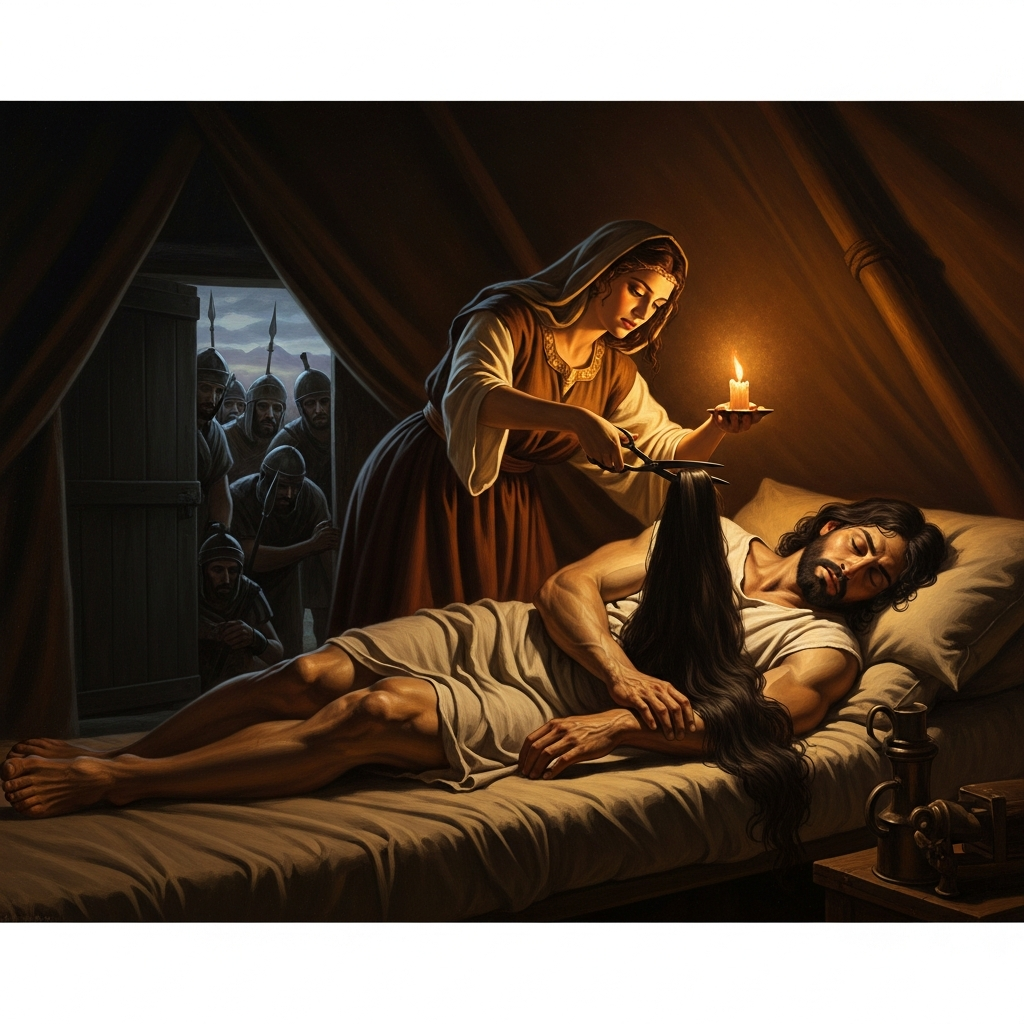
She let him sleep with his head in her lap. While he slept, she signaled the man waiting in the next room. The man was a barber. He came in quietly with a razor. He shaved off the seven locks of Samson’s head — carefully, slowly, his hair falling on the floor of her bedroom.
Then, when he was bare-skulled, Delilah began to torment him. The text says: she began to torment him. She woke him. She prodded him, pinched him, struck him. Samson, the Philistines are upon you. He woke. He stood up to shake himself, the way he had shaken off the bowstrings and the ropes and the loom — and he could not. He knew not that the LORD was departed from him.
The Philistines came in. They seized him. They put out his eyes. They took him down to Gaza, bound him with bronze fetters, and made him grind grain in the prison house — the work of an ox or a woman.
His hair, the text notes — almost in passing, but the note carries everything — began to grow again.
There was a great festival of Dagon in Gaza some months later. The Philistine lords gathered in the temple of their god to celebrate the capture of their old enemy. The temple was full — three thousand on the roof alone, the text says, and the lords and ladies of the cities below. They called for Samson. Bring him out so we can have sport with him. He was brought from the prison, blind, on a chain, led by a boy. They mocked him before the columns of the temple. They danced.
Samson said to the boy: Lead me to the pillars on which the house stands, that I may lean against them.
The boy led him to the two great central pillars. Samson set one hand on each. He said — and this is the only prayer Samson ever speaks in the text, the only moment of theological reflection in his violent career — Lord GOD, remember me, I pray. Strengthen me only this once, O God, that I may be at once avenged of the Philistines for my two eyes.
He pushed.
He set himself between the pillars and leaned. He said: Let me die with the Philistines. He pushed.
The pillars went. The temple came down. Three thousand on the roof, all the lords of the cities below, and Samson himself in the rubble. The text reports the kill count without affect: the dead which he slew at his death were more than they which he slew in his life.
His brothers came down for the body. They carried him up to the burial place of his father.
The Samson story is the most pagan in Hebrew Scripture and the strangest. The hero is a violent man. His relationships with women are catastrophic. His strength is conditional on a vow he keeps imperfectly and a haircut he gives away. He prays only twice in his life — once when he is thirsty, once when he is dying — and both prayers are answered with the same muscular literalism that runs through the whole narrative.
But the story sits in the Hebrew canon for a reason. It preserves something the editors did not feel they could excise: the older recognition that the strength of a leader is not something the leader owns. It is something on loan. It can be removed. It can be removed by a woman in a bedroom in the Sorek valley, lightly, in stages, with the right questions and the right tears. The barber will come quietly afterward. The eyes will go in Gaza. The temple will fall, but the temple coming down is not victory. It is what you have to settle for, when you have already given everything else away.
Scenes
In the vineyard outside Timnah, a young Samson tears apart a roaring lion with his bare hands
Delilah's bedroom in the Sorek valley
Samson, blinded, in the temple of Dagon
Echoes Across Traditions
Entities
- Samson
- Delilah
- The Philistine lords
- Manoah
Sources
- Judges 13-16
- Josephus, Antiquities of the Jews V.8
- Pseudo-Philo, Biblical Antiquities 43