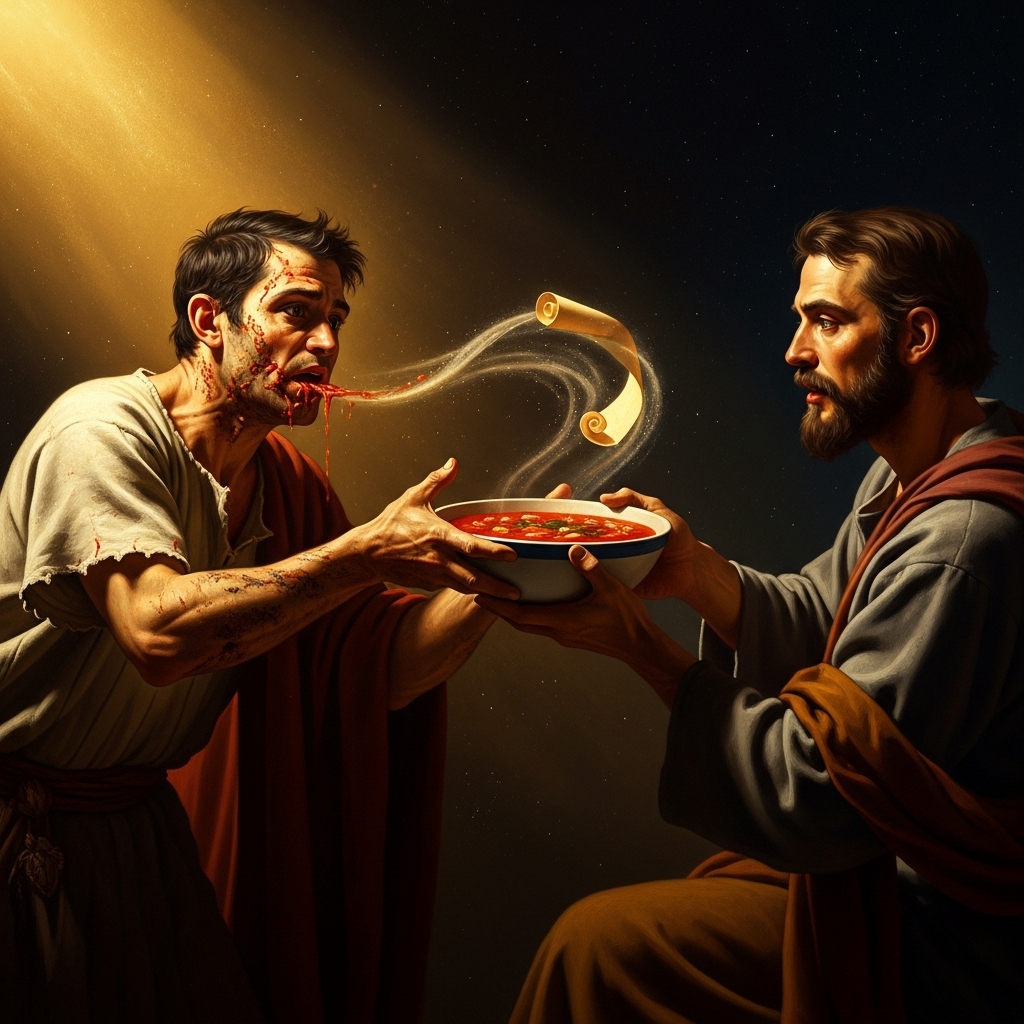
Esau Sells His Birthright for a Bowl of Stew
c. 1800 BCE (patriarchal era) · The encampment of Isaac in the Negev, the open hearth at the tent door
Contents
A red-haired hunter comes home from a bad day in the field to find his quiet brother stewing red lentils. He is famished. He demands the soup. The brother says: sell me your birthright. He shrugs. He sells it. He eats.
- When
- c. 1800 BCE (patriarchal era)
- Where
- The encampment of Isaac in the Negev, the open hearth at the tent door
The boys had fought in the womb.
Their mother Rebekah had been barren for twenty years. When at last she conceived, the pregnancy was so violent — the children inside her struggling so hard against each other — that she went to the LORD to ask why. The answer she received was a couplet of prophecy: Two nations are in your womb, and two peoples born of you shall be divided. The one shall be stronger than the other; the elder shall serve the younger.
The elder shall serve the younger. This was not the rule. The rule, in every patriarchal society Israel knew, was that the firstborn received the double portion, the patriarchal blessing, the position of head of household after the father’s death. The Hebrew Bible accepts this rule as the default — and then proceeds, almost without exception, to overturn it. Isaac is preferred over Ishmael. Jacob is preferred over Esau. Joseph is preferred over Reuben. David is preferred over his older brothers. Solomon is preferred over Adonijah. The firstborn keeps losing the inheritance to the younger sibling.
The pattern starts here.
Esau came out first. He was red — admoni, ruddy — and hairy, like a little garment of fur. They named him Esau (the etymology is uncertain). His brother came out clutching Esau’s heel. They named him Jacob — Yaaqov, the heel-grabber, with a pun on aqab, to overreach or to deceive. The names were prophecies of who they would be.
They grew up. Esau was the outdoorsman. He was a cunning hunter, a man of the field. Jacob was a quiet man, dwelling in tents. The text says, with characteristic candor, that Isaac loved Esau because he ate of his game — venison, the warm meat of a successful hunt — and Rebekah loved Jacob.
The family was divided right down the middle.
One day Esau came in from the field hungry.
The text uses the verb form that suggests not just hunger but exhausted, half-collapsed hunger. He had been hunting all day and had not killed anything. He had not eaten. He was famished.
He came up to the tent. There was a smell coming from the cooking-fire. Jacob was at the fire, stirring a pot. The pot held lentil stew. Red lentils. The stew, as it cooked down, was the color of dried blood. The smell was thick and warm.
Esau said: Let me eat some of the red — that red there. I am about to die. (The Hebrew is comic in its imprecision: he doesn’t even use the word for stew; he just gestures and says that red, that red. The text gives him the nickname Edom — the red one — partly because of his hair, partly because of this moment of pointing at the stew.)
Jacob looked up.
He had been waiting, perhaps for years, for a moment like this. He had seen his brother eat after long hunts. He had measured the brother’s appetite against the brother’s foresight. He had calculated.
He said, quietly: Sell me first your birthright.
The birthright. The bekhorah — the firstborn’s portion. Two-thirds of the patrimonial estate, the position of head of clan, the responsibility for the family’s continuity. In the religious accounting of Israel-to-be, the channel through which the covenant with Abraham would flow — the inheritance not just of property but of the divine promise.
Esau looked at the soup. He looked at his brother. He laughed, the way an exhausted man laughs at a bad joke. I am about to die, he said. What use is a birthright to me?
The line is the moral of the story. The narrator does not need to comment.
Jacob said: Swear it to me first. He wanted the oath. He wanted the contract.
Esau swore. He swore the birthright away — the firstborn’s portion, the family priesthood, the channel of Abraham’s blessing — for a bowl of lentil stew. He sat down. Jacob handed him bread and the stew. Esau ate, and drank, and rose, and went his way.
The text closes the scene with five Hebrew verbs in a row: and-he-ate, and-he-drank, and-he-rose, and-he-went, and-he-despised. He despised his birthright. The verbal economy is brutal: the man’s whole inheritance is gone in five verbs and a dish of lentils.
Years later, Isaac was old.
He was blind. He sensed his death was near. He called Esau and asked him to go out and hunt and prepare savory game for him, that I may bless you with the blessing of my soul before I die. Esau took his bow and went out into the field.
Rebekah heard.
She moved fast. She found Jacob. Go to the flock and bring me two good kids. I will make them into food, the kind your father loves. You will take it in to him, and he will bless you instead. Jacob, anxious — but Esau is hairy and I am smooth; if my father feels me, he will know me a deceiver — was reassured by his mother. She took Esau’s clothes, which were in the tent, and put them on Jacob. She took the skins of the kids and put them on the smooth back of Jacob’s hands and on his neck. She gave him the cooked meat.
He went in to his father.
Isaac heard the voice. The voice is the voice of Jacob, he said, but the hands are the hands of Esau. He was uncertain. He felt the hands. He smelled the clothes. The tactile and olfactory evidence overrode the auditory. He blessed Jacob.
The blessing was given. The blessing, in the Hebrew imagination, was a real transfer of power; once spoken, it could not be revoked.
Esau came back from the field. He prepared the game. He brought it in. He said: Father, rise and eat of your son’s venison. Isaac said: Who are you? Esau said: I am your firstborn, Esau.
Isaac trembled. He trembled exceedingly. He understood. He had blessed the wrong son, and the blessing could not be taken back. He said: Yes, and he shall be blessed.
Esau cried out — a great and exceedingly bitter cry, says the text, the howl of a man learning that his future has been redirected. Have you only one blessing, my father? Bless me, even me also. But the patriarchal blessing had been spent. Isaac could give him only the leavings — a smaller blessing, a future of swords and serving his brother, with the eventual loosening of the yoke.
Esau hated Jacob. He swore to kill him after their father’s death. Rebekah, hearing of the threat, sent Jacob away to her brother Laban in Haran — Jacob would spend twenty years there, married to two wives and producing twelve sons, before returning to face his brother again.
But the central scene of the brothers’ relationship is not the deception of the blind father. The deception was the formal transfer; the substance had already changed hands years earlier, at the cooking-fire. Esau had despised the birthright. He had sold it for what was in front of him.
The Letter to the Hebrews, two thousand years later, would distill the Esau pattern into a single proverb: do not be like Esau, who for one meal sold his birthright. It became the type of every short-term-thinking trade in religious moral psychology. The pottage. The smell of the soup. The famished man at the door. The cool brother at the fire who has been waiting, with a wooden spoon and a question.
The Hebrew Bible is not warm to Jacob. It calls him the heel-grabber; it lets us see his cold maneuvers. But it does not pretend Esau was the right heir. The man who can sell his future for one bowl of soup is the man who, in the religious accounting, never really had the future to begin with. The inheritance follows the person who values it. Esau’s hunger was a real hunger. The price he paid for ending it was the longest payment in the book.
Scenes
The tent at evening
Esau bursts in from the field, sunburnt, stinking of game, his bow on his shoulder, his face desperate with hunger
The exchange
Echoes Across Traditions
Entities
- Esau
- Jacob
- Isaac
- Rebekah
Sources
- Genesis 25:19-34
- Hebrews 12:16-17
- Genesis Rabbah 63
- Philo, On Sobriety 26