The Maize God Is Decapitated and Blooms
Mythic time — the era before the Hero Twins; Classic Maya tradition · Xibalbá, the Maya underworld; the ball court; the gourd tree
Contents
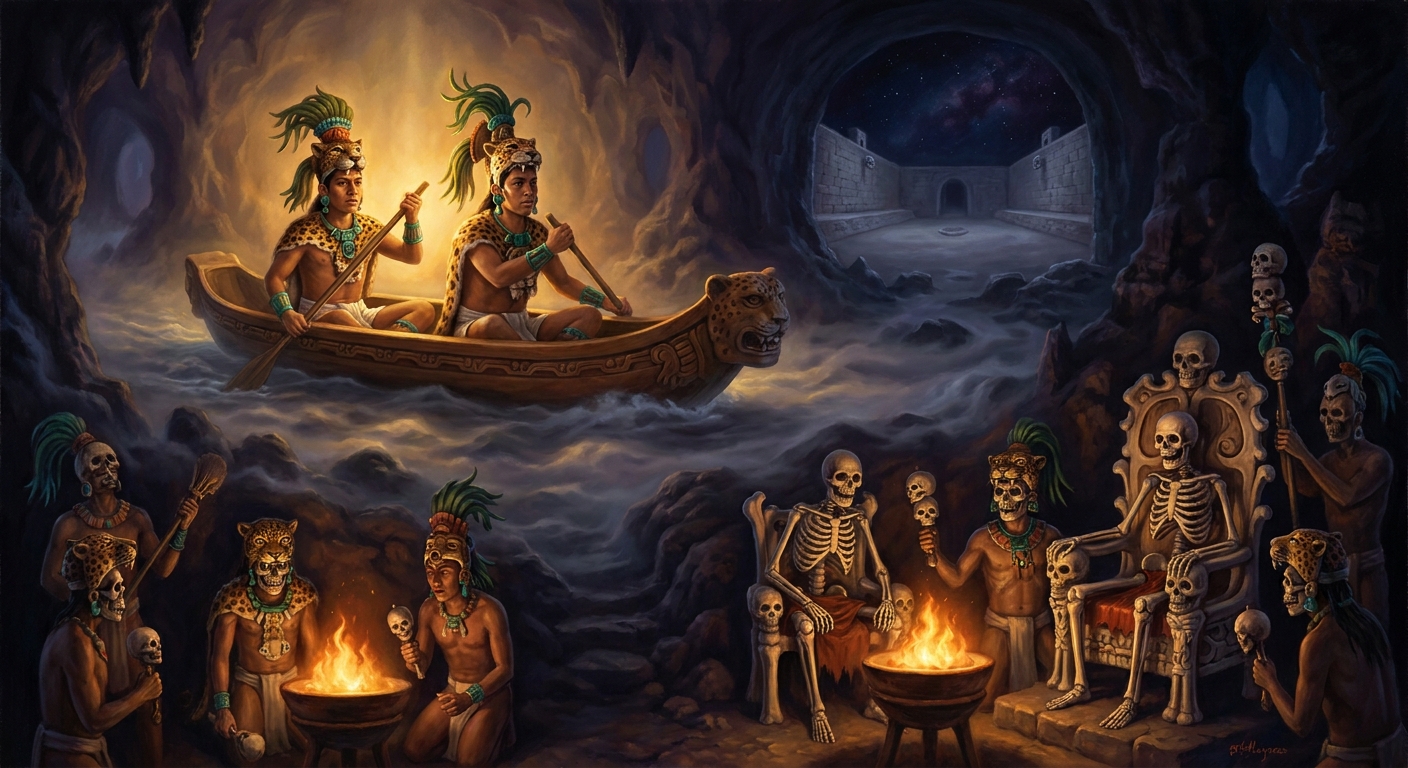
Hun Hunahpú, the Maize God, descends to Xibalbá, is killed by the lords of death, and is buried beneath the ball court — but his severed head placed in a gourd tree generates new life, encoding the complete logic of Maya agriculture as death and resurrection.
- When
- Mythic time — the era before the Hero Twins; Classic Maya tradition
- Where
- Xibalbá, the Maya underworld; the ball court; the gourd tree
Before the Hero Twins, there is their father.
Hun Hunahpú — One Hunahpú, the Maize God, the First Lord — is a ballplayer. He is also a musician: he and his brother Vucub Hunahpú play instruments, they create things, they move through the world of the surface with the creative energy that the ballplayer gods possess. But their ball court is above the road that leads to Xibalbá, and the sound of their playing reaches down.
The lords of death send their owls up.
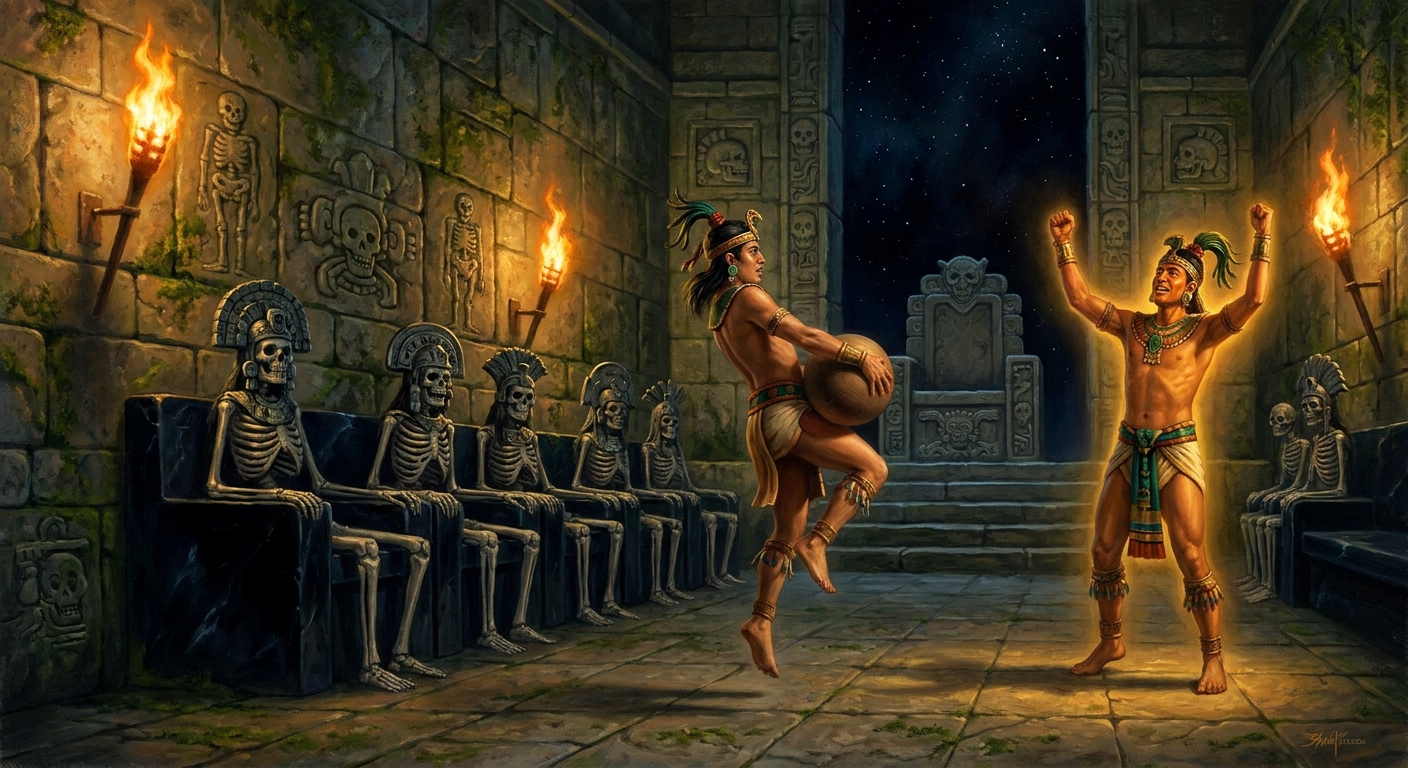
The brothers go. The Popol Vuh records this journey without illusion: they go and they fail. They are offered the hot stone to sit on and they sit on it and burn. They are given cigars in the Dark House and they burn the cigars through and bring back stubs — evidence of expenditure, of loss — while their sons will later preserve the cigars intact. The lords of Xibalbá take them through the houses and the brothers do not survive.
They are killed. The text does not specify exactly how. They are killed and buried.
Vucub Hunahpú’s body goes under the ball court. Hun Hunahpú’s body goes under the ball court too, but his head — that is different. His head is placed in the fork of a dead tree at the road junction of Xibalbá, as a trophy, as a warning, as a display.
The dead tree blooms.
The tree had been bare before the head arrived. No fruit, no leaves, a dead thing standing at the crossroads. But with the head of the Maize God in its branches, it puts out gourds — round, pale, hanging among the branches in clusters, looking exactly like skulls if you know what you are looking for, looking exactly like fruit if you do not.
The lords of Xibalbá declare the tree sacred and forbidden. No one shall approach the tree. No one shall touch the fruit. No one shall stand beneath it.
A young woman named Xquic hears about the tree and goes to see it.
The head of Hun Hunahpú spits into her palm. She conceives. She carries the pregnancy upward through the earth to the surface, escaping the lords who would kill her, and she comes to the house of Xmucane and she has the twins.
This is the whole story of Maya agriculture compressed into a myth.
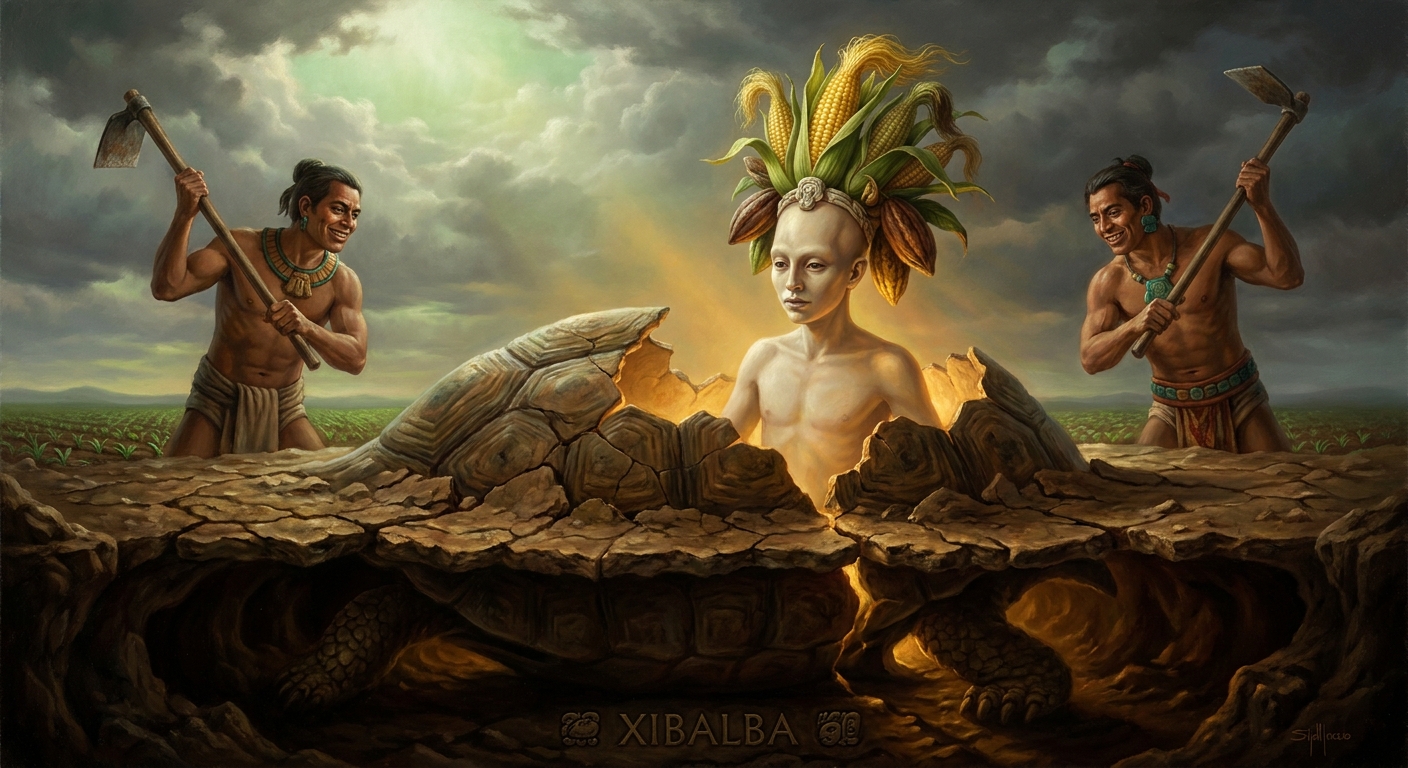
The Maize God is cut. In Classic Maya art — on painted pottery, on carved stone panels, in the stucco facades of temples — the Maize God is shown in exactly this moment: his head severed, his neck a stalk, his head blooming upward from below the earth like a corn plant from its hole. The iconographic signature of the Maize God is the corn foliage that sprouts from his head. He is the plant. His skull is the seed. His burial is the planting.
The agricultural year follows his logic. The milpa is cut and burned in the dry season — the violence of the clearing. The corn is planted in the holes made with a digging stick — the burial. It rains. The corn sprouts green from the dark earth — the head among the gourds, the new generation from the dead one.
The Hero Twins are the new crop. They are what the planted seed generates — not the same seed, transformed, but new plants that carry the DNA of their father upward into the light. Hunahpú and Xbalanqué look like their father. They play his game. They return to the place that killed him and they finish what he could not finish.
In the Classic period at Palenque and Copán, the kings were buried as the Maize God. Their jade-adorned burials, positioned in the pose of the descending deity, enacted the same journey. The king goes into the earth the way corn goes into the earth, the way Hun Hunahpú went into Xibalbá, and the expectation is the same: something will come up.
The pyramid over the burial is the mountain of creation. The growing corn on the stucco facades is the Maize God rising. The living king who comes after — the heir, the new reign — is the Hero Twin, the proof that the seed did not die.
The head in the gourd tree is still there, still spitting, still generating.
It generates everything.
Echoes Across Traditions
Entities
- Hun Hunahpú
- Vucub Hunahpú
- One Death
- Seven Death
- Xquic
Sources
- Popol Vuh, translated by Dennis Tedlock (Simon & Schuster, 1985)
- Allen J. Christenson, *Popol Vuh: The Sacred Book of the Maya* (University of Oklahoma Press, 2007)
- Karl Taube, *The Major Gods of Ancient Yucatan* (Dumbarton Oaks, 1992)