Jezebel and Naboth's Vineyard
c. 870 BCE · Jezreel in the Northern Kingdom of Israel, Naboth's ancestral vineyard, the palace of Ahab
Contents
A king sulks in bed because a peasant will not sell him the family vineyard. His wife, a Sidonian princess, asks the question fatal to all of biblical history: 'Are you not king of Israel?' She forges letters in his name, hires false witnesses, and arranges a judicial murder. The vineyard becomes the king's. The dogs are already running.
- When
- c. 870 BCE
- Where
- Jezreel in the Northern Kingdom of Israel, Naboth's ancestral vineyard, the palace of Ahab
Ahab was the king of Israel. He had married a woman named Jezebel — daughter of Ethbaal, the Sidonian priest-king — and she had brought with her, as part of her marriage settlement, the cult of Baal and the cult of Astarte. The kingdom now had two religions running simultaneously: the older Yahwism of Israel’s heritage and the imported worship of Phoenician gods, with their priests, their groves, their high places.
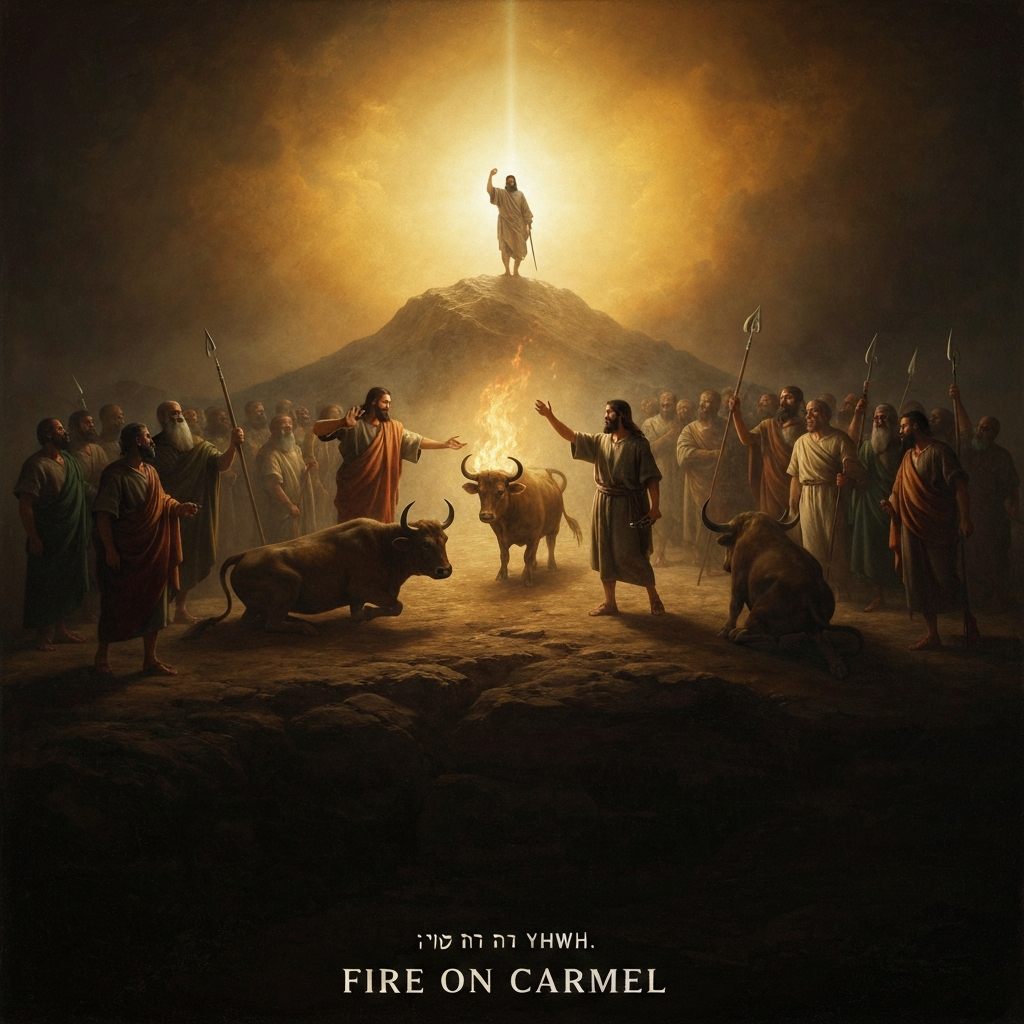
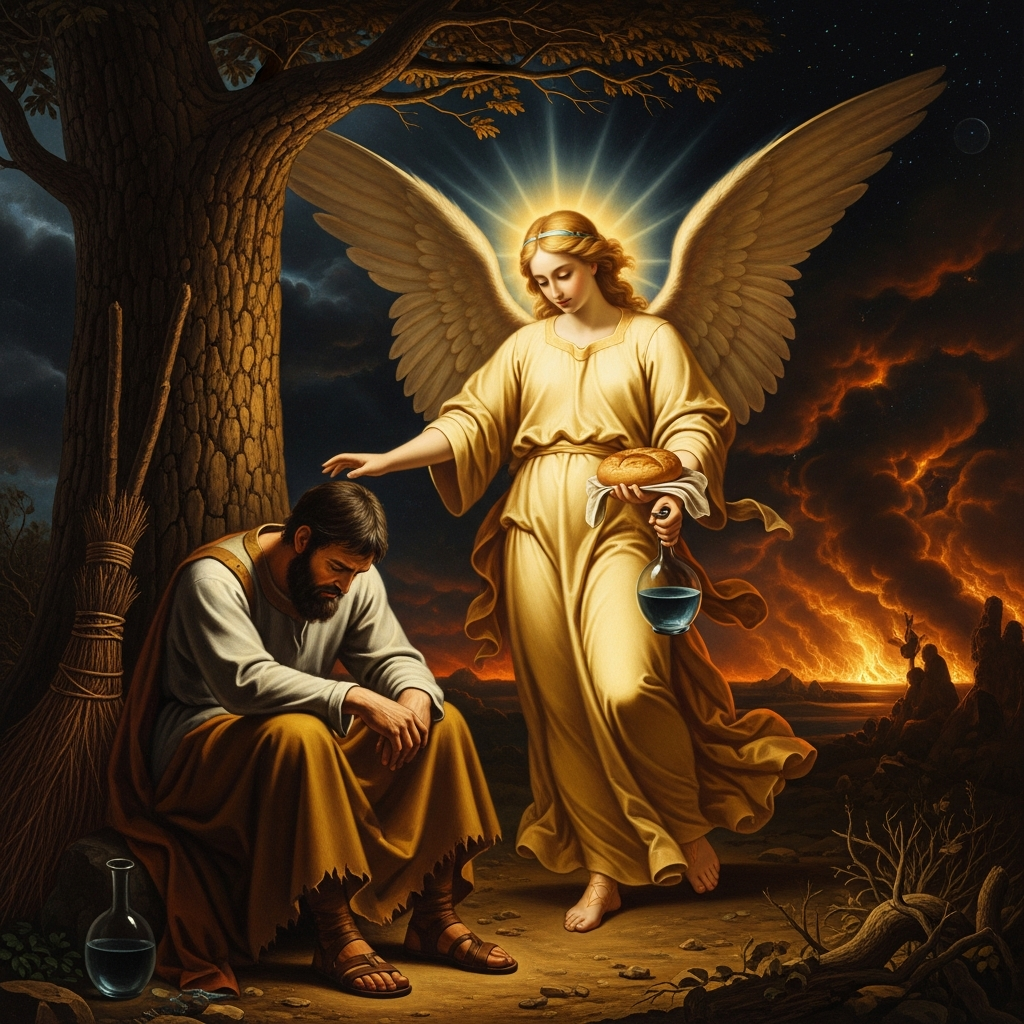
The prophet Elijah had been opposing all of this. He had brought down a three-year drought. He had won the great contest on Mount Carmel and slaughtered four hundred and fifty prophets of Baal at the brook Kishon. He had survived Jezebel’s attempt to kill him by fleeing to Horeb. He had returned to Israel after his theophany and was now living somewhere in the kingdom, watching, waiting.
The kingdom had, in other words, two centers of moral authority: the queen with her Phoenician priests, and the prophet with his Yahwist conscience. The king was caught between them.
Then there was Naboth.
Naboth was a man in Jezreel. He owned a vineyard. The vineyard was on the slope below the king’s summer palace at Jezreel — a parcel of land that had been in Naboth’s family for generations, planted by his ancestors, the kind of vineyard whose vines had been pruned by the same family for so many generations that the rootstock was older than the kingdom.
Ahab wanted it.
He went down to Naboth one day. He was, on the face of it, polite. Give me your vineyard, he said, that I may have it for a vegetable garden, because it is near my house. I will give you a better vineyard than it. Or, if it is good in your eyes, I will give you the price of it in silver.
The offer was, by ordinary standards, fair.
Naboth said no.
His reason was theological, and the king understood it. The LORD forbid that I should give the inheritance of my fathers to you. The land in Israel was not, in principle, alienable. The land had been parceled out at the time of Joshua, tribe by tribe, family by family, and the family parcel — the nahala — was inheritance. It was held by each generation in trust. It was not for sale. It was not for trade. The king himself had no right to it. The Mosaic code preserved this: in the year of Jubilee, every land sold reverted to its original family, because no Israelite finally owned the land — only used it. The king understood the principle. He was a Yahwist by upbringing, however compromised by his marriage. He turned around and went home.
He went into his palace. He went into his bedroom. He turned his face to the wall. He refused to eat.
Jezebel found him there.
She had been raised in a different kingdom. In Phoenicia, and in every kingdom around Israel — in Egypt, in Assyria, in Aram-Damascus — the king’s word was law and the king’s want was the kingdom’s policy. The notion that a king might be told no, by a peasant, on grounds of ancestral religion, would have struck her as primitive and obnoxious.
She sat on the bed beside her sulking husband. She asked: Why is your spirit so sad that you eat no bread? He told her about Naboth’s refusal. She listened to the whole story.
Then she said the line that earns her place in the Hebrew Bible. Are you not king of Israel? Arise, eat bread. Let your heart be merry. I will give you the vineyard of Naboth the Jezreelite.
The line is the founding charter of every act of state corruption. It is not naked despotism — Jezebel will do what she does within forms. It is the discovery that the forms themselves can be made to serve. I will give you, she says — meaning, I will arrange that the vineyard becomes yours through the proper legal mechanisms. The mechanisms will be technically lawful. The result will be murder.
She set to work that afternoon.
She wrote letters. She wrote them in the king’s name. She used the king’s seal — the lion of Israel pressed into wax. The letters went to the elders and the nobles of Naboth’s own town, the men who would naturally be the judges in any local case.
The letters said: Proclaim a fast. Set Naboth on high among the people. Set two men, sons of Belial — sons of worthlessness, base scoundrels — before him, to bear witness against him saying, “You blasphemed God and the king.” Then carry him out and stone him to death.
The instructions were detailed. The legal forms were precise. The fast was the gathering occasion. The placement of Naboth on high — in a prominent seat — gave the proceedings public visibility. The two witnesses fulfilled the Mosaic requirement of two witnesses for a capital case (Deuteronomy 17:6). The charge — blasphemy and treason — was the only charge that carried mandatory death and forfeiture of property. The forfeited property of a traitor reverted to the crown.
Every step was within the law. Every step was a lie.
The elders did as Jezebel had written. They proclaimed the fast. They set Naboth on high. They produced the two paid liars. The liars testified that they had heard Naboth curse God and the king. The crowd took him outside the city. They stoned him to death — and, the Greek versions add, his sons with him, so there would be no heirs to claim the land.
The elders sent word back to Jezebel: Naboth is stoned and is dead.
Jezebel went to Ahab. She said: Arise, take possession of the vineyard of Naboth the Jezreelite, which he refused to give you for money — for Naboth is not alive, but dead.
Ahab arose. He went down to take possession.
He was walking through the rows of vines, perhaps already beginning to plan where the new vegetable beds would go, when a man came toward him along the path.
It was Elijah.
The prophet had been told by the LORD what had happened. He had been told to go to the king. He had come. He stood in the path of the king and looked at him. The king said: Have you found me, my enemy?
Elijah answered: I have found you. Because you have sold yourself to do evil in the sight of the LORD — thus says the LORD: in the place where dogs licked the blood of Naboth, dogs shall lick your blood, even yours. As for Jezebel, the dogs shall eat Jezebel by the wall of Jezreel. Anyone of yours who dies in the city, the dogs shall eat. Anyone of yours who dies in the field, the birds of the air shall eat.
The prophecy was specific. The dogs of Jezreel — the half-wild dogs of every Bronze Age city, who lived on the edges and the offal — would lick the blood of the king. They would eat the queen. The dogs were already gathered at Naboth’s body. They would gather again.
Ahab heard this. He tore his clothes. He put sackcloth on his flesh. He fasted. He walked softly. The text says he went softly — humbled. The LORD told Elijah, because Ahab humbles himself, I will not bring the evil in his days; in his son’s days I will bring it on his house.
The deferral was a deferral, not a cancellation.
Ahab died of an arrow wound at Ramoth-Gilead a few years later. The arrow found him by accident — an enemy archer drew at random — through a chink in his armor. They drove him back from the battle in his chariot. He died slowly, propped up to keep the army from realizing the king was dying. They washed his chariot afterwards in the pool of Samaria. The dogs of the pool licked the blood off the chariot and the floor. The text notes this without comment. According to the word of the LORD which he spoke.
Jezebel lasted longer.
Years later, Jehu — anointed king by Elisha, riding in furious vengeance — entered Jezreel. He came under the walls of her palace. She heard he was coming. She painted her eyes. She did her hair. She stood at her upstairs window — old now, queen still — and called down to him as he rode through the gate. Is it peace, Zimri, you murderer of your master?
Jehu looked up at the window. He did not bother to answer her. He called to the eunuchs who stood with her: Throw her down.
They threw her down.
She fell to the courtyard. The horses trampled her. Jehu rode over her body without stopping. He went into the palace. He ate. He drank. After he had eaten, he remembered: Bury that cursed woman. She is, after all, a king’s daughter.
The servants went out to bury her.
There was nothing left to bury but the skull, the feet, and the palms of her hands. The dogs had eaten the rest.
The Naboth story is one of the few passages in the Hebrew Bible where the prophetic critique of power is rendered in entirely procedural terms. There is no thunderbolt, no fire from heaven, no plague. There is only the slow inexorable execution of a sentence pronounced by an honest man in a vineyard. The institutional mechanism that Jezebel weaponized — courts, witnesses, legal forms — is the same mechanism that, twenty years later, finds her at the upstairs window. The dogs were already on their way the day she pressed the seal into the wax.
Scenes
On a hillside above Jezreel, Naboth tends his vines, the gnarled stocks heavy with green clusters
In an upper room, Jezebel writes letters at a small table
At the city gate, Naboth stands accused before the elders
Echoes Across Traditions
Entities
- Jezebel
- Ahab
- Naboth
- Elijah
Sources
- 1 Kings 21
- 1 Kings 16:29-33
- 2 Kings 9:30-37
- Josephus, Antiquities VIII.13.8