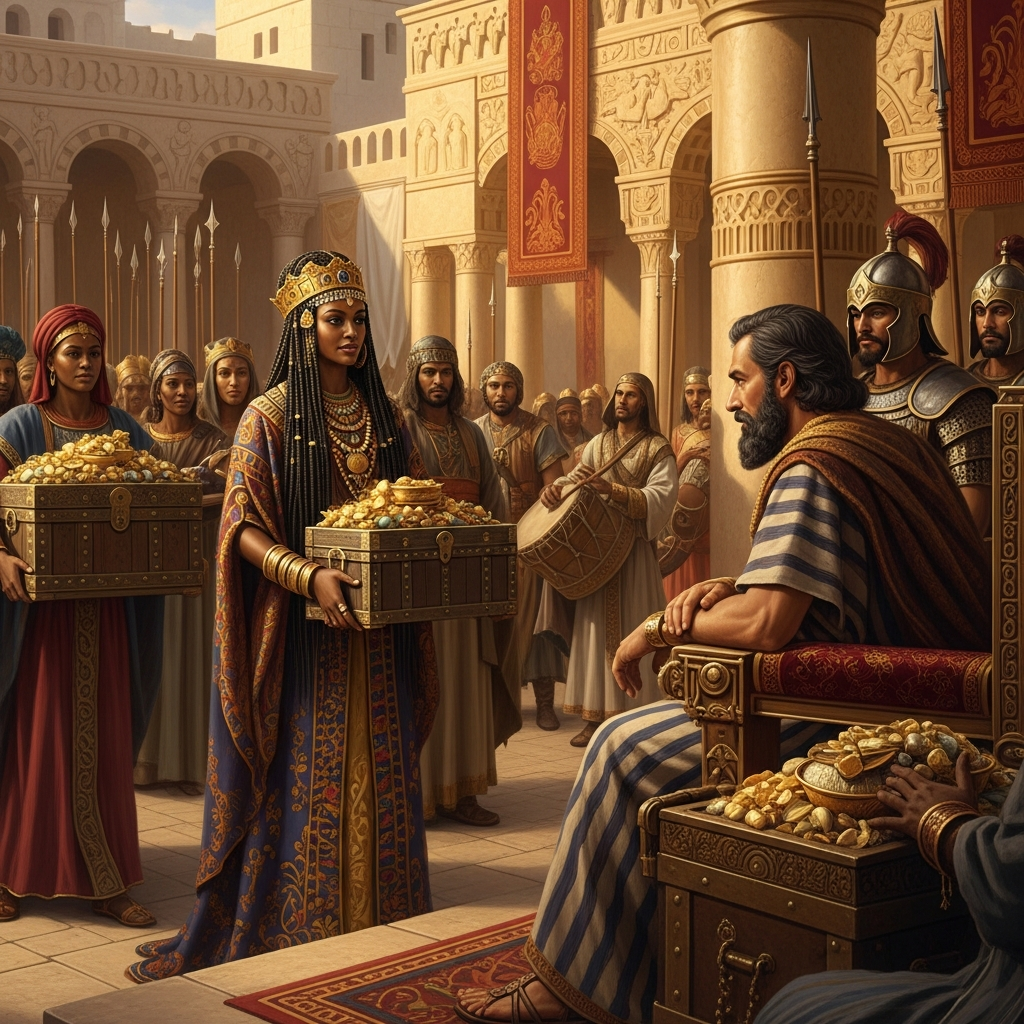
The Queen of Sheba's Visit to Solomon
Kebra Nagast compiled c. 14th century CE; oral traditions much older; Solomon dates to c. 970–931 BCE · Ethiopia (Aksum); Jerusalem; the journey between
Contents
Makeda, the Queen of Sheba, journeys to Jerusalem to test Solomon's wisdom — and returns to Ethiopia carrying his child Menelik I, who will found a royal line lasting until Haile Selassie in 1974. The Kebra Nagast is Ethiopia's answer to Genesis: how the Ark and the covenant came to Africa.
- When
- Kebra Nagast compiled c. 14th century CE; oral traditions much older; Solomon dates to c. 970–931 BCE
- Where
- Ethiopia (Aksum); Jerusalem; the journey between
Her merchants came first.
Long before Makeda herself, the trade routes from the incense-bearing south had carried men through Jerusalem’s markets — men who returned home speaking of a king who knew the answer to every question, who could interpret dreams and bird-calls and the movement of wind, who had built a temple so vast and so full of light that travelers stood in the gate unable to enter because the glory inside paralyzed them. The merchants brought back descriptions. They brought back the smell of cedar. They brought back fragments of what Solomon had said.
Makeda listened to all of it.
She was already a ruler of consequence — the Kebra Nagast calls her queen over one hundred and forty kingdoms, and while this is the language of legend, the historical core is real enough: Aksum was the capital of a trading empire that moved gold, ivory, aromatic resins, and enslaved people across the Red Sea and down the Nile, and its queen in this period would have been a power on the level of the Pharaoh. She needed no king’s wisdom to govern. She was already governing.
But something in the merchants’ reports would not leave her alone.
Solomon knew the names of things. Not just the human names — the names that God had given before language was divided. He knew what the birds said to each other at dawn. He knew what the roots of herbs were for before the apothecaries learned it. He knew, the merchants said, the shape of the question that had no answer and the answer to the question that had no shape.
Makeda gathered her household — seven hundred and ninety-seven camels, mules without number, enough gold and precious stones to fill a room — and she rode north.
The journey from Aksum to Jerusalem took six months.
She arrived at Solomon’s court in the dry season, with dust still on her robes from the Sinai roads, and the king received her in his hall of cedars with the kind of quiet that very confident men deploy when they have nothing to prove. He had been told she was coming. He had spent the interval thinking about how to receive her.
The Kebra Nagast records what she asked him, though it admits the list of riddles could fill its own book. She asked about what travels without moving, what gives without diminishing, what binds without thread. She asked theological questions — questions about the nature of the God who had no body and no location and could not be pointed at but could not be escaped. Solomon answered them all, and each answer produced a longer question, and this is the shape of good theological conversation: it does not terminate.
He asked her questions in return.
By the second month, they were no longer testing each other. They were thinking together, which is a rarer and more dangerous intimacy.
On the last night, Solomon made Makeda a bargain.
He would provide her a feast — his best feast, the kind that only the king of Israel could prepare — and she could eat and drink of everything. In return, she could take nothing from the palace. Nothing of his, not even a cup of water. She agreed readily. The feast was magnificent.
At midnight, she woke with a terrible thirst.
The palace was sleeping. Makeda rose and found a jar of water by the bed and drank from it. And Solomon — who had been lying awake waiting for exactly this — spoke from the dark: You have taken what was mine. The bargain is satisfied.
This is the moment the Kebra Nagast hinges on. The taking of water — the most basic thing, the thing no one can deny anyone — is the mechanism by which the covenant passes. Solomon said: I release you from the bond. But first: what will you give me in return?
He named what he wanted. She agreed.
In the morning she left Jerusalem with the child already beginning inside her, and the long road south was different than the road north. She carried more than she had brought.
The son was born in the mountains of Aksum, and Makeda named him Menelik — son of the wise man — and she raised him in the sight of the mountains that her god, whom she had now accepted as the God, had made before the world put names to anything.
When Menelik was twenty-two, he asked to go north.
He wanted to see his father. He had heard all his life about Jerusalem, about the cedar temple, about Solomon’s hall of questions. He had grown up in its shadow, the son of the story rather than the story itself. Makeda let him go. She gave him her merchants and her guards and her blessing, and she stood on the ridge above Aksum watching the caravan diminish into the northern haze.
She had begun the story. Her son was going to complete it.
She did not yet know that he would come home carrying God’s most sacred object in the back of a cart, and that the God she had learned in Jerusalem would follow His Ark south, and that it would never leave Africa again.
But she turned back into the city to govern, and she governed well, and she is buried in the mountains of Ethiopia, and her name is still spoken as a queen.
Echoes Across Traditions
Entities
- Makeda (Queen of Sheba)
- Solomon
- Menelik I
- Azariah
Sources
- Kebra Nagast (Glory of Kings), compiled c. 14th century CE, attributed to Yeshaq of Aksum
- E.A. Wallis Budge (trans.), *The Kebra Nagast* (1922)
- Cain Hope Felder, *Stony the Road We Trod: African American Biblical Hermeneutics* (1991)
- G.W.B. Huntingford, *The Historical Geography of Ethiopia* (1989)
- 1 Kings 10:1–13 (Hebrew Bible)
- Surah al-Naml 27:20–44 (Quran)