The God That Was Invented
Serapis cult established c. 305–283 BCE under Ptolemy I; Serapeum destroyed 391 CE · Alexandria, Egypt; the Serapeum temple; eventually spread through the Roman Empire
Contents
When Ptolemy I Soter took over Egypt after Alexander's death, he needed a god that both Greeks and Egyptians could worship. He commissioned theologians from Memphis and Athens to design one. They took Osiris and Apis the bull, merged them with Zeus and Asclepius, and produced Serapis — a bearded Greek god who ruled the underworld, healed the sick, and carried a grain basket on his head. The Serapeum of Alexandria was one of the wonders of the ancient world. The temple was destroyed by Christian monks in 391 CE. Serapis was discontinued. The designed god didn't last, but the design — the syncretic deity — has been the blueprint for every colonial theology since.
- When
- Serapis cult established c. 305–283 BCE under Ptolemy I; Serapeum destroyed 391 CE
- Where
- Alexandria, Egypt; the Serapeum temple; eventually spread through the Roman Empire
Alexander the Great died in Babylon on June 10, 323 BCE, without a settled heir.
His generals spent the next twenty years fighting each other over the pieces of the empire he had built. By around 305 BCE, the contest had stabilized into a rough equilibrium of successor kingdoms — the Antigonids in Macedonia, the Seleucids in Asia, and Ptolemy in Egypt. Ptolemy had secured Egypt almost immediately after Alexander’s death; he was there when Alexander died in Babylon, and he managed to intercept Alexander’s body on its way to Macedonia and bring it to Egypt, where its presence would lend divine legitimacy to his new dynasty.
But Ptolemy had a problem that Alexander had not solved.
He ruled a country with an ancient, highly developed, deeply conservative religious system — the Egyptian temple tradition, administered by a professional priesthood that had been managing the relationship between the divine and the human for three thousand years. And he ruled it in the name of a Macedonian Greek monarchy, for a court that was Greek in language and culture. The two constituencies were not hostile, but they did not share a religious vocabulary. The Egyptian temples were not Greek temples. The Greek gods were not Egyptian gods. For Ptolemy’s dynasty to work, he needed a deity that both sides could approach.
He commissioned one.
The design team was small and well-chosen.
Timotheus was an Athenian priest of the Eumolpid family — the hereditary priests of Eleusis, the greatest mystery cult in the Greek world, men who understood how religious awe was constructed and transmitted. Manetho was an Egyptian priest from Sebennytos who had already begun the work of translating Egyptian religious history into Greek — he was the author of the Aegyptiaca, the first systematic account of Egyptian history in a language Greeks could read.
Timotheus brought Greek theological sophistication. Manetho brought knowledge of Egyptian religious tradition and the authority to speak for the Egyptian priesthood. Together, under Ptolemy’s commission, they produced Serapis.
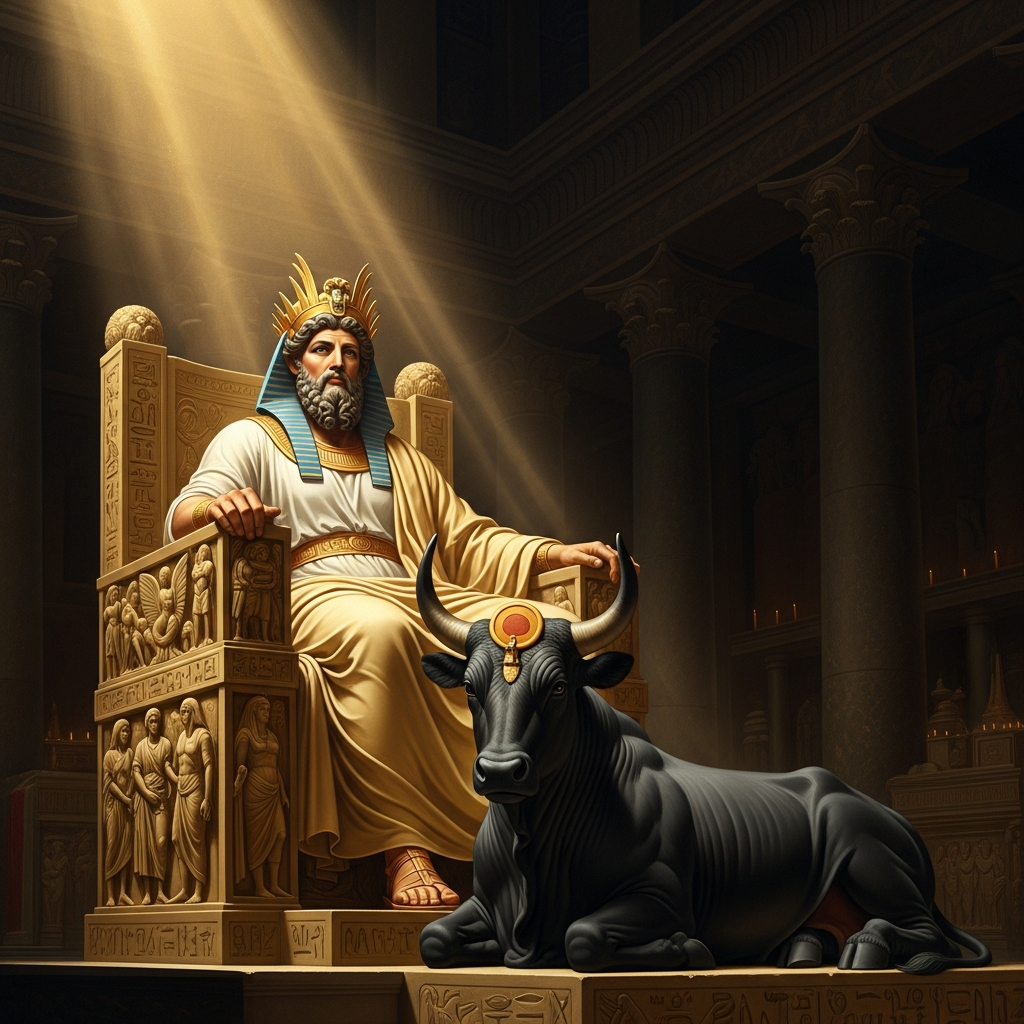
The sources for Serapis are transparent about the engineering. They took Osiris-Apis — the sacred bull of Memphis, called Osorapis in Greek, who was the form of Osiris as ruler of the dead and judge of souls — and merged it with the Greek iconography of a dignified, bearded, senior deity. They gave him attributes of Zeus (sovereignty, power), Hades (underworld rule), Asclepius (healing), Dionysus (abundance and fertility). They placed on his head the kalathos — a basket or grain-measure crown — which was simultaneously an Egyptian attribute and a Greek symbol of agricultural abundance.
The resulting figure: a large, bearded, rather magnificent Greek-looking god with a grain basket on his head, ruling the underworld, healing the sick, commanding the sea, giving grain and prosperity. He looked like Zeus if Zeus had gone to Egypt and adjusted. He looked like Osiris if Osiris had studied Greek. He was, in fact, neither — or both — or the space between them.
He worked.
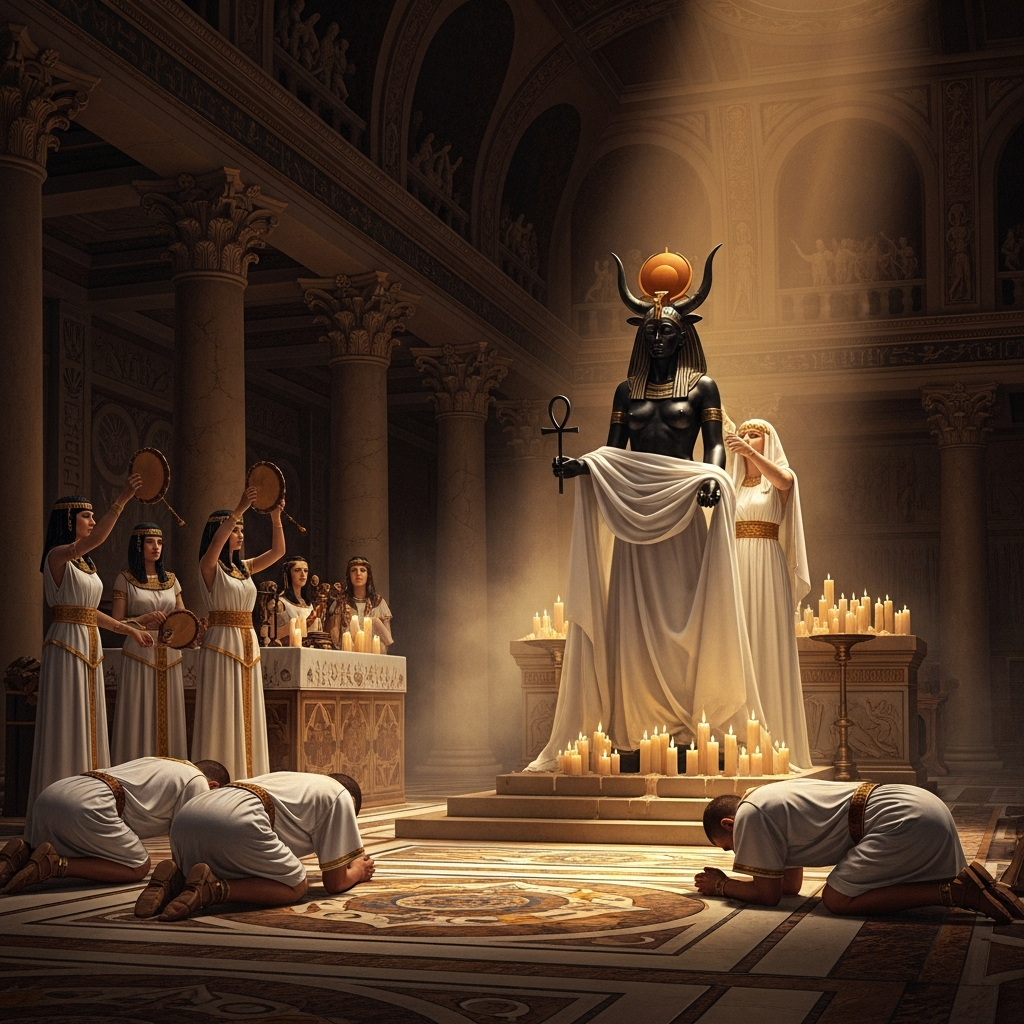
The Serapeum of Alexandria became one of the great temple complexes of the ancient world.
Built on the hill of Rhakotis in the western quarter of Alexandria, it housed a massive cult statue of Serapis that ancient sources describe with reverence and awe: an enormous seated figure, bearded, with a grain basket crown, holding a scepter, positioned so that the morning light from the temple’s eastern window fell directly on the face at sunrise. Strabo visited and wrote about it. Livy mentions it. Josephus describes the neighborhood. The temple complex included libraries, cult rooms, and a subterranean passage.
The cult expanded rapidly. By the first century CE, Serapis had temples throughout the Mediterranean world: in Rome, in Delos, in Athens, in Thessalonica, in Carthage. He was particularly associated with healing — the sick came to his temples to sleep, to receive dream-visions, to be cured. He was also associated with the sea, and sailors made dedications to him at ports across the empire.
He absorbed as he spread. In Rome, Serapis was partly identified with Jupiter. In the eastern Mediterranean, he merged with Helios, the sun. The grain basket became a solar crown. The god that had been designed to bridge two cultures was acquiring the flexibility of a genuinely organic divine figure.
The Christian emperor Theodosius issued his edict against pagan temples in 391 CE.
The bishop of Alexandria at that time was Theophilus — a man of considerable political ambition and considerable capacity for violence, who understood that the Serapeum was the most visible symbol of the old religion in the most important city in the eastern empire. He obtained imperial permission and sent a Christian mob to the hill of Rhakotis.
The ancient sources describe what happened with a kind of horrified fascination. The pagan priests defended the temple. The Christians breached the doors. The great statue of Serapis — the one whose face caught the morning light, the one that had stood there since Ptolemy’s commissioning — was broken apart with axes. Its head was dragged through the streets. The library was destroyed or dispersed, depending on which source you trust.
After the statue was destroyed, Theophilus made a point of showing the crowd what was inside it. The holy of holies — the space behind the cult image — contained, he said, ritual objects of an obscene nature. Whether this was true or propaganda is debated by historians. What is not debated is that once the statue was gone, the Serapeum’s power as a religious site collapsed. Serapis was discontinued.
But the design lived.
The technique Ptolemy commissioned — find two religious traditions, identify the structural parallels, produce a divine figure who satisfies both — was already so embedded in Hellenistic religious practice by 391 CE that it could not be discontinued with the destruction of one temple. Every Roman provincial cult had used the same method. Every missionary tradition that followed applied the same logic.
What the Serapis project makes visible is the usually concealed apparatus of religious syncretism: the patron (Ptolemy), the designers (Timotheus and Manetho), the political purpose (dynastic legitimacy across cultural divisions), and the machinery (theological merging, new iconography, purpose-built temple). Usually these elements are obscured by time and by the piety of later practitioners who know the result but not the origin. With Serapis, the origin is documented. The god was designed in a committee in the early 3rd century BCE, and we know who was on the committee.
Every designed god casts this light backward: on every other god whose design we have forgotten, because the documentation didn’t survive, or because the designers had the good sense not to write it down.
Echoes Across Traditions
Entities
- Serapis
- Ptolemy I Soter
- Timotheus of Athens (priest-designer)
- Manetho of Memphis (priest-designer)
- Osiris-Apis (the source figure)

Sources
- Tacitus, *Histories* IV.83–84 (c. 105 CE)
- Plutarch, *On Isis and Osiris* 28 (c. 100 CE)
- Diodorus Siculus, *Library of History* I.25 (c. 60–30 BCE)
- John E. Stambaugh, *Sarapis under the Early Ptolemies* (1972)
- Sarolta Takács, *Isis and Sarapis in the Roman World* (1995)
- Jan Assmann, *Of God and Gods: Egypt, Israel, and the Rise of Monotheism* (2008)