Part of the Bestiary Compendium
Shape-shifters change form and change back. The metamorphosed don’t get that option. These are the beings who crossed a threshold — through punishment, prayer, enlightenment, or death — and came out the other side as something permanently different. The old form is gone. There is no return.
This section catalogs the one-way transformations across world mythology: who changed, what they became, and the brutal or beautiful reason why.
Art style:
hyper-realistic divine transformation, the body caught mid-change between two states, dramatic chiaroscuro lighting, the horror and beauty of permanent metamorphosis, cinematic composition, oil painting rendering, 8kThe Metamorphoses — Permanent Transformations
| Who | From | To | Why | Tradition | Source |
|---|---|---|---|---|---|
| Lot’s Wife | Woman | Pillar of salt | Looked back at Sodom | Biblical | Gen 19:26 |
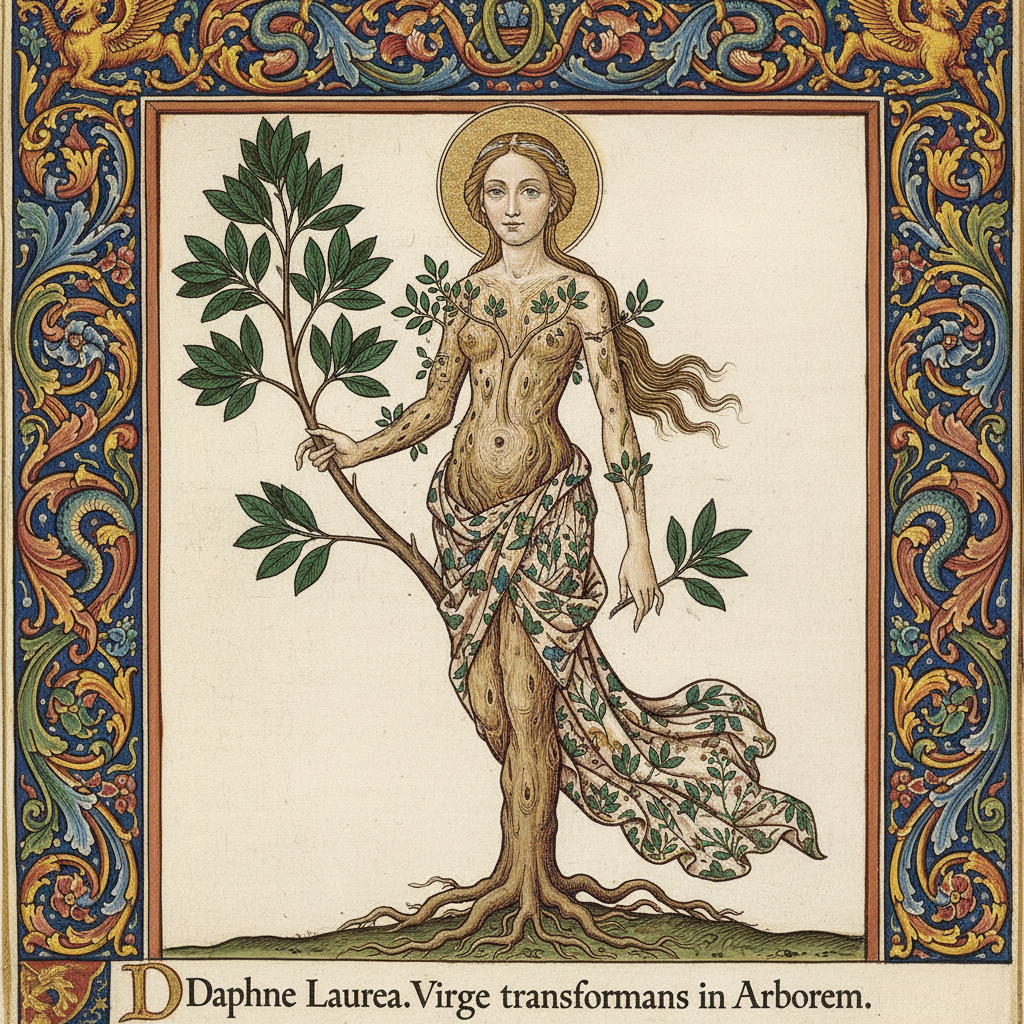
| Daphne | Nymph | Laurel tree | Fled Apollo’s pursuit; prayed for escape | Greek | Ovid, Metamorphoses |
| Arachne | Master weaver | Spider | Boasted she was better than Athena | Greek | Ovid, Metamorphoses |
| Lycaon | King of Arcadia | Wolf (first werewolf) | Fed human flesh to Zeus to test him | Greek | Ovid, Metamorphoses |
| Narcissus | Youth | Flower | Fell in love with his own reflection; wasted away | Greek | Ovid, Metamorphoses |
| Enoch | Human patriarch | Metatron (greatest angel) | “Walked with God; then was no more” | Jewish | 3 Enoch, Gen 5:24 |
| Nebuchadnezzar | King of Babylon | Beast (7 years) | Pride: “Is not this great Babylon I built?” Temporary, reversed. | Biblical | Dan 4 |
| Bear and Tiger | Animals | Woman (Ungnyeo, first Korean ancestor) | Ate garlic and mugwort for 100 days in a cave; only the bear endured | Korean | Samguk Yusa |
| Koschei the Deathless | Sorcerer | Death externalized into nested objects | His “soul” lives outside his body: needle → egg → duck → hare → chest → oak → island | Slavic | Russian folklore |
| Siddhartha Gautama | Prince | The Buddha (The Awakened One) | Not physical but THE transformation: from ignorance to enlightenment under the Bodhi tree | Buddhist | Pali Canon |
| Saul of Tarsus | Persecutor of Christians | Paul the Apostle | Blinded on the Damascus road; saw again as a different person | Biblical | Acts 9 |
| Izanami | Creator goddess | Queen of the Dead | Died giving birth to fire (Kagutsuchi); chose to remain in Yomi | Shinto | Kojiki |
The Taxonomy of Transformation
Not all metamorphoses are created equal. They cluster into types that reveal what each culture believes about the relationship between identity and form.
| Type | Mechanism | Reversible? | Examples |
|---|---|---|---|
| Punishment | God transforms the offender | Usually not | Arachne, Lycaon, Lot’s Wife |
| Escape | Transform to flee | No | Daphne (to escape Apollo) |
| Ascension | Human becomes divine | No | Enoch → Metatron, Heracles → Olympian |
| Enlightenment | Consciousness transforms | No (in theory) | Buddha, Paul |
| Death-transformation | Death changes the being’s nature | No | Izanami, Osiris (alive → Lord of Dead) |
| Externalization | Soul/death placed OUTSIDE the body | Until found | Koschei (Slavic), some fairies |
What the types reveal
Punishment transformations (Arachne, Lycaon, Lot’s Wife) are the most common and the most brutal. The gods don’t just kill — they edit. Arachne wove too well, so she weaves forever as something people crush underfoot. Lycaon served human meat, so he becomes the thing that eats it. Lot’s Wife looked back, so she stays — permanently facing what she should have left behind. The punishment isn’t destruction. It’s irony made flesh.
Escape transformations (Daphne) are the saddest. Daphne doesn’t choose to become a tree. She chooses not-Apollo, and the universe provides the only available exit. Her father, the river god Peneus, grants her prayer by destroying her human form. She escapes the predator by ceasing to be prey. This is liberation that looks exactly like annihilation.
Ascension transformations (Enoch → Metatron) are the rarest and most dramatic. Enoch doesn’t die — Genesis says he “walked with God; then he was no more.” The Talmudic and mystical traditions fill in the gap: Enoch was taken to heaven and transformed into Metatron, the angel of the divine presence, with 36 pairs of wings and eyes that see everything. The human body burned away. What remained was fire. This is metamorphosis as promotion — but the cost is everything you were.
Enlightenment transformations (Buddha, Paul) are the most philosophically interesting because nothing physical changes. Siddhartha sat under a tree and stood up as the Buddha. Saul was knocked off a horse and got up as Paul. The body is the same. The mind is completely different. Every tradition that includes this type is making a radical claim: the real transformation is internal, and physical metamorphosis is just the crude, visible version of what enlightenment does invisibly.
Death-transformations (Izanami, Osiris) are the metamorphoses no one chooses. Izanami dies giving birth to fire and becomes the Queen of the Dead — not because she wanted to, but because death in the Kojiki isn’t an ending, it’s a reassignment. Osiris is murdered by Set, dismembered, reassembled by Isis, and becomes Lord of the Underworld. In both cases, death doesn’t destroy the being — it repurposes them. The dead god becomes the god of death. The function follows the fate.
Externalization (Koschei) is the strangest category and perhaps the most modern-feeling. Koschei the Deathless doesn’t transform himself — he transforms his mortality, removing it from his body and hiding it inside a needle, inside an egg, inside a duck, inside a hare, inside a chest, on an island, under an oak. His death is a series of Russian nesting dolls. You can’t kill him by stabbing him — you have to find the island, find the oak, find the chest, catch the hare, catch the duck, find the egg, break the needle. It’s the original horcrux.
The Profiles
Lot’s Wife — The Pillar of Salt
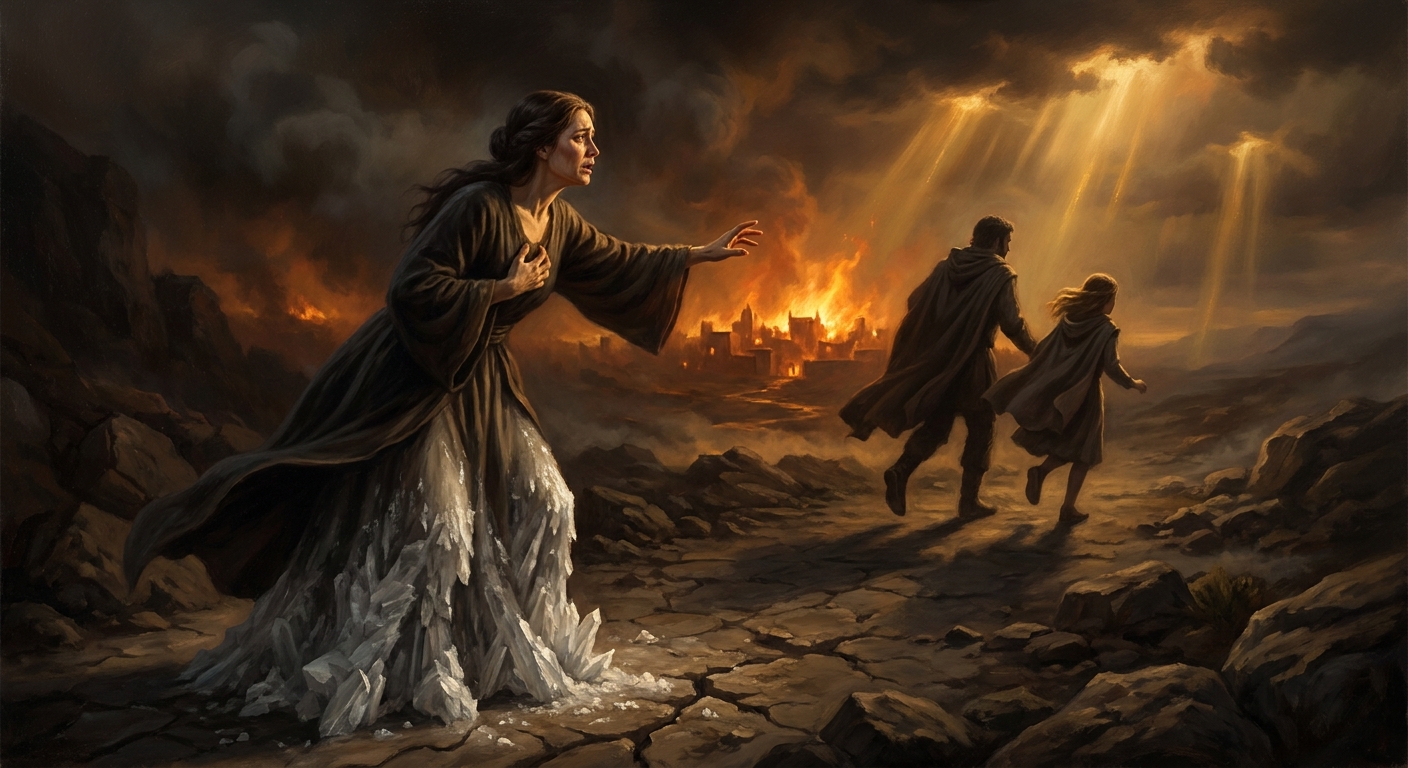
She doesn’t have a name. In Genesis 19:26, she is simply “his wife,” and her entire story is a single verse: “But Lot’s wife, behind him, looked back, and she became a pillar of salt.”
That’s it. One glance. One transformation. No appeal, no warning beyond the angels’ instruction to flee without looking back. The cities of Sodom and Gomorrah are burning behind her, and she turns — maybe out of grief, maybe curiosity, maybe defiance — and she’s salt. Standing there. Forever.
The rabbinical tradition gives her a name (Ado or Edith, depending on the source) and a backstory: she refused hospitality to strangers and used salt to do it, so salt is what she becomes. The punishment fits the sin with surgical precision.
Jesus references her in Luke 17:32: “Remember Lot’s wife.” Three words. The shortest sermon in the Gospels. The message: don’t look back. The past will crystallize you.
hyper-realistic divine transformation, a woman's body mid-transformation into a pillar of crystalline salt, one hand still reaching backward toward a burning city on the horizon, dramatic chiaroscuro lighting with fire-glow from Sodom behind her, her face caught between grief and shock as salt crystals crawl up her skin, the horror and beauty of permanent metamorphosis, cinematic composition, oil painting rendering, 8kDaphne — The Laurel Tree
Apollo sees Daphne and wants her. Daphne runs. She runs until she can’t run anymore, then prays to her father, the river god Peneus: “Destroy this beauty that pleases too well.” Peneus answers. Bark crawls up her legs. Her arms become branches. Her hair becomes leaves. Her feet root into the earth. Apollo arrives just in time to watch the woman he wanted become something he can never have.
He touches the trunk. Her heart is still beating inside the wood.
Apollo claims the laurel as his sacred tree. He weaves her leaves into the crown that becomes the symbol of victory, poetry, and achievement. Western civilization’s highest honor — the laurel wreath, the poet laureate, the baccalaureate — is a memorial to a woman who chose to become a plant rather than be touched by a god.
hyper-realistic divine transformation, a young nymph mid-transformation into a laurel tree, bark climbing her legs and torso while her arms extend into branches bursting with green leaves, her face tilted skyward in a mixture of relief and agony, Apollo reaching toward her from behind with desperate outstretched hands, dramatic chiaroscuro lighting in a forest glade, the horror and beauty of permanent metamorphosis, cinematic composition, oil painting rendering, 8kArachne — The First Spider
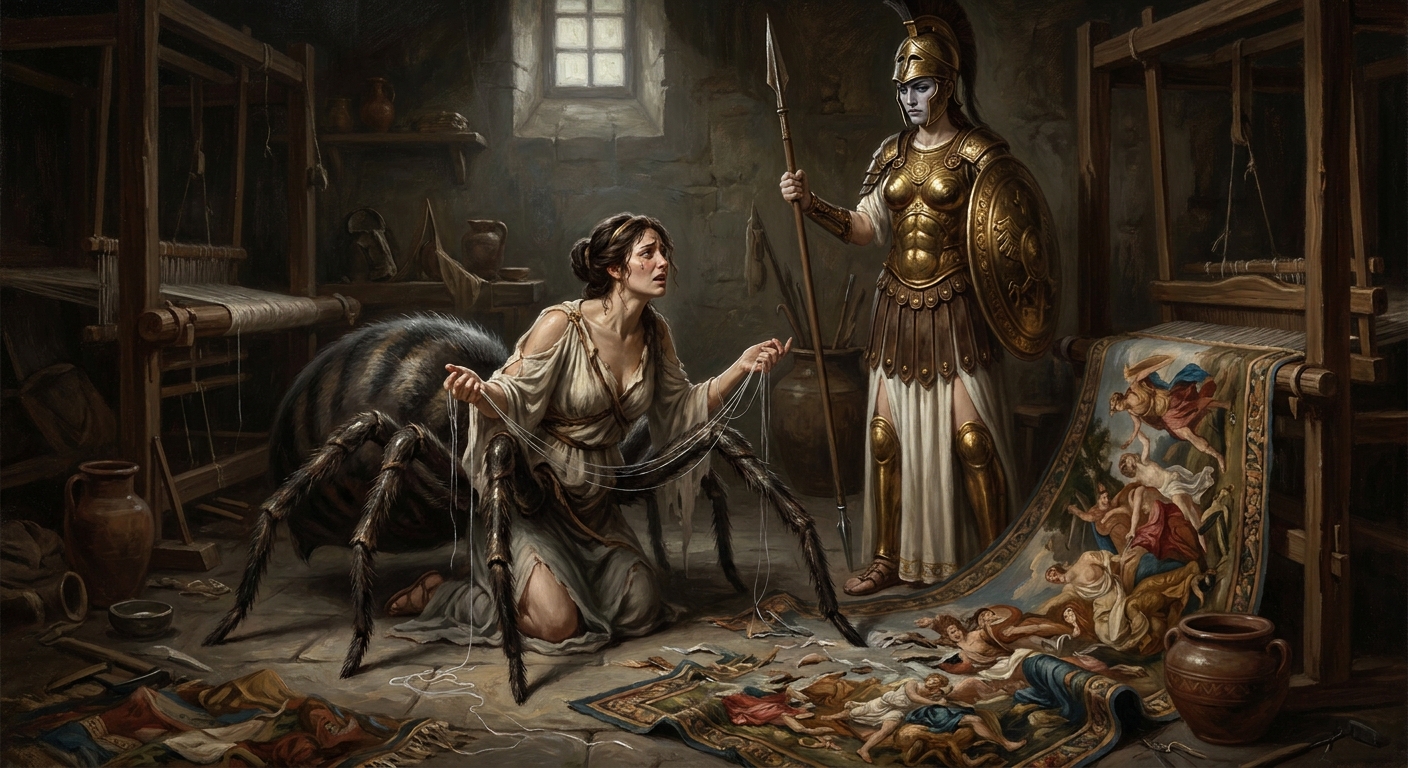
Arachne was a mortal weaver so skilled that people said she must have learned from Athena herself. Arachne’s response: “Athena could learn from me.” This is the wrong thing to say about a goddess.
Athena appeared disguised as an old woman and warned her. Arachne doubled down. So Athena revealed herself and challenged Arachne to a weaving contest. Athena wove the gods in their glory. Arachne wove the gods at their worst — Zeus’s rapes, Poseidon’s assaults, Apollo’s deceptions. Every thread was an accusation.
The devastating detail: Arachne’s work was flawless. Even Athena couldn’t find a fault. So Athena destroyed the tapestry, beat Arachne with the shuttle, and when Arachne tried to hang herself in shame, Athena transformed the rope into a web and Arachne into a spider. “Live, guilty woman,” Athena said. “And spin forever.”
Arachne won the contest and lost everything.
hyper-realistic divine transformation, a woman suspended in mid-air transforming into a spider, her torso shrinking as extra limbs emerge from her sides, silk threads streaming from her body as her human face contracts into chelicerae, Athena standing below watching with cold satisfaction, dramatic chiaroscuro lighting in a Greek temple workshop, looms and tapestries visible in the background, the horror and beauty of permanent metamorphosis, cinematic composition, oil painting rendering, 8kLycaon — The First Werewolf
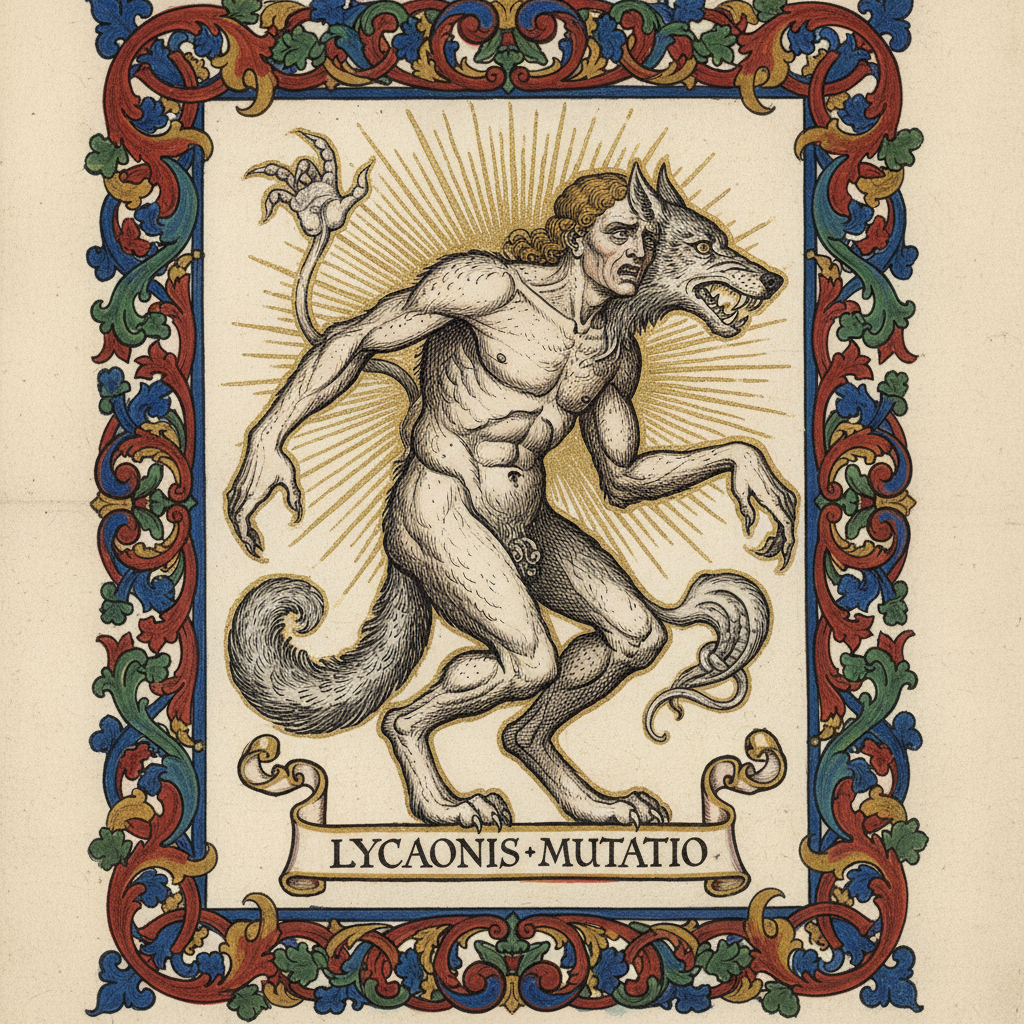
King Lycaon of Arcadia wanted to test whether his guest was really Zeus. His method: serve the god human flesh. In some versions, it’s a child. In others, it’s a prisoner. In Ovid’s telling, Lycaon also tried to murder Zeus in his sleep.
Zeus was not amused. He blasted Lycaon’s palace with lightning and transformed the king into a wolf. Ovid describes the transformation with clinical precision: Lycaon’s clothes become fur, his arms become legs, his prayers become howls. But his eyes stay the same. The gray, hungry, human eyes.
Lycaon is the origin of the word “lycanthropy.” He is the first werewolf — not because he chose the wolf, but because the wolf was what he already was. Zeus didn’t change Lycaon’s nature. He revealed it.
hyper-realistic divine transformation, a king mid-transformation into a wolf, his royal robes tearing as gray fur erupts across his body, his jaw elongating into a muzzle while his crown tumbles away, his eyes remaining terrifyingly human in the wolf's face, a banquet table with overturned goblets and horrified guests behind him, Zeus standing wreathed in lightning, dramatic chiaroscuro lighting, the horror and beauty of permanent metamorphosis, cinematic composition, oil painting rendering, 8kNarcissus — The Flower at the Pool
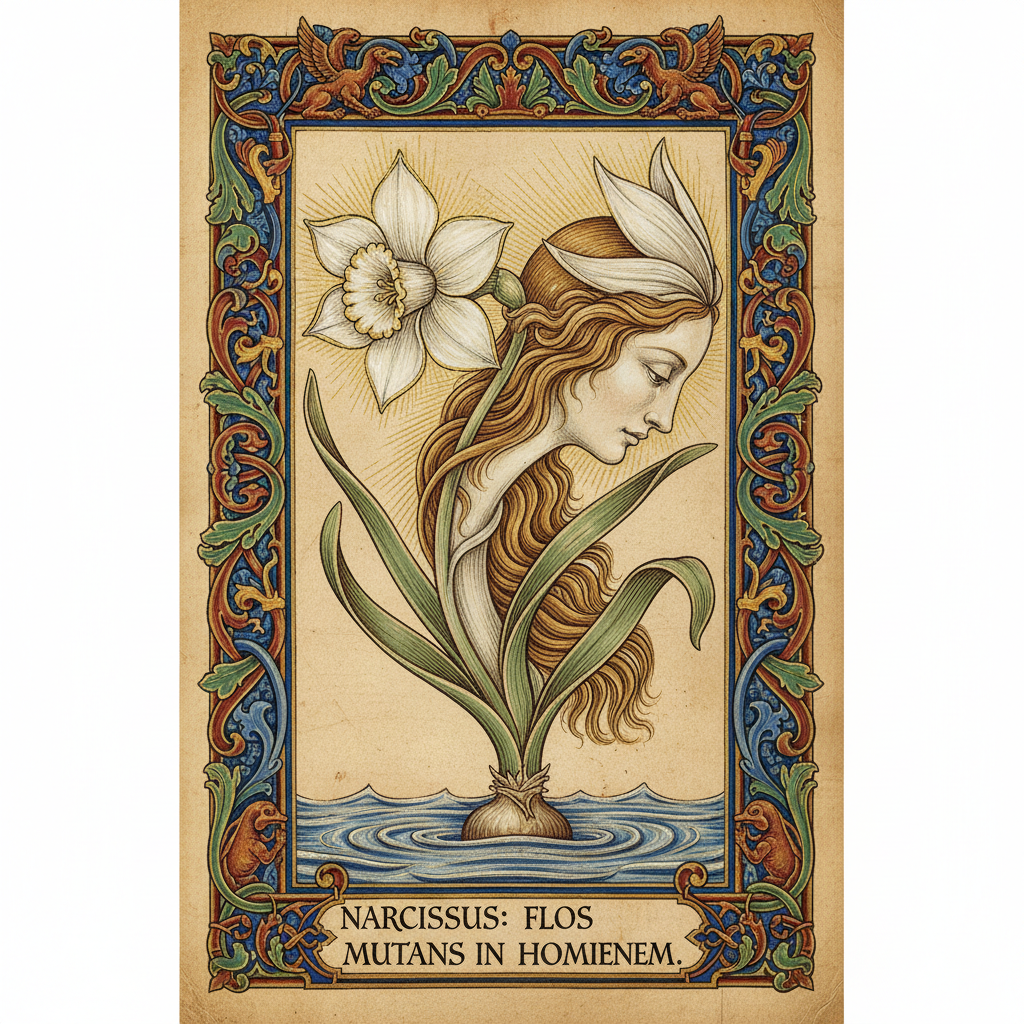
Narcissus was so beautiful that everyone who saw him fell in love. He rejected them all. The nymph Echo loved him until she wasted away to nothing but a voice. The youth Ameinias killed himself on Narcissus’s doorstep. The gods noticed.
Nemesis, goddess of revenge, led Narcissus to a pool. He saw his reflection. He fell in love with it. He couldn’t leave. He couldn’t touch it. He lay there, staring at himself, refusing food and water, speaking to the face in the water that couldn’t answer, until he died.
Where his body had been, a flower grew — white petals around a yellow center, bent toward the water. Still looking at its own reflection.
The narcissus flower is real. It grows near water. Its head droops toward the surface. Botanists named it after the myth, or the myth named it after the flower. Either way, it’s a memorial to the boy who loved himself to death.
hyper-realistic divine transformation, a beautiful youth lying beside a still forest pool, his body dissolving into the earth as white and gold narcissus flowers bloom from his chest and limbs, his face still reflected in the water below, the reflection reaching up as the real body transforms into petals, dramatic chiaroscuro lighting filtering through ancient trees, the horror and beauty of permanent metamorphosis, cinematic composition, oil painting rendering, 8kEnoch → Metatron — The Man Who Became the Greatest Angel
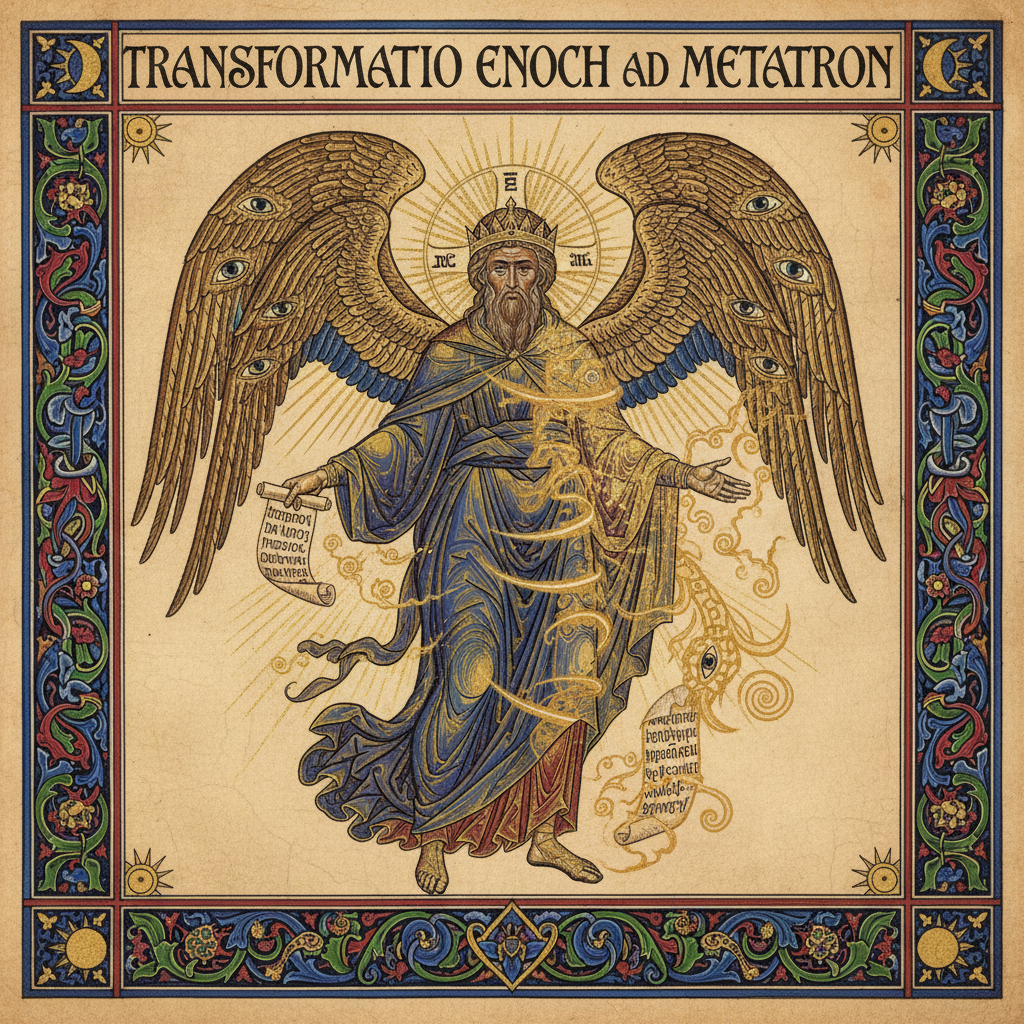
Genesis 5:24 is one of the strangest verses in the Bible: “Enoch walked with God; then he was no more, because God took him.” Not “he died.” Not “he was buried.” He was taken.
The mystical Jewish tradition fills in the gap with the most dramatic promotion in religious history. According to 3 Enoch and the Hekhalot literature, God lifted Enoch to heaven and rebuilt him. His flesh became flame. His sinews became fire. His bones became embers. His eyes became torches. God gave him 36 pairs of wings and 365,000 eyes, one for each day of the year. He was renamed Metatron — “the one who sits beside the throne” — and given authority over all the angels.
Metatron is sometimes called the “Lesser YHWH,” which caused enormous controversy. A human became an angel so powerful that he could be mistaken for God. The Talmud records a heretic named Elisha ben Abuya who saw Metatron seated in heaven and concluded there were two powers — a theological crisis that echoes through centuries of Jewish mysticism.
This is metamorphosis as apotheosis. Enoch didn’t just change form. He changed ontological category.
hyper-realistic divine transformation, a human patriarch ascending through clouds of fire, his mortal flesh burning away to reveal a towering angelic form with 36 pairs of luminous wings unfolding, his eyes multiplying across his body into thousands of blazing points of light, the throne of God visible as pure radiance above, dramatic chiaroscuro lighting with divine fire consuming the human form, the horror and beauty of permanent metamorphosis, cinematic composition, oil painting rendering, 8kNebuchadnezzar — The King Who Ate Grass
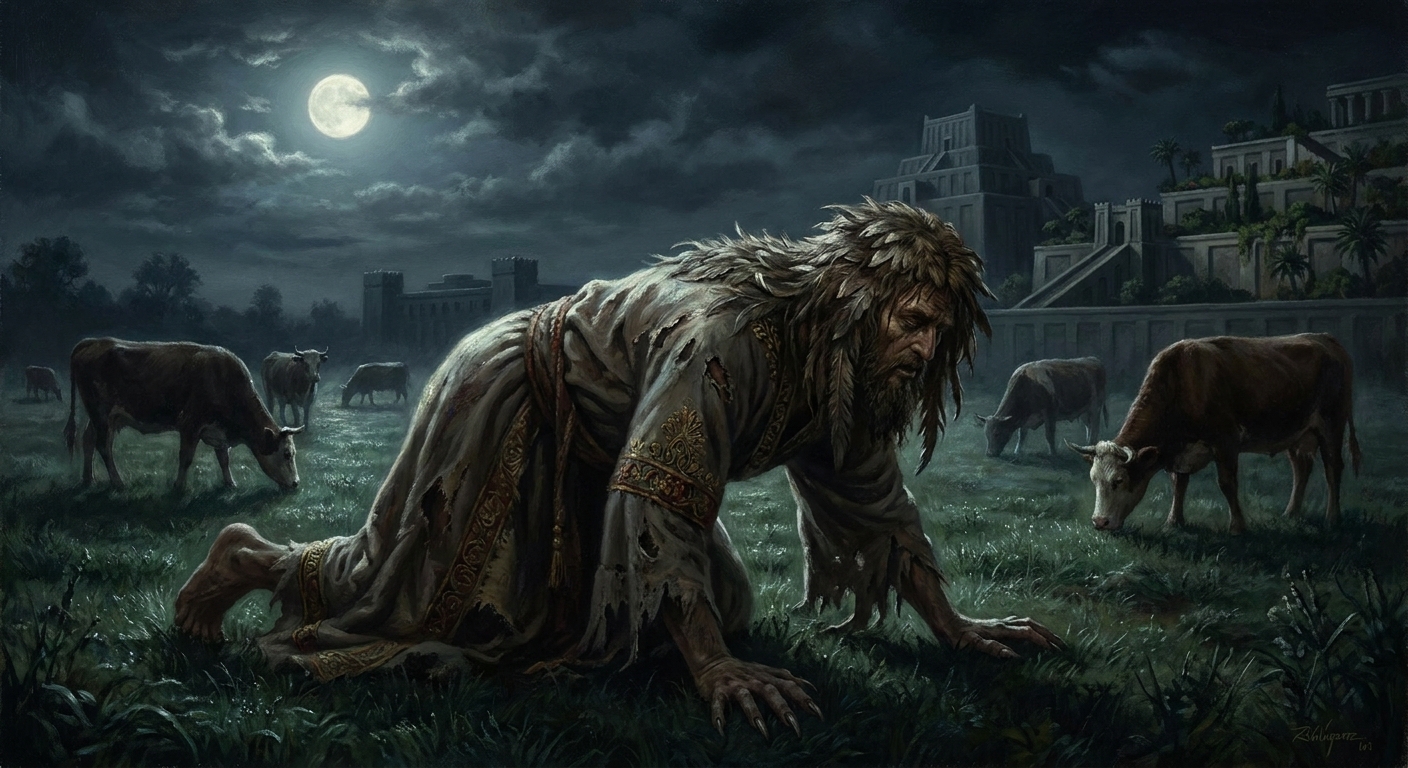
Nebuchadnezzar II built Babylon into the greatest city on Earth. Then he stood on his palace roof and said: “Is not this the great Babylon I have built as the royal residence, by my mighty power and for the glory of my majesty?” The words were still in his mouth when a voice from heaven spoke: “Your royal authority has been taken from you.”
Daniel chapter 4 describes what happened next: Nebuchadnezzar was driven from human society. He ate grass like an ox. His hair grew like eagles’ feathers. His nails became like birds’ claws. For seven years.
This is the only metamorphosis on this list that reverses. After seven years, Nebuchadnezzar “raised his eyes toward heaven, and his sanity was restored.” He got his kingdom back. But the text makes clear: the transformation wasn’t madness. It was education. The most powerful man in the world had to become a beast to learn that he wasn’t God.
This is the anomaly in the taxonomy — a metamorphosis designed to be temporary, a punishment that’s actually a lesson.
hyper-realistic divine transformation, a once-mighty king on all fours in a wild field, his royal robes tattered and filthy, his hair grown wild and matted like feathers, his fingernails curved into talons, his eyes wild and animal but retaining a flicker of human awareness, the silhouette of Babylon's hanging gardens and ziggurats visible on the distant horizon, dramatic chiaroscuro lighting under a stormy sky, the horror and beauty of permanent metamorphosis, cinematic composition, oil painting rendering, 8kUngnyeo — The Bear Who Became a Woman
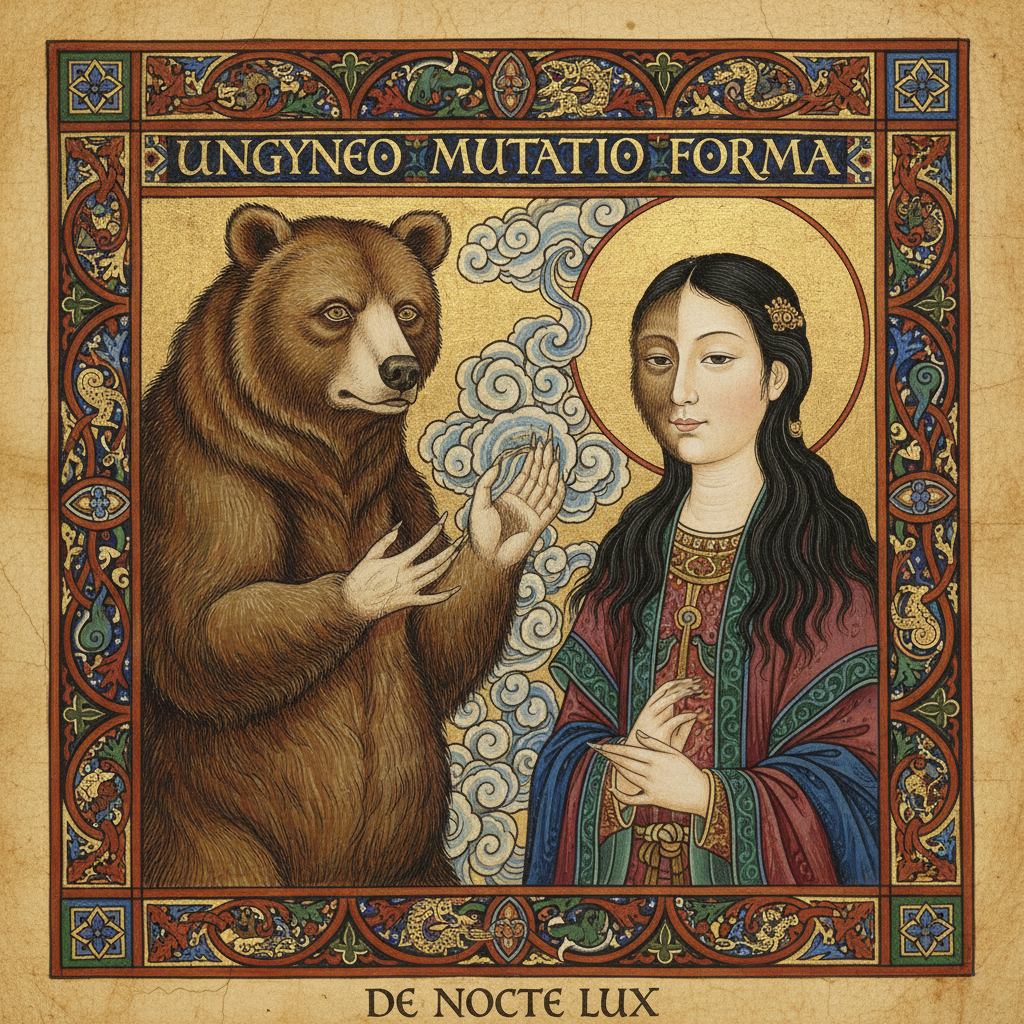
In the Korean creation myth from the Samguk Yusa, a bear and a tiger both prayed to Hwanung, the son of the Lord of Heaven, asking to become human. Hwanung gave them a test: stay in a cave for 100 days, eating nothing but garlic and mugwort.
The tiger gave up after twenty days.
The bear endured. On the twenty-first day, she transformed into a woman — Ungnyeo, the first Korean woman. She prayed for a husband. Hwanung took human form and married her. Their son, Dangun, founded Gojoseon, the first Korean kingdom, in 2333 BCE.
This metamorphosis is unique because it’s earned. No god imposed it. No curse triggered it. The bear chose transformation and paid for it with a hundred days of darkness, garlic, and wormwood. The tiger — stronger, fiercer, more impressive — couldn’t do it. Patience and endurance outranked power.
Ungnyeo is the only figure on this list who transformed through sheer will. Every other metamorphosis requires divine intervention. Hers required divine permission and personal suffering.
hyper-realistic divine transformation, a bear inside a dark cave transforming into a beautiful Korean woman, her fur receding as human skin emerges, her posture shifting from four legs to two, bundles of garlic and mugwort scattered around the cave floor, a beam of divine light streaming through the cave entrance illuminating the transformation, dramatic chiaroscuro lighting, the horror and beauty of permanent metamorphosis, cinematic composition, oil painting rendering, 8kKoschei the Deathless — The Man Who Hid His Own Death
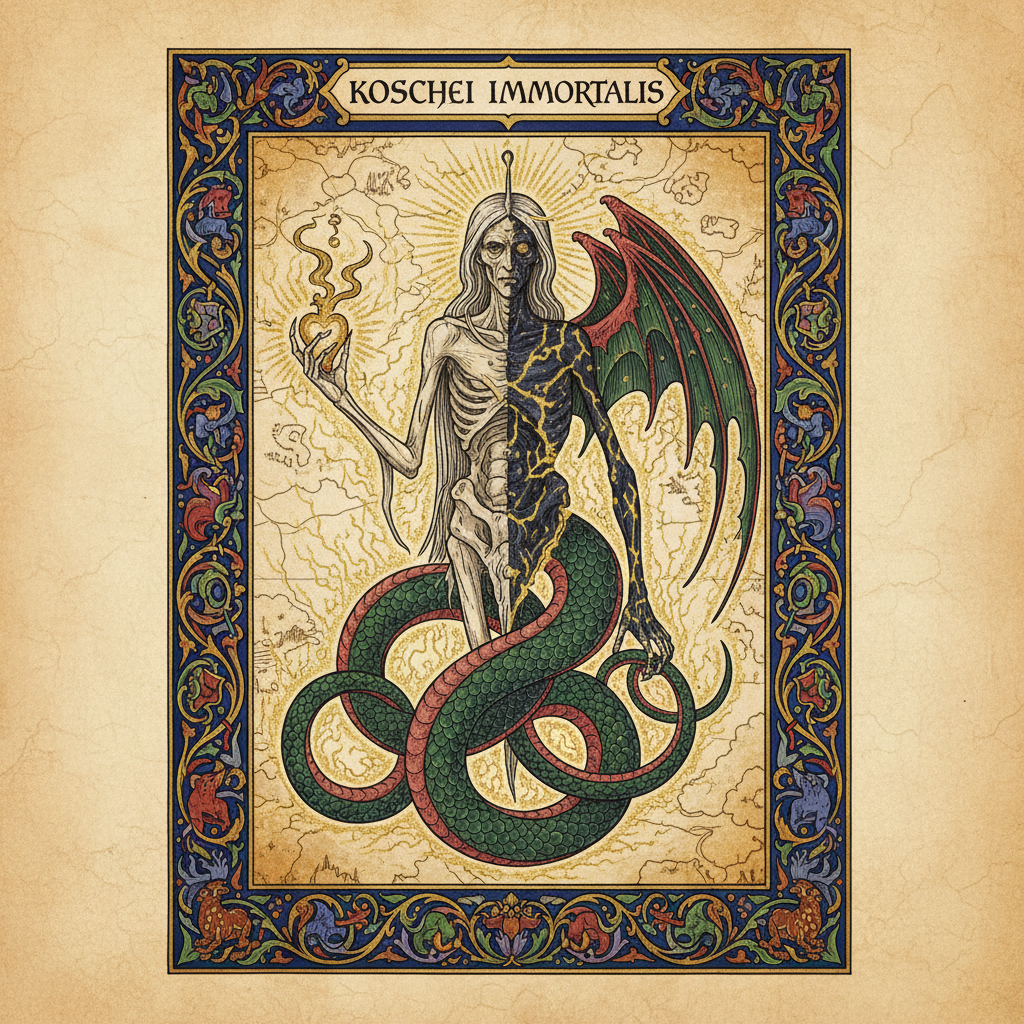
Koschei didn’t transform his body. He transformed his mortality. He removed his death from his body and hid it inside a needle, inside an egg, inside a duck, inside a hare, inside an iron chest, buried under an oak tree, on the island of Buyan in the middle of the ocean.
This makes him effectively immortal. You can stab him, burn him, drown him — it doesn’t matter. His death isn’t in his body. It’s on an island, inside a tree, inside a chest, inside a hare, inside a duck, inside an egg, inside a needle. Break the needle, and Koschei dies.
The hero Ivan Tsarevich (it’s always Ivan) has to find the island, uproot the oak, open the chest, catch the hare (which bolts), catch the duck (which flies), catch the egg (which falls into the sea), and then snap the needle. It’s the most elaborate kill chain in world mythology.
Koschei is the prototype for every villain who stores their soul separately from their body. Tolkien’s Sauron and his Ring. Rowling’s Voldemort and his Horcruxes. The concept is pure Slavic folklore, and it’s built on a profound metaphysical idea: if identity can be separated from the body, then the body is just a container. Kill the container all you want. The real thing is somewhere else.
hyper-realistic divine transformation, a gaunt and terrible sorcerer standing amid a dark forest, his chest split open to reveal an empty cavity where his heart should be, ethereal chains of energy extending from the void outward to a distant island visible through a mystical portal, showing nested objects -- an oak tree containing a chest containing a hare containing a duck containing a glowing egg, dramatic chiaroscuro lighting, the horror and beauty of permanent metamorphosis, cinematic composition, oil painting rendering, 8kSiddhartha → Buddha — The Awakening
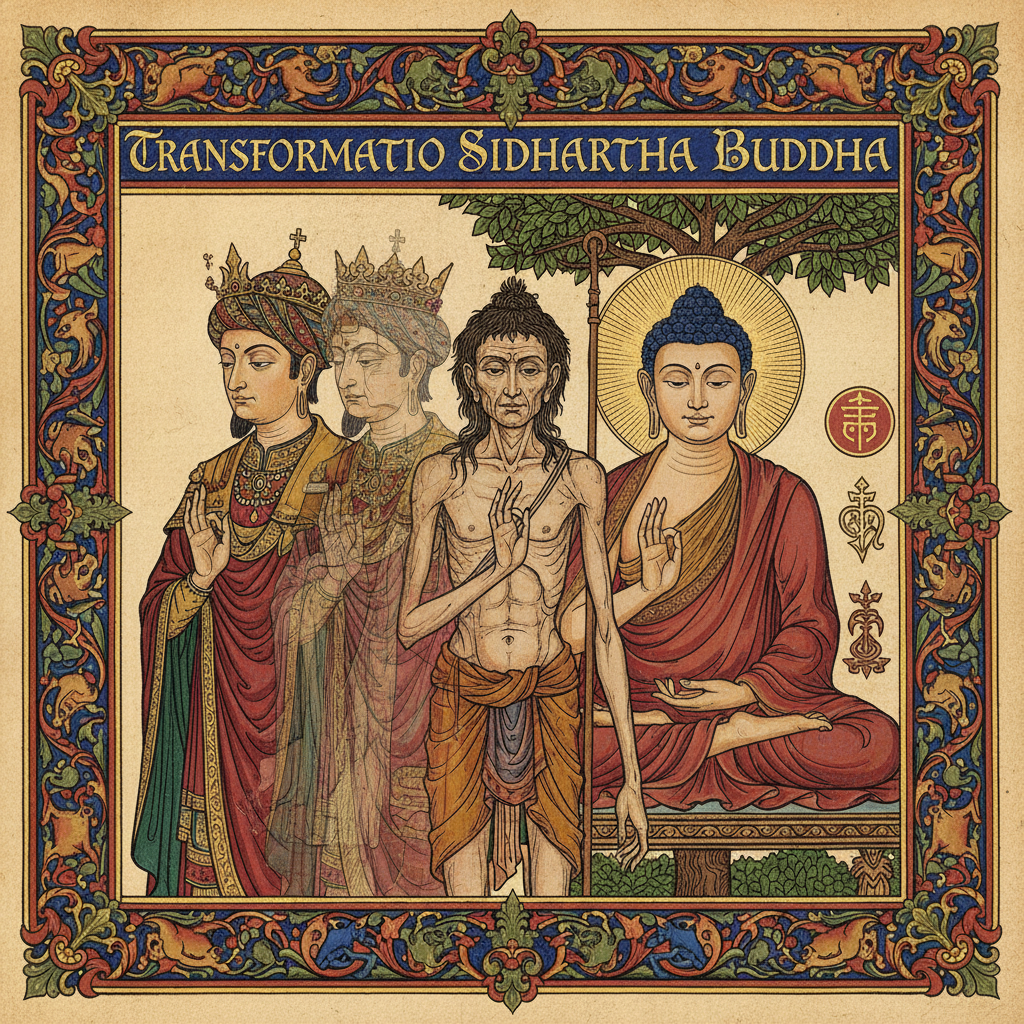
Prince Siddhartha Gautama of the Shakya clan left his palace, encountered suffering, and spent six years searching for liberation. He tried asceticism until he nearly died. He tried meditation under every teacher available. Nothing worked.
Then he sat under a fig tree in Bodh Gaya and decided not to get up until he understood. Mara, the lord of desire and death, attacked him with armies, temptations, and his own beautiful daughters. Siddhartha touched the earth and said: “The earth is my witness.” Mara vanished. At dawn, Siddhartha saw the morning star and understood the nature of suffering, its origin, its cessation, and the path.
He stood up as the Buddha. Same body. Different being.
This is the metamorphosis every other one points toward. Lot’s Wife changed form. Arachne changed species. Enoch changed ontological category. The Buddha changed consciousness. The tradition claims this is the only transformation that matters — physical metamorphosis is just the universe’s crude metaphor for what enlightenment does invisibly: the complete, irreversible dissolution of the self that suffered and the arising of the self that sees.
hyper-realistic divine transformation, a prince seated in lotus position beneath a vast Bodhi tree, his mortal form radiating golden light as enlightenment transforms him, Mara's defeated armies dissolving into darkness around him, his right hand touching the earth as witness, a halo of cosmic awareness expanding from his crown showing the interconnection of all things, dramatic chiaroscuro lighting with dawn light breaking on the horizon, the horror and beauty of permanent metamorphosis, cinematic composition, oil painting rendering, 8kSaul → Paul — The Damascus Road
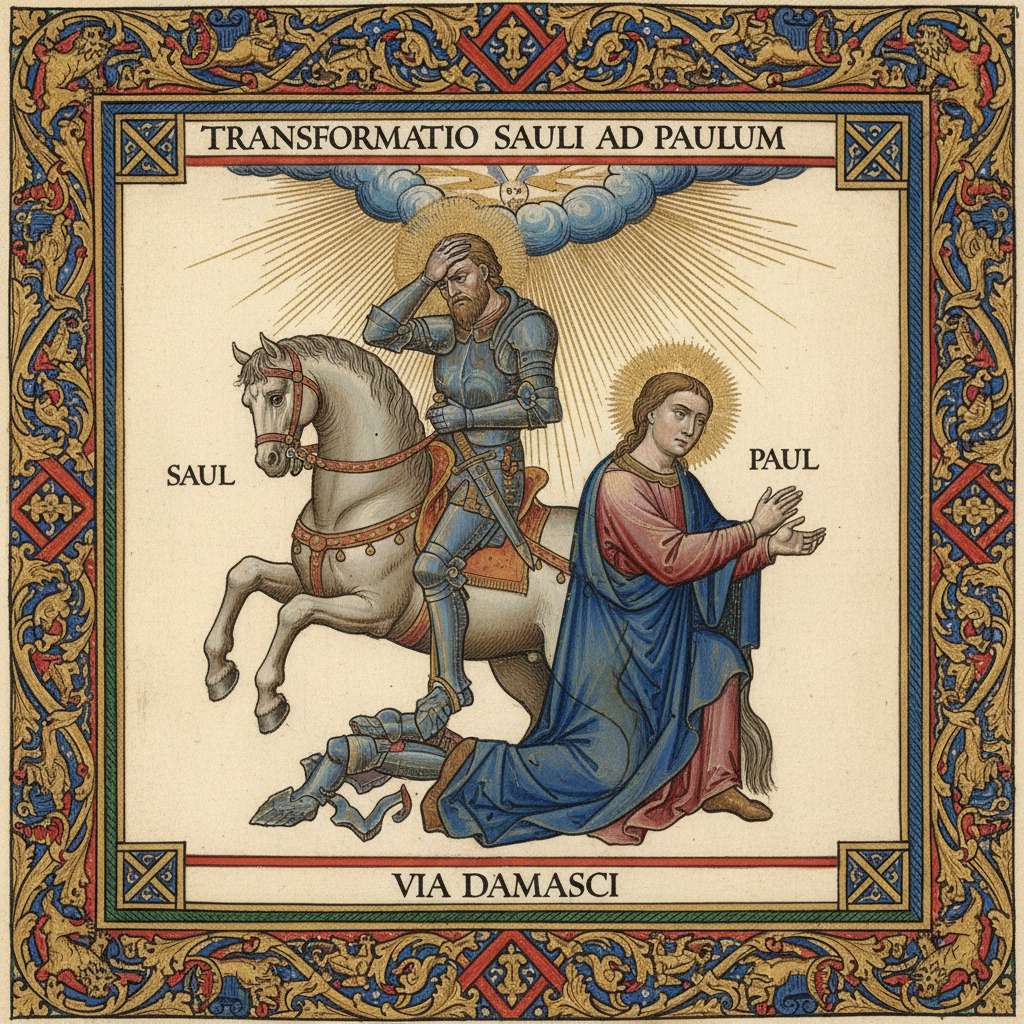
Saul of Tarsus was a Pharisee who hunted Christians. He held the cloaks of the men who stoned Stephen, the first Christian martyr. He carried letters of authority to arrest followers of “the Way” in Damascus.
On the road to Damascus, a light from heaven knocked him to the ground. A voice said: “Saul, Saul, why do you persecute me?” He asked who was speaking. “I am Jesus, whom you are persecuting.” When Saul stood up, he was blind. For three days he couldn’t see, eat, or drink.
A Christian named Ananias — terrified, because Saul was the man who arrested Christians — laid hands on him. Something like scales fell from Saul’s eyes. He could see again. He was baptized. He took the name Paul.
The transformation is total. Saul the persecutor becomes Paul the apostle. The man who arrested Christians becomes the man who writes half the New Testament. The blindness isn’t just physical — it’s the old identity being burned away so the new one can see.
Paul’s metamorphosis is the template for the conversion narrative in Western culture. Every story of radical personal change — from addiction to sobriety, from cruelty to compassion, from certainty to doubt — echoes the Damascus road: knocked down, blinded, rebuilt.
hyper-realistic divine transformation, a man fallen from his horse on a desert road, a blinding pillar of divine light striking him from above, his eyes burning white as scales begin to form over them, his documents of persecution scattering in the wind, other travelers cowering and shielding their eyes, the city of Damascus visible in the distance, dramatic chiaroscuro lighting with the divine light overwhelming the desert sun, the horror and beauty of permanent metamorphosis, cinematic composition, oil painting rendering, 8kIzanami — The Creator Who Became Death
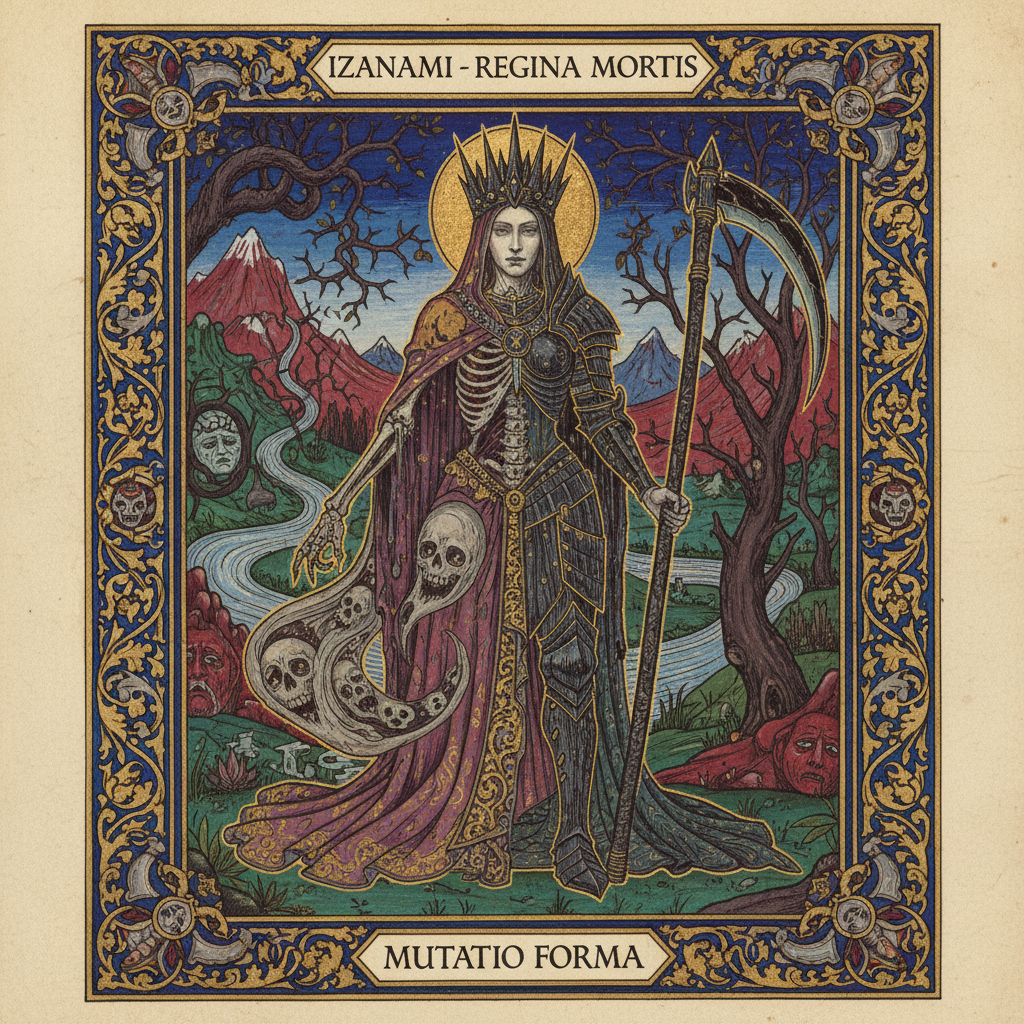
Izanami and Izanagi created the Japanese islands together. They were partners — the first divine couple in Shinto mythology. Then Izanami gave birth to Kagutsuchi, the fire god, and the birth killed her. She descended to Yomi, the land of the dead.
Izanagi couldn’t accept it. He followed her into the underworld, just as Orpheus followed Eurydice. Izanami told him not to look at her. He lit a torch.
What he saw: Izanami’s body rotting, crawling with maggots and thunder gods. She was no longer his wife. She was the Queen of the Dead, and she was furious that he had seen her.
She chased him out of Yomi. Izanagi sealed the entrance with a boulder. From opposite sides of the stone, they divorced. Izanami screamed: “I will kill one thousand of your people every day!” Izanagi replied: “Then I will give life to one thousand five hundred.” And that, the Kojiki says, is why people die and why more are born.
Izanami’s metamorphosis is the origin of death itself. She didn’t choose to become the Queen of the Dead. Death chose her, and she chose to stay.
hyper-realistic divine transformation, a goddess in a dark underground cavern, her once-beautiful form decaying and transforming into the Queen of the Dead, maggots and ethereal thunder spirits crawling across her rotting divine flesh, her eyes blazing with fury and betrayal, her husband visible fleeing through a tunnel of stone behind her, Shinto torii gates crumbling in the underworld darkness, dramatic chiaroscuro lighting with sickly green bioluminescence, the horror and beauty of permanent metamorphosis, cinematic composition, oil painting rendering, 8kThe Uncomfortable Principle
Every metamorphosis on this list follows one rule: you become what you already were.
Arachne was a spider before Athena made it official — she was obsessive, patient, and made beautiful things no one valued. Lycaon was a wolf before Zeus made it literal — he ate people. Narcissus was already trapped in self-regard before the pool. Lot’s Wife was already crystallized in the past before the salt. Siddhartha was already awake before the Bodhi tree — he just didn’t know it yet.
The metamorphosis doesn’t create something new. It reveals something that was always there. The gods don’t invent your punishment or your promotion — they strip away the disguise of your human form and show what you really are.
This is why physical metamorphosis and enlightenment belong in the same category. The Buddha’s transformation and Arachne’s transformation operate on the same principle: the outer form changes to match the inner truth. The difference is that the Buddha’s inner truth was liberation, and Arachne’s was obsession. Same mechanism. Different results.
The real horror of metamorphosis isn’t the change. It’s the recognition.
graph TD
    subgraph "Taxonomy of Transformation"
        A[Metamorphoses] --> B[Punishment]
        A --> C[Escape]
        A --> D[Ascension]
        A --> E[Enlightenment]
        A --> F[Death-Transformation]
        A --> G[Externalization]

        B --> B1["Arachne → Spider"]
        B --> B2["Lycaon → Wolf"]
        B --> B3["Lot's Wife → Salt"]
        B --> B4["Nebuchadnezzar → Beast<br/>(temporary)"]

        C --> C1["Daphne → Laurel Tree"]

        D --> D1["Enoch → Metatron"]

        E --> E1["Siddhartha → Buddha"]
        E --> E2["Saul → Paul"]

        F --> F1["Izanami → Queen of the Dead"]
        F --> F2["Narcissus → Flower"]

        G --> G1["Koschei → Death Externalized"]
    end
The Shape-Shifter Distinction
This section deliberately excludes the shape-shifters cataloged in The Shape-Shifters. The distinction matters:
| Shape-Shifters | Metamorphoses | |
|---|---|---|
| Direction | Reversible, cyclical | One-way, permanent |
| Agency | Usually voluntary | Usually imposed or triggered |
| Identity | ”I am still me in another form" | "I am no longer what I was” |
| Purpose | Tactical (seduction, combat, escape) | Existential (punishment, transcendence, death) |
| The tell | Identity leaks through the new form | The old identity is gone |
Shape-shifters wear forms like clothes. The metamorphosed are their new form. Loki becomes a horse and is still Loki. Arachne becomes a spider and is no longer Arachne. That’s the line.
Some figures appear in both categories. Lycaon is here as a metamorphosis (permanent wolf) and the werewolf concept he spawned appears in Shape-Shifters (reversible wolf). Nebuchadnezzar’s transformation reverses, making it arguably a shape-shift with a seven-year delay. The categories leak. Reality is messier than taxonomy.
Cross-References
- Lot’s Wife, Nebuchadnezzar, Saul/Paul — full entries in Biblical
- Daphne, Arachne, Lycaon, Narcissus — full entries in Greek & Roman Mythology
- Enoch/Metatron — full entry in Angels
- Siddhartha/Buddha — full entry in Buddhist Sacred Figures
- Izanami — full entry in Shinto & Japanese Mythology
- Koschei — Slavic folklore (cross-referenced in multiple files)
- Ungnyeo — Korean foundation myth (Samguk Yusa)
- Arachne, Lycaon, Lot’s Wife, Nebuchadnezzar — also appear in The Punishments
- Shape-shifters (reversible transformations) — see The Shape-Shifters
Sources
- Ovid, Metamorphoses (8 CE) — Daphne, Arachne, Lycaon, Narcissus
- Genesis 5:24, 19:26 — Enoch, Lot’s Wife
- Daniel 4 — Nebuchadnezzar
- Acts 9 — Saul/Paul
- 3 Enoch (Sefer Hekhalot, c. 5th-6th century CE) — Enoch → Metatron
- Kojiki (712 CE) — Izanami
- Samguk Yusa (1281 CE) — Ungnyeo (Bear Woman)
- Alexander Afanasyev, Russian Fairy Tales (1855-1867) — Koschei the Deathless
- Pali Canon (Majjhima Nikaya, Vinaya Pitaka) — Siddhartha → Buddha
- Gershom Scholem, Major Trends in Jewish Mysticism (1941) — Enoch/Metatron tradition
- Charles Segal, Landscape in Ovid’s Metamorphoses (1969) — Ovidian transformation patterns
- W.G. Aston (trans.), Nihongi: Chronicles of Japan (1896) — Izanami alternate tradition