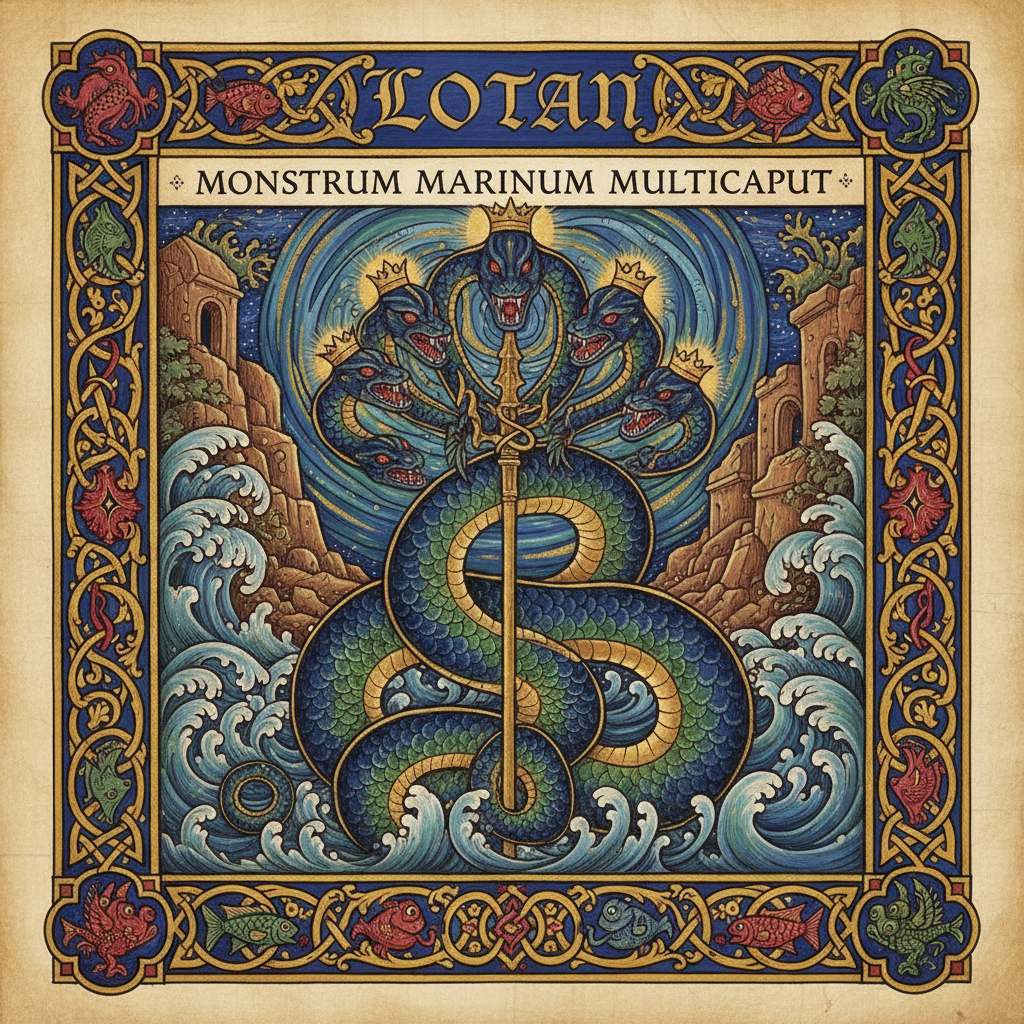
Combat Profile
Abyssal Coils
Lotan wraps reality itself in serpentine chaos, dealing catastrophic damage to all existence and binding cosmic order.
Primordial Hunger
Lotan's very presence erodes divine barriers and weakens the bonds holding creation together.
Defeated by Baal (in Ugaritic) and YHWH (in biblical adaptation)
“When you struck Lotan, the fleeing serpent, finished off the twisting serpent, the tyrant with seven heads…”
Lore: Lotan (also spelled Litanu) is a seven-headed sea serpent, servant or manifestation of Yam, and the single most directly traceable mythological entity from Canaan into the Bible. The Ugaritic text (KTU 1.5 I 1-3) calls him btn brh (“the fleeing serpent”) and btn ‘qltn (“the twisting serpent”). Isaiah 27:1: “In that day YHWH will punish Leviathan the fleeing serpent, Leviathan the twisting serpent.” (Isaiah 27:1) The Hebrew is virtually identical to the Ugaritic. “Lotan” and “Leviathan” are cognate words — the same name in different Semitic languages. Not a parallel. The same creature.
Psalm 74:14 (“You crushed the heads of Leviathan”) preserves the multi-headed tradition (Psalm 74:14). Revelation 12:3 (“a great red dragon, with seven heads and ten horns”) is the final Christian transformation. The seven-headed chaos serpent traveled from Ugaritic myth (c. 1400 BCE) through Israelite poetry (c. 700 BCE) into apocalyptic literature (c. 95 CE), accumulating new theological meanings at each stage but never losing its fundamental identity: the seven-headed monster from the sea that the divine warrior must destroy.
Parallel: Lotan IS Leviathan (same being, different language). He parallels Tiamat (Babylonian), the Hydra (Greek — also multi-headed), Jormungandr (Norse world-serpent), and Apophis (Egyptian chaos serpent). The seven-headed serpent motif appears in Sumerian art as early as 3000 BCE, making it one of the oldest continuous mythological images in human history.
1 min read
Baal; YHWH; the divine warrior archetype
KTU 1.5 I 1-3; Isaiah 27:1; Psalm 74:14; Revelation 12-13