Combat Profile
Syzygy
Unites two separated souls or cosmic principles into perfect spiritual wholeness, transcending duality and material corruption.
Pleroma Sanctum
All within the sacred space experience healing of inner division and liberation from the false god's dominion.
Requires gnosis; cannot be performed by the ignorant or the merely pious
“If anyone becomes a child of the bridal chamber, he will receive the light. If anyone does not receive it while he is in these places, he will not be able to receive it in the other place.” — Gospel of Philip
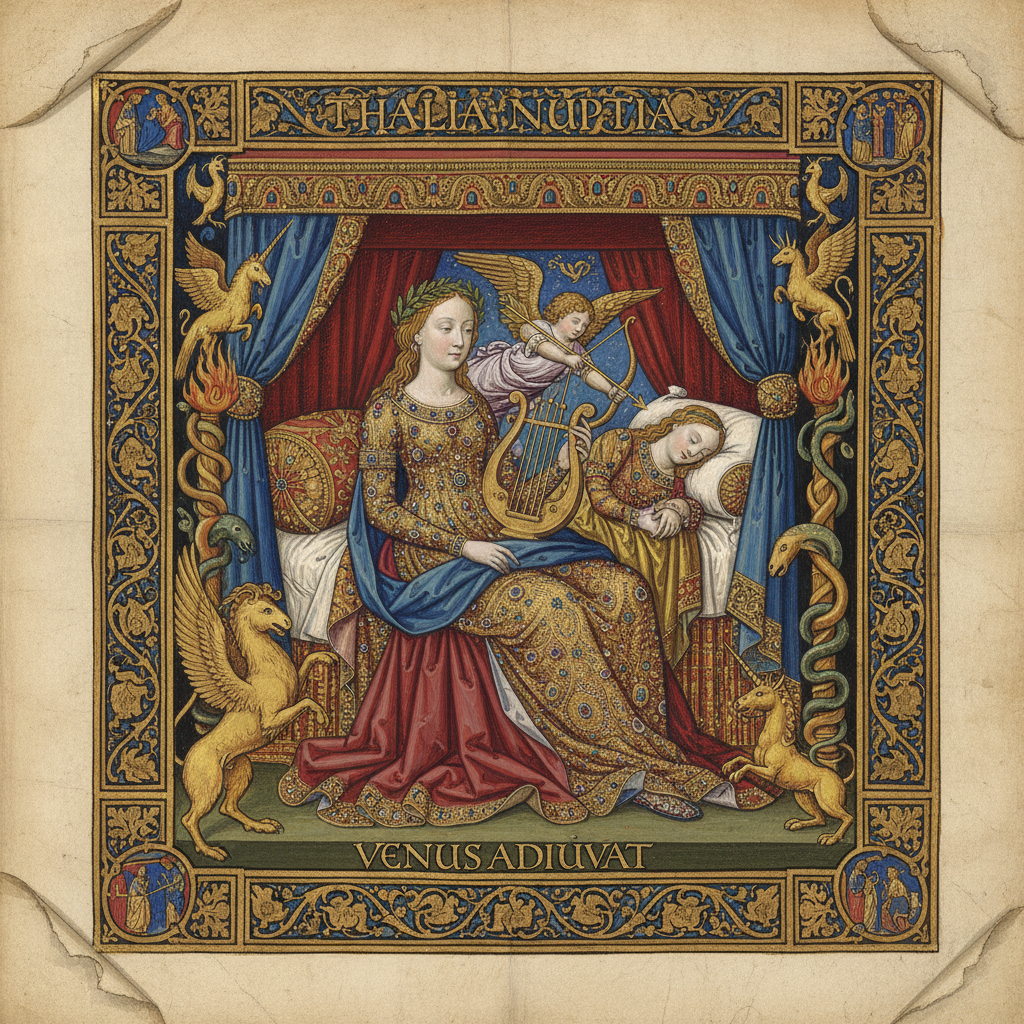
Lore: The Bridal Chamber was the supreme sacrament of Valentinian Christianity — higher than baptism, higher than the eucharist, higher than anointing. It was the ritual reunion of the soul with its divine counterpart, its syzygy — the other half from which it had been separated when Sophia fell from the Pleroma (Gospel of Philip 70-86). The Gospel of Philip describes it as the holiest of holies, the inner sanctum where division is healed and the soul returns to its original unity.
The theology behind it was breathtaking: the Valentinians believed that every human soul had a divine counterpart, an angelic twin in the Pleroma. The fall of Sophia had shattered the original unity of male and female, spirit and matter, above and below. Death, suffering, and ignorance were all consequences of this division. The Bridal Chamber reversed the fall. In this sacrament, the initiate was spiritually reunited with their heavenly counterpart, becoming whole again — not merely forgiven (as in orthodox Christianity) but restored to the pre-cosmic unity (Gospel of Philip 76). The Gospel of Philip states: “When Eve was in Adam, there was no death. When she separated from him, death came. If she enters into him again and he embraces her, death will no longer exist.” (Gospel of Philip 68)
Parallel: The Bridal Chamber maps onto sacred marriage traditions across the ancient world: the hieros gamos (sacred marriage) of Mesopotamian religion, where the king ritually united with the goddess Inanna; the Marriage of the Lamb in Revelation 19, where Christ is united with his Bride (the Church); the Kabbalistic reunion of the Shekhinah with the Holy One; and the Hindu concept of Shiva-Shakti union. But the Valentinian version is unique in making this the central sacrament of a Christian community — not a mythological event in the past or an eschatological promise for the future, but a ritual available now to the initiated.
2 min read
The Demiurge and the Archons, who enforce separation
*The Gospel of Philip* 67-86; *Exegesis on the Soul*; Pagels, *The Gnostic Gospels*; DeConick, *The Great Mystery of Marriage*