Combat Profile
Spark of Defiance
grants allies immunity to mental domination and reveals hidden gnosis that turns enemies' deceptions against them
Feminine Divine Essence
all healing and protective effects are amplified; resistance to oppressive forces increases with each ally liberated from control
Operates within the Demiurge's domain; must be rescued by the angel Eleleth when Yaldabaoth's forces overwhelm her
“It is I who am the part of my mother. And it is I who am the mother. It is I who am the wife. It is I who am the virgin.”
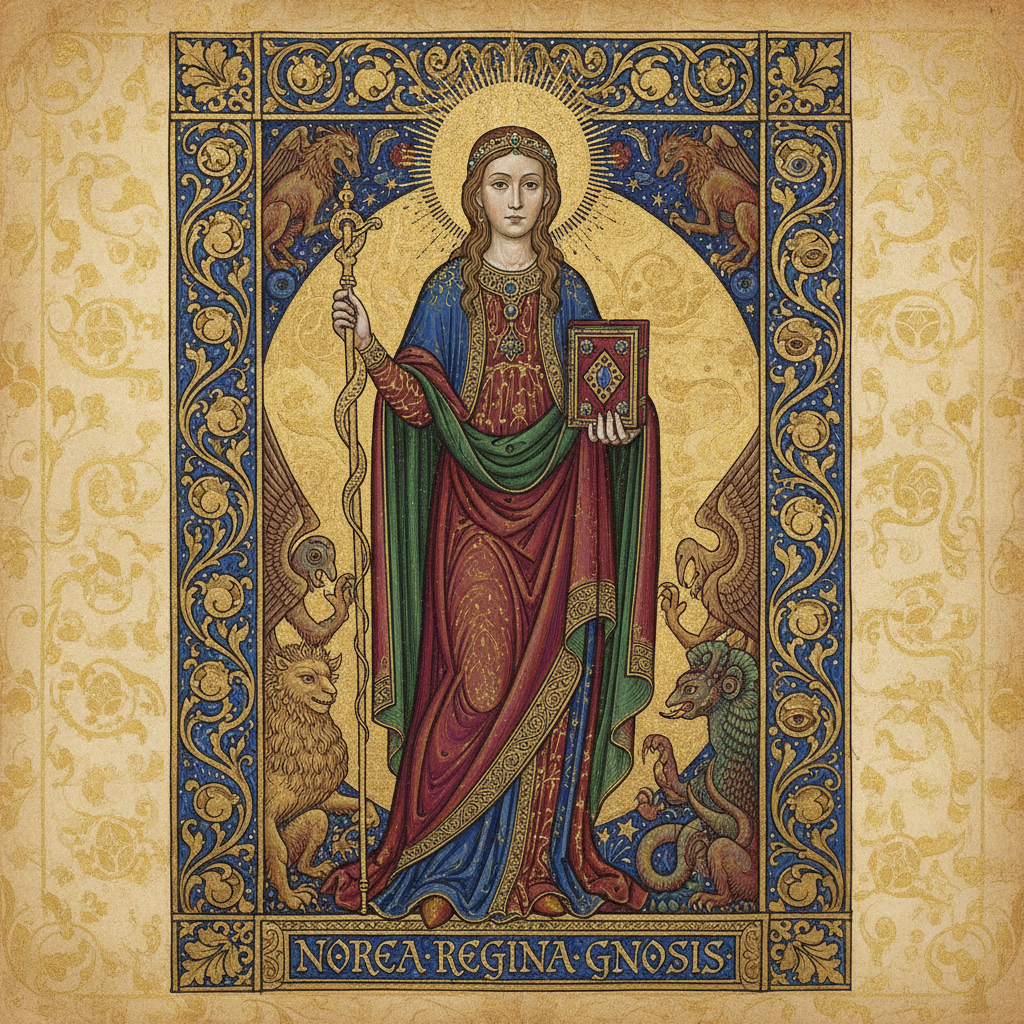
Lore: Norea is one of the most astonishing figures in all of Gnostic literature — and she appears nowhere in the Bible. In Gnostic tradition, she is the wife (or daughter) of Noah, and she is the hero of the Flood story. While Noah obediently builds his ark at the command of Yaldabaoth (who plans to drown the seed of Seth), Norea sees through the deception. She recognizes the Flood for what it is: the Demiurge’s attempt at genocide against those who carry the divine spark. So she burns the ark. Not once — three times. Each time Noah rebuilds it, Norea sets it on fire.
When the Archons try to assault her, she cries out to the true God — not the Demiurge, but the Monad above — and the great angel Eleleth descends from the Pleroma to rescue her (Hypostasis of the Archons II,92-96). Eleleth reveals to Norea the truth about the cosmos: that Yaldabaoth is a blind pretender, that the material world is a prison, and that her true home is in the Pleroma. The Hypostasis of the Archons presents this as the moment when feminine divine knowledge triumphs over masculine false authority. Norea does not submit, does not obey, does not board the ark. She resists the Demiurge’s authority with fire and is vindicated by the highest heaven.
Parallel: Norea has no direct parallel in any other tradition — she is genuinely unique. The closest structural analogues are Lilith (Jewish tradition), who refused to submit to Adam and was demonized for it, and Antigone (Greek tragedy), who defied the king’s unjust law and accepted the consequences. But Lilith was recast as a demon, and Antigone died. Norea is vindicated. She is the rare figure in ancient religious literature who defies male divine authority, is proven right, and is rescued by a higher power that confirms her resistance. She is a 2nd-century feminist hero hidden in a jar in the Egyptian desert for 1,600 years.
2 min read
Yaldabaoth and the Archons, whom she defies openly
*The Hypostasis of the Archons*; *The Thought of Norea*; *On the Origin of the World*; King, *What Is Gnosticism?*