Combat Profile
Divine Descent
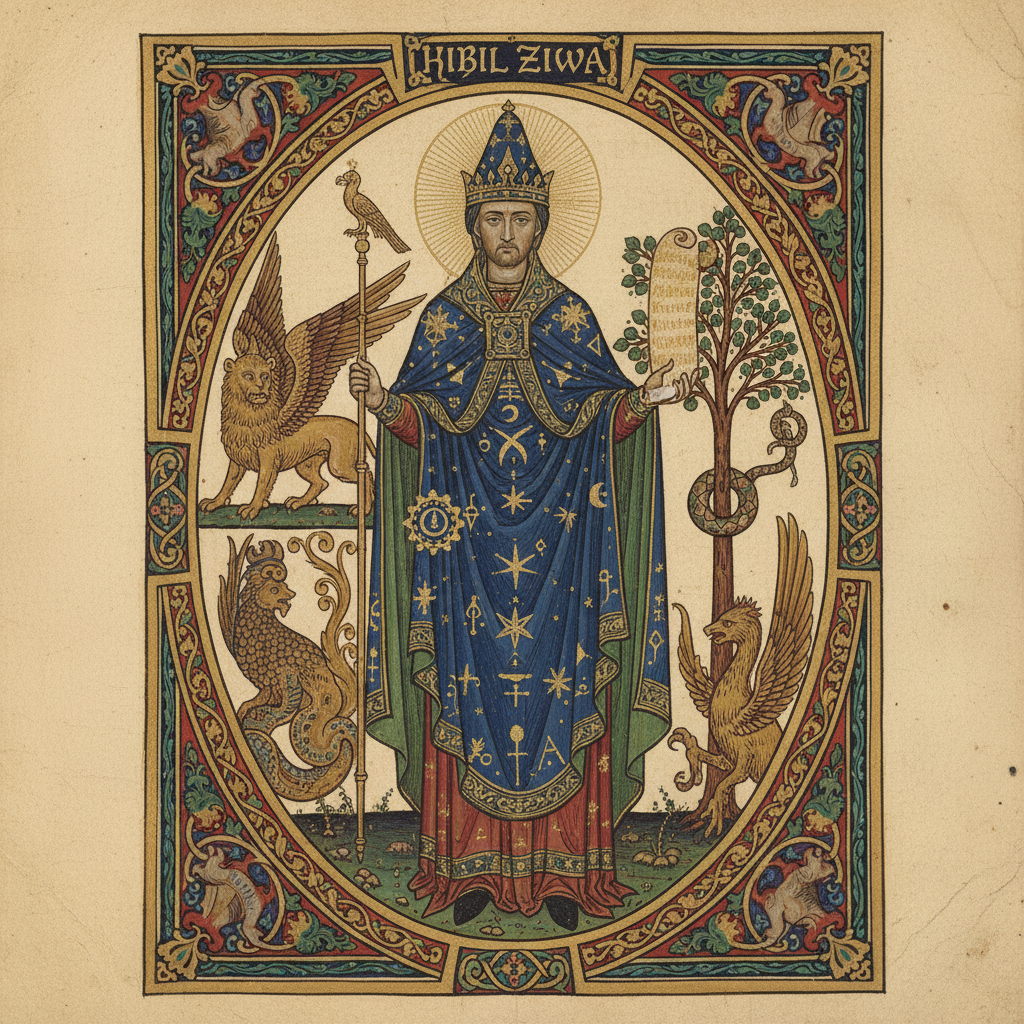
Hibil Ziwa plunges into the abyss to liberate imprisoned souls, temporarily rendering allies invulnerable while dealing massive damage to chthonic forces.
Savior's Radiance
All light-aligned allies gain increased resistance to shadow and corruption; Hibil Ziwa's presence weakens the power of underworld entities.
Must physically enter the realm of darkness, temporarily subjecting himself to its power
“Hibil Ziwa went down to the world of darkness. He broke the gates and slew the guardians and brought forth the soul of Adam.”
Lore: Hibil Ziwa (also spelled Hibil Ziva — “Radiant Hibil”) is the great champion of the light-world in Mandaean mythology. His defining act is one of the most dramatic narratives in Gnostic literature: a descent into the underworld to rescue the soul of Adam, the first human. The Ginza Rabba describes his journey in vivid detail — he descends through multiple matarata (purgatory stations or watchhouses), each guarded by increasingly terrible demonic beings. At each station, he must fight or outsmart the guardians. He battles the great dragon Ur, confronts Ruha and her demonic offspring, and ultimately reaches the deepest level of darkness where Adam’s soul is held captive.
Hibil Ziwa does not merely reveal knowledge — he fights. He is the Mandaean action hero, the divine being willing to enter the enemy’s domain and wage war for the liberation of a single soul. His descent and return become the template for every Mandaean soul’s journey after death: the masiqta (the funerary rite that guides the dead soul upward through the matarata) mirrors Hibil Ziwa’s descent in reverse. What he did going down, the soul must do going up. His victory guarantees that the path is open.
Parallel: Hibil Ziwa maps onto Christ’s “Harrowing of Hell” (the apocryphal tradition that Christ descended to Hell between his crucifixion and resurrection to free the righteous dead — see the Gospel of Nicodemus), Inanna’s descent to the underworld (Sumerian — the goddess who passed through seven gates, was killed, and returned), and Orpheus’s journey to Hades to retrieve Eurydice. The Mandaean version is closest to the Christian Harrowing, but with a critical difference: in the Christian tradition, Christ’s descent is a one-time event tied to the crucifixion. In Mandaean tradition, Hibil Ziwa’s descent established a permanent pathway that every soul can follow. He did not just rescue Adam — he mapped the route home.
2 min read
Ur, the great dragon of the underworld, and the demonic guardians of each *matarata* (purgatory station)
*Ginza Rabba* (Left Section); *Diwan Abatur*; Buckley, *The Mandaeans*; Drower, *The Mandaeans of Iraq and Iran*