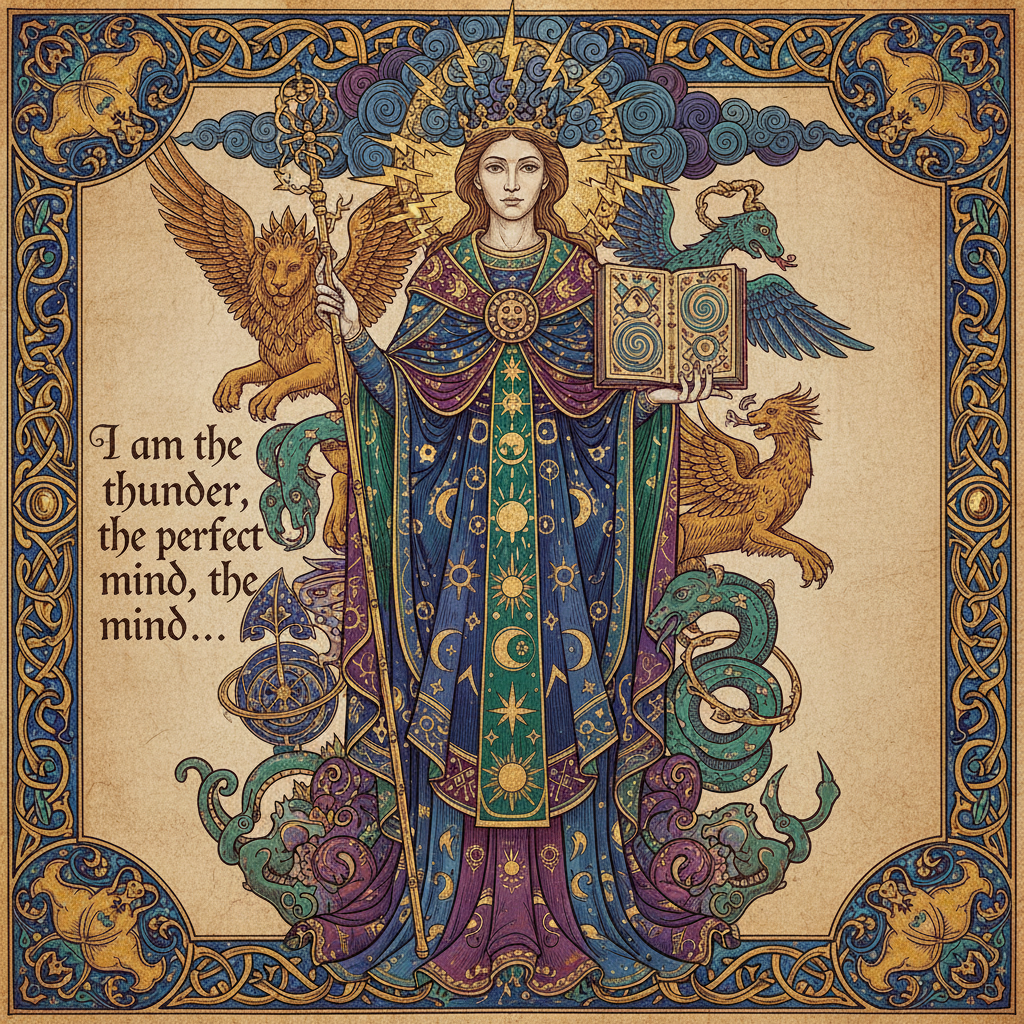
Combat Profile
Paradox Revelation
Simultaneously manifests contradictory truths, forcing enemies to comprehend irreconcilable realities that shatter their understanding.
Perfect Gnosis
All allies gain clarity on hidden knowledge and transcend binary perception, seeing all perspectives as unified whole.
None; the speaker transcends all categories including weakness
“I am the whore and the holy one. I am the wife and the virgin. I am the mother and the daughter. I am the members of my mother. I am the barren one and many are her sons.”
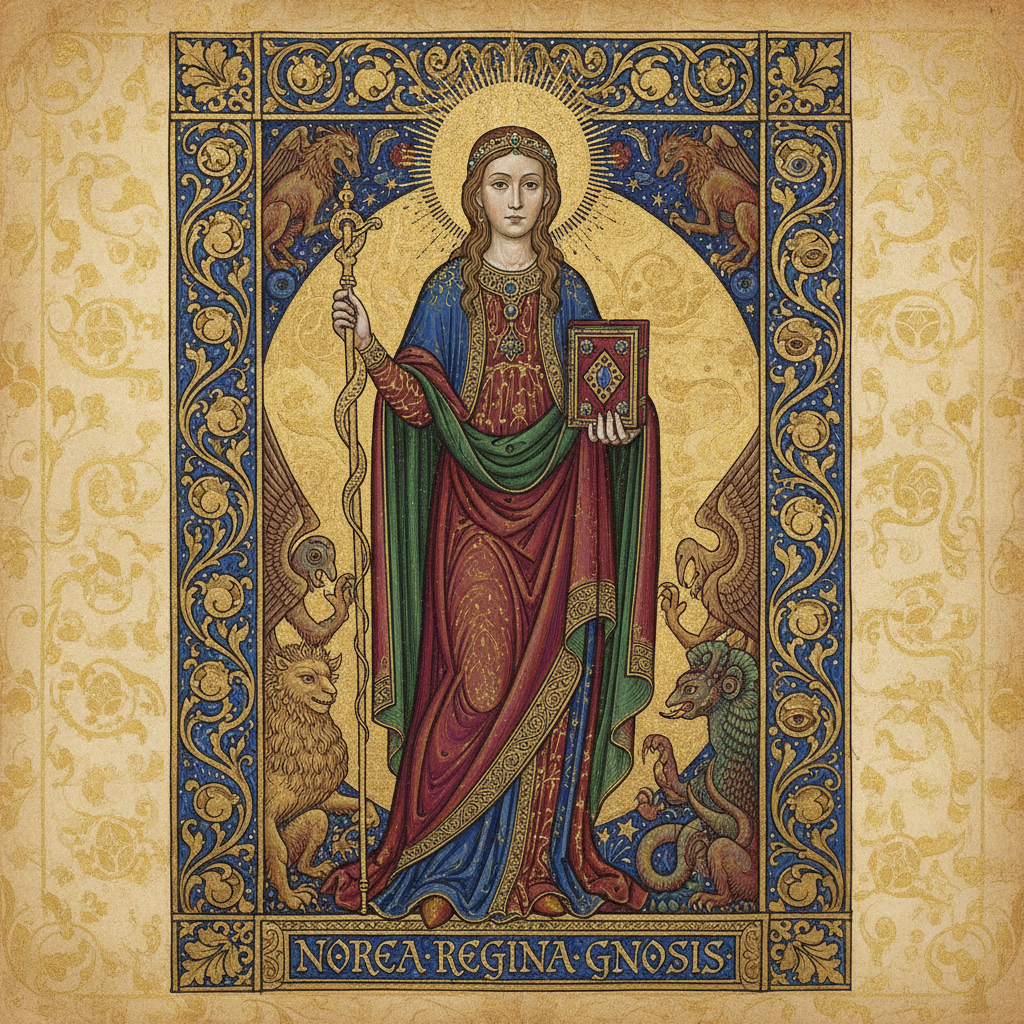
Lore: The Thunder, Perfect Mind is the most enigmatic and poetically powerful text in the entire Nag Hammadi library — and possibly in all of ancient literature. It is a revelation discourse spoken by a female divine figure who identifies herself through an unbroken series of contradictions. She is “the first and the last,” “the honored one and the scorned one,” “the whore and the holy one,” “the wife and the virgin,” “the silence that is incomprehensible and the idea whose remembrance is frequent.” She is everything and its opposite, simultaneously.
No narrative frame explains who she is. No myth contextualizes her speech. She simply speaks — thundering contradictions that shatter every binary the human mind can construct: sacred/profane, virgin/whore, honored/despised, knowledge/ignorance. Scholars have variously identified her as Sophia, Barbelo, Isis, or a figure beyond any single mythological identity. The text resists interpretation because that is the point. The divine feminine, in this text, cannot be reduced to any single category. She is not the Virgin Mary (pure) or Mary Magdalene (repentant) or Eve (fallen). She is all of them and none of them and the space between them. The Thunder is the Gnostic tradition at its most radical: not just inverting the orthodox hierarchy, but dissolving all hierarchies entirely.
Parallel: The Thunder, Perfect Mind parallels the paradoxical self-declarations found across mystical traditions: the Hindu neti neti (“not this, not that” — the divine defined by negation), the Tao Te Ching’s “The Tao that can be told is not the eternal Tao,” and the Zen koan tradition that shatters rational categories. The closest structural parallel is the Devi Mahatmya (Hindu), where the Great Goddess declares herself to be all things — creator, sustainer, destroyer, matter, spirit, ignorance, and knowledge. But the Thunder is more radical even than the Devi Mahatmya, because it refuses to resolve the paradoxes. The Hindu goddess ultimately reveals herself as supreme. The speaker in the Thunder never resolves — she remains contradiction itself, forever.
2 min read
None; the speaker contains all oppositions within herself
*The Thunder, Perfect Mind* (Nag Hammadi Codex VI); Taussig, *A New New Testament*; MacRae, *The Thunder: Perfect Mind*