Combat Profile
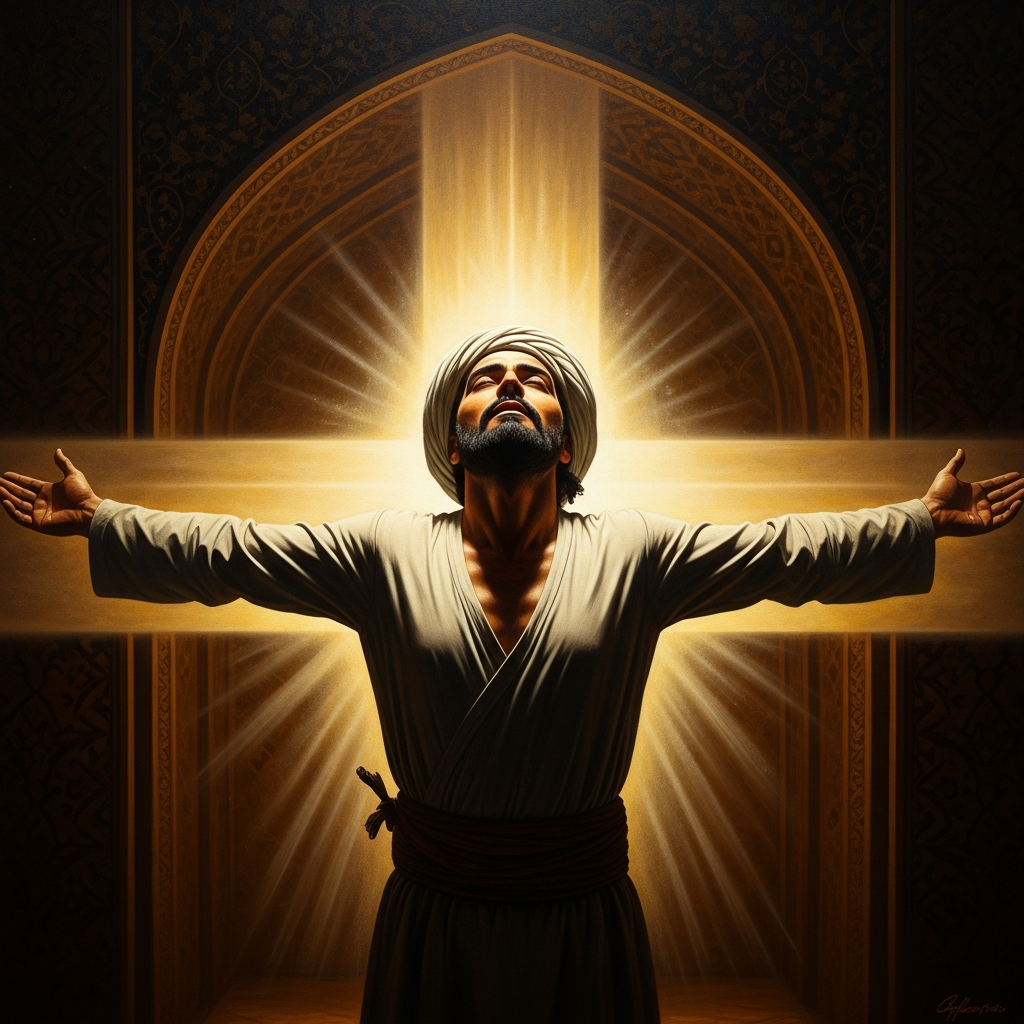
I Am the Truth
Hallaj utters the unutterable; the words burn through the speaker, dissolving the ego so completely that what remains can only be God speaking from the man-shaped hollow.
Ash on the Tigris
Hallaj's death cannot be a defeat; every drop of his scattered blood became another Sufi, every flake of his ash another path, and the executioner's sword only served to prove the point.
Husayn ibn Mansur al-Hallaj (c. 858-922) was a Persian wool-carder (“hallaj” means “carder of cotton”) and ecstatic mystic who declared, in the streets of Baghdad: Ana al-Haqq — “I am the Truth.” Since al-Haqq (the Truth) is one of the ninety-nine names of God, the Abbasid jurists charged him with blasphemy. He was tortured for nine years, then executed in 922: hands and feet cut off, eyes gouged, body crucified on a gibbet, then burned, the ashes scattered into the Tigris. Tradition holds that he prayed for his executioners and laughed as they killed him. To the orthodox, he was a heretic. To the Sufis, he was the saint who annihilated himself so completely in God that only God remained to speak through him.
Hallaj is the paradigmatic Sufi martyr. His statement is the limit-case of fana (annihilation): when the ego has been so utterly extinguished that the speaker is no longer the man but the divine reality speaking through the man. Later Sufis — even the cautious Junayd, Hallaj’s own teacher — distinguished between his statement (true) and his expression of it (imprudent). The lesson Sufis drew was not “do not seek union” but “guard the secret.” His death became the sign that the path is real and the price is real.
Biblical Parallels: Hallaj’s “I am the Truth” maps directly onto Jesus’ “I and the Father are one” (John 10:30) and “before Abraham was, I am” (John 8:58) — statements that, in their context, also drew accusations of blasphemy and a death sentence. His prayer for his executioners (“O Lord, forgive these Your servants, for if You had revealed to them what You have revealed to me, they would not be doing this”) echoes Jesus’ “Father, forgive them, for they do not know what they are doing” (Luke 23:34). He stands beside Stephen the Protomartyr (Acts 7) and the entire tradition of Christian martyrs who claimed direct vision and were killed for it. Among the Christian mystics, Marguerite Porete — the Beguine burned in Paris in 1310 for her Mirror of Simple Souls — is the closest parallel: a mystic of annihilation who refused to recant.
Cross-Tradition: Hallaj parallels the Hindu jivanmukta whose realization of Aham Brahmasmi (“I am Brahman”) in the Upanishads is structurally identical to Ana al-Haqq. He also parallels Socrates drinking the hemlock for his daimonic truth, Mansur’s older Hindu contemporaries the bhakti and tantric saints, and — in the Jewish tradition — the four sages who entered the Pardes (the orchard of mystical vision), of whom only Akiva emerged sane (and was later flayed alive by the Romans).
2 min read