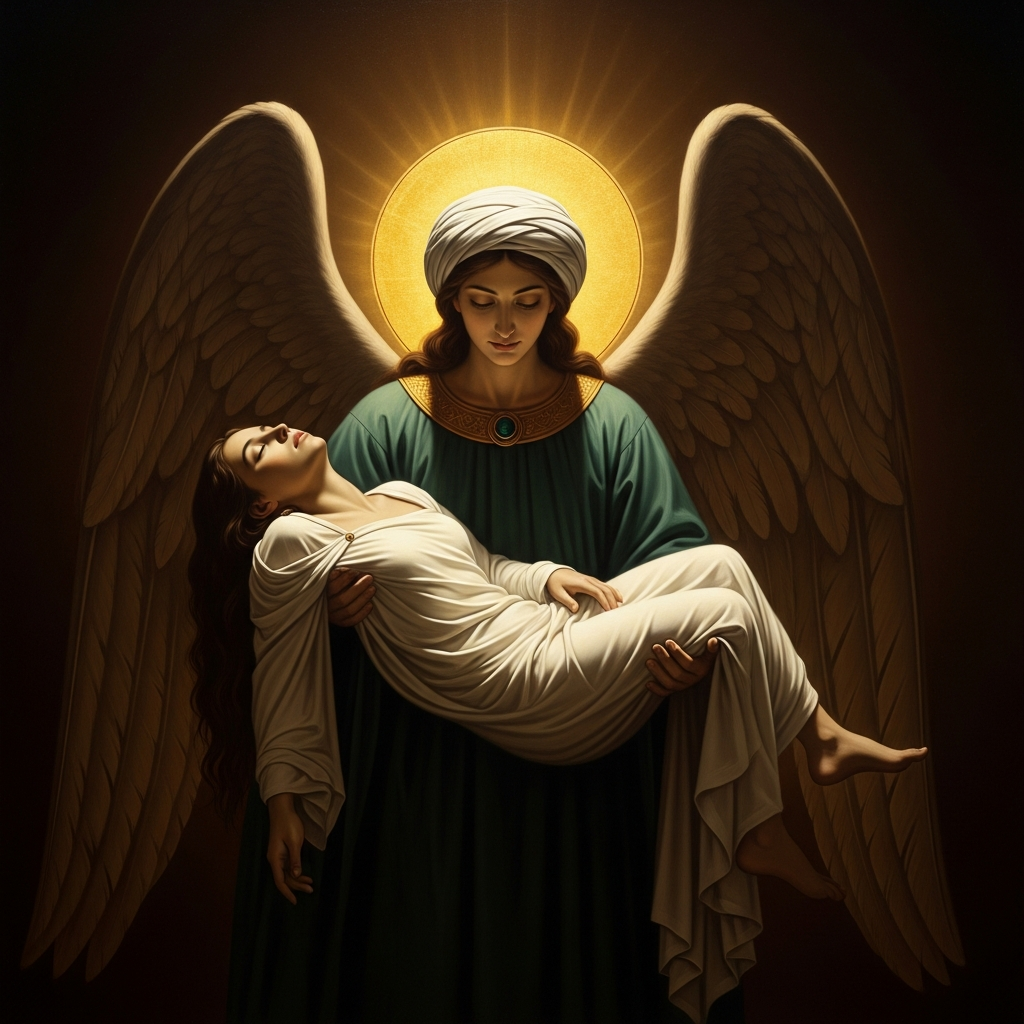
Combat Profile
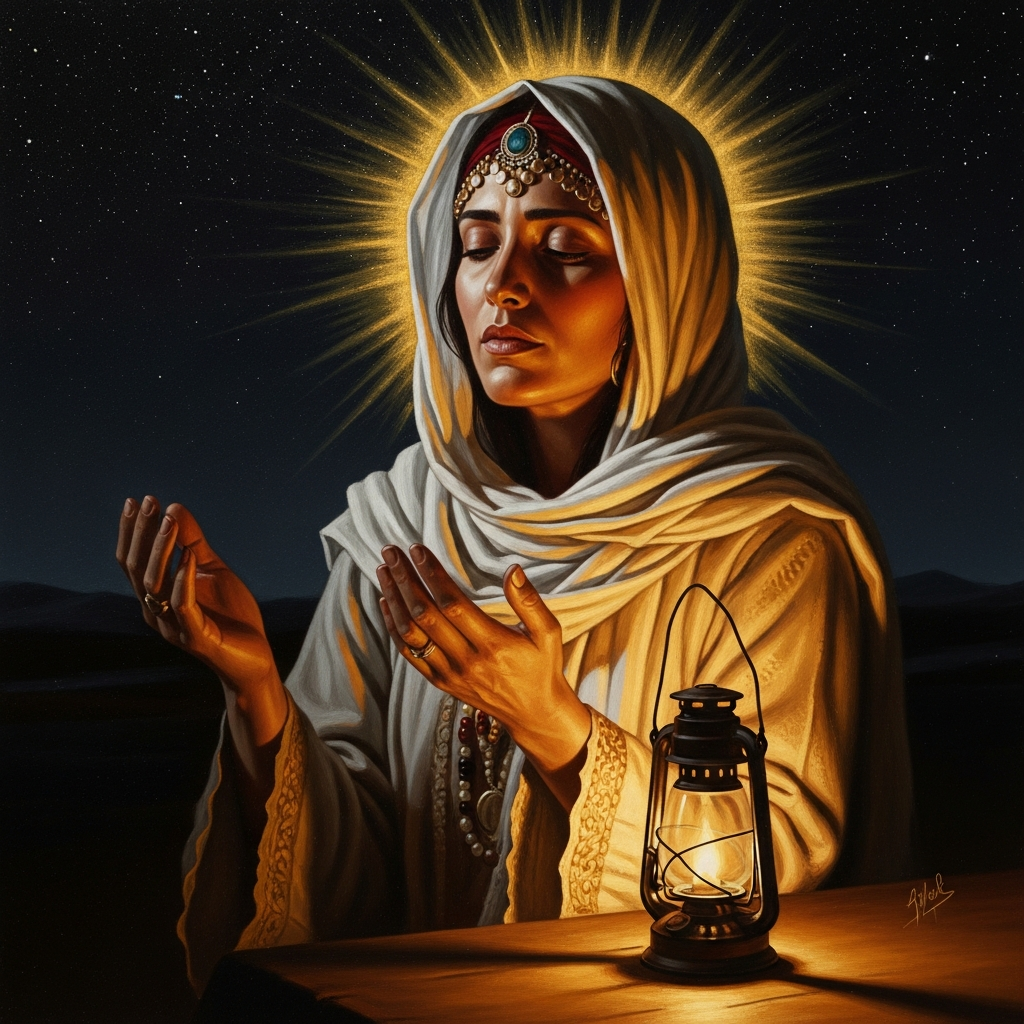
Torch and Bucket
Rabi'a sets fire to Paradise and douses Hell so that nothing remains between the lover and the Beloved except love itself, unbought and unbribed.
Love for Its Own Sake
Rabi'a's presence purifies the surrounding air of all transactional religion; her gaze reveals every prayer made for reward as a betrayal of the One who deserves to be loved without conditions.
Rabi’a al-Adawiyya of Basra (c. 717-801) is one of the foundational figures of Sufism — the slave girl who became one of the earliest and greatest exponents of pure divine love. The legends are dense and probably mostly fabricated: born the fourth daughter of a poor Basran family (hence “Rabi’a,” “the Fourth”), orphaned in famine, sold into slavery, freed when her master saw her praying surrounded by light. She refused all offers of marriage, including from the great Sufi Hasan al-Basri, on the grounds that she had no time spare from God. She is reported to have walked through Basra carrying a torch in one hand and a bucket of water in the other, saying: “I want to set fire to Paradise and pour water on Hell, so that men may worship God for His own sake, not from hope of reward or fear of punishment.”
This is the founding declaration of mahabba (love) as the core of the Sufi path — love for God’s own sake, with no admixture of self-interest. Before Rabi’a, Sufism was largely ascetic and fearful. After Rabi’a, it became a love-mysticism. Every later Sufi poet — Hallaj, Rumi, Attar, Hafiz — drinks from her cup. She is sometimes called the “Mother of Sufis,” the woman who taught Islam how to love God.
Biblical Parallels: Rabi’a corresponds to the Christian women mystics of love — Teresa of Avila, who would dance for joy in the cloister; Catherine of Siena, who took Christ as her husband; Marguerite Porete, who spoke of the soul as “annihilated in love”; Hadewijch of Antwerp, the Beguine poet of minne (courtly love transposed to God). She parallels the Mary who anointed Jesus’s feet with costly perfume (Mark 14:3-9) — the woman whose love is pure expense. Her insistence on disinterested love anticipates the Christian doctrine of agape and the Lutheran gratis — grace and love as gift, not transaction.
Cross-Tradition: Rabi’a parallels the Hindu bhakti saints, especially Mirabai and Akkamahadevi — women who refused marriage for the divine bridegroom. She parallels the early Buddhist theris (enlightened nuns) of the Therigatha. In the Christian Beguine movement of the medieval Low Countries, lay women practiced exactly her style of independent, intense devotional life.
2 min read