Combat Profile
Six Hundred Wings
Jibrail unfurls the spectrum of his being and the seer is granted *ma'rifa* — direct knowledge that bypasses all reasoning and sets the heart on its true axis.
First Intellect
Jibrail is the angelic mind through which all teaching descends; every prophecy, every gnosis, every moment of *kashf* (unveiling) passes through his hand.
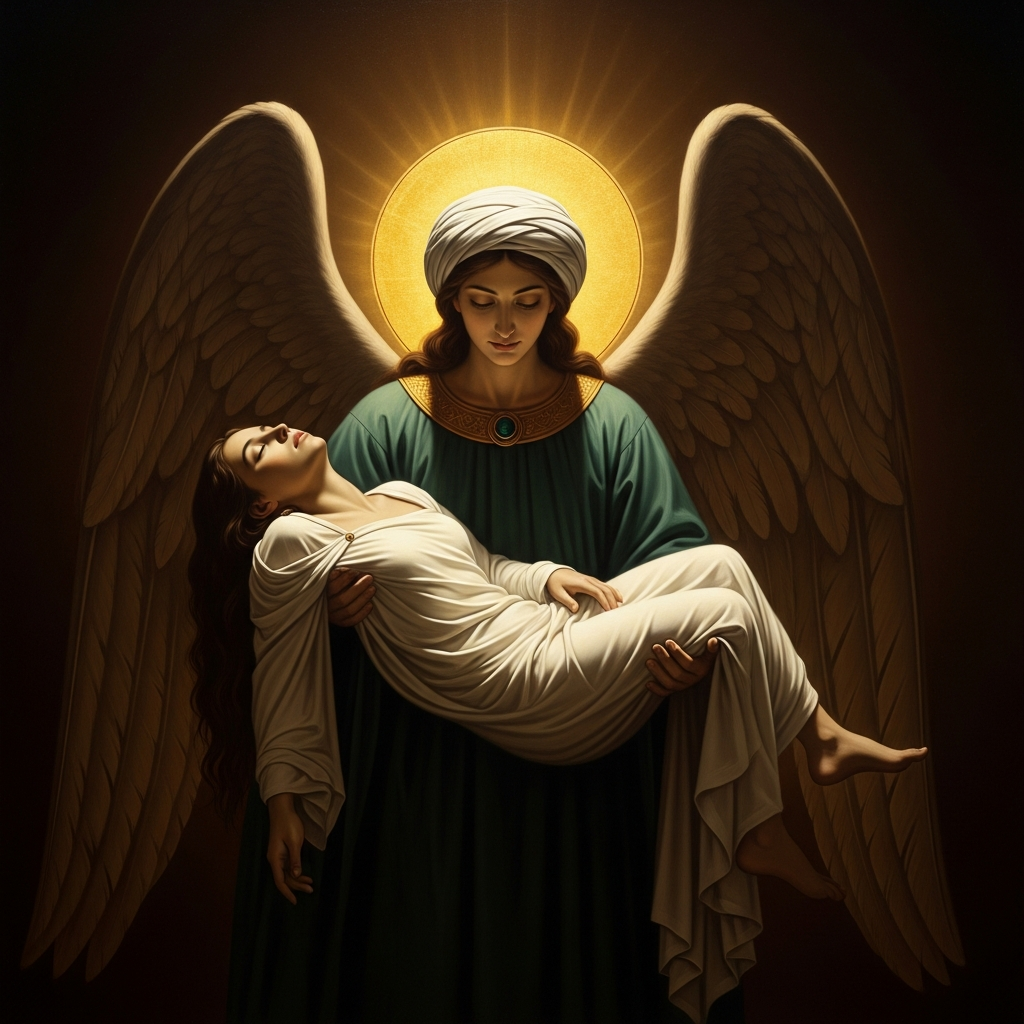
Jibrail (Gabriel) in standard Islamic theology is the angel of revelation — the one who descended to Muhammad in the Cave of Hira and dictated the Quran over twenty-three years. But in Sufi cosmology Jibrail is more: he is the Aql al-Awwal (First Intellect), the cosmic teacher, the principle by which divine knowledge enters every level of the cosmos. He taught Adam the names. He taught the prophets the meanings. He continues to teach the saints in their deepest visions — appearing in the imaginal realm (Alam al-Mithal) under various forms: a beautiful youth in white, a man of light, a vast presence with six hundred wings.
In Suhrawardi’s Hikmat al-Ishraq (Philosophy of Illumination), Jibrail is the fundamental angelic intelligence — the Active Intellect — through whom the soul receives all ma’rifa (gnosis). Sufi initiations frequently report Jibrail’s presence at the threshold; some saints are uwaysi through him, instructed without intermediary. His name Jibrail (Hebrew Gavri-El) means “God is my strength,” and that is what he is: the strength of the divine reaching down into the structures of the soul to teach what cannot be taught.
Biblical Parallels: Jibrail is the same Gabriel who appears to Daniel (Daniel 8-9), to Zechariah (Luke 1:11-19), and to Mary (Luke 1:26-38) — the angel of annunciation in both traditions. The Sufi elevation of Gabriel to the rank of First Intellect parallels the Christian Logos theology (John 1, where the Word is the agent of creation and the principle of intelligibility), and the Jewish Metatron tradition — Enoch transformed into the great angel who dictates the heavenly tablets and serves as the divine scribe and teacher.
Cross-Tradition: Jibrail parallels the Vedic Hiranyagarbha (the golden womb, the cosmic mind) and the Hindu Brihaspati (priest of the gods, lord of speech). In Buddhism he resembles Manjushri — the bodhisattva of wisdom who carries the sword that cuts ignorance. In Greek philosophy he is the Nous of Plotinus, the second hypostasis after the One.
1 min read