Combat Profile
Return to the Lord
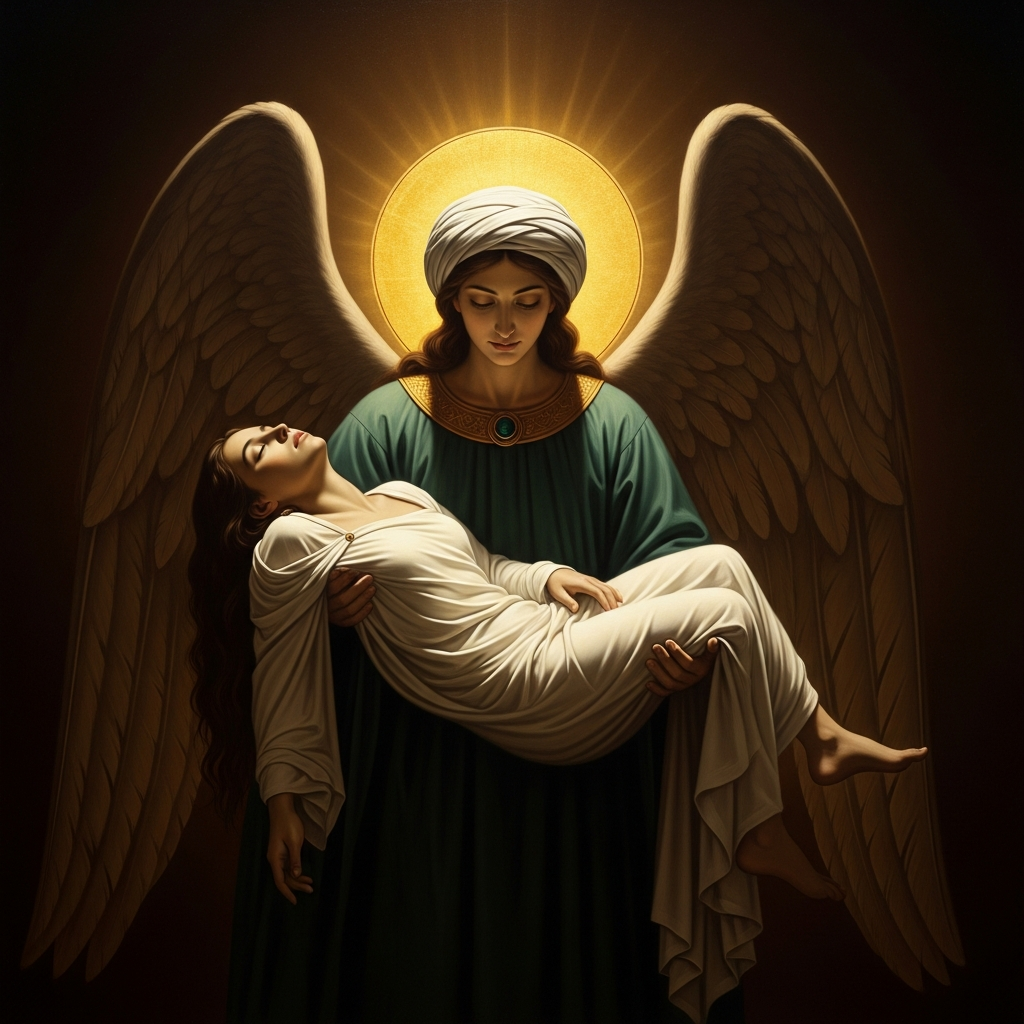
The Nafs al-Mutmainna is invited back into God's presence, "well-pleased and well-pleasing," having become so transparent that its will and the divine will are no longer distinguishable.
Stillness Beneath the Storm
The peaceful self cannot be perturbed; praise and blame, gain and loss, even life and death pass over it like wind over deep water, leaving the depth untouched.
The Nafs al-Mutmainna — “the peaceful soul,” “the self at rest” — is the seventh and final stage of the nafs, the self that has been so refined by spiritual discipline that it has become transparent to God. The Quran addresses it directly: “O peaceful soul! Return to your Lord, well-pleased and well-pleasing. Enter among My servants and enter My garden” (Quran 89:27-30). This is the achieved state — the goal, in some sense, of the entire path.
The peaceful soul is not asleep; it is awake without anxiety. It is not anesthetized; it has simply integrated every level beneath it. Its desires are now identical with God’s; its will moves with the divine will; it is, in the language of Junayd, “as it was before it was” — restored to its primordial state of fitra. The Sufi who reaches this stage is unmoved by praise or blame, by gain or loss, by life or death. The seven veils have been pierced. The work is done. What remains is service.
Biblical Parallels: The Nafs al-Mutmainna corresponds precisely to Paul’s “It is no longer I who live, but Christ who lives in me” (Galatians 2:20) — the achieved state in which the ego has been so dissolved into the divine life that “I” and “Christ” are indistinguishable speakers. It parallels the theosis (divinization) of Eastern Christian tradition — the process by which the human being becomes “by grace what God is by nature.” It echoes the Beatitude “Blessed are the pure in heart, for they shall see God” (Matthew 5:8) and the Sabbath rest of Hebrews 4:9-10. Teresa of Avila’s “seventh mansion” of the Interior Castle is the same achieved peace.
Cross-Tradition: The Nafs al-Mutmainna parallels the Hindu jivanmukti — the one liberated while still alive, who has realized Sat-Chit-Ananda (being, consciousness, bliss) and acts in the world without attachment. In Buddhism it corresponds to the arhat and ultimately the bodhisattva state — nirvana not as extinction but as the peace of anatta (no-self) realized in the midst of activity. The Daoist zhenren (true person) and the Confucian junzi (gentleman) reach toward similar heights through different vocabularies.
2 min read