Contents
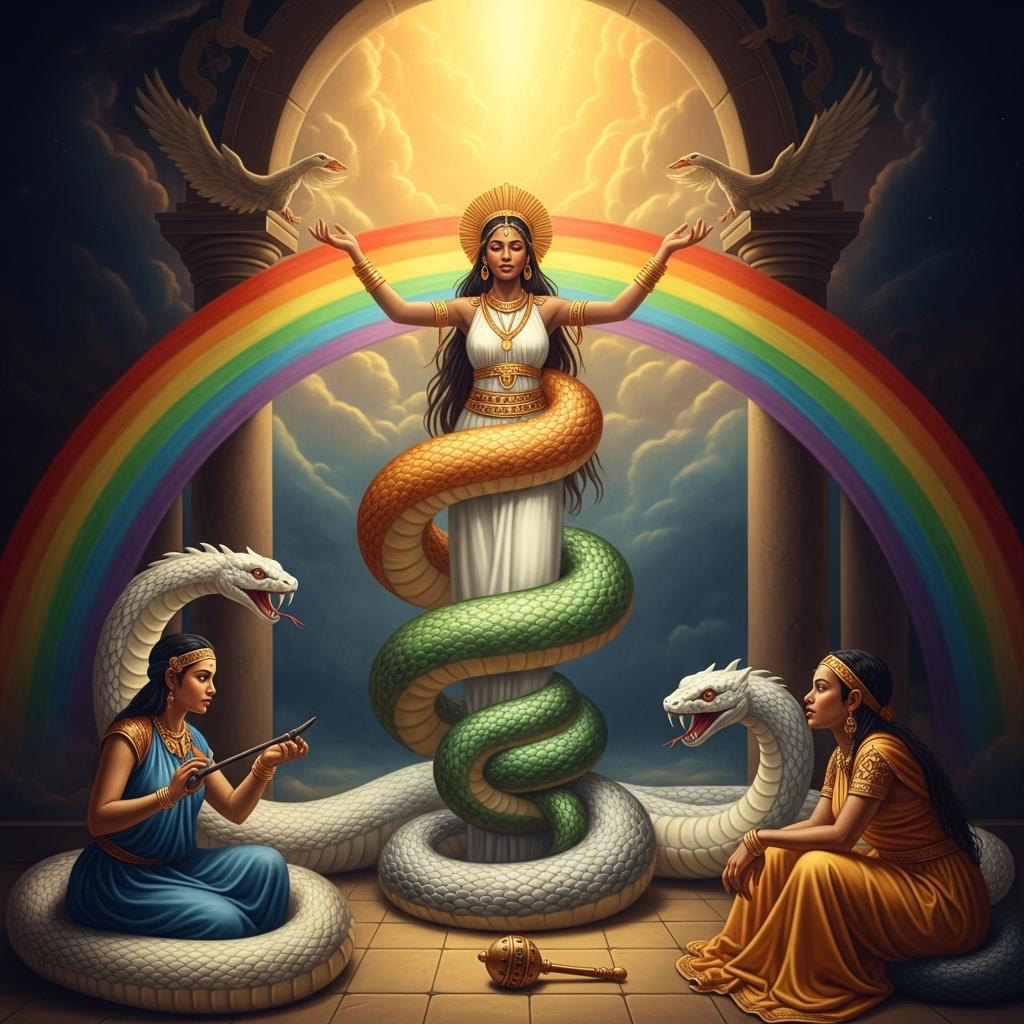
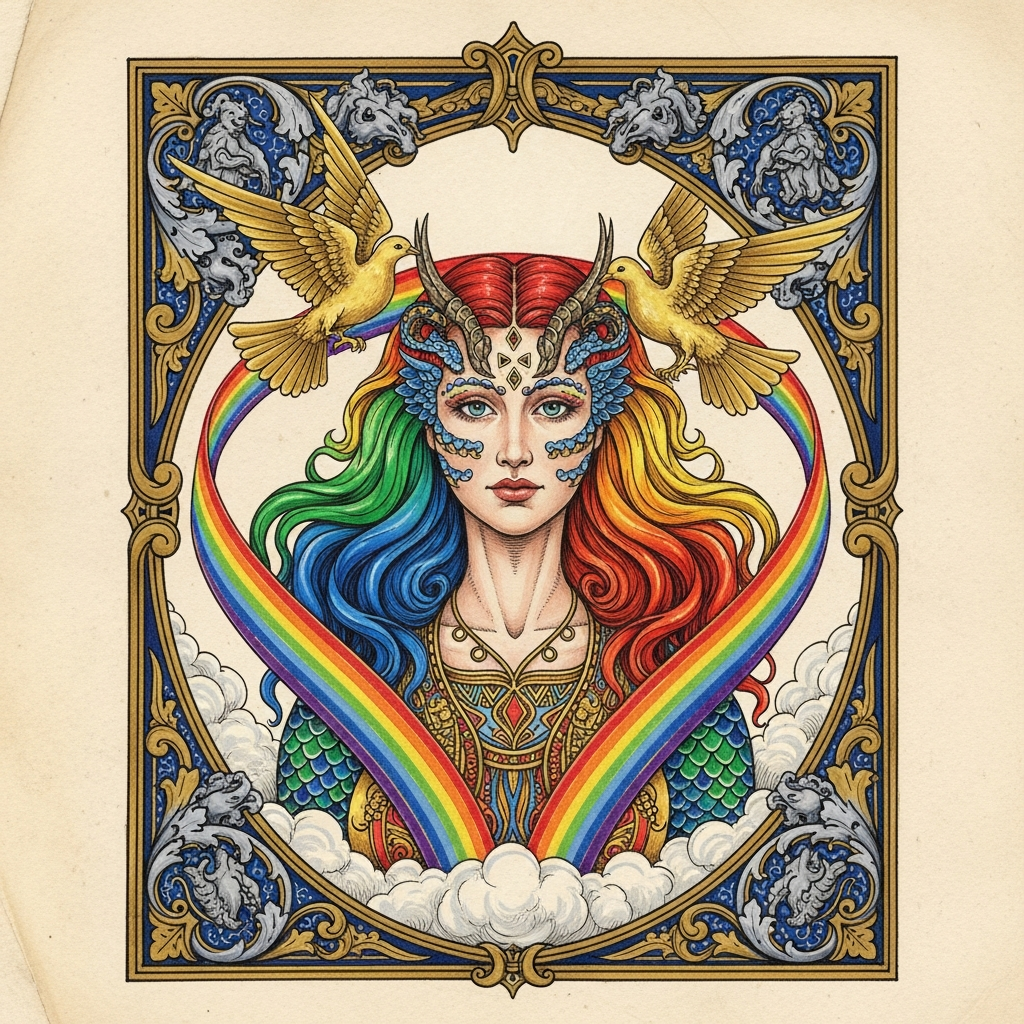
Ayida Wedo is the rainbow serpent who coils beneath the earth and above the sky simultaneously. She and Damballah, the great white serpent-lwa, are the paired forces of creation — he is the ancient wisdom, she is the life-sustaining waters. Between them they hold everything up. When they embrace, the world is stable. When one is absent, the other must carry the weight alone.
- When
- Haitian Vodou developed from 17th century CE onward, drawing on Fon/Ewe/Yoruba traditions
- Where
- The sky and the depth of the earth simultaneously · Haiti · the African diaspora
When the rain ends and the sun returns, Ayida Wedo becomes visible.
The rainbow is her body arcing across the sky — visible proof of her presence, temporary as she chooses to be visible, there and gone as clouds shift. She is the female half of the first pair: Damballah Wedo, the ancient white serpent-lwa who embodies pure wisdom and primordial energy, and Ayida Wedo, the rainbow serpent, his consort, the sustaining water that makes life possible.
Together they coil around creation.
Vodou’s cosmology inherited its paired serpent structure from the Fon and Ewe peoples of West Africa, particularly from Dahomey (present-day Benin), where the supreme deity was Mawu-Lisa — a dual being, female-male, associated with the moon-sun pairing. The serpent associated with these traditions was Da Ayido Hwedo, the rainbow serpent who carried the creator god Mawu in his mouth while she made the world, depositing mountains and valleys as he coiled. When the work was done, Da Ayido Hwedo coiled beneath the earth to support its weight.
In the crossing of the Atlantic — in the holds of the slave ships, in the sugar plantations of Saint-Domingue, in the revolutionary violence of 1791-1804 that made Haiti the first Black republic — these traditions survived. They changed. They absorbed elements of French Catholicism (Ayida Wedo is often syncretized with the Virgin Mary, specifically Our Lady of the Immaculate Conception — the whiteness, the purity, the serpent beneath her feet transformed). They merged with Yoruba and Kongo traditions from other parts of West and Central Africa.
What emerged was Vodou: not the corrupted caricature that Haiti’s enemies invented, but a living religious tradition with a sophisticated cosmology, an elaborate ritual practice, and a set of spiritual beings — the lwa — who were not gods in the Western sense but more like principals, elder spirits who had roles in the maintenance of the world.
Ayida Wedo is one of the most senior.
Her domain is defined by what she connects.
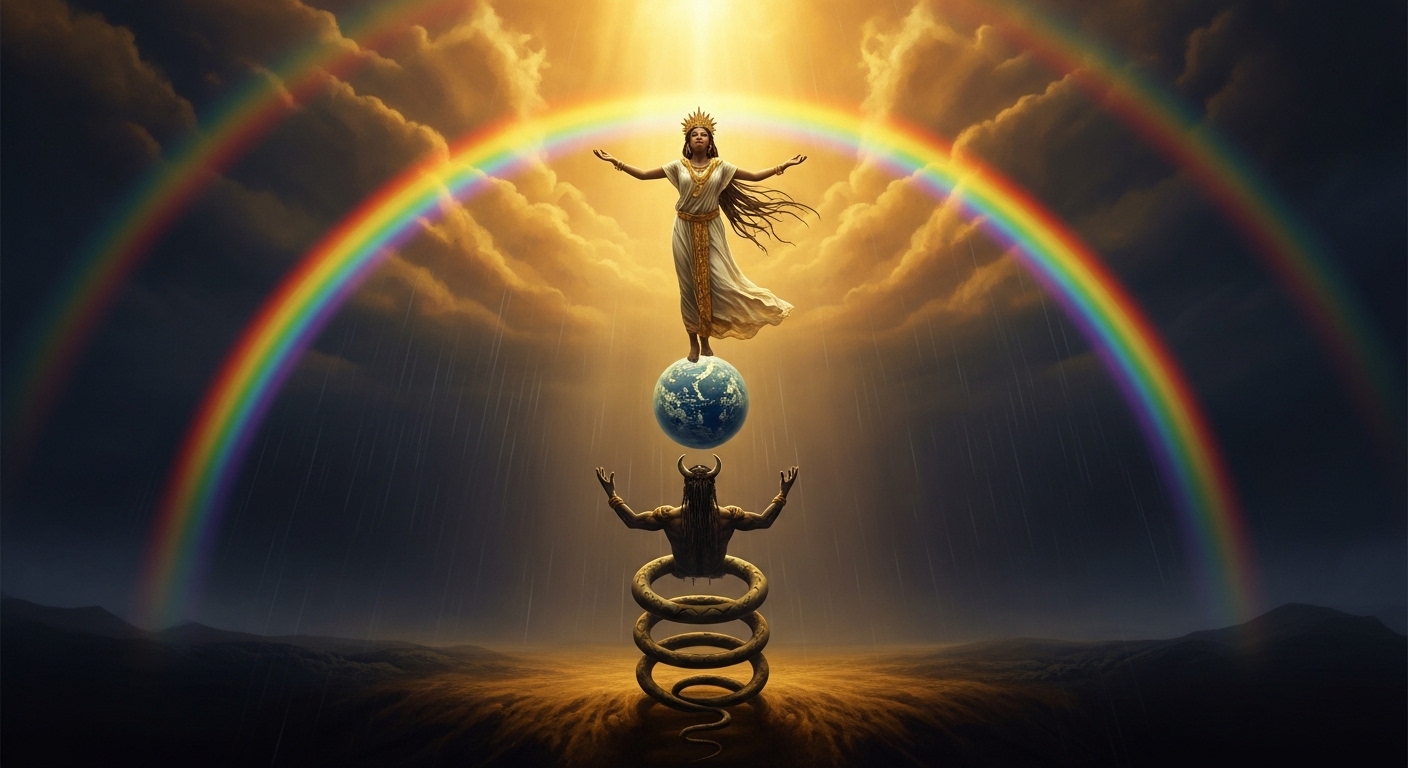
The rainbow connects sky to earth, passes through water (the rain that preceded it), catches light. Ayida Wedo’s body is this connection made permanent: she is the principle by which above and below remain in relationship with each other, the sustaining arch without which the sky falls and the earth loses its moisture.
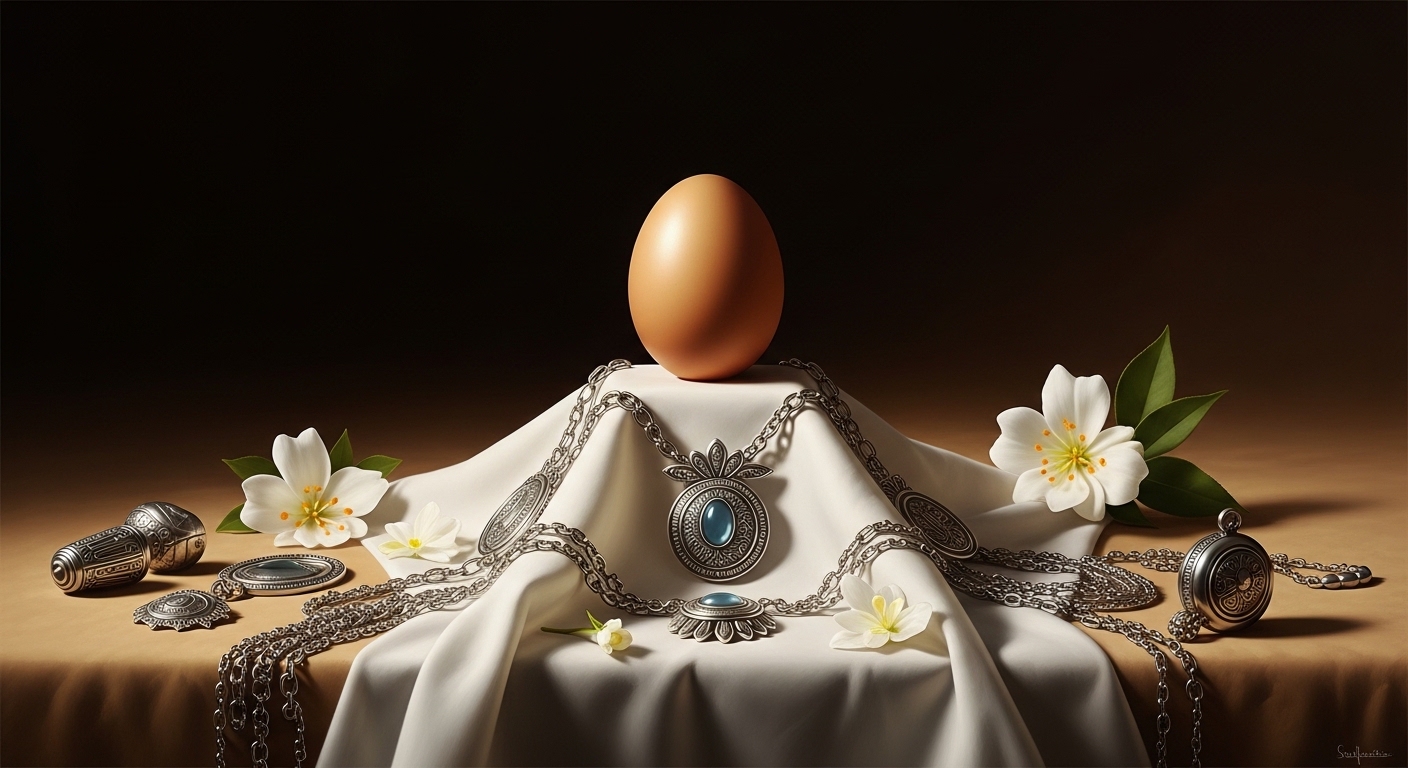
Her offerings are white: eggs (the unbroken, the whole), white flowers, silver jewelry, clear water. The color white in Vodou is associated not with emptiness but with pure potential — the state before specification, the condition of possibility. Ayida Wedo’s white is the clear sky after rain, the moment when the rainbow appears against grey and gold.
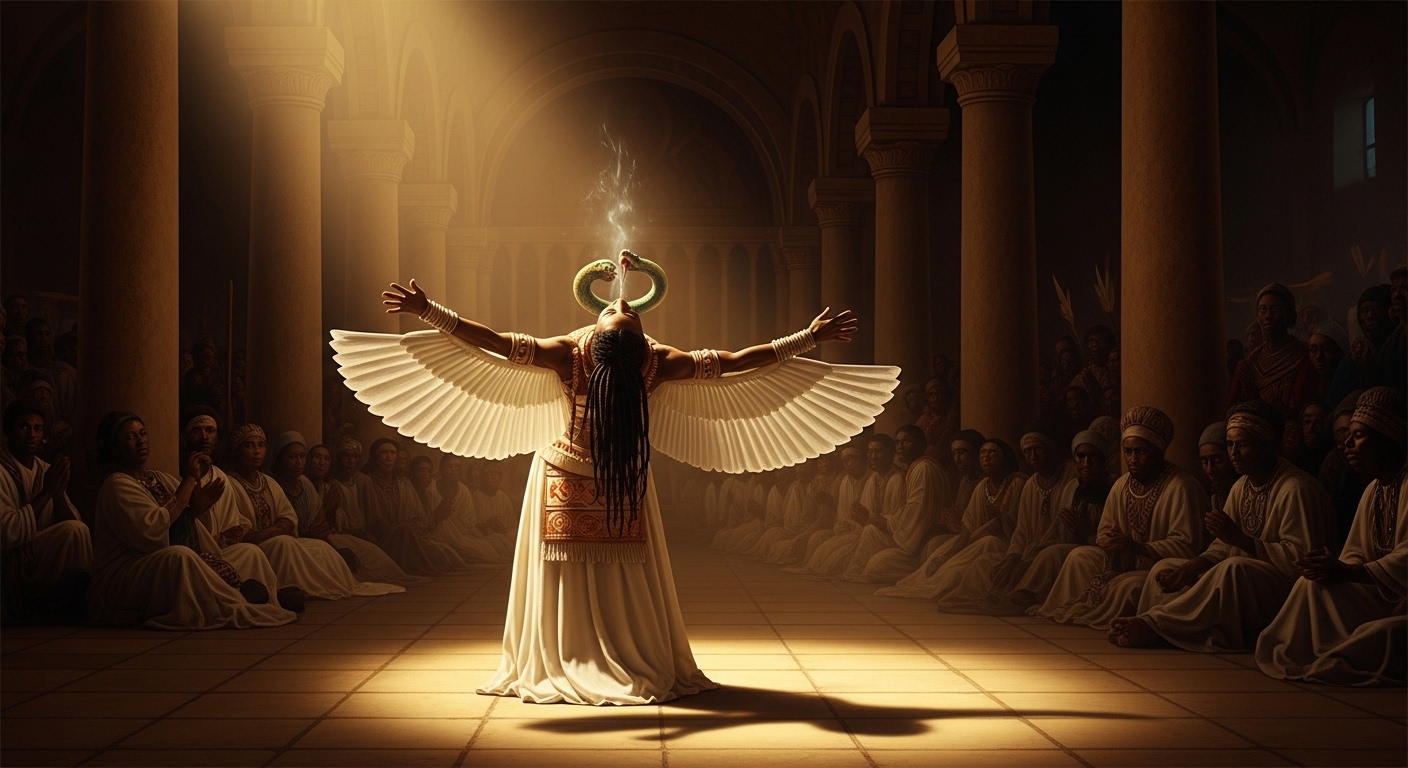
Damballah and Ayida Wedo together are served in the same rite. When Damballah possesses a devotee, the person climbs high — up a tree, up a column — and moves like a snake, and communicates only in the sibilant language of serpents, which only trained priests can interpret. When Ayida Wedo possesses a devotee, the movement is different: arching, spanning, the body becoming a bridge.
The two serpents together represent what the Vodou tradition calls the foundation of things: the pair that holds creation in its embrace, not by ruling it but by supporting it.
Ayida Wedo is associated specifically with fertility and with the waters that make fertility possible.
She is the rain that comes when the crops need it. She is the amniotic water of birth. She is the rainbow that signals the storm’s end and the return of sun. Her presence means that the sky and earth are still in relation — that the exchange between above and below that sustains life has not broken down.
Her absence — in the Vodou imagination — would mean drought. It would mean the disconnection between sky and earth, the failure of rain to fall, the death of the crops. The rainbow is evidence that the world is whole. When Ayida Wedo is not visible, she is still present; the rainbow simply reveals her.
The revolution that made Haiti a free nation — the only successful slave revolution in history, 1791-1804 — was organized in part through Vodou practice. The ceremony at Bois Caïman in August 1791 is the founding moment in the Haitian national narrative, presided over by the lwa through their possessed servants. Damballah and Ayida Wedo were among the forces invoked.
In the aftermath of the revolution, the French and the Vatican and the United States spent decades trying to suppress Vodou, understanding correctly that it was both the religion and the political philosophy of the Haitian people. The Catholic Church launched formal anti-superstition campaigns. The American occupation (1915-1934) targeted Vodou practice directly.
It survived.
Ayida Wedo’s arch holds up a sky that has been struck at repeatedly. The rainbow appears after every storm.
It is still appearing.
Scenes
Echoes Across Traditions
Entities
- Ayida Wedo
- Damballah
- Agwe
- La Sirene
Sources
- Haitian Vodou oral tradition, collected by Alfred Métraux, Voodoo in Haiti (1959)
- Zora Neale Hurston, Tell My Horse (1938)
- Karen McCarthy Brown, Mama Lola: A Vodou Priestess in Brooklyn (1991)
- Leslie G. Desmangles, The Faces of the Gods: Vodou and Roman Catholicism in Haiti (1992)