Combat Profile
Voyage Blessing
grants safe passage and favorable winds to those who honor him, ensuring ships and travelers reach their destinations unharmed
Master of the Depths
controls ocean currents, weather at sea, and the abundance of marine life, offering protection to sailors and fishermen who show proper respect
His domain is vast and often beyond human control. The sea gives and the sea takes. Agwe can ensure safe passage, but he cannot control every storm or every sudden tide
“Agwe rides the waves like a king upon his throne. He calls to the fish and they come. He calms the waters for those who honor him.” — Vodou tradition
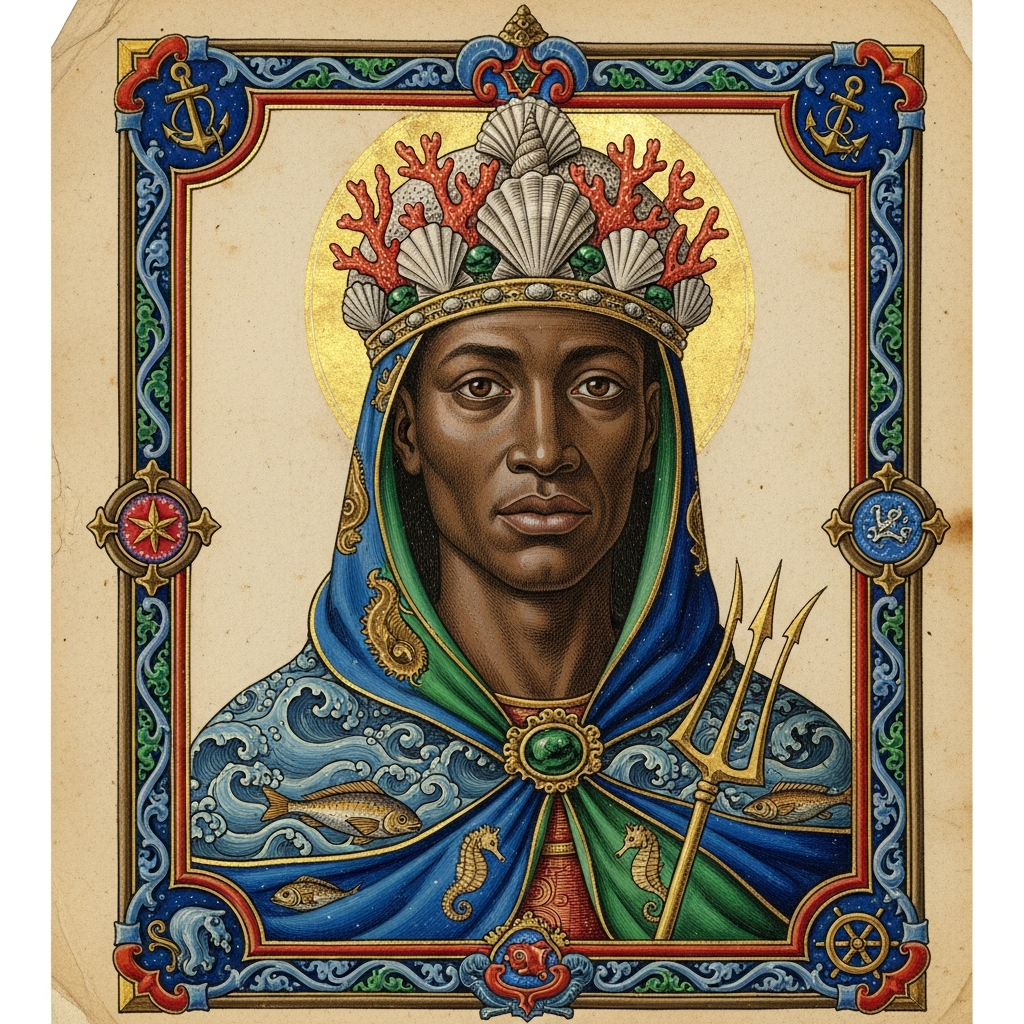
Lore: Agwe (also Agwé, Agué) is the Lwa of the sea, of ships, and of safe passage over water. He is depicted as a powerful man, often shown riding waves like a king riding a horse, adorned with a captain’s uniform or a mermaid’s tail (the boundary between human and sea). His colors are blue and white. His symbols include ships, anchors, and maritime tools. He is calm, powerful, and respects those who understand and honor the ocean’s vast power.
In Haitian tradition, which was built on an island, Agwe is essential. The Middle Passage brought enslaved Africans across the Atlantic; ancestors arrived by ship; the revolution was defended by Haitian naval power against the British and French fleets. Agwe protected those crossings. He remains the spirit of fishermen, sailors, and anyone whose livelihood or survival depends on the sea.
Parallel: Poseidon (Greek god of the sea and earthquakes), Neptune (Roman equivalent), Yemoja (the African mother of the waters — see Yoruba.md), and Tiamat (the Mesopotamian primordial ocean). In Norse tradition, the complex relationship between the sea and death (the sea as both provider and taker). All cultures that depend on oceans have a sea god — the acknowledgment that the sea is a power that must be respected and propitiated.
1 min read
Yemoja (the great ocean mother in Yoruba tradition -- see [Yoruba.md](Yoruba.md)) represents the vastness and the unknowable depth that even Agwe respects. Where Agwe is the specific god of ships and safe passage, Yemoja IS the ocean itself
Maya Deren, *Divine Horsemen: The Living Gods of Haiti* (1953); Karen McCarthy Brown, *Mama Lola: A Vodou Priestess in Brooklyn* (1991); Wade Davis, *The Serpent and the Rainbow* (1985)