Combat Profile
Divine Duality
grants allies doubled power when acting in perfect synchrony, merging opposing forces into transcendent wholeness
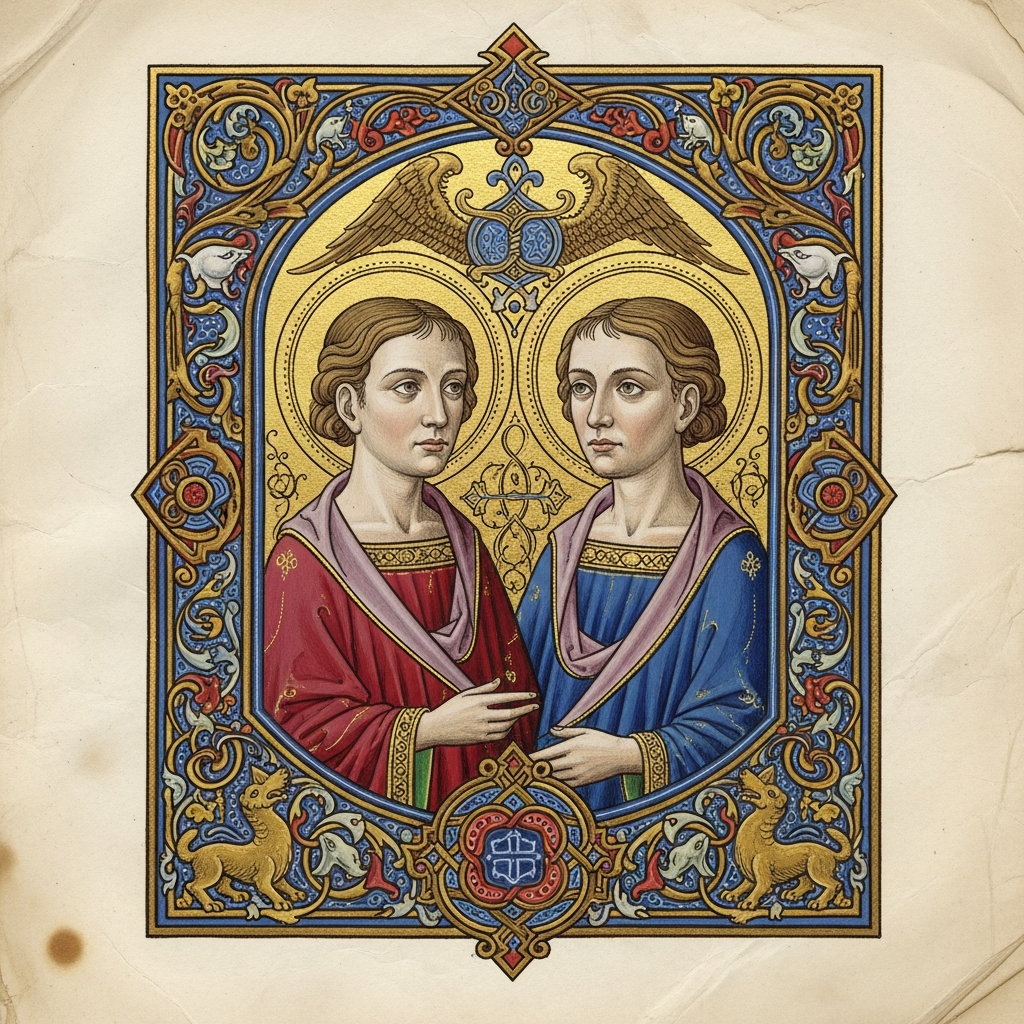
Sacred Twins
all effects are amplified when paired or mirrored, and opposing powers within the bearer achieve balance rather than conflict
Separation. Marassa is power through duality. If the twins are separated, their power is diminished. But they cannot be separated -- they are one consciousness in two bodies, one soul in two forms
“The Marassa are one and two. They are the beginning of all things. They are more powerful than the Lwa who came after them. To honor the Marassa is to touch the source.” — Vodou tradition
Lore: The Marassa Jumeaux (The Sacred Twins) are among the most mysterious and most powerful of all the Lwa — more ancient than Damballa, more fundamental than the distinction between Rada and Petwo. They are not two separate entities but one consciousness in two forms, one power that operates through duality. They are depicted as children, which is remarkable — in Vodou, these are understood to be younger (more playful, more innocent) than the elder Lwa, yet far more powerful.
The Marassa represent the principle that all power comes through pairs, through duality, through the balance of complementary opposites. Male and female, light and dark, creation and destruction, beginning and ending — the Marassa is the consciousness that understands all pairs simultaneously. In ceremony, they are always honored first, before any other spirit, because they are the source from which all other duality emerges.
When the Marassa are present (which is rare, reserved for only the most significant ceremonies), the energy is described as overwhelming — not violent, but intensely present, as if all the power in the universe is concentrated in a single point. Those mounted by the Marassa move with perfect symmetry, perfect balance, as if two people are dancing in the same body.
Parallel: The Gemini twins in astrology (Castor and Pollux), the twin serpents of the Caduceus (Mercury’s staff), the twin raven’s of Odin (Huginn and Muninn — Thought and Memory), Shiva and Shakti, the yin-yang symbol of Taoism, Esau and Jacob (the twin conflict that reflects divine paradox in Genesis 25-27), and the principle of complementary opposites in quantum mechanics (wave-particle duality, entanglement). The Marassa is the spiritual embodiment of the principle that all reality operates through pairs.
1 min read
Nothing counters the Marassa. They are older than the other Lwa, more fundamental, more powerful than any single spirit. They are the original pair from which all other duality emerges
Maya Deren, *Divine Horsemen: The Living Gods of Haiti* (1953); Karen McCarthy Brown, *Mama Lola: A Vodou Priestess in Brooklyn* (1991); Wade Davis, *The Serpent and the Rainbow* (1985)