Combat Profile
Maternal Fury
unleashes devastating retribution against those who harm the vulnerable, channeling the rage of a thousand wronged mothers into unstoppable force
Sacred Protector
surrounds the oppressed and her children with unbreakable spiritual armor that strengthens in the face of injustice and cruelty
Her rage. Ezili Danto's fury on behalf of the oppressed can be overwhelming -- when she mounts a devotee, the possession is violent, intense, often accompanied by weeping and incoherent speech. She stutters and cannot speak clearly because, according to tradition, her tongue was cut out at Bois Caïman so she could never reveal the revolutionaries' plans
“Ezili Danto does not speak. She screams. She weeps. She fights. And she never, ever stops protecting her children.” — Vodou tradition
Lore: Ezili Danto (Erzulie Dantor) is the dark mother of Haitian Vodou — not dark as in evil but dark as in fierce, midnight-deep, uncompromising. She belongs to the Petwo nation of Lwa, the hot, fierce, fire-born spirits that are unique to the Haitian experience (as opposed to the Rada Lwa, who are cooler and derive more directly from African antecedents). The Petwo spirits were forged in the crucible of slavery — they are the Lwa of resistance, rage, and revolution, spirits who emerged because the gentler Rada Lwa were not enough for what the enslaved faced in Saint-Domingue.
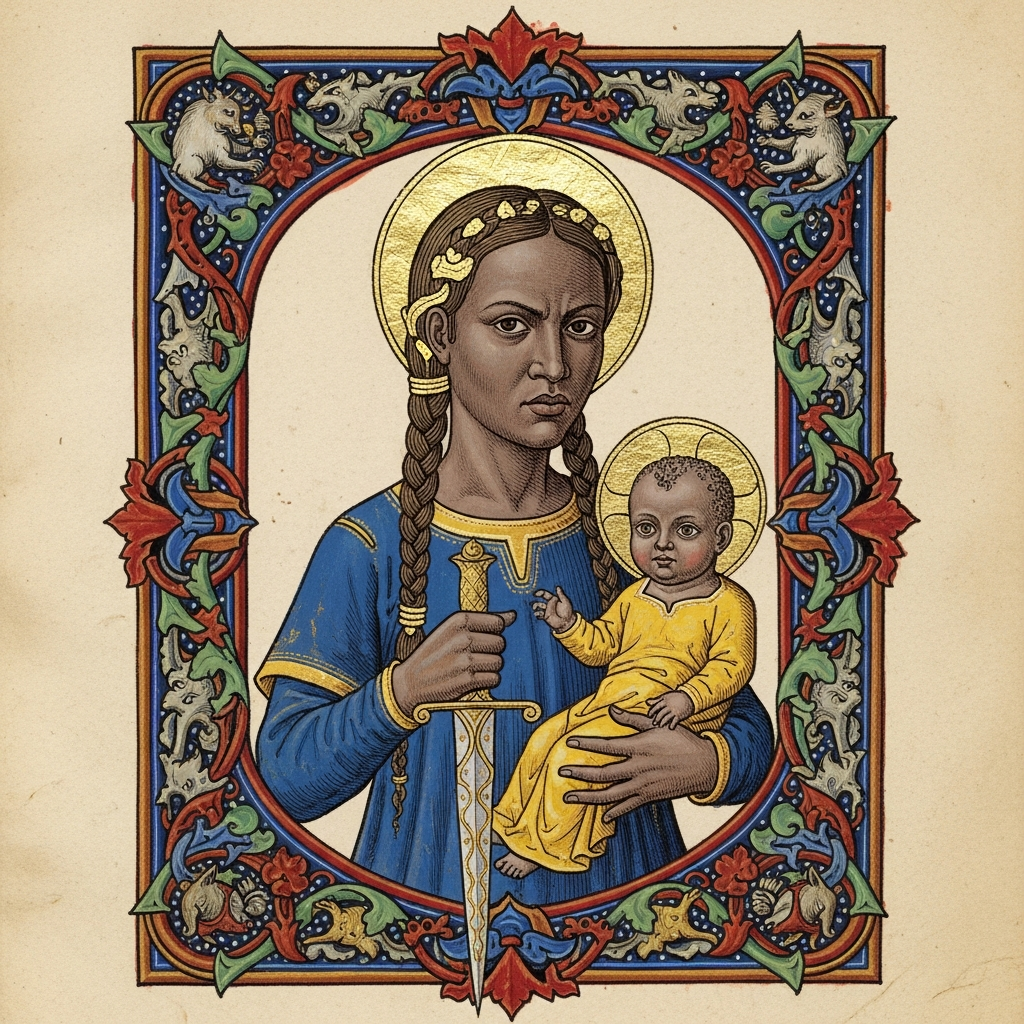
Ezili Danto is depicted as a dark-skinned woman with scars on her cheek — identified with the Black Madonna of Częstochowa (Matka Boska Częstochowska), a Polish Catholic icon of the Virgin Mary whose face bears sword scars. How a Polish Madonna became the face of a Haitian revolutionary spirit is itself a story of the diaspora: Polish soldiers who had been sent to Haiti as part of Napoleon’s army defected to the Haitian side (they recognized that the enslaved were fighting the same kind of imperial oppression they had experienced under Russian and Prussian rule). They brought their icon with them. The scarred face of the Black Madonna became the face of Ezili Danto — the mother scarred by suffering who fights back.
Ezili Danto does not speak in clear words. When she mounts a devotee, she makes a distinctive sound: “ke-ke-ke-ke” — a stuttering, inarticulate cry that is understood as both weeping and battle cry. The tradition explains this in two ways. One: her tongue was cut out at Bois Caïman so she could never betray the conspiracy to the French. Two: what she has witnessed — the suffering of the enslaved, the murder of children, the systematic brutalization of her people — is beyond language. Her inarticulate cry is the sound of grief too deep for words and rage too vast for speech. She is the patron of single mothers, of women who have been beaten, of children who have been abandoned, of anyone who fights alone against impossible odds. She does not negotiate. She does not forgive those who harm children. She fights.
Parallel: Durga, the Hindu warrior goddess who was created when the male gods could not defeat the buffalo demon Mahishasura — they pooled their weapons and power and created a feminine force more powerful than any of them individually (Devi Mahatmya). Like Ezili Danto, Durga is the divine feminine at its most terrifying and most protective, the mother who goes to war. Kali, who dances on the battlefield drinking the blood of demons — the same energy of sacred feminine rage. The comparison to the Virgin Mary is structural (Ezili Danto IS the Black Madonna in Vodou iconography) but also theological: Mary’s Magnificat (Luke 1:46-55) is a revolutionary hymn (“He has brought down rulers from their thrones and has lifted up the humble; He has filled the hungry with good things and has sent the rich away empty”) that reads like a blueprint for the Haitian Revolution. Michael the Archangel leading the heavenly host against Satan (Revelation 12:7-9) — the divine warrior fighting evil with divine mandate. Ezili Danto is all of these: Durga’s power, Kali’s fury, Mary’s revolutionary promise, and Michael’s heavenly warfare, compressed into the scarred face of a Black woman who refuses to stop fighting.
3 min read
Nothing counters a mother fighting for her children. Ezili Danto is the spiritual embodiment of the force that will burn the world down to protect the vulnerable. She is countered only by her own grief
Maya Deren, *Divine Horsemen: The Living Gods of Haiti* (1953); Karen McCarthy Brown, *Mama Lola: A Vodou Priestess in Brooklyn* (1991); Elizabeth McAlister, *Rara!: Vodou, Power, and Performance in Haiti and Its Diaspora* (2002)