Combat Profile
Liberation's Wisdom
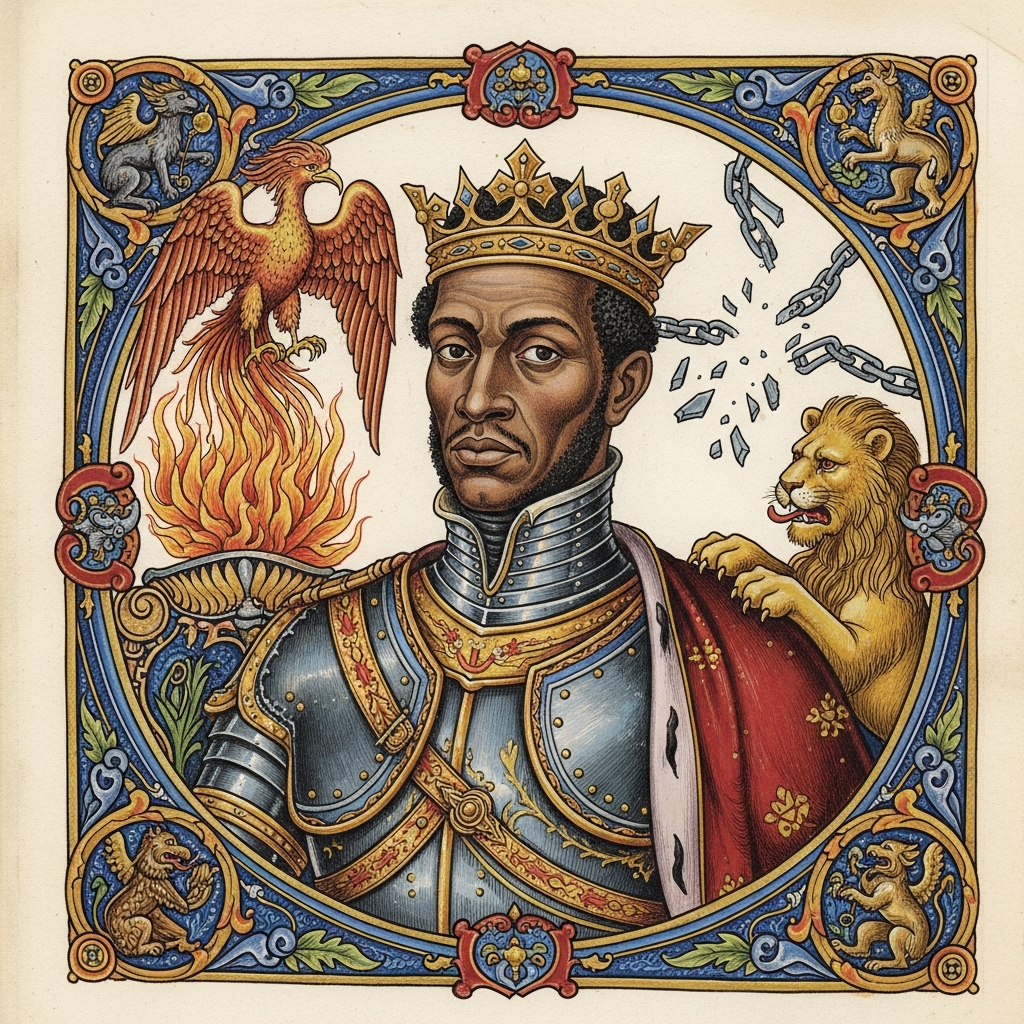
channels divine strategy to unify fractured forces and transform enslaved populations into an unstoppable revolutionary army
Synthesis of Spirits
exists between Catholic saint veneration and Vodou lwa communion, granting immunity to spiritual division and moral compromise
Trust. Toussaint's fatal flaw was his belief that the French could be reasoned with. In 1802, he agreed to a negotiated peace and was arrested through treachery by Napoleon's general Leclerc. He was shipped to Fort de Joux in the French Alps and left to die of cold and starvation. His trust in diplomacy over the sword cost him his life -- but not his revolution
“In overthrowing me, you have done no more than cut down the trunk of the tree of Black liberty in Saint-Domingue. It will spring back from the roots, for they are numerous and deep.” — Toussaint Louverture, upon his arrest (1802)
Lore: François-Dominique Toussaint Louverture (c. 1743-1803) is one of the greatest military commanders in modern history and one of the most deliberately forgotten. He was born into slavery on the Breda plantation in northern Saint-Domingue, but was literate, well-read (he knew Caesar’s Gallic Wars, Raynal’s History of the Two Indies, and the works of the French Enlightenment), and deeply religious — a devout Catholic who attended Mass regularly AND a man steeped in the Vodou tradition of the enslaved community. This dual spiritual identity was not contradiction but synthesis: like the Orishas hidden behind Catholic saints, Toussaint embodied the fusion of African and European spiritual power.
After the Bois Caïman ceremony and the initial uprising, Toussaint initially did not join the revolt (he was in his late forties, a relatively privileged enslaved person, a coachman like Boukman) (Bois Caïman, Aug 14 1791). But within months, he had joined the revolutionary forces and rapidly demonstrated military genius of the highest order (Bell, Toussaint Louverture: A Biography, 2007). He trained formerly enslaved people — most of whom had never held a weapon — into a disciplined army that fought using guerrilla tactics perfectly adapted to the mountainous terrain. He played the Spanish against the French, then switched allegiance at the precise moment when it served the cause of abolition. He defeated a British expeditionary force of 20,000 that had been sent to seize the colony (the British lost 25,000 soldiers to combat and disease — one of the worst military disasters in British Caribbean history) (James, The Black Jacobins, 1938). He defeated multiple French commanders. He unified the entire island of Hispaniola under his governance.
Napoleon, furious at being defied by a formerly enslaved Black man, sent his brother-in-law General Leclerc with 40,000 troops — the largest army ever dispatched to the Western hemisphere at that point — with secret orders to restore slavery (Dubois, Avengers of the New World, 2004). Toussaint fought brilliantly but was eventually tricked into a negotiated surrender and arrested (Bell, Toussaint Louverture: A Biography, 2007). He was shipped to Fort de Joux, a medieval fortress in the freezing Jura Mountains of eastern France — as far from the Caribbean as his captors could send him. He was denied adequate food, clothing, and medical care. He died on April 7, 1803, in a cold cell. But his prophecy proved correct: the revolution continued without him. Jean-Jacques Dessalines, his lieutenant, defeated the remnants of Leclerc’s army (Leclerc himself had died of yellow fever — the Lwa of disease fighting for Haiti). On January 1, 1804, Dessalines declared independence (Dessalines’ Declaration of Independence, 1804), and the nation was named Haiti — the original Taino indigenous name for the island, rejecting the French name “Saint-Domingue” entirely.
Parallel: Judas Maccabeus, the Jewish guerrilla commander who defeated the Seleucid Empire’s professional armies through tactical brilliance and religious conviction (1 Maccabees 3-9). Like Toussaint, Maccabeus was fighting for the survival of his people’s freedom and faith against a vastly superior military power. Like Toussaint, he won battles that should have been impossible. Moses, who led an enslaved people out of bondage and did not live to enter the Promised Land (Deuteronomy 34). Toussaint led his people toward freedom and did not live to see the independence he made inevitable. Spartacus, who led the greatest slave revolt in Roman history — but Spartacus lost. Toussaint won. His revolution is the only large-scale slave revolt in human history that resulted in the creation of a free nation. And Napoleon himself: Toussaint was called “the Black Napoleon” by contemporaries, and the comparison was not flattery but statement of fact. Napoleon recognized Toussaint as his equal and hated him for it.
3 min read
Napoleon devoted enormous resources to destroying Toussaint specifically. But even after Toussaint's capture and death, the revolution continued under Dessalines and Christophe. Toussaint's strategic genius had already made the outcome inevitable
C.L.R. James, *The Black Jacobins* (1938); Laurent Dubois, *Avengers of the New World* (2004); Madison Smartt Bell, *Toussaint Louverture: A Biography* (2007)